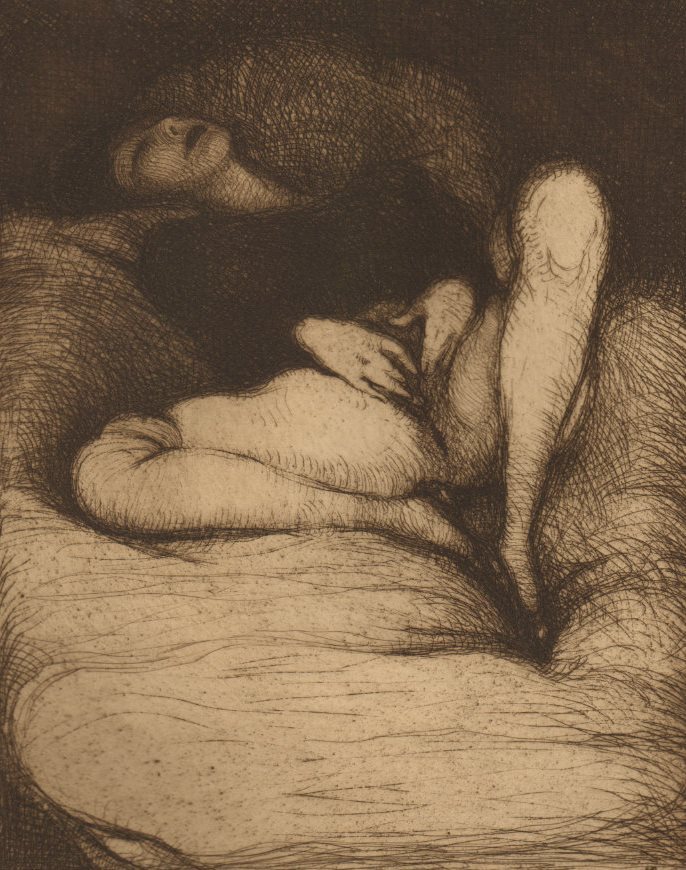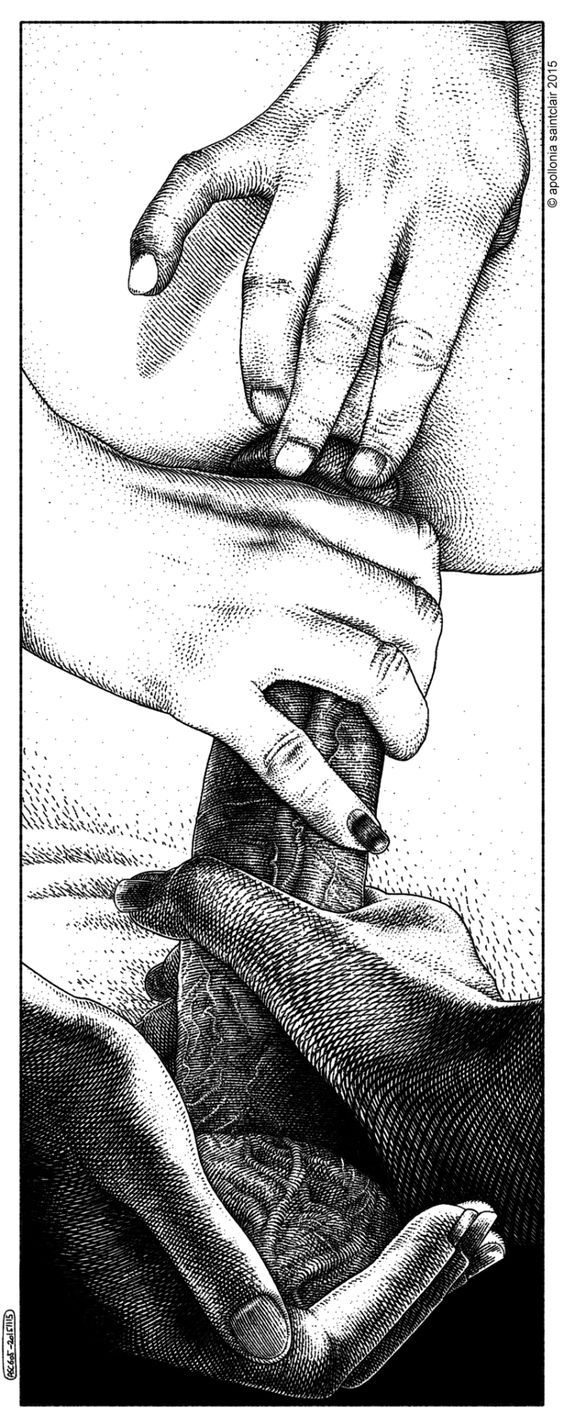
Apollonia Saintclair605 – Les béquilles [The Third Auxiliary] (2015)

Each time I re-encounter Saintclair’s work, my appreciation of her talent expands.

Like Mœbius–who’s syncretism of sacred (attuned to the rigorously established precepts of classical drafting and design in high art) and profane (explicitly graphic depictions of sexual activity) is almost certainly a major influence–Saintclair almost always releases work that is both salacious and eminently refined.

I adore the image above. I appreciate the fact that I actually sat here for ten minutes decoding the fact that the hands depicted here belong to four different people.

Further, I love the way her treatment of cross hatching and shading render appear to be almost art nouveau-esque when you are examining the piece close at hand, and then when you zoom out and see it at a distance, the stylization diminishes to affect a sort of photo-realistic look.

Compositionally, I can’t see how anyone could look at this and not appreciate the careful balance between highlight and shadow–I mean this illustration is, after all, a gradient from top to bottom (light to shadow). But like the yin-yang symbol, the shadows in the light area balance against light in the shadow areas. It’s masterful, really. (She’s probably also riffing on Escher here.)

Lastly: for three years–give or take and excluding guest curatorial stints–I’ve insisted on alternative between B&W and color images every other post on this blog. (I know, I know–your mind is blown.)

It’s not especially easy to pull of. There is a dearth of B&W stuff, a surfeit of color. So it’s refreshing to have an artist whose work successfully scratches a particular itch in such a virtuoso fashion.

(Disclaimer: this Tumblr was high af off Cali’s finest medical edibles while writing this post.)

Mr. Instant PhotographyGorgeous poetic Ginger (2016)

The form of this recalls the Arseni Khamzin’s photo I featured last year–the down tilt of the camera, the balancing between positive and negative space.

I prefer the sharp, 3-D affect of Khamzin’s work but the way the muddy lighting renders the subject above so that it appears his skin tone is actually being leached from his body by the white-white of his surroundings. (I also love the insouciance with which he’s aware of the camera but trying to appear as if it could only be so lucky if he granted it even the most ephemeral of eye contact.)

The model’s pose is in keeping with the sculptural traditional of contrapasto–one leg is weight bearing and rigidly position, the other is more expressively position, whereas the arm one the opposite side from the weight bearing leg is active, the second arm (opposite the non-weight bearing leg) is also less active and more focused on balancing the composition. (Here those traits are reversed as the left hand and right foot are the ‘weight bearing’ anchors and the right arm and left leg are more expressive and distributive of weight.)

There’s also a nice dynamic to the pose, where it seems as if he rolled away so that he’d be more visible to the gaze interrogating him but also at the same time, he’s protecting  his body with his hand across his belly and bracing to potentially have to roll back towards the viewer.

From the standpoint of visual grammar, although I agree that the frame edge can be used in such a way as to imply a continuity of space between what is in the frame and what remains unseen just beyond the edge of the frame, the frame edge is usually inviolable.

The frame edge here is inviolable. Thus with the exception of half of his thumb, all of the fingers on his right hand are removed and his left leg is amputated mid-shin.

To my way of reading this speaks to an intrinsic acknowledgment by the image maker that the subject retains a degree of autonomy despite the photographers imposition of the boundaries of a frame upon the scene.

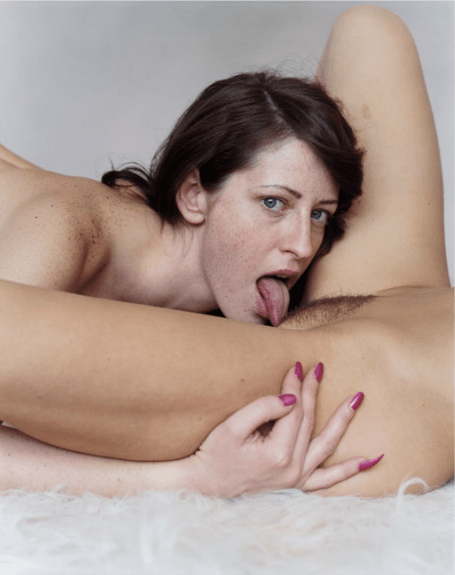
Bettina Rheims – MC6 II from Morceaux choisis series (2001)

I’m not especially familiar with Rheims work but from what I’ve seen of it, she seems to meet her subjects halfway.

What I mean by that is not something I know how to easily indicate. It’s kind of like this: most photographers/image makers operate with a reliable fixation on appearance as factual representation. In other words: they trade in the ontology of I can see this and I can show you this, so this must be ‘real’.

There’s a lot made of Rheims and her use of color in concert with insanely high quality printing to “[make] the flesh appears living and [contribute] a disconcerting realism.”

I don’t disagree with that summation. It’s more that I think the way Rheims uses her erotics as a mode of unsettling the viewer serves to create work that trades less in establishing sacred cow archetypes and more to show people as they are instead of how they would like to be seen or represented.

And isn’t that just the central tenet of artfulness–the dialectic between hyper-stylization as a destination in and of itself vs that rare effortlessness that takes oodles of effort to accomplish but the accomplishing carefully erases any sign of over-the-top intentionality on the part of the creator.

For something as heavily contrived as the above image is: shot in a studio, with precise lighting orchestration, there is something compelling about the way it absolutely doesn’t read as pornography in spite of what it depicts.

(Full disclosure: the above is not the image I wanted to post most of all. I am especially fond of this one from the same series but I couldn’t find a HQ scan of it, unfortunately.)

Agnieszka SosnowskaLansendi, Iceland (2012)

I first encountered Sosnowska’s work through Lensculture’s underwhelming showcase of her work.

Several months later, I caught a broader cross section of her work as part of the Traces of Life exhibition at the Reykjavik Museum of Photography.

What struck me immediately was how good her printmaking chops were and how her digital presence seemed almost completely devoid of life by comparison.

Yet what strikes me looking at this photo which–excepting the stunningly luminous range in skin-tone and subtle gradations in the sky, which my guess would be were burnt in–limits everything in the frame to three zones: the textured black sand (Zone II), the dark grey rocks (Zone IV) and the sky (Zone IX).

It’s also interesting to note how Sosnowska has been working with variations on the idea of the image for more than a decade. For homework: compare and contrast the above with this photo from 2007.

Anonymous – Submission to NNSS July 28 (2013)

OMFG. I had a dream about this triptych!

A former employee was sitting on floor with her dress forming a perfect circle around her, her bare, unshaved legs sticking out enough to show that she was sitting frog style.

The room was an amalgam of my room when I last lived with my mom, my current bedroom at that time and the second space I rented with several college chums after earning my undergraduate degree.

The floor was made from these broad, pine planks that were worn smooth after years of things scuffling against it.

In the way dream logic works, there was a perfectly sensible reason for her to be sitting in my room. Although we’re still loosely connected, she’s not someone I see with any regularity. And there was a feeling (in the dream at least) that she wasn’t there to hang out and whatever had brought her there was already completed.

This young woman–we’ll call her Skye–tends to be fragile to a fault and prone to fits of profound melancholia. Yet, on the rare occasion that she’s in a good mood, she takes on this affected simpering bravado that would–on anyone else–appear pout-y and conceited, except on her it comes off as playful and perhaps even a bit edgy.

I suddenly felt as if she’d hidden something in my room and I was expected to find it. I looked around but without knowing what I was looking for it all felt awkwardly contrived.

Something made me think of Charlie’s BB gun. I was pretty sure that I’d thrown it away years ago. But I felt suddenly as if Skye had either found it and wasn’t happy about my having it or that it would be super bad if she knew I still had it.

I began to tear the room apart in an effort to find it and get rid of it. Sure enough it was in a shoebox, wrapped in a towel. I showed her and she thought it was dumb that I had it but she didn’t say more than that.

She was still sitting there. I wondered why she was still there. I sheepishly said that she’d been in my room long enough that she probably had a pretty good idea what a pervert I was. She said she did but that she actually thought it was charming.

I put the BB pistol back in the shoebox and buried it in the closest again. When I turned back to her, she was holding the hem of her skirt up and was stroking the shaft of a fairly large cornflower blue phallus. A small purple vibrator was wedged between her crotch and the floor. Her boy shorts were a canary yellow except where the humming vibrator pressed against the outline of her vulva, a dark mustard color spreading slowly outward.

This is okay, right? She asked.

Alek LindusUntitled (2010)

I was in time, in flight, in finiteness. The present had
disappeared, there was nothing left for me but a past and a tomorrow, a
tomorrow which I was already conscious of as past.
Since then I have
tried, every day, to cling on to something stable, I have tried
desperately to recover a present, to establish it, to widen it.
Eugene Ionesco, Fragments of a Journal