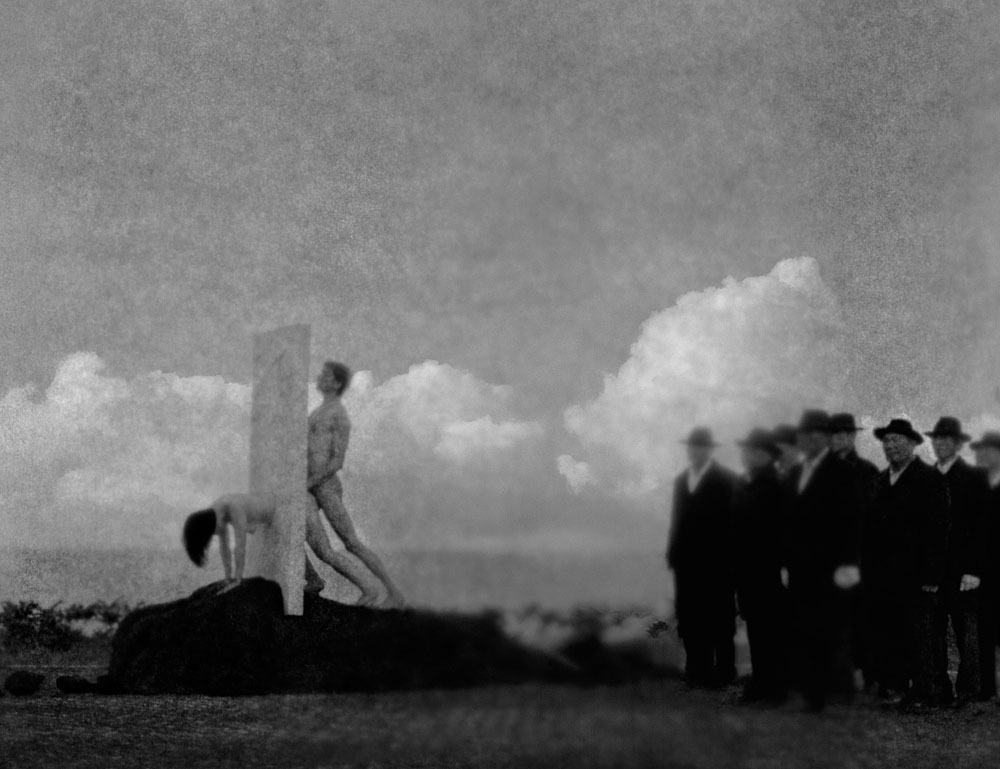
Hsieh Chun-Te – The Romance on the Stele from Raw series (1987-2011)

The images in the Raw series are intended to be narrative–yet what the narrative entails remains muddled due to how little is available on the artist in English.

For example: an image titled Bitches was, according to Chun-Te inspired as a result of: “overhear[ing] a journalist
friend of mine who got beaten up during an investigation of human
trafficking of a prostitution ring. Girls were captured then sold, some
of them tried to escape.”

I was not able to find the creative impetus underlying the above image. In fact, I discovered very little of merit beyond this blurb from the 2011 Venice Biennale.  I agree that themes of desire, eroticism and death permeate his work. But, he’s clearly working within the Surrealist tradition. (I feel as if this is so apparent as to not need comment but to put to fine a point on it, he makes a point of telegraphing this affectation via his inclusion of bowler hats–a reference to Margritte’s seminal painting The Son of Man.

I’m inclined to disagree with the aforementioned blurb w/r/t what the above image depicts. It takes the easy route of correlating death and eroticism and suggests the image depicts a scene of capital punishment by means of being fucked to death. (The pose of the woman in the image suggests she’s still very much alive.)

And that is definitely an interpretation in keeping with the tone. Except, I read this as a far more nuanced examination of punishment in society. The relationship between the person receiving punishment and the remove at which the person who inflicts the punishment must be placed in to avoid sullying polite society by association.

I look at this and see it point to an irony. We’re not okay with this because of the context–restraint as a means to facilitating punishment and punishment as a means of retaining social control.

But this can also be read as an allegory of the relationship between pornographic performance and consumption within a capitalist, hetero-patriarchal system.

And really one of the reasons this works so well is that the author is clearly far more interested in pointing to a slippery corollary than passing any sort of judgment on it.

Paola AcebedoTiran Como Conejos (2012)

I’m of the mind that anyone/everyone is capable of making an objectively good image.

This begs the question: if anyone can do it, does that preclude lens based work from consideration as art?

Well, if you’re a photographer or image maker you already know the answer: of course not! There’s more to photography/image making than producing an objectively good image.

First off: you have to know a successful photo or image from an unsuccessful one. And this is one of the things with which photography/image making will forever struggle: each and every one of us has been inundated with lens based visual culture since birth–as such, everyone thinks they’re already a subject matter expert. (I’ve been running this blog for 5 years and I was a freaking MFA Photography student for a bit before I got seriously disenchanted with the whole charade and dropped out; point being I’ll be the first one to admit that my knowledge on the subject is found–more often than not–to be lacking.)

But distinguishing between a successful photo or image and an unsuccessful one isn’t always straight forward. Much in the way that you can ask a room full of 18 undergrads to define love and receive 36 different, often conflicting responses, show a group of folks an array of 36 different photos/images and while there’s likely to be more overlap than you did asking them to define love, there will be no immediate agreement.

I think: a lot of people privilege their own perspective. (And I do not mean that pronouncement as an implicit value judgment–only insofar as one is aware of and takes account for this bias; I will not abide blissful ignorance or arrogant equivocation.) Most beginning photography students believe themselves to be the next Cartier-Bresson just by virtue of the ontology of their status as a photo student. Hell, I did too when I first started.

The difficulty with that perspective is that you tend to use your misguided belief in your own creative infallibility as a means of justifying the importance of your Perspective. Yes, there is value in those truly outstanding makers who teach us new ways of seeing. However, of those, truly great visionaries–and pro-tip: a true visionary isn’t going to dub themselves as such (sick and tired of advertisements for hacky visual crap by the likes of dimwits like Zach Snyder and Gore Verbranski being termed ‘visionary’)–the ones who never bothered to scuffle along, stumbled and fell repeatedly trying to learn both the basics of visual grammar and the grown more intimately familiar with the history of the form, are the exception that proves the rule.

It’s dumb (again not a value judgment, more a noting of self-imposed limitation) to think you know better just because you’re doing the work.

Second, being able to distinguish between an objectively good image and an objectively bad image is one thing. Much in the same vein that we teach children to choose between right and wrong only for the child to grow up and realize that decision making in the real world rarely affords such simplicity. Frequently, you’re left with work that isn’t exactly bad but isn’t actually good either. (This is actually something I’m struggling with in my own work: the hard wired urge to include the objectively good over the technically muddled but luminously singular work.)

I’m not controverting @reverendbobbyanger‘s recent Sunday Post reminding that: good enough is not. I’m merely saying that photography and to a lesser extent image making–due to the rapidly advancing technology available for digital intervention/manipulation–WYSIWYG… it’s not like a painting where you can shift things around to suit your purposes after you’re well and truly off down the road.

But I’ve danced around enough the reason I’m getting into all of this is because I think the above image is a stellar example of reclaiming an image that was objectively muddled.

The image itself does not work. Yes, the compression of color is interesting–the cabinets, tile and dishwasher create a palate accentuating the skin tone in such a way that it sort of permeates the scene–much the way the smell of sweat and sexual effluvia swirls around the entwined bodies of spent lovers. There’s also something to the staging that seems exaggerated and awkward but at the same time conveys something of the experience of saying to a new love, I’m not sure I can get off again but maybe let’s try anyway.

Note how the camera is askew in alignment with the back wall–i.e. the right side of the camera is angled back and away from the wall, as opposed to being on a rigorously parallel plane to it. Further, the vertical frame edge is not squared with the seams of the cabinets/tiles in the backsplash; the slight uptilt only serves to exaggerate these flaws. (Emotionally, this was the right choice and it opens up the frame, providing more context; conversely, the dishwasher and the area in the top, right hand corner really screws with the visual flow as the eye scans the image.)

In other words, there are interesting things about the image. But it doesn’t exactly work. How do you solve a problem like that?

Well, Acebedo, broadens the context but presenting the image as if it were pinned to a page in an old album with yellowing scotch tape. It renders the image more inherently visceral. (Also, mysterious.)

But the thing I like most is how it preserves the anonymity of the participants. I cannot even begin to articulate how adamantly opposed I am to decapitating anyone in an image to preserve anonymity. There is always a way to include the head in the frame and then to–if need be–creatively obscure it. This is a great example.

Finally, I love that this adopts the fine art photographic tendency of naming a picture in such a fashion where the title merely describes the image. (A great way of underscoring that the image speaks for itself.) Here, you don’t have to have taken a day of Spanish to be able to perfectly translate the title: They fuck like rabbits.

Also, you really should check out Acebedo. There is something profoundly lonely about her work but it replaces sadness and longing with the feral possibility inherently in being alive and breathing.
Rodolfo AsinNoelia (2013)

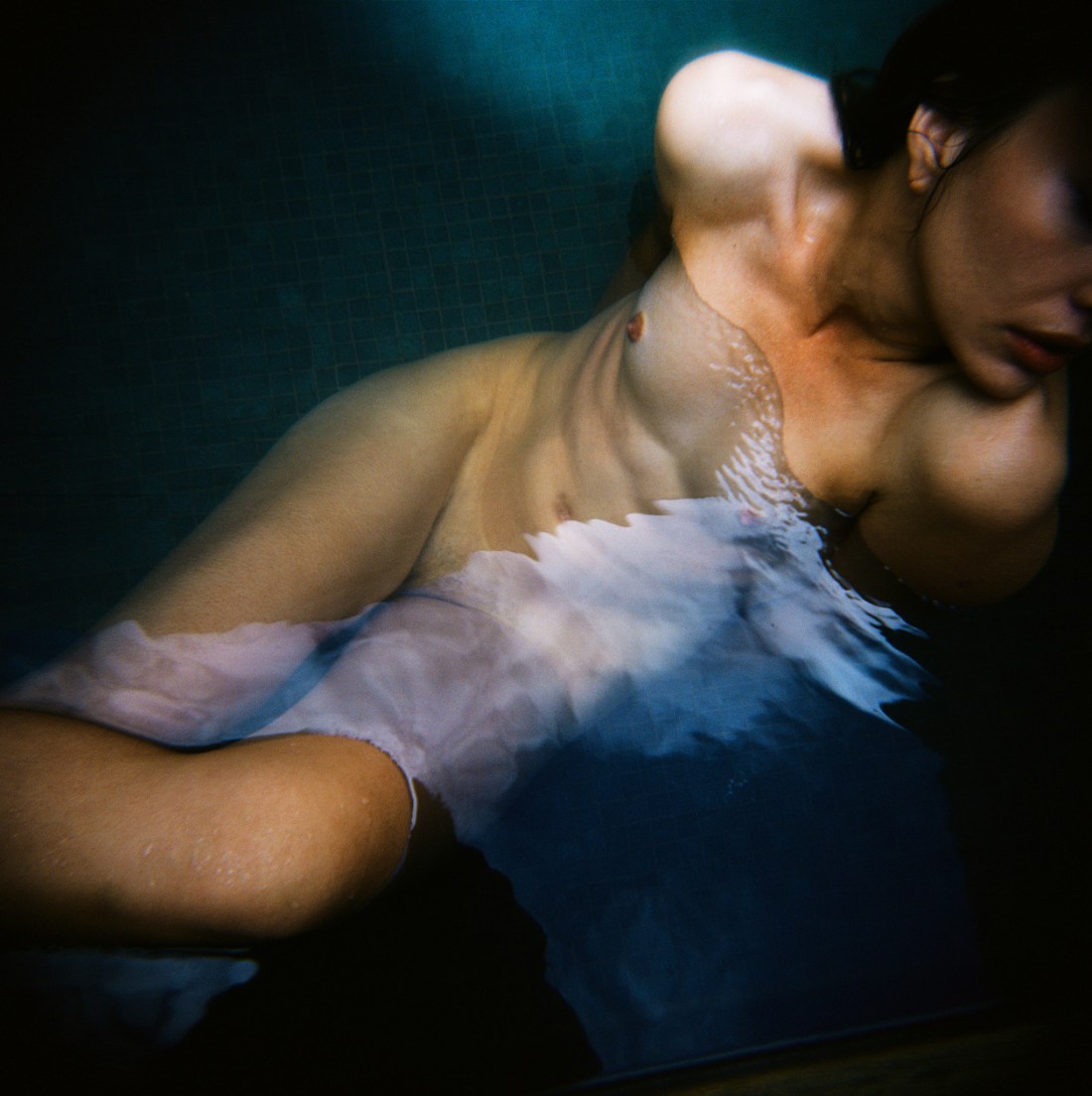
A black and white photograph (and I say photograph specifically because no matter what your opinion on digital, there is no damn reason anyone should be working in B&W in digital–it’s just poor form) can convey a lot of things. It can be sinister, moody, clinical, severe, etc., etc.

In other words, a B&W photograph no matter the concept or execution carries a sense of shining a light onto a scene in a such a way that allows the viewer to discover the foreign in the familiar.

Color just doesn’t work like that. A photo or image can be in color and be good and important and sumptuous without really even being about the color.

So every B&W image is at a certain level monochromatic in the same way and every color photo or image appears in color in a different way.

Loosely speaking, when we are interrogating color images there are two sorts of photos/images: those in color and those about color.

To my mind, William Eggleston is really the only photographer who ever managed to cobble together a body of work managed–largely–to accomplish both.

Eggleston established a beach head that allowed other photographers–like Stephen Shore, Jeff Wall and Joel Sternfeld to emerge. These photographers were interested in trying to bridge the gap between color as facet of the image and color as intrinsic to the images manifold meaning.

Yet, most work post-Eggleston color work seems less interested in solving a problem like color than dealing with issues of color fidelity, depicting mundane normalcy (for some reason B&W always seems more immediate and authentic, even though it’s not how we naturally perceive the world) and the employment of color as a means of orchestrating emotional response.

Whereas, folks like Harry Gruyaert, focused on color itself.

Now what I find interesting is that to a certain degree Shore, Sternfeld and Gruyaert and desaturate their photos, the images lose some of their punch but they still work. (With Gruyaert, you have to bear in mind that he titled his images. Also, I’ll concede that this might be splitting hairs since both Shore and Wall both work in both color and B&W.)

Eggleston desaturated is just fucking pointless–the color is effectively the glue holding everything together.

These days–sadly–most of the raft of internet famous photographers & image makers produce images in color or B&W and more likely a combination of the two. But I’m hard pressed to name anyone who like Eggleston is making work that only works in color. @pru-e is the first person who comes to mind. (But that’s also not entirely fair since she’s arguably one of the best up and coming image makers in the world.)

Asin, like Shore, Wall and Sternfeld, loses a good bit of his punch in a desaturated reimagining of his work. But he is doing some extremely exciting things with color. The work absolutely loses some of its punch in B&W but it also loses a vitality that the color contributes to the scenes.

I’ve featured another of his images several years back and I was just as taken with his use of color then as I am now.

Source unknown – Title unknown (19XX)

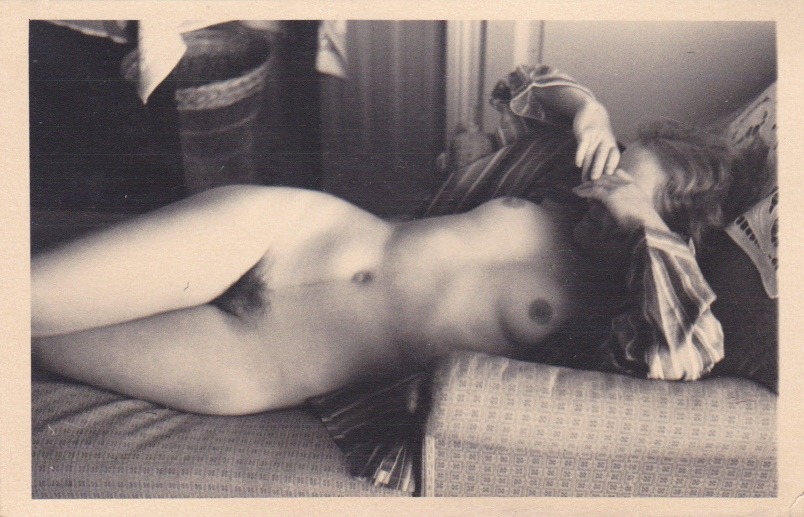
There are just scads of similarities between the above and Modigliani’s Nu Couché au coussin Bleu.

I’m much more interested in the differences, however.

The above is firmly contextualized within a room. A fainting couch, a table covered with a cloth, a wastebasket, wallpaper and what could be wainscotting or a closed door.

Modigliani, on the other hand, moves from left to right through most detail–the texture of the couch–to less detail (the subject) and then to least detail (i.e. the background that shares both the color scheme and a Rorschach-esque feel of the cover art for the latest Cobalt album Slow Forever).

Also, the subject above has her right leg over her left thigh, effectively the opposite of Modigliani–where the subject is depicted with her top leg pushed back and her lower leg forward; to me this suggests a sense where in the image above the subject is either waking from a nap, except for the way she’s covering her eyes–which is clearly more coy and playful given her smile.

Whereas with Modigliani, there’s a sense that this is a post-coital scene and the subject is trying to leave the suggestion that she’s ready for round two open.

To me that’s one of the most exciting things about photography. To an extent–greater than with painting but with less rigidity than sculpture–you are limited to what is physically possible. Modigliani was shit at depicting bodies. His most famous painting Reclining Nude (1917) is a great example of this. As anyone with breasts knows when you lay flat on your back, a great deal of the volume of the breast pushes into the armpit area. Actually, I’m making it more difficult then I need to just compare the above image with Nu Couché au coussin Bleu and you’ll clearly note how the pose looks IRL vs in a painting.

I actually prefer the above to anything I’ve ever encountered of Modigliani work. I especially like the way she’s wearing the vertical striped shirt and how that both compliments the wall paper and creates dimensionality against the pattern of the couch.

But both the photographer her and Modigliani make the same mistake. There’s no sense of extension beyond the boundary of the frame edge. The glimpse of the world we’re provided is purposefully bounded. We see what we are intended to see and nothing more.

Physically, both models legs are amputated just above the knee and as such they cannot leave the scene where they have been splayed for the viewer.

Nicolás UribeSunday Conversation (2008)

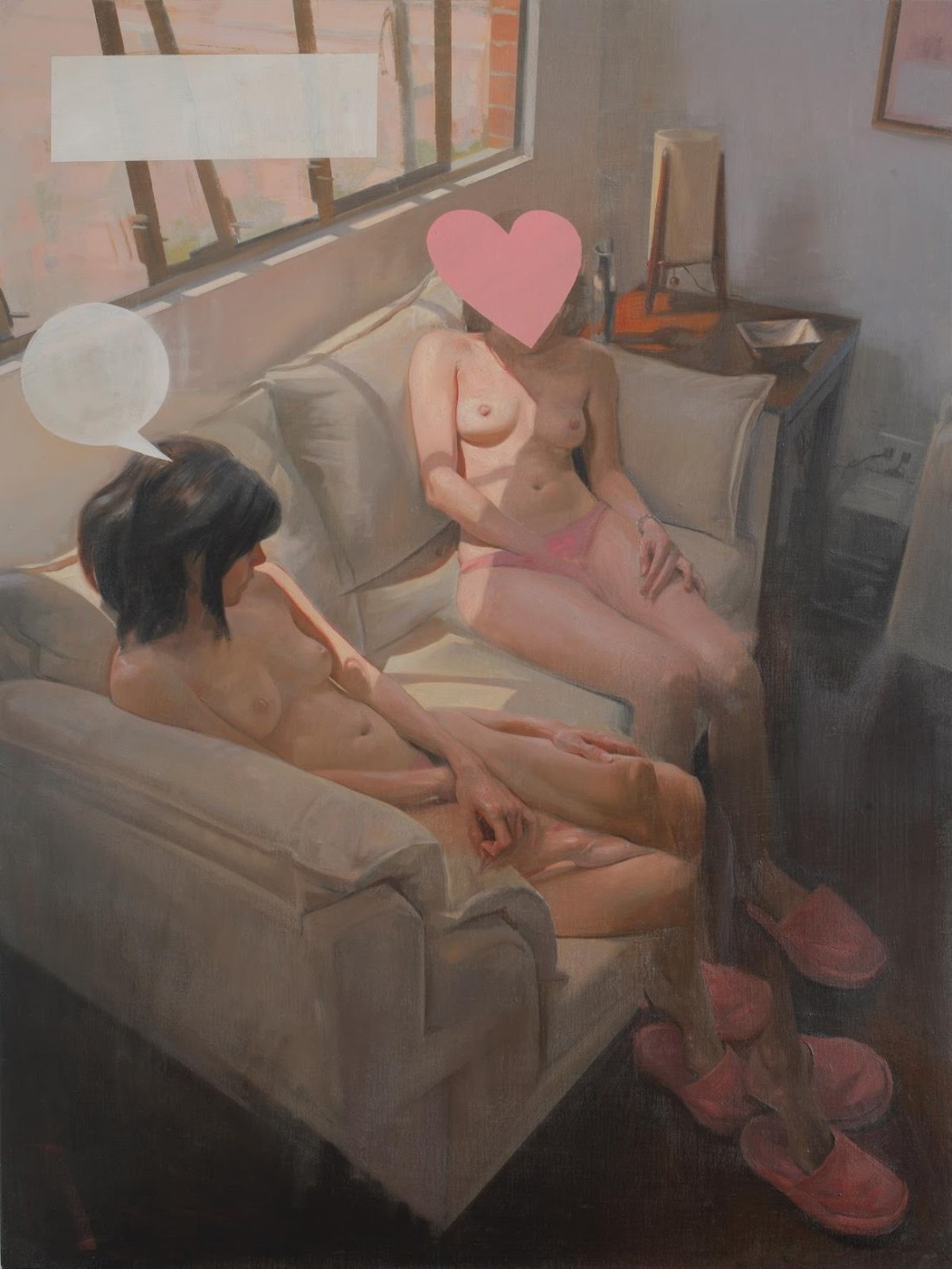
I really love this guy’s work.

But this one in particular has a lot of meaning for me.

My life has been a living hell for the last five months. My partner is dependent, at least, in all likelihood addicted to pain killers. She’s fine as long as she can get pills but when she can’t she becomes profoundly emotionally abusive, manipulative and suicidal.

For the longest time, she was the only person who wanted me and more than that wanted to be with me. But at the end of May last year, I went out to the Bay Area for the first time and spent 48 hours with my friend Amadine (not her real name).

It was maybe the best 48 hours of my entire life. I have only ever felt so completely connected with one other person in my life.

Anyway, the first night I was with her we ate edibles together and sat on the couch in her living room talking. As those of you in California already know, the CA medical edibles tend to come in a bit higher in THC concentration than they are advertised. For example: at that point I was consuming around 35mgs on a two days on-one day off rotation. I ate something like 65mgs that night and I’ve only been that stoned maybe three other times in my life.

Amadine was outline three projects she wants to work on, one involving animation.

Unlike this painting, we were fully clothed. In fact, her partner was in the other room. We also were not sitting side-by-side. She was sitting with her back against the arm of the couch, with her legs crossed, her knee touching my thigh.

The only light in the room was a lamp on Amadine’s desk–her desk being in a recessed work space divided off from the main room by one of those antique dividers with the carved wooden arabesques. As my eyes scanned between her eyes and the room–I have trouble with eye contact and while that trouble is almost non-existent with her, I had to keep shifting my gaze because the urge to lean forward and kiss her was so overwhelming.

The light through the carved gaps seemed like it was rotoscoped, it kept undulating and shifting slightly distracting me. Amadine stopped talking and we just sat there looking at each other for what felt like five minutes. She finally giggled and smiling broadly said, wow, yo, that was super intense.

It’s taken a while but we’ve finally gotten around to talking about our experiences of that weekend. And it turns out that we are both insanely attracted to each other but that due to a number of factors in her world right now it’s not something that those feelings aren’t something that can be acted upon just yet.

So yeah, this painting perfectly captures the feeling of sharing space and time with a dear friend that I love and am devastatingly attracted to…

It’s probably not realistic and I know we won’t hook up when I see her again next month, but I stupidly have in mind that we might be able to share space again like before, perhaps more inline with this painting. (We both have a pronounced nudist streak, so it’s not impossible even if it is unlikely.)

Creyr Glas LightworksIsola Bathing Nude (2016)

I find it positively odd how many photos of people in bath tubs there are on Tumblr. I mean, if you want to think of a room with decent lighting bathrooms are not the first option that comes to mind. (Perhaps it’s because I live in New York City where most bathrooms are windowless, feature only overhead lighting and are so small where if you turn around too fast, you’ll run into yourself.)

Most of these photos tends to strive for the sort of ideal frame within a frame as exemplified by Lee Price’s Pink Cupcake along with his latest series Surfacing.

The rest seem to juggle having a high enough angle to see into the tub while also being close enough to the subject so as to not have the composition overwhelmed by bathroom related scenery.

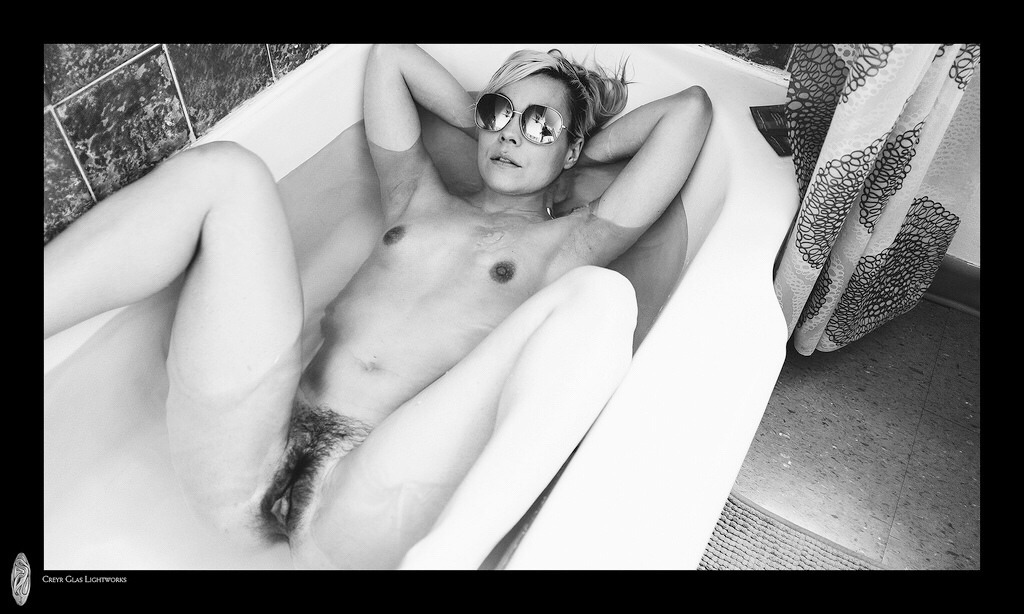
Chip Willis’ extremely clever use of a mirror to open up this incredible image of Nathalia Rhodes is a personal favorite. And I’d wager Creyr Glas Lightworks is familiar with it based on the image above. The pose is reminiscent and the mirrored sunglasses suggest further points of comparison.

Compositionaly the angle of the tub edges lead the eye at an upward angle toward Isola’s face, the shower curtain calls out, demanding attenting and we’re aware of the fall off of light as we move away from the tub, the eyes snap back, drifting back and forth between her genitalia and her mirrored shades.

The rule of thirds informs this shot. The inside edge of the tub at the top and the inside edge of the shower curtain.  The top of her right leg is also more or less aligned with a third segment of the frame.

I just really do not like the fact that her legs are amputated at the ankle. It implies a lack of mobility and given how wide the angle of view is I suspect the image maker lined up the shot to perfectly observe the rule of thirds and then leaned in closer to give it a little bit edgier feel. That edgier feel does not vibe at all with the tone and feel of the image. (Isola seems pretty comfortable and devil may care about what anyone else thinks about her or her body in the moment presented.)

I have no idea regarding the image makers background but this was taken with a Fuji X100T (a great for the price, MFT rig). But it’s digital and the black frame is something you’d not have the option for if you were working in traditional B&W–although it would work for B&W slides (further the mirrored sunglasses are positively made for B&W chromes, but I digress). That ultra bright bath tub edge in the lower right foreground would have to be substantially burned in to read on a traditional print, which would make getting a more or less even white across the entire bathtubs visible surface a nearly day long process in and of itself.

Still, despite the considerable flaws, it’s a memorable image in a way that 95% of the tubshots I’ve featured previously just do not accomplish. That’s worth noting, I believe.

Source unknown – Title unknown feat. Anina Silk and Joy (2010)

I’m not 100% on the attribution here but I’m pretty sure the year and performers are correct. (If anyone knows where they real clip originates, I’d be interested in seeing it actually.)

Ass play isn’t really my thing. It can absolutely shorten the length of time it takes me to climax and it changes my awareness of what muscles do what when I’m orgasming. Neither of those things really add anything to the experience for me.

If my partner is into it, I’m willing to experiment just so long as my partners mouth as well as my mouth don’t go anywhere near an anus or anything that’s been inserted into an anus. (I know everyone on Tumblr swears about how wonderful analingus is to give and receive, but yeah… no thank you.)

Thus, it’s a little odd that I’m including this in some ways–considering it’s ostensibly a warm up for anal fisting. The reason I like it is two-fold.

First, it reminds me of being five. I had a friend in my neighborhood named Dirk (not his real name but his real name was also disturbingly phallic in hindsight).

Dirk liked to play a game called ‘butt work’. One person would pull down their pants and lay face down on the ground the other person would pull the cheeks of the butt apart and look at, blow on, tickle or insert a finger into the other’s rectum.

I liked the shameless curiosity of it. The experimentation involved.

It was also turn based. I’d lay there hidden from view of the adult world by bushes while someone probed my body. It wasn’t the most comfortable thing but I knew there’d be a chance for me to be equally curious about their body if I was patient.

It’s that sort of I won’t ask you to let me do anything to you that you also wouldn’t ask me to do to you mentality that appeals to me.

I’ve been thinking about this a lot lately. Although I would also like to make porn at some point, I’m currently interested in pushing my personal photographic work in a more erotic direction. But I am patently uncomfortable with asking anyone to do something unless there’s some sort of mutuality to it. I have zero interest in pursuing anything exploitative.

I’ve not made much progress on figuring it out. But I did want to point to the mutuality that radiates from this image and to point to that feeling as something I’d like to learn how to encourage and foster in my own work.

Hans BellmerStudies for Georges Bataille’s L’histoire de l’oeil (1946)

Beyond a generalized outline and the Freudian psychoanalytic babble about the more unsettling aspects of his work–erotomania, pedophilia, etc.–my gut feeling is that the majority of art historians really get Bellmer all wrong.

It’s a bit too facile to call him a perverted pedophile–I won’t argue that his work doesn’t support these claim but only pursuing it to the point of dismissing him for his proclivities is perhaps cutting of one’s nose to spite one’s face. (Especially when you realize that almost all of his work that incites cries of pedophilia was a response to the cult of the perfect body in Germany circa the 1930s.)

The thing I think it’s important to keep in mind is how Bellmer repeatedly situated his work to stand firmly in a position counter to authoritarianism.

I find the Freudian analyses of him and his work even more frustrating–with their insistence on interpreting surrealist images as coded subconscious projections, i.e. Bellmer was a repressed homosexual (at that I have to question whether the person making that claim has ever even really looked at his work in more than a cursory fashion, he’s very much obsessed with female sexuality in a way that no gay man I know is…)

There’s talk of oedipal anxieties and fear of castration–and while both fit into the anti-authoritarian locus of his work, I read things differently. I feel a sort of shared experience with Bellmer–an overarching sadness at AMAB status and a sort of erotomania as the only perceived means of recovering some of the experience of what it might be to experience sexual awakening in a manner suiting your actual gender identity.

I feel like so much of Bellmer’s work is actually more literally anti-authoritarian than most people realize–because it channels a frustration with authoritarianism where your experience is limited by being born into the wrong body.

Further, non-consensual interactions are the bread and butter of both authoritarianism and pedophilia. I don’t know for sure that Bellmer had his head entirely screwed on straight in this regard–but I can’t see that he wouldn’t have been unaware of it. And while the stories of him hiring young girls to pose provocatively for him are unsettling, I’m reasonably sure that the resulting images would most likely be to unsettling to serve as pornographic material and I think that fact is crucial in understanding Bellmer and his work.

On a slightly different note, given the ascendancy of Drumpf in my own country, I think Bellmer is an artist not only due an in depth re-evaluation but who also has a great deal to offer on the subject of how art should strive to fight fascism. (If there are an gallerists reading this: Ana Mendieta is another artist who needs a major retrospective stat.)