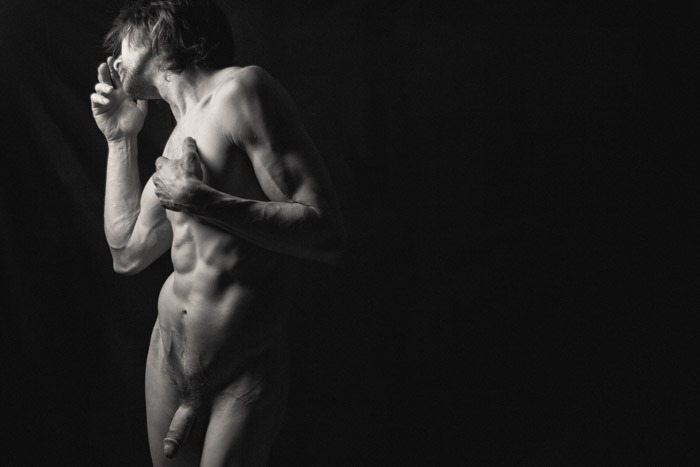
DearIndifference – Untitled from Out of The Shadows / Into The Light series (2013)
Chiaroscuro is the art historical term used to indicate work–predominantly oil paintings–which feature a strong divergence between light and dark.
A lesser known term that is frequently used interchangeably is tenebrism.
The two terms are not interchangeable.
When you’re discussing, say: Rembrandt, you’re firmly in the realm of chiaroscuro–contrast between light and shadow used to pointedly dramatic effect.
Tenebrism is less dramatic and more outright violent–in fact, it’s a term that might as well be reserved for the work of Caravaggio.
…
The confusion in application seem to mostly post-date the work which was foundational in illustrating their attributes. Chiaroscuro was a product of the early Renaissance; Caravaggio was either late Renaissance or post-Renaissance, depending upon whom you ask.
In the early 17th Century, a bunch of Dutch painters traveled to Rome and became insufferable Caravaggio fanboys. They returned to Holland and dubbed themselves The Utrecht Caravaggisti. (The work of these folks with which I am familiar is decidedly chiarscurous–as opposed to tenebristic–in nature.)
I am hardly an art historian–although I had an extraordinary Survey of Western Art I & II professor–but I can’t look at the work of these Caravaggisti and not see how it shaped Rembrandt’s style. Yes, Rembrandt can be gloomy and murky–but with a few exceptions (The Night Watch being one), Rembrandt dwelt in shadows and mid-tones; his work lacks the riotous gambit from light to dark that I see as a prerequisite for application of the term ‘tenebristic’.
(Add to the list of essays I’ll never get around to writing an analysis of how the film theory pissing match over where noir officially ends and neo-noir begins is actually staggeringly interrelated with the considerations of chiaroscuro vs tenebrism.)
…
I would unequivocally take about the above in terms of tenebrism. Further, I think its texture, scale and nuance are effing extraordinary.
It’s also audaciously brash in a very quiet way–typically, with so much negative space you’d want to position the subject so that the position of the head and neck invite the viewer to consider the negative space. The negative space here feels holistic. The pose is such that the body not only balances the frame so that your eye scans and rescans everything whether there’s something to see there or not–but there’s a way in which the subject ignoring the massed darkness, seems to create this tension between light and dark. Is his body emerging from it or being swallowed by it?
Also, it’s as if the raised left hand, the tilted head and the unseen eyes are actually more focused on the shadows than if the viewer were allowed to see the subject gazing into the darkness.
Truly excellent work, this.

 Acetylene Eyes