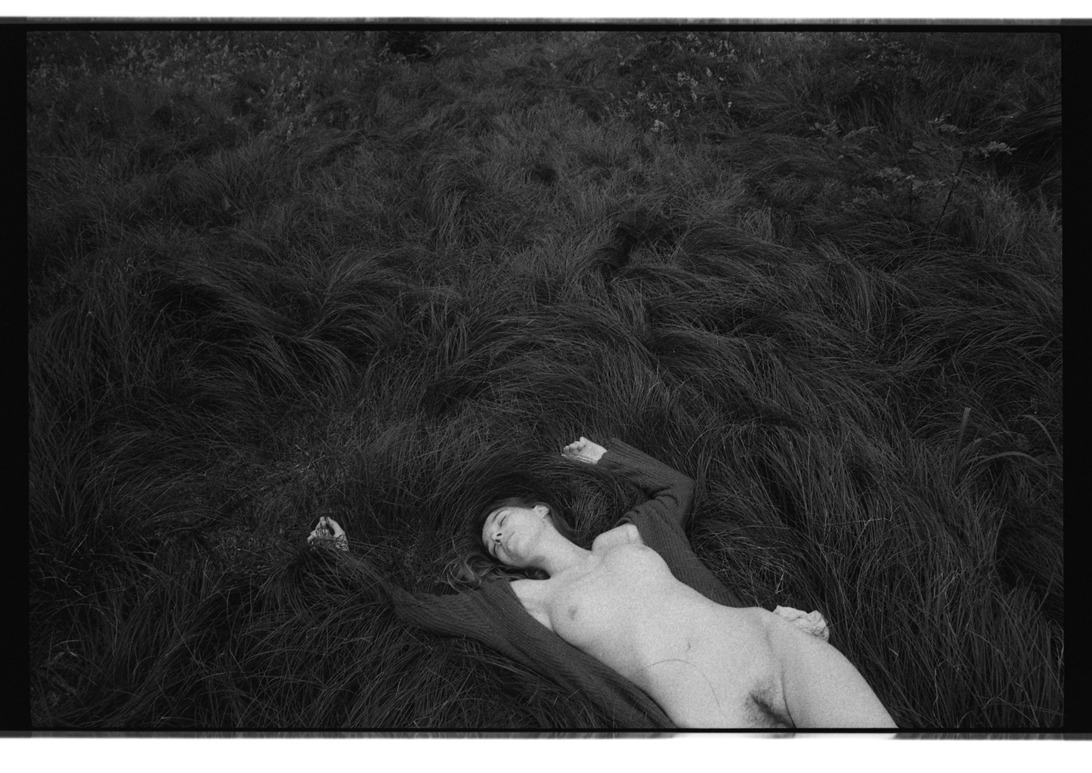
Davide Padovan – Sara Pavan (2016)
I feel like photos/images–and just to clarify this blog strives to counter the current conflation of analog processes (photography) with digital media/methods (images) of lens based visual representation–of nude/semi-nude woman reclining supine amidst lush vegetation are a dime a dozen these days.
That being said, there’s something special about this… I want to say ‘photo’–the shadows appear thicker and more viscous than I’m accustomed to seeing from digital–but the beveling at the lower frame edge seems indicative of some sort of post-production intervention… so we’re going to go with ‘image’ in order to exercise appropriate caution.
I feel like representing nude bodies in or against the backdrop of a landscape is a fairly common motif throughout art history. I feel the justification for this ranges from an urge to envision a sort of utopian realm, a preference for timelessness, a juxtaposition between the predictable solidity of the body contrasted with feral flora variegation.
Hopefully, you’ll excuse* the trotting out my overused example of Edward Weston’s famous nude surrounded by desert sand–however, I think one of the reasons they are so memorable to me is because these photos employ more than one justification for their existence:
- An interest in contrasting the texture of flesh with the grain of sand;
- A sort of vague narrative insinuation that the woman is sunbathing instead of posing for a camera.
The second notion is important because it’s a way of thwarting criticisms of catering to the art historical (lecherously entitled) male gaze.
(I’ve also suggested previously that a figure in a landscape is intrinsically narrative by default.)
Anyway, what I like about this is that it’s doing something I can’t recall ever seeing before: as the industrial world becomes more and more ‘technologically advanced’, there are increasingly insurmountable barriers between humans and the natural world–we don garments to protect against the elements, design and build structures to shelter and protect us. In effect, we are separating ourselves from the natural world of which we are an inherent part and function of.
This image seems to be embodying the same sort of openness to the environment that inspired Walt Whitman to personify nature as if it were his beloved when he wrote in Leaves of Grass: I will go to the bank by the wood and become undisguised and naked.
*The laziness in recycling this example is due to the fact that I am feverishly working on applications to a handful of MFA programs and I am honestly spread far, far too thin. (But I am committed to keeping this project up and running even if I am thoroughly overwhelmed; thank you for bearing with me.

 Acetylene Eyes