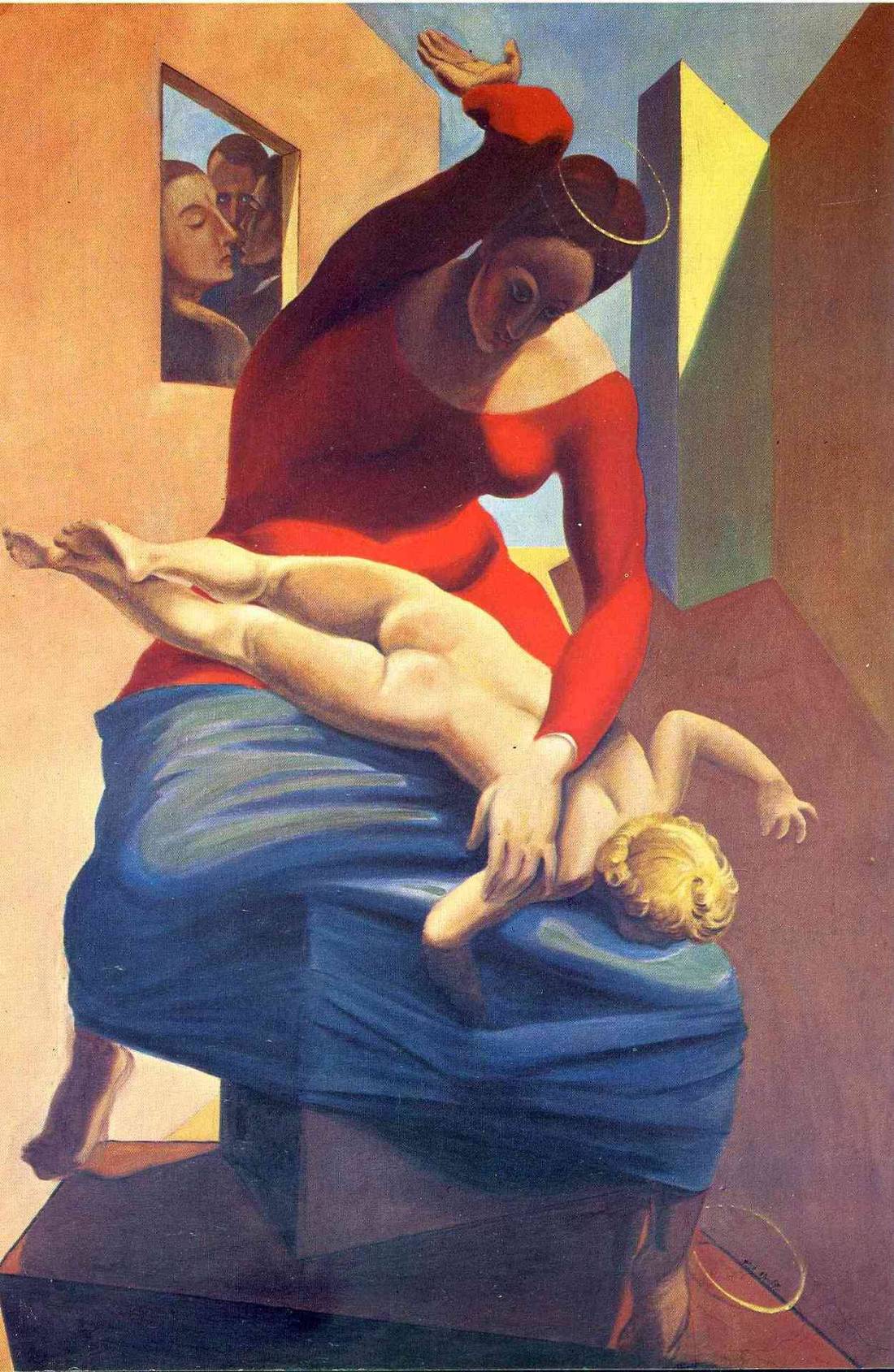
Max Ernst – The Virgin Spanking the Christ Child before Three Witnesses: Andre Breton, Paul Eluard, and the Painter (1926)
As far as differentiating between Dada and Surrealism, the rationale is more or less that Dada:
- embodied a visceral revulsion to the violence resulting from The Great War,
- was vehemently anti-art in conceptualization and execution, and:
- emphasized nonsense whether by flouting symbolic convention or thwarting efforts to untangle meaning through analysis.
Surrealism might well be described as dadaism that was decidedly pro-art (Margritte, for example, was a painter of extraordinary talent and sensitivity) and who instead of embracing nonsense, took the domain of the unconscious human mind as its inspiration.
Personally, I’ve only ever managed to link Duchamp with Dada. I’ve read a number of things that argue–with luminous insight–that Matisse and Picasso out to also be considered under the Dada umbrella. But I always sort of shrug and wonder what the point is in going to that kind of trouble? Essentially, Picasso is cubism, so why shuffle him into a movement that he–judging by the modern western art historical canon–far eclipsed as a mature artist. (Matisse is another story for another time.)
For some reason, the other way I think about it is that Dada and Surrealism are not unlike the so-called Meeting of Waters in South America–where the dark waters of the Rio Negro meet with the chalky brown waters of the Amazon. The two rivers come together and fly several miles side by side without mixing.
Looking further down stream you can see the way the impetus for Dada leads to Yves Klein–yes, his Leap into the Void but even more than that his Zone of immaterial pictorial sensibility which prefigured both conceptual and performance art.
Whereas Surrealism and it’s all but universal preoccupation with Freud’s banal bullshit and wish to uphold the sanctity of Capital A art as a medium–has infused virtually every discipline and genre of creative expression.
None of this is news. But I do think it’s interesting to consider Ernst as the great fence straddler–half Dada provocateur, half Surrealist impresario.
In the scene above, Ernst depicts himself alongside writer André Breton and poet Paul Éluard, both pointedly surrealists. They are seen through a window–not unlike witnesses to an execution–except that can’t seem to be arsed to bear witness so much as be seen as present.
The room is incongruent, seemingly not held to laws of perspective or expectation. (Although–it does absolutely suggest a stripped down version of what Margritte would posit in his own style shortly after.) In the foreground, the holy mother hold what appears to be a five or six year old nude Christ child on her lap–cheated with his ass positioned so that the viewer gets an optimal view of it. The holy mother has her hand poised over her head–clearly preparing to bring it down soundly against the bare ass of her holy progeny. (And everything about Mary and Jesus is a logical predecessor to Bathus’ work.)
There’s also the fact that the holy mother’s head is surrounded by a halo, while the child’s has tumbled onto the floor.
It’s depiction of not sparing the rod and therefore not spoiling the child is entirely in line with Xtian precepts. Yet, what about the tumbled halo–the holy in guarding the boundaries of holiness creates through discipline and punishment that which it seeks to prevent: unholiness? (Also, I think it’s funny that I look at it and see a great advertisement against corporal punishment in child rearing… how time marches on and how cultural contexts shift.)
I sort of view it as cheap, unconsidered blasphemy as a means of positioning Dada–which would’ve already been fundamentally anti-Xtian–and Surrealism in a sort of conversation with regard to the futility (or non-sense) inherent in interpretation.

 Acetylene Eyes