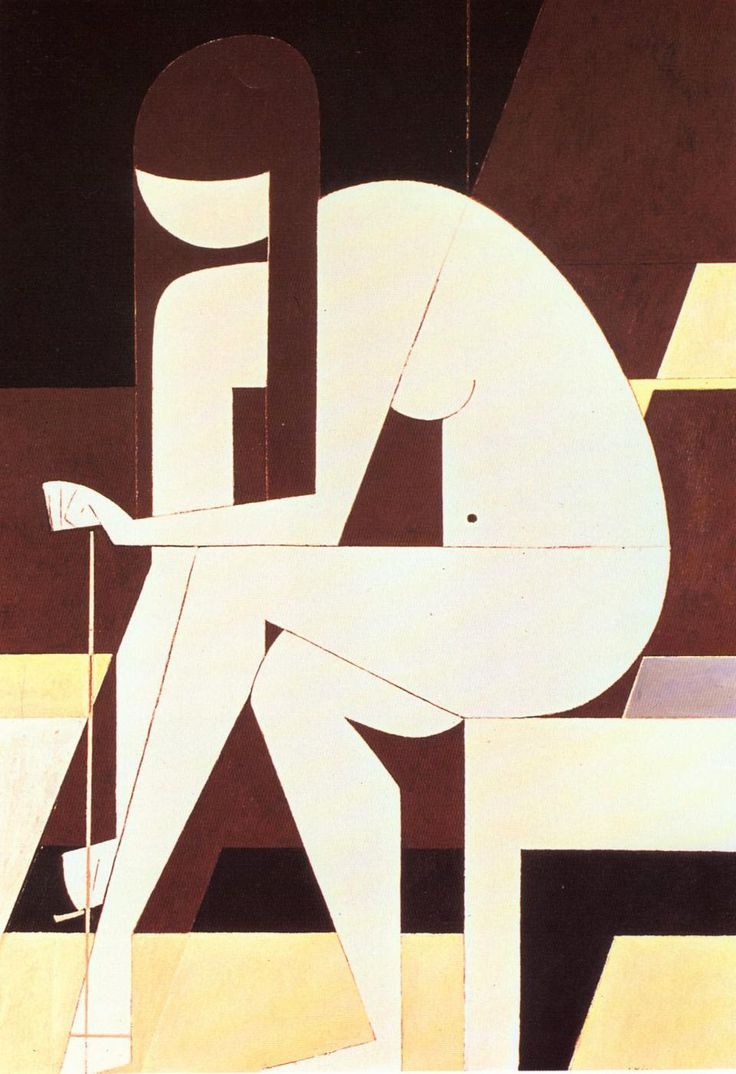
Yiannis Moralis – Girl Untying Her Sandal (1973)
You know that thing you do where you find a nice green grassy area in a park, lay on your back watching the clouds shift overhead and try to see the clouds as shapes other than clouds–an elephant, a steam train the Buddha? (See also: pareidolla.)
Call me sentimental if you must but I think that sort of thing is a good creative practice to encourage.
What does that have to do with this painting? Well, I think first of all the instinct of an art historian is going to be to term this as cubist in nature. I’m not entirely sure I’d agree with that.
By and large: cubist work has a sense of multi-planar dimensionality–most cubist painting ends up looking like fragmented origami with enough of the original form to allow for general identification or one of those foil, fabric and paint mixed media collages.
This takes a single view and more or less sticks with it. I know very little about Moralis other than he was Greek and dabbled in a shit ton of different styles–yes, including cubism. But he was also interested in mosaics and I think that it’s better to view this in that context.
I feel like mosaics are sort of the best way of teaching people to see both the forest (or to re-embrace my original metaphor: clouds) for the trees (the suggestive shapes the clouds take on).
Let me attempt to clarify what I mean. Consider this design:

It’s a standard checkerboard–big whoop. Well, what if I told you I see a flying saucer. I’ll understand if you are quizzical but the important thing is that given this I can show you what I mean in a way that I cannot with cloud watching.

In effect a mosaic is a means of teaching how to see less what is than what is possible to see.
And that’s really the brilliance of this painting. It instructs not only in how to see but via that teaching allows the viewer to witness something beautiful in a task that is usually so mundane as to not receive the attention of creative reverie–untying sandals.

 Acetylene Eyes