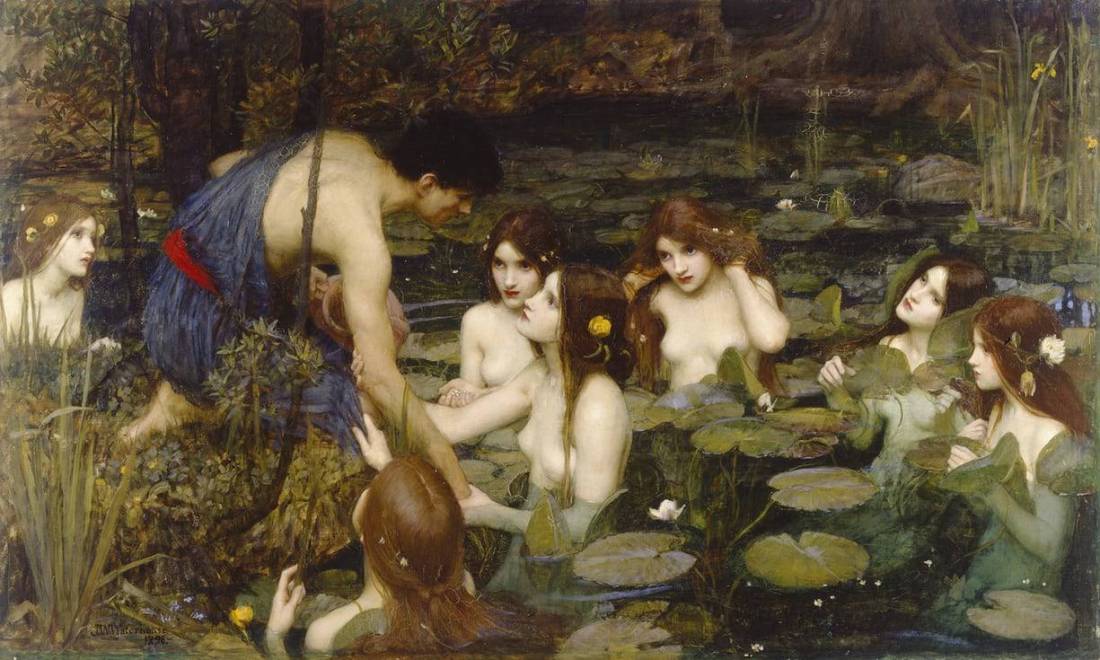
John William Waterhouse – Hylas and the Nymphs (1896)
Unless you’ve been living under a rock, you will almost certainly know about the Manchester Art Gallery’s decision to remove this painting from display. (You’ll note that this story has been updated several times in a way which makes it contradict itself several times.)
The story has shifted and morphed a number of times–unfortunatley, I do not have cached versions of it available to reference: but here’s my understanding of how things played out:
Under the auspice of extending the Time’s Up and #MeToo movements general impetus to art history, the Manchester Art Gallery announced that it would be not only removing the painting from display but also removing post cards of the painting from their gift shop.
We I first encountered the story there was no mention that this was a temporary experiment. As it turns out the museum saw this action as a gimmick–intended to foment conversation on the long history of blatant misogyny in art history as well as tying into an upcoming exhibition by Sonia Boyce.
As of this writing the painting has been rehung.
I’m not especially interested in exonerating Waterhouse–I don’t care for his work, personally. I also think that the accusations that this is just another in a long line of mainstreaming so-called SJW puritanism are entirely facile arguments. But conceptually there are a number of things about this stunt that were poorly considered and/or executed.
First off, anyone who has studied mythology will know that Hylas was gay. Also, like: y’all do know that his fascination with these nymphs ends up getting him killed, right? (Conceptually: there’s an argument that by choosing this painting to take down, there is contained a biting critique of Time’s Up and #MeToo–a kind of let’s question the sexualization of female bodies in this one case where those bodies will subsequently punish a man whose attention they have claimed?)
Second, if the issue really is the sexualization of not just women’s bodies but of young women’s bodies–then why aren’t we critiquing the work of folks like Klimt and Schiele first? The Guardian article mentions that the painting was and is once again hanging in a room entitled In Pursuit of Beauty? Thus, again–from a conceptual standpoint–the museum is shirking its own role and responsibility in this kerfuffle. (What would’ve been more interesting is to fill the same room as the Waterhouse with paintings made by women artists roughly concurrent to Waterhouse.)
Third, I’m not unaware that many consider Waterhouse to have been very nearly a pornographer. And I’m sure there are bawdy sketches with which I am not familiar but generally speaking there’s this notion that in order to become a suspect on counterfeit currency you study the real currency as opposed to the fakes. If you’ve studied either Art or pornography–to any extent you should be able to identify it as the former and not at all the latter.
Lastly, there’s a difference between having to see something–i.e. a monument to the confederacy (from which there is no separating a fundamental conviction in white supremacy) or a confederate general vs something in an art museum. There is absolutely a prolonged and difficult conversation that needs to be had about the legacy of objectification with regard to depictions of femininity in art. For example: as much as I adore Emma Sulkowicz her latest piece protesting Picasso and Chuck Close (and seriously fuck both those ass hats sideways with a shovel), was sloppy and haphazard but it at least did more than point to a problem it suggested a means of addressing the problem moving forward.

 Acetylene Eyes