
Source unknown – Title unknown (201X)
Blessed are they who see beautiful things in humble places where other people see nothing.
–Camille Pissarro
Source unknown – Title unknown (201X)
Blessed are they who see beautiful things in humble places where other people see nothing.
–Camille Pissarro
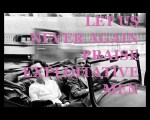



wonderlust photoworks – [↑] After Walker Evans’ Main Street Ossining, New York, 1932 (2018); [↖] After Joel Meyerowitz’s Movie Theater Booth, Times Square, New York City, 1963 (2018); [↗] After Bruce Davidson’s People Sunbathing in Central Park, New York City, USA 1992 (2018); [+] After Lee Friedlander’s New York, 1966 (2018); [↙] After Garry Winogrand’s Untitled from Women are Beautiful, 1971 (2018); [↘] After Robert Franks’ Elevator, Miami Beach, 1955 {commonly referred to by both the artist and the art world as ‘Elevator Girl’} (2018)
I was already souring on street photography in general but with the reality of a sexual predator being elected president of the US, the subsequent #MeToo and #TimesUp movements, I’ve been thinking a lot about why street photography (in generally) and men who take creepy photos of women without their informed, verbal consent (specifically) are not something we should continue to accept uncritically.
With the recent life-time SCOTUS appointment of a mediocre white man, who continues to face credible allegations of sexual predation, this project has been my way of coping with a lot of complicated emotions–both as a femme person and the survivor of sexual assault and intimate partner violence.
Another precipitating factor was having someone in my program (a white, cis-het dude) surreptitiously taking photos of me without asking for and receiving my consent to do so. (This is also the same fucker who contextualized his own work along the trajectory from Walker Evans to William Eggleston to Alec Soth and mentioned Dorothea Lange as nothing more than a footnotes to his revered Evans.)
(Further: in the process of making this work, I’ve realized through extensive self-reflection that my own experience is that men take photos of me assuming permission, whereas women always ask first.)
In the tradition of feminist appropriation art (esp. Sherrie Levine), I’ve incorporated aspects from Jenny Holzer aphoristic work and the Guerrilla Girls protest art and applied feminist slogans as text interventions to sacrosanct, iconic examples of creepy, entitled work made by men that continues to be widely praised but really should not be.
This project is aware of the current conversations surrounding controversial historical monuments and the complicated discourse surrounding problematic works and makers embodied with greater or lesser success of the symbolic ‘cancellation’ of Waterhouse’s Hylas and the Nymphs by the Manchester Art Gallery as well as Emma Sulkawicz’s recent performances questioning how to deal with problematic men in art.
Not included in this post but included in the upcoming exhibition will be a critique of my own admittedly limited street photographic practice.
And to avoid being a lazy progressive, I will also suggest options for respecting consent and personal autonomy that could perhaps still fit within the street photographic tradition in ways which minimize objectification and exploitation.
This project is titled Let Us Never Again Praise Exploitative Men. It is dedicated to Artemesia Gentileschi.

Tamara Lichtenstein – Untitled (2018)
I’m not sure the composition completely works in this photo–there’s a simultaneous sense of space being flattened (the photographer is almost certainly as far back as she can be against the railing and the model appears to be right up against the plant) but also there’s an insistence on contextualizing the location as being on the water front.
What saves it is the mood or tone–the pose is melancholy, contemplative and sensual all at once. Yet, what really keeps me coming back is the texture. The vertical lines where she’s holding the diaphanous material taut against her throat, the horizontal lines of the roof overhanging the deck, the vertical moire interference of the screen and the radial extrusions from the plant.
Against, all logic, I think this might be an exception to the rule of #skinnyframebullshit; in that I think if you’d taken the camera where it is when this photo was snapped and rotated it 90° counterclockwise, I think this photo could’ve taken on the same sort of ephemeral tactility that enlivens so much of the best of Jeff Wall’s work.
As it is, it’s still head and shoulders above the rest of most of the glut of work released by internet famous photographers.





[↑] Richard Learoyd – After Ingres from Presences series (2011); [^] Source unknown – Title unknown (201X); [↙] Richard Kern – Title unknown from New York Girls series (1995); [↓] RylskyArt – Amateri feat. Kylie Miny (2016); [↘] Rylsky – Title unknown feat. Nikia A for MetArt (201X)
Follow the thread.
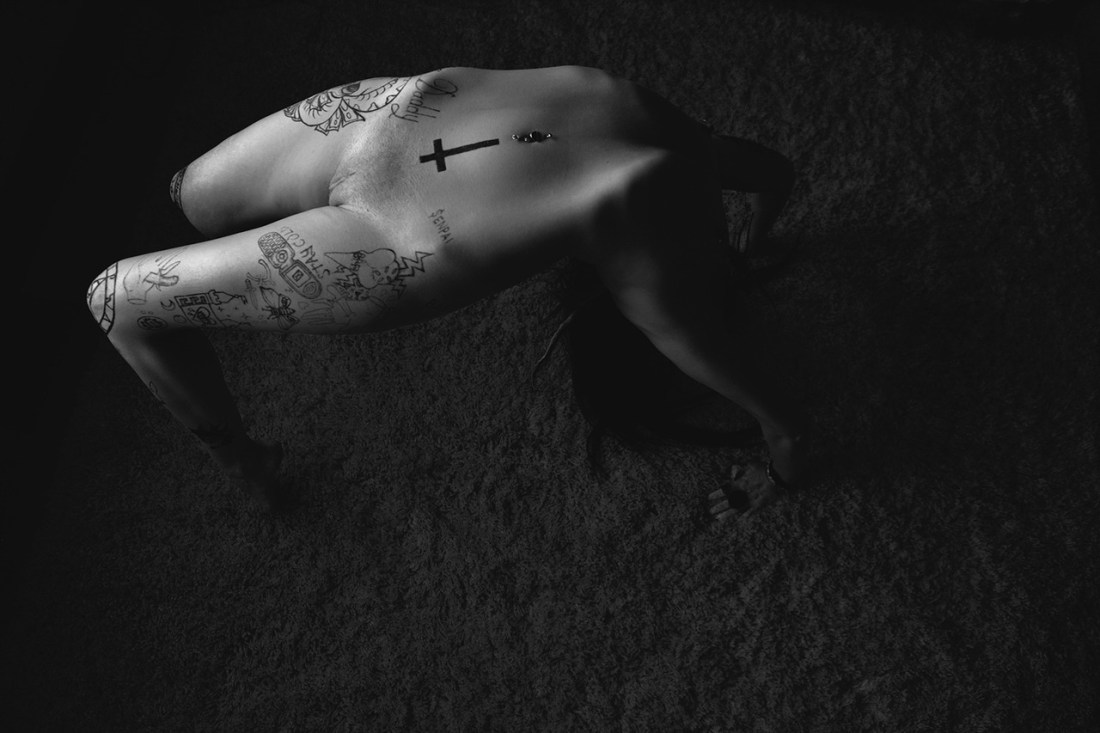
Helena Darling AKA The Woods Witch – Title unknown (201X)
I love everything about this–and Darling’s images are 120% worth digging into–however, I’m less interested in talking about the tenebrism in this or the compositional acumen (reading from left to right, you see the backbending body first and then the framing negative space balances the positive space in a way that insists upon the viewer considering both what is visible and what is occluded within the context of the frame in its entirety).
Instead what I’m interested in is the inverted cross tattoo.
First off, it’s a fraught symbol. There’s all the goth scene appropriations and witchy applications and it’s become an over-the-top cliché in black metal–and unfortuantely, through black metal the image has been appropriated by some less than savory ideologies.
The reason the symbol appears to me is that way back in the day when I was dabbling in staunch atheism (a viewpoint I have only slightly more sympathy for these days than Evangelicalism) is because, I don’t think anyone who identified as an atheist in the late 90s and was really into the fringes of the metal and progressive rock scenes, didn’t go through a phase of confrontationally pointing out to Xtians that were it not for sheer luck they’d be Mithrians (after the Mithras fertility cult).
All I really knew about the cult was that many of their rituals bore more than a passing similarity to Xtian observances. I remember being told by several of my acquaintances who were self-proclaimed occultists that the symbol of the inverted cross was originally associated with the Mithras cult.
Further, the Roman crucifix was an inversion and perversion of the Mithrian symbology framing the ‘rightside up’ iteration as a symbol of death by linking it with the prominent mode of capital punishment.
Subsequently, the Roman Catholic Church appropriated the symbol as a means of claiming dominion over the realm of death through Christ’s death and resurrection.
However, most sources cite the origination of the inverted cross as the Crucifixtion of St. Peter–who insisted on being crucified upside so that no one would associate his death with Christ’s. (Given my understanding of the image, I find this complication utterly fascinating.)
I was less than critical with a lot of stuff I was consuming in my early 20s. So I went back to check the validity of this and although I can’t find any definitive proof I did discover the apparently initiates to the Mithras cult went through an induction ceremony that unfolded a-whole-fucking lot like a baptism and ended with the inductee having a cross scarified onto their forehead.
If you consider this in the context of the fact that Rome was already a full-blown empire before the Mithras cult came up and it appears that crucifixion would’ve risen to predominance around the same time as the cult. And given the disparity between a fertility cult and the death cult of state sanctioned executions, I don’t think my understanding is entirely implausible here.
Either way: I am increasingly preoccupied with the panoply of often contradictory significations folks impose on simulacra. To me: such signs are more resistent to the ascription of extant meaning and instead require both constant personal re-evaluation as well as contextual exegesis. In other words: it’s difficult to make an idol of that which will always and forever remain ambiguous.
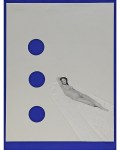
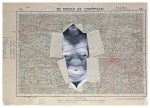

Avi Yair – Untitled (2017)
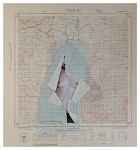
These are enormously eye catching for a number of different reasons–the dynamism of the design elements (each of these four is exceedingly graphically astute in it’s use of line, shape and form–I especially like the way that the collage interventions are structured in order to convey the work has been stripped away to reveal an underlying image; that to me renders these less collage than sculptural excavation).
There’s also a lot of notions of representing three dimensions in two–but in a way that is fundamentally between two and three dimensions.
The inclusion of maps is especially poignant beings as maps are inherently problematic. There’s the simple fact that Euclidian geometry breaks down when you move away from the 2D into the 3D, for example an equilateral triangle inscribed on the surface of a sphere does not form a closed triangle, it’s just three different lines that share a connection to each other but do not form a contained shape.
Historically, this has caused all kinds of misunderstandings. The maps with which most of us are familiar preference the northern hemisphere and western hemisphere (for example Brazil is roughly the same size as the Lower 48 but looking at a typical map, you’d not easily grasp that; also, the US and Europe are presented in relationship to each other and then secondly the rest of the world is added in in relation to them.
Maps also delineate boundaries between geopolitical nation-states, boundaries between water and land, etc. Thus, it feels like the presence of naked bodies speaks to questions of boundaries as far as what is appropriate, what isn’t, what is celebratory, empowering and natural vs. sexualized or otherwise libidinous.
If that were all these did, I feel that would be interesting but not necessarily conceptually ambitious enough. The thing that appeals to me is that the interplay between maps and bodies begs questions of the discrepancies between accurately representing three dimensions in two and referential utility. (In a lot of my current grad school research practice: I keep coming back to Borges’ On Exactitude in Science postulates a kingdom so obsessed with its own accurate mapping that a map is commissioned that ends up being the same size as the terrain it purports to map. In the end, it ends up rolled up and rotting in the desert.
Or, to put it another way (if you are–like me–of a decidedly Wittgenstein-ian bent: explanations come to an end somewhere.

Laura Brink – missrudy (201X)
I’m not 100% on the attribution for this. While there is definitely enough of a stylistic similarity to guess that it might be Brink’s work–it’s substantively different as far as tone and form.
Either way: I like it a lot.
There’s an increasing amount of work out there preoccupied with representing menstruation. As you’ll certainly recall Rupi Kaur’s Period went several rounds with the ‘Gram censors. (See also: Ashley Armitage’s The Girls Room series, several of Lynn Kasztanovics photos from more than a decade ago & this blog’s #menstruation tag.)
Representation matters. However, I think more often than not by the time we actually start talking about the importance of representation–it’s unfortunately almost always in defense of those who are arguing that the fact that there’s already some representation means that more representation will result in the erasure of the status quo’s perspective.
That’s why I think we should shift the representation matters conversation from quantity of representation to quality of representation. (Because with representation comes less nuanced and non-contemplative knee-jerk demographic place holders instead of fully realized, dimensional representations.)
What I like about this is that although you can read it as being about menstruation–there is something fantastic about it. The boots suggest something at least somewhat badass if not warrior like.
There’s a sense of damage, too. Even if this isn’t a depiction of menstruation, there’s no way this blood isn’t emerging from an intimate wound. But with the two fish trying to swim against the stream–salmon, at least, swim upstream to procreate. The whole thing has a strong sense of the cyclic.
I’m not comfortable going as far as to say that this is necessarily a personal mythologization of menstruation. (Much to my chagrin, I do not menstruate–although I am aware that cramps can be demonstrably equivalent to the pain associated with a heart attack and that I’m sure bleeding from genitals for 8 days a month would probably make me far bitchier than I already am.) But I know from friends who do menstruate that there’s a tendency to think of your cycle as something familiar–Aunt Flow coming to visit, Shark Week, etc.
Even if I can’t necessarily interpret the elements of person myth underlying this, there’s a consistency in the presentation that suggests a fully realized way of relating to the experience.
It’s likely a problematic association but one of my first internet friends back in the early 90s claimed to be able to sense past lives of her friends. She always maintained that I had been a Russian peasant girl in a previous life. It was an idea I never questioned–although I was less than willing to engage with it then than I am now.
I think the difference is that there have been a handful of moments in my life where it feels as if another presence possesses my body and while in possession of it, I experience something that is comparable to the way that giving sexual pleasure at the same time as receiving sexual pleasure can cause this exponential feedback loop where you try to give back the same pleasure you are receiving and your partner(s) lean in also and the intensity builds crescendos upon crescendos or orgasmic pleasure. These moments it feels like I am sharing that experience with a ghost. I think of the ghost as a Russian peasant girl.



 Acetylene Eyes