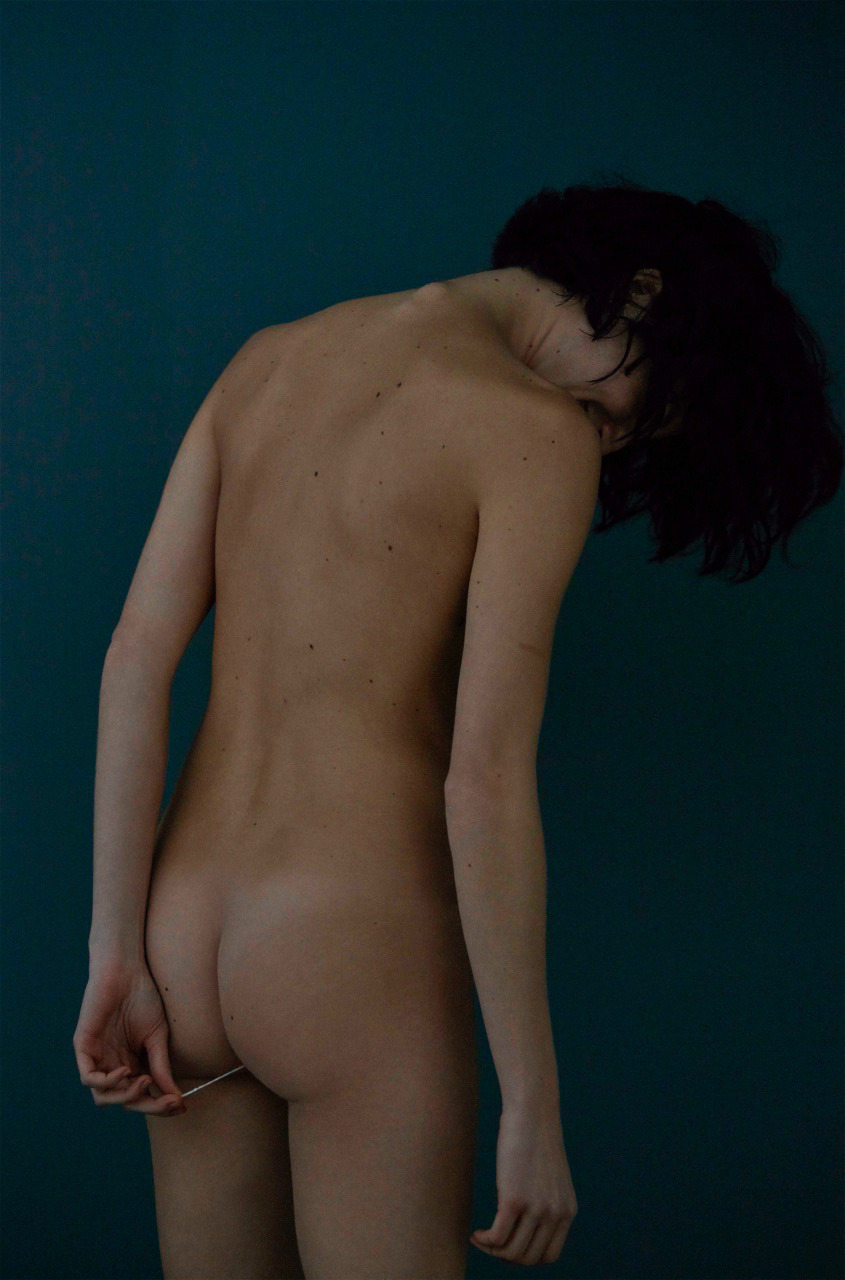
Nobuyoshi ArakiErotos (1993)

If there were a social media site that used Facebook-esque relationship statuses to track opinions regard an array of notable artists, my entry for Araki would be: It’s Complicated.

I appreciate his life-long commitment in documenting the erotic and/or transgressive aspects of human experience. But by the same token his prolific output–and let’s be honest, prolific isn’t even close to a strong enough word, something closer to ‘profuse’ is more apropos–is off-putting; the feeling it instills is one of throw everything at the wall and let’s see what stick instead of any coherent, contemplative, and disciplined editing.

The above photograph is causing me to rethink some things. For example: I’m not sure it changes anything about how I feel w/r/t what I interpret as lackadaisical editing. However, it’s probably intellectually dishonest to use that as a justification to disqualify everything the man has ever made. And in fairness, while I do find much of his work to be redundant and under-edited, Araki has produced six or eight images that are indelibly imprinted upon my visual imagination.

All that reminds me of one of the best pieces on understanding art that I’ve ever encountered in which Maria Popova unpacks Jeanette Winterson’s Art Objects essay.

Winterson, finds herself in Amsterdam, describes the experience thusly:

I had fallen in love and I had no language. I was
dog-dumb. The usual response of “This painting has nothing to say to me”
had become “I have nothing to say to this painting.” And I desperately
wanted to speak. Long looking at paintings is equivalent to being
dropped into a foreign city, where gradually, out of desire and despair,
a few key words, then a little syntax make a clearing in the silence.
Art, all art, not just painting, is a foreign city, and we deceive
ourselves when we think it familiar. No-one is surprised to find that a
foreign city follows its own customs and speaks its own language. Only a
boor would ignore both and blame his defaulting on the place. Every day
this happens to the artist and the art.

We have to recognize that the language of art, all art, is not our mother-tongue.

This attitude is presented as a prophylaxis for the I just don’t get it mode of art criticism.

It’s as stellar a metaphor as it is nuanced and astute. Yes, it’s great to know what you like and to be able to explain why you like it–I’d venture that it’s integral to any creative practice.

But part of seeing is resisting the tendency to avoid engagement with what you are seeing. And viewing something through the filter of past experience, of trenchant opinions, is a mistake.

One should never cease to questions assumptions, values and opinions–because to stop might mean pulling up short of the one question that toppled the entire house of cards.

This photo has made me realize that I’m likely very wrong about Araki. And as much as we strive to always be in the know and adept at negotiating understanding, taste and opinions–it really is incredible to be presented with the opportunity to correct a long, unconsciously repeated mistake.

So here’s to being wrong. Learning and growing.
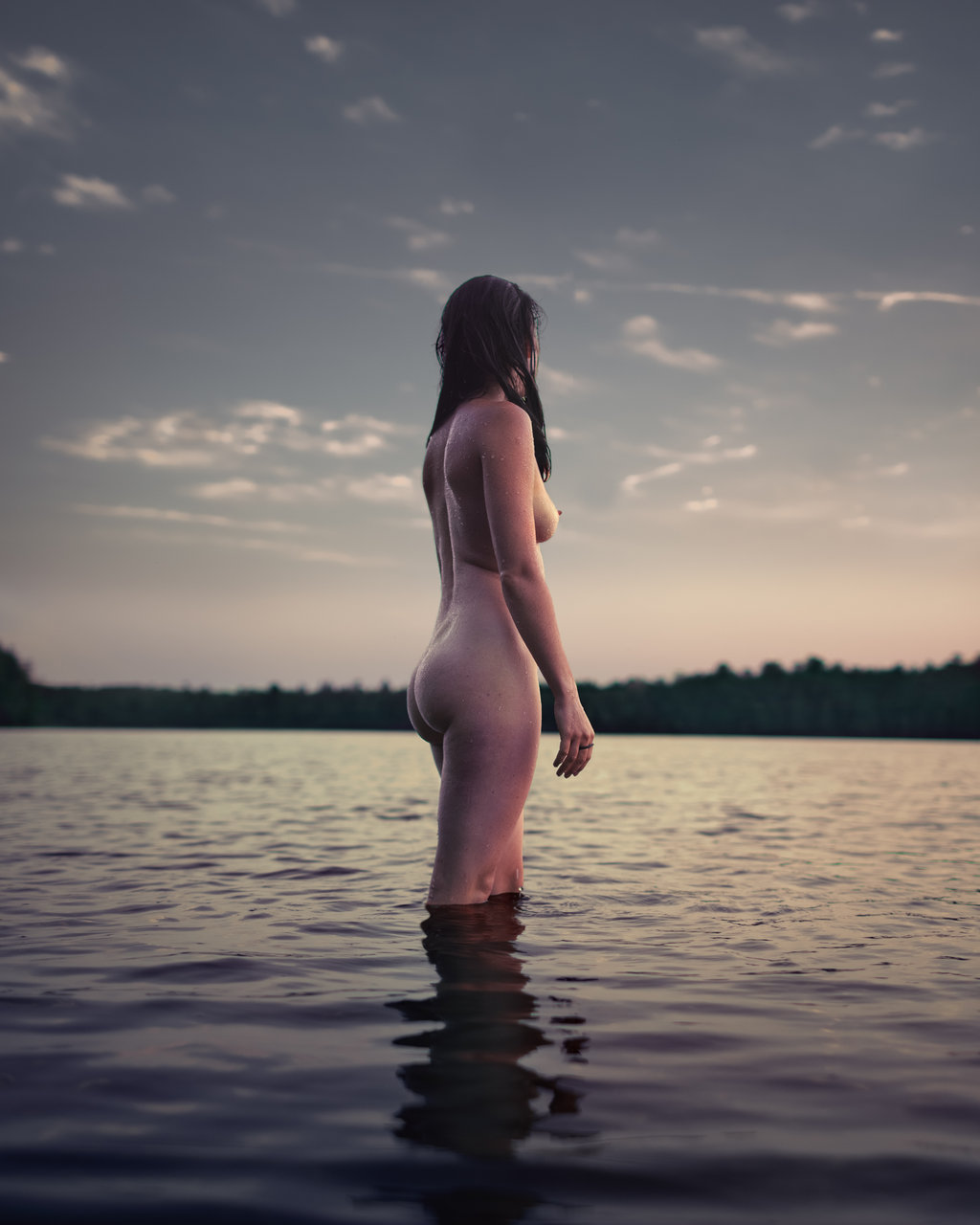
Benoit PailleRainbow Family member 39 (2011)

I can’t think of a contemporary image maker who casts a wider net than Paille.

In the last five years, he’s explored Crewdson-esque quasi-narrative, made a bunch of stuff with strobes mounted on drones, used a video game as a point of departure for landscape work, created realistic scenes via masterful Photoshop manipulation and made portraits of business owners in and around Paris.

Not all of it works. Yet, what’s surprising is how much of it does. And usually what makes that which works do so is a direct result of Paille’s fascination with surreal, psychedelia-inflected lighting.

The above is wonderful because of the subtle and dynamic gradation of skin-tone–red, purple, pink and peach tones that present with something like an inversion of the sky. (I’m saying it poorly–but think of the sky as if it were a positive and the woman as if she were a negative placed onto a positive field.)

The slight cant of the horizon and the way her reflected shadow goes completely black in the water all work together for an arresting, incisive image.

On track again soon

Apologies for lack of new posts over the last week, I needed to take some time and focus on other things for a bit. (For once it was to deal with exquisitely ecstatic experiences–I seriously had the most amazing six days, I can’t even–instead of my usual wrestling with demons/mental illness–so yay!)

I should have a new queue up and running by late Friday-early Saturday and we’ll hopefully run uninterrupted through late August.

Thanks again for following and take care of yourselves.

-a.

vivipiuomeno1:

Judy Dater (U.S.A. 1941) Untitled (Self-Portrait with Sparkler) 1981, Gelatin silver print, 15 × 19 in.

Dater’s Self Portrait with Snake Petroglyph is the first of her photographs I encountered.

I love it. (So much in fact, that I riffed off of when I made this photograph.)

Shortly after, I tuned into Imogen and Twinka at Yosemite and it’s narrative bent couldn’t be more relevant to my own photographic preoccupations.

The above is a more resolute photo, more symbolically charged.

Victoria Gannon’s commentary Judy Dater: On Vaginas and Earthworks is a addresses the broad strokes reasonably well: the Freudian notion that vaginas are voids needing to be filled, how the sparkler Dater is holding behind her back and between her legs serves as the focal point of the photo, the work’s position within a historical context of Second Wave Feminism.

Such points are clearly valid–although I bristle a bit at the notion that Carolee Schneermann’s Interior Scroll was anything less than proto-Third Wave. 

Yet, I think in Gannon’s effort to associate the Dater with feminism, there’s an overlooking of the radical ambiguity of this image. To her credit, she does note that the space behind Dater isn’t land, it’s an expanse of water–something I completely missed.

The light is also between day and night–whether it’s dawn or dusk, remains uncertain. (Although my gut says dusk.)

Further, Dater is standing behind a steam vent or fumarole. I have no idea if it was intentional, but I was almost certain it was a geyser.

Part of my reason for thinking that is a result of visiting iGeysir in Iceland–the site from which the word originates. (Spoiler alert: it’s a tourist trap par excellence.)

The thing that visiting there made me realize is it’s not just porn where folks fixate on ejaculatory spectatorship–when Geysir spews, everyone stops and watches with rapt awe.

I have no idea if Dater meant for the viewer to think of a geyser. But the way she’s standing, defiant–with the light dying out in the sky–with fire symbolically emanating from between her thighs, there seems to be something radically talismanic about her formulation with regards to this image, a reformulation where femininity is the site of an equal but opposite force of nature. Something perhaps less historically observed, but as this photo asserts, it’s high fucking time that prejudice was upset.

Cass BirdHeather Kemesky (2016)

Usually I’m not into editorial or quote-unquote lifestyle work.

What tends to resonate is image makers who take what functions and discard the rest. (Here I’m thinking of Lina Scheynius with the way she appropriates the tropes and visual language of lifestyle only to filter them–incongruously–  through her distinct lo-fi aesthetic and diaristic tendencies.

Bird’s work is more of a hybrid between editorial and lifestyle. Were that all, then I would be less enamored with her work than I am.

Perhaps the best way to get at what I mean is to focus on the hybridization. Usually, editorial work is supplemental to text–it’s a form of illustration, in effect/a picturebook for adults. Whereas, lifestyle tends to be fixated on immediacy of experience, beautiful people in exotic locales appearing relaxed and happy.

From the former, Bird adopts an unusual concreteness. Her images always have a lucid and clearly legible tone. (Consider the above: there fading light and heavier hues, lend a melancholic feel that is subsequently amplified by the gravity of the pose–head down, the look at me I’m on my period implication, belied by the might as well be joyful grin.) The tone alone frequently contributes a strong narrative thrust to the images. In other words, these images are able to stand on their own independent of their intended context.

Whereas with the latter, there’s an immediacy of bearing witness. I’m struggling with how to articulate what I mean on this point but it’s something like the built in interest that comes with viewing images of people you know, say on Facebook, on vacation, hanging out, going to a show, etc. They don’t have to be good, for you to experience some slight vicarious rise in yourself.

Bird’s work has that sort of feeling to it, except the images aren’t just interesting for what they document, they are astute considered and technically accomplished.

Lastly, Bird is clearly a talented image maker. But I get the feeling she’s an even better editor. I had a really difficult time deciding which image of hers to feature. I ended up going with this one but I’m head over feet for this one. When editing there’s a tendency to focus on style to the diminution of substance, an impetus for excluding the imperfect in favor of the unimpeachable. So it’s nice to see an image maker who although she seems to have precocious luck at capturing that perfect moment in an exceedingly well-considered composition, will opt out of any sort of perfectionism in favor of an indelible moment.

Amandine KuhlmannCinq Sens [Five Senses] (2015)

The adage talent burrows, genius steals–most often attributed to Oscar Wilde–actually originates from T. S. Eliot:

Immature poets imitate; mature poets steal;
bad poets deface what they take, and good poets make it into something
better, or at least something different.

There’s zero question that Kuhlmann is stealing with this series. The color palate, poses and timing might as well be verbatim visual quotes from the posters for master provocateur Lars von Trier’s Nymphomaniac.

I won’t argue that these images are better than the posters. If nothing else, the posters almost certainly required a team of creatives and tens of thousands of dollars to produce. They are more dynamic, dimensional and artfully constructed.

But Eliot doesn’t imply that the only justification for theft is that you make something better–making something that is at least different is also an option.

Kuhlmann succeeds admirably in that regard by focusing on little tics–scratches, broken blood vessels under the skin, a silvered thread of spit suspending bubble of saliva above a mouth open in an orgasmic gasp, hair clinging to sweat slick skin.

Looking at these makes me realize that although the Nymphomaniac posters are technically superior–they could have been much more impactful if those responsible for creating them had been more attentive to such seemingly mundane details.