
Raggana Photography – Portrait (2015)
io fu gia quel che voi siete e quel chio son voi anco sarete (I was once that which you are, and what I am you also will be)
Raggana Photography – Portrait (2015)
io fu gia quel che voi siete e quel chio son voi anco sarete (I was once that which you are, and what I am you also will be)
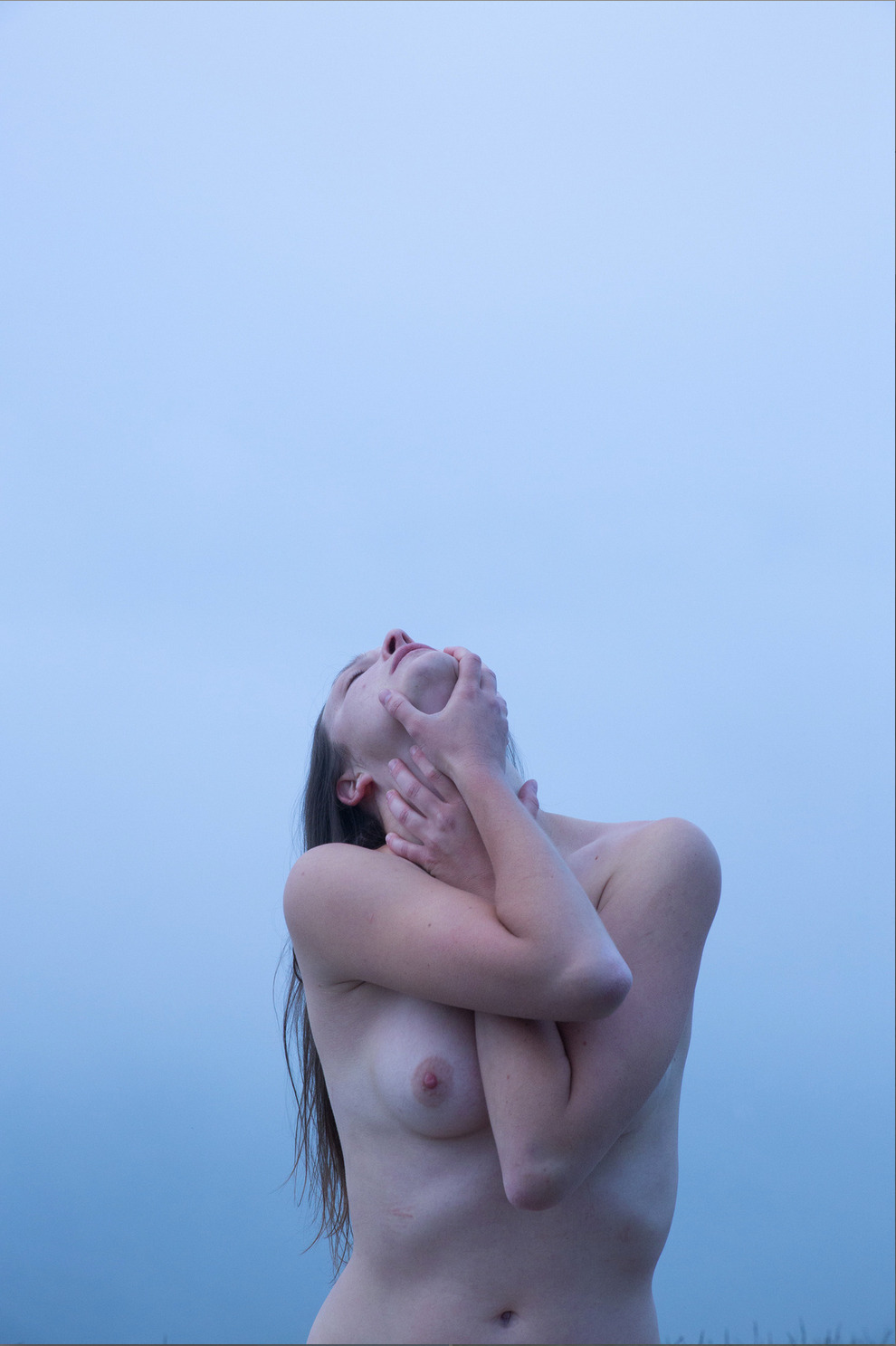
Anastasia Ruiz – Untitled from Escape series (2015)
I LOVE the way it’s both flat–the subject in the foreground and the blue-white gradient of sky in the background–at the same time there is this weird dimensionality to it. (I mean look at her right elbow blocking her left forearm and how that suggests spatial cues that contribute a palpable sense of her right nipple, right breast and upper body all offset by the hair trailing down her back behind her.
It’s the same thing with her overlapping hands-right over left (and oh god look at her left thumb against her neck!) Her lips nostrils and earlobes backed again by her trailing hair.
And the way the tippy tops of beach grass stalks at the lower right frame edge render the space between her body and the right edge of the frame a sort of neither positive nor negative space that perfectly balances the extensive negative space within the frame.
Also, the composition moves the eye downward and subsequently pushes it up again.
As an image maker, Ruiz is all over the place. She studies fashion but pursues interests in practices as diverse as 3D printing, video, graphic design and illustration.
It’s easy to see the influence of Lina Scheynius and Traci Matlock on her work. (Interestingly: I always see correlations with Benoit Paile–as far as scale and perspective go; and Matthieu Soudet as far as scene manipulation is concerned.)
And as much as these are sort of secondary influences (from an art history snob standpoint), I don’t hold it against Ruiz because her work is interesting and she knows how and way to employ vertical frames that are not #skinnyframebullshit.
As far as that goes: she’s already better than ¾ of the image makers out there today.

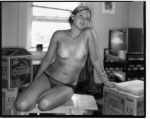
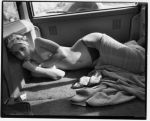


Ted Partin – [↖] Dallas (2008); [↗] New Have I (2004); [+] Brooklyn (2004); [↙] Brooklyn (2004); [↘] Brooklyn (2004)
I’m flabbergasted at how little of Partin’s work there is floating around out there in the interwebz–almost none of it on Tumblr.
Scanning the critical exposition on it, it’s easy to understand why–sadly, there’s a roughly two decade lag between what the gatekeepers of fine art will publicly endorse and great new work that is being made in the here and now.
Part of the problem is that critics–and I’m accusing myself just as much as anyone else–tend to shout about the easy connections. Folks want to contextual Partin as the heir apparent to Goldin and Clark.
It’s not that such connections are inaccurate it’s just that placing them side by side like that you emphasize a sort of insider’s perspective into the experience of counter culture youth. And that relationship simply isn’t borne out in the work.
Two more appropriate corollaries might be Ryan McGinley and Mark Steinmetz–the later as a result of the unmediated/unrehearsed immediacy of framing and McGinley’s fascination with youth culture is more in-line with the work than Clark; although even McGinely is problematic as he tends to fixate on fetishizing youth whereas Partin seems more interested in a sort of humanistic elegy.
Or, if you’re looking for brownie points: you could argue for interpreting the work as an allergic reaction to Winograd’s Women Are Beautiful.
Any way you slice it: it’s nearly meditative work that makes up for what it lacks in maturity and breadth of scope with a precocious and raw intimacy that somehow manages to avoid both documentary sterility and voyeuristic fixation.
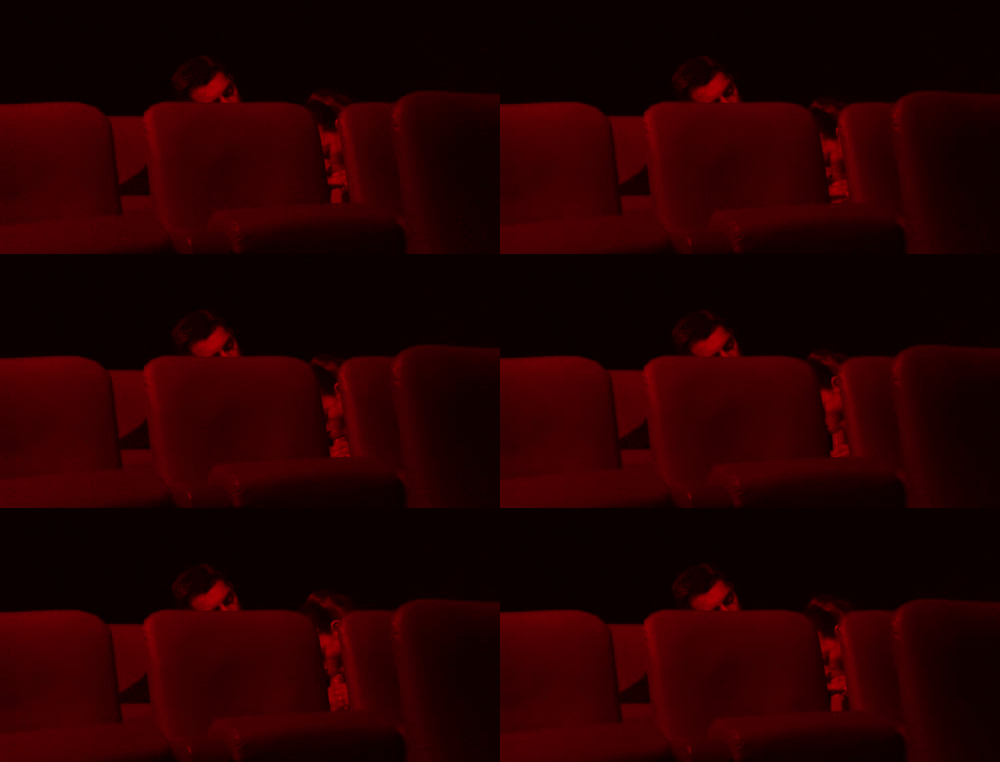
Murielle Scherre – J’fais du porno et j’aime ça (2009)
If you’ve followed this blog for any time, you’ll have likely figured out that one of my primary fixations is how the alleged dichotomy between porn and art is total horse shit.
And I’m not imply that this is art–wherever it’s from, some thought went into making it (both the original scene and the subsequent gif loop).
But it raises an interesting point by implication or does so for me; namely: how depressingly formulaic depictions of sexuality tend to be in the cinema.
Its a nuanced, multi-valent consideration what with the dearth of any substantive male nudity to speak of. (Not looking at you, Tom Hardy. Keep up the excellent work, sir.)
But while we are getting more hanging dong, it’s mostly flaccid, incidental dick. Whereas you can bet that if a woman is naked in a film that she’s either just had sex with a man or is about to have sex with a man. It’s wearying.
And then there’s the chaste way that sex scenes are shot: the viewer is offered a view of the action including a full view of the woman with enough suggestive footage to make sure it’s clear what’s happening and then cut to post-coitus.
I guess that’s why I’ve always appreciate Lars von Trier. The way he shoots sex scenes is always slightly salacious but at the same time at least honest about human curiosity.
Ultimately, that’s what I like about this loop. It’s not subtle. You see a hard cock being fellated but the way it’s put together gives it a context, i.e. a couple in a movie theater.
I, for one, would love to start seeing sex scenes like this in R-rated films. Because yes, we do absolutely need to start creating a place for non-sexualized female nudity; but at the same time we need to balance out the historical tendency of editing out phalluses.

Dmitry Kuklin – Girl on the bridge (2010)
I like the fact that when Kuklin photographs nudes, he mixes up it–featuring both men and women.
On top of nudes, he works with landscapes and more traditional portraits.
His work is all mostly middling–except for this, which is so effing exquisite it manages to transcend its many flaws.
Coming from me that’s saying a lot as I am normally prone to throwing up a little in my mouth when middling image makers embrace alternative process–in this case: cyanotype–in an effort to attribute some sense of distinction to otherwise mediocre work.
In Kuklin’s case the cyanotype gambit pays off–not due to luck so much as a result of working squarely within the confines and expectations established by art historical tradition, i.e. he’s intimately familiar with the history of portraiture and landscape as themes for visual depiction.
To me: it’s obvious that he lack formal training. The above, for example: if you squint and tune out everything that makes it so compelling you’ll not that the way you can’t see her right arm is super awkward and distracting, the way she’s sitting perpendicular to the bridge is also not entirely compositionally effective given the disbursed negative space. (In addition: you can argue that her right leg is distracting, too–but I thought it was trailing off the bridge into dark water at first. Clearly that’s the effect Kuklin’s going for but there’s no way the water would be higher than the bridge given her position.)
However, the expression and the over-exposure of her left shoulder separates her from the background, this is counter-intuitive given the other lighting cues but actually serves to balance the highlights in the foreground–her skin and underwear, the shoes in the mid-ground and the rhizomatic grasses and their mid-tones in the background.
It’s also charming that she has and seems completely oblivious too the hole in the crotch of her knickers.



Source unknown – Title unknown (201X)
From a technical standpoint, these images are rull bad–over exposed (most likely due to a low-end digital device with limited dynamic range), the framing seems pretty much random/offers limited context regarding setting (most likely due to limitations presented by the layout of the room) and there’s no evidence of any kind of blocking/staging.
Now, that third bit ends up working–to a certain extent–in favor of the images. The more or less cluttered composition and technical limitations draw attention to gesture and expression. For example: I absolutely adore the way the young woman on the right is watching her friend attentively while her friend seems pretty much focused on her own personal interior experience. (It’s charming the way the young woman on the right is pretty much always trying to touch her friend’s skin–even if it is only a small part of her leg. Also, note how both their legs drift open as the sequence progresses.)
There’s something else I noticed that I think warrants comments. It’s difficult to see but I thought for the longest time that the images we posted out of order. I mean: in the first frame it looks like the young woman on the right has already discarded her underwear, whereas it’s definitely still on in the second image. I spent about five minutes looking back and forth to realize that she’s pushing the vibrator down the front of her undies in the first image. I really like the way that the young woman on the left is less apprehensive about being more undressed but seems more shy about masturbating in front of someone else, whereas the young woman on the right seems perfectly comfortable with masturbating but less so with being nude.
I feel as if this is one of those images that while decidedly not art in it’s present instantiation has a great deal of potential to be–with better craft and execution–Art. The subject is resonate, the interpersonal dynamics incisively rendered and whether intentional or not the staging of the sexual action away from the camera at worst sublimates the typical issues of the art historical male gaze; or, as I would argue: frustrates them.
And I will offer one piece of unqualified praise: even with the intense overexposure the attention to color is astute–the pillows contrasted with the sheets. The matching pink of the pink top and the other woman’s pink knickers vs. the orange top and purple knickers.


Lúa Ocaña – Untitled selections from Don’t break series (2011)
One of Nietzsche’s most oft quoted aphorisms comes from Beyond Good and Evil:
Wer mit Ungeheuern kämpft, mag zusehn, dass er nicht dabei zum
Ungeheuer wird. Und wenn du lange in einen Abgrund blickst, blickt der
Abgrund auch in dich hinein. [He who fights with monsters should look to it that he himself does
not become a monster. And when you gaze long into an abyss the abyss
also gazes into you.]
It’s the second bit about gazing into the abyss which seems to me to be applicable to Ocaña’s photos.
This was the first image of hers I stumbled upon.
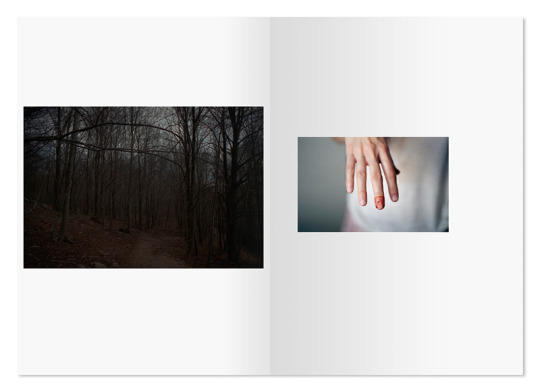
The photo on the left reminds me of the stuff Sally Mann was doing between Deep South and Proud Flesh–too dark to determine whether its twilight pastoral or turgid nightmare.
Yet paired with the second photo of a bloody finger–which might have been taken by any number of internet famous photographers–any sense of sinister menace resolves into something closer to the slow ache of an unrequited longing; as if the beauty as well as desperation of existing in a desolate space transform one into something that mirrors similar beauty entwined with desperation.
Ocaña is doing revelatory work in exploring the interplay of images. (I especially admire the way she’s employing text, mixing B&W and color–something I’ve struggled with how to pull off in my own work–and so openly demonstrating her process.
But here we should return to the images with which this post opens from the series Don’t break.
My Spanish is godawful but here’s what I’ve got as far as an ultra literal translation of the artist statement:
This project is about delicate-ness; where absence, the unattainable and loneliness form the central conceptions. Nudity is de-emphasized and employed as a means of establishing an intimate, relateable frame for the work.
Each photo/diptch presents an anonymous protagonist. The relationship between photos morphs across the series and establishes a larger context given the work taken as a whole.
Assuming I got even a fraction of that right, I would deem the work highly successful.
However, heading back now in the direction of the quote with which I opened this post: I read this article recently in the NYTimes about a newly discovered ‘music center’ in the brain. I was fascinated and appalled in equal measure.
See: I’m a disciple of Wittgenstein. And one of the most salient facets of Wittgenstein’s work is the notion that contrary to the accepted Cartesian model, meaning does not derive from internal mental processes. As W. puts it: if every time I understand how to solve a problem I experience a white flash as if a light bulb is suddenly illuminated above my own head, the white flash is not ‘understanding’. I am justified in saying I understand only when I am able to correctly solve the problem.
Thus, if we say that music activates a certain area of the brain that language and aleatoric sound do not–how much further is it to test if something is music or not by strapping someone into an MRI and playing them a sample and then judging by how they react deeming music or not?
One of the great sadnesses of my life is that I possess no talent for playing music–although I am more sensitive to music than any other form of art. (I’ve gotten higher off songs than I’ve ever managed with any illicit substance.) To me there’s something musical about walking through a snowy forest with no one around for miles and you can actually hear real silence for once or the way the calack-calack of trains always ends with a half-measure rest instead of the expected completion of the rhythmic expectation. Hell, right now I’m listening to Tim Hecker…
Is what Ocaña does photography or collage. I’d argue it’s both. And to me that both is incredibly important.
Imagine I’m standing listening to you tell a story. You’re back is to the ocean and I’m facing you. We’re standing on a hill and the sun falling toward the ocean. And then something between your story and the orange-mauve color of the sky sets my brain on fire. I point and you turn and look. Either you’ll see it or you won’t. By the time I find the words to indicate that to which I am pointing, it’s spell on me will have ended. But by pointing there is a chance that you might catch the tail end of the same spell. That I might share it with you. That you might know too.
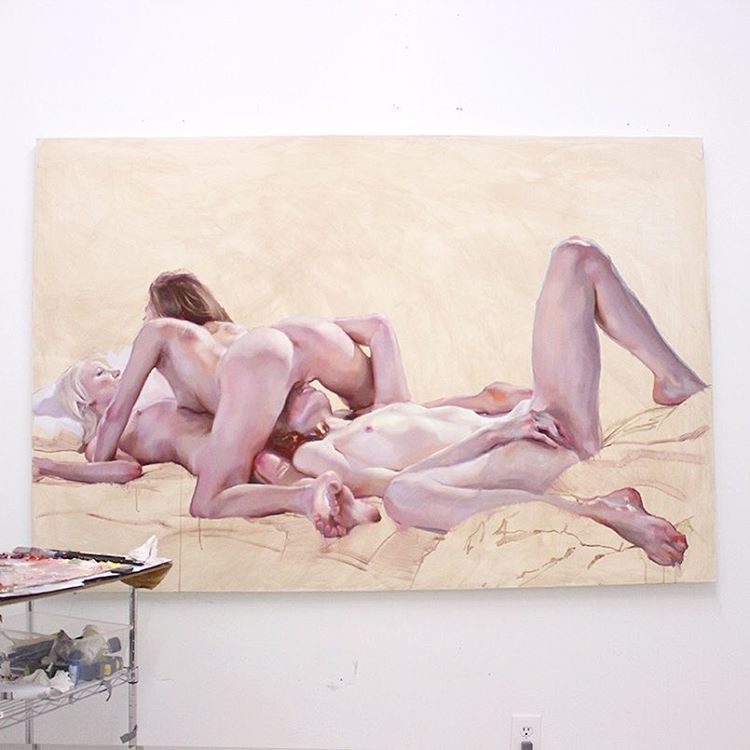
Ivan Alifan – The three graces (2016)
This does several things very well.
Although much of oil painting art historically centers on mythology (Greek and Roman or Xtian), most renowned oil painters were decidedly secular humanist in nature.
The tropes of mythology and religion were widely legible, there was built in interest (due to the universality of public familiarity) and generally if someone had money to hire an up and coming painter, depending upon their particular bent–mythology or religion could be counted on as a source of inspiration.
There was also certain visual coding associated with either. Whether it was the saints or a bible story or an incident from the Illiad, there were interesting technical considerations about staging, technique, etc.
But there was also the way many artist filtered the making of their work through their sexuality. I’m thinking here mainly of Leonardo and Michelangelo, but I’m pretty sure you can follow the trajectory of painting while illuminating this tendency.
What I find clever about this is the way that it–instead of making the myth/religion its pretext, it places its interest in the sexual front and center.
However, in doing this, it’s accomplishing a clever sleight of hand. Because if you know, The Graces were Aglaea (Beauty), Euthymia (Grace) & Thalia (Good Cheer/Festivity).
The first bit about this is to note that all three were Zeus’ daughters and therefore this isn’t just a lesbian menage a trois–it’s incestuous to boot–something you aren’t going to know unless you understand the mythological context.
It’s interesting to play attribute the correct name to the correct figure. My best guess is right-to-left: Aglaea (beauty is inherently untouchable), Euthymia is straddling Aglaea having her clitoris sucked on by Thalia–grace being a singular experience and good cheer requiring both being merry and making merry.
But what I think I like the most is that this is staged to titillate the voyeuristic viewer, but the angle is such as to thwart any sort of expectation that this scene was staged specifically for the so-called male gaze.


[↑] Heinz Hajek-Halke – Washing (1928); [↓] Willy Ronis – Le Nu Provençal (1949)
Juxtaposition as commentary

 Acetylene Eyes