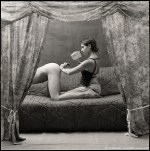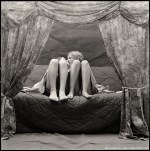
Torbjørn RødlandKneefix (2010-2014)

Jens Hoffman on Torbjørn Rødland:

Tales of weirdos, bizarros and people just like us. The photographs of Torbjørn Rødland  are  strange  and  ugly,  they  are  repulsive,  perhaps  perverted  and  disgusting, somewhat  unpleasant  and  yet  they  are  also  familiar,  pretty  and  attractive,  simple and ordinary, maybe even erotic yet straightforwardly normal. We are caught in a rare mix of reactions, warm and intriguing, cold and captivating, giving us shivers and  comfort  at  the  same  time.  Everyday  items  and  situations  at  their  most  surreal and grotesque, beauties and beasts, terror and tranquility. Uncanny, eerie and per-verted transformations. The gloss of a contemporary fashion magazine and the horrors of Hieronymus Bosch next to one another, hand in hand, face to face. Northern Gothic lens sketches.An  octopus  wrapped  around  a  person’s  hand.  Facial  mask  made  of  plastic  over  a woman’s face. Red haired boy with marker strips on his shoulder and a broken arm. In a forest with hands wearing sneakers. Pair of legs bound together with string. Another body, sideways, gymnastics with the head against the wall, bleeding. High heel, leg and paint. Elbow pads on the floor. Syrup and napkins on the ground. Long dark hair, red and black ribbons, a beautiful girl and a pool. Black paper, white fabric and a bug.Is this here to grab out attention, fascinate and shock us on the level of the eye or are we looking at a fantastic world of true bizarreness hidden underneath our gardens, streets and houses and inside the depths of our souls and bodies? Is this what we will become or where we came from? Caricatures of ourselves or the real us? 

wonderlust photoworksEcho from Address the Void series (2009)

To my Darkness and my Light,

I
unfold myself; you, in turn, call to me with your warm and aching
mouth— its tongue, a delicate command I will not long withstand.

Your lips spill sighs; I drink until your thirst is sated.

Trembling
hands steady me beneath you.  You guide me toward your deepest
acceptance.  I find a center in you; you grasp me and gasp.

(You
shudder— hands bracing the afternoon light dying against such white
walls.  I see your ineffable Beauty with the eye of god.  I fall and
place this feeble kiss to caress the spine as I pass.)

With you I experience annihilations most will never know.

After
I am restless; you know what I want is what I will never achieve
alone— you coax from my every ending its next beginning.

We must map these new and nameless oblivions together.

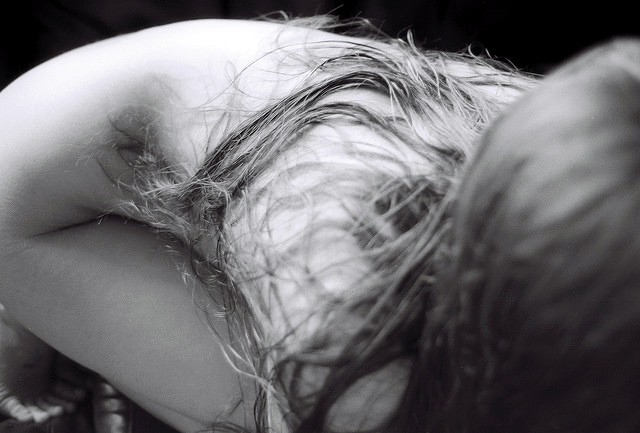
Pola Esther – Untitled Diptych from Mutual Attraction series (2012)

I saved this to my drafts a few weeks back with the intention of pulling together a short piece comparing it with the Sheer Delight editorial Robbie Fimmano shot for Interview Magazine back in March–specifically the variation circulating with the effing brilliant addition of a corresponding color palates.

Only at the moment I’m following a different thread–so I’m calling an audible and running a different direction with this.

For the last month or so, I’ve been working on a piece of fiction. I’m still unsure what form it’s going to wind up taking on but for now, let’s say it’s novel-esque.

The impetus for writing it emerged from two things:

  1. I am extremely alarmed by the increasing prevalence of the notion among many (but especially Evangelical Xtians) that despite being a decisive majority, American freedoms are under attack–you know the type of people who think unironically that being correctly labeled a bigot is somehow more damaging that you know centuries of institutional prejudice;
  2. While I try to live my life in a fashion which minimizes (if not eliminates) regret, there are times when I wonder to myself how my life might be different if I could go back and pass on a little wisdom to my younger self.

The tricky part with that second thing is I usually think I’d want to go back to myself at 19; Yet, lately I’ve realized that I was already too beaten down and cynical then. In reality, I’d probably need to go back 6 years further.

As far as the first thing goes: one of the reasons such bullshit persecution complexes rile me so easily comes as a result of having–much to my then and continued chagrin–attended a parochial high school.

Any attempt to bridge the gap between your adult self and the thirteen year-old precursor is a bizarre experience. What’s a little unnerving to me  is how much this character resembles a girl I actually knew in high school.

Her name was Beckie and she was the closest my school had to the central casting I-don’t-care-what-anyone-says-punk-rock-is-alive-and-kicking teen angst soap opera trope.

She was generally exuberant. Socially awkward but in a charming way that constantly pointed to an individual who was both extravagantly kind and shamelessly wore her heart on her sleeve.

While she wasn’t physically bullied, she was heinously body shamed. Like looking back on it now, it upsets me. She was extremely tall. If memory serves she was the tallest person in her class from 7th to 9th grade.

At my school, you had to walk between classes in a single file line. Thus frequently, you’d end up waiting in the hallway while other people emptied out of a classroom. I remember a boy walking up to Beckie, grabbing the squared neckline of her dress, pulling it out and looking down the front of her shirt and telling her that she should think about putting some band-aids on those mosquito bites. Carpenter’s dream and Pirate’s dream jokes chorused after her wherever she went. (I don’t think she actually owned a bra until 11th grade and then it was a sports bra for the sake of propriety.)

But still, she was kind to everyone.

As I’ve worked on this story, I’m actually finding that I full-blown regret that I never go to know Beckie better. I see how much we had in common then–but I had my head up my ass then. Was focused on the wrong things; things that ended up inflicting woulds that would take years to heal, if they ever did.

I see how much we have in common now: she’s a studio photographer and as much as I’m not fond of studio photography, she’s got some tight chops.

It occurs to me that even though there has always been a part of me not-so-secretly twitterpated by her, I think she’d maybe have been a better person to know than any of the people I associated with then–all of whom are decades gone at this point.

And as I’m banging my head against a wall trying to find someone to collaborate with on a photography project in Iceland this September, I realize that as strange and probably slightly creepy as it seems, the people I’ve been approaching and have largely ignored me–all have something in their work or personality that reminds me of Beckie.

That’s why I’m mentioning this here. I feel like you can look at just about any single image Esther makes and be hypnotized by it. But her diptychs have a way of returning your eye to the image with more attention and greater insight.

Or maybe I’m talking out of my ass…

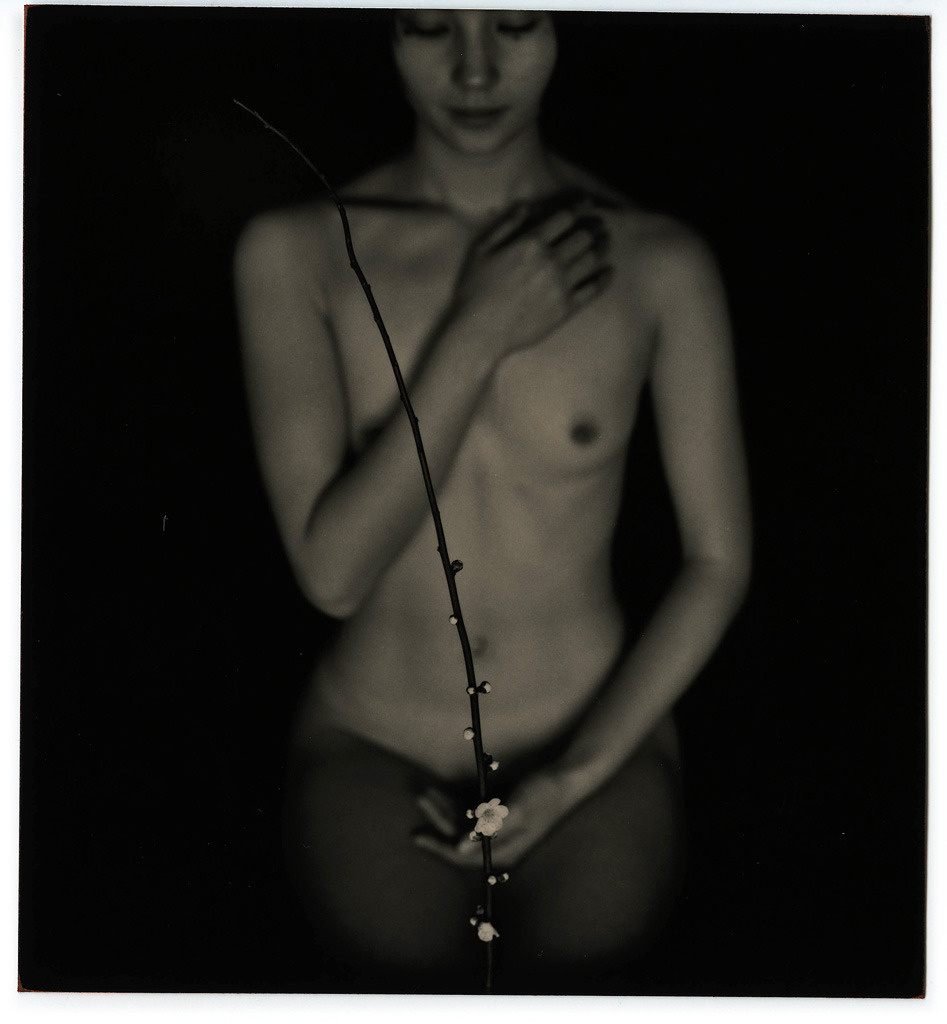
Masao YamamotoTitle Unknown (19XX)

When I learned about the haiku form in like 7th grade or some shit, what I took from the lesson was the whole 5-7-5 syllable patterning and that they all seemed to be meditative on nature.

For probably a good decade, my approach to the form was on par with South Park.

But what gets glossed over is the connection between the first 12 and the disjunction/rupture inherent in the final 5 syllables.

In effect, the above image is a photographic approximation of a haiku. There are two distinct planes in the frame–differentiated by depth of field; the blossoming cherry branch in the foreground, the young woman in the mid-ground.

This was almost certainly shot with a telephoto lens–which has the effect of magnifying the subject. However, telephoto lenses also compressed the distance between objects. Thus although there may be twenty feet between the subject and a wall, it appears as if the subject is relatively close to the wall. (The famous cinematographic example of this is that famous scene in the Coen Brothers’ Raising Arizona with the baby in the car seat in the middle of the road with a station wagon barreling down on it.)

Given that the background in this print is so pitch dark that it seems like an Edward Weston wet dream and that the blossoming branch in the foreground is so dark–only remaining visible due to the body separating it from the background, what originally appeared as discrete planes, interpenetrate.

Bonus factoid: Apparently, Yamamoto isfond of employing tea to stain his prints.

Pixoom PhotographieTitle Unknown (2015)

If you’ve followed this blog for any time, you are most likely painfully aware of my aversion to portrait orientation in lens based image making.

I refer to it–with profound contempt–as #skinnyframebullshit.

It’s a term I use a lot and I’m always linking to the same article I wrote more than two years ago. So–with the notion in mind that someone seeking to determine counterfeit from legitimate currency always studies the real item instead of the fake–it occurred to me that being as this image is not only stunningly gorgeous but also in no way shape or form #skinnyframebullshit, that it might be time for me to create a positive reference instead of a negative one.

It’s maybe not the best place to start but one of the things that doesn’t directly relate to my hatred for portrait orientation but does inform it is the increasing ubiquity of digital imaging technology. (Again, if you’ve followed me for any time you’ll know that I am obsessively anal about differentiating between digital and analog processes. Yes, they are built off the same chassis but their respective functions are vastly different in practice.)

By now, you all are familiar with shitty Youtube videos wherein due to the shape of and interface of our smart phones you get a preponderance of video with vertical frames. It’s ugly, sloppy and I would maintain a poor reflection of the author’s basic intelligence.

I’ve been pretty active in Internet photo communities since 2006. Back then, folks making work were basing it off the history of lens based image making up to that point. Yeah, you had vertical oriented images but whether or not there was a reason for them to be vertical (i.e. an internally consistent compositional logic) they were the distinct minority.

Of that minority, a plurality featured this sort of self-conscious flipping the physical camera body on its side makes me look more like a photographer. When you do it, you feel a little rebellious.

Now, if you’re a person shooting on film, then you drop what you shot at your lab (or better yet, process yourself); and then you pop your slides or negs down on a light table and have a look-see. The thing you note immediately is that your vertically oriented frames break the flow of your reading your slides. You end up having to flip the filmstrip, contact sheets or whatever. Invariably, this causes you to favor either the landscape or portrait images due to the fact that it’s easier to read images that are in line with however you have the page currently oriented.

I learned quickly that there really needs to be a compelling reason for a shot to be vertically oriented. And with my reluctance to deal with vertical oriented shots, I realized that almost categorically, image makers opt for vertical orientation as a compositional shortcut. Like: oh, hey…what I want to shoot won’t fit this way, I’ll just flip the camera and that’ll fix it. Makes sense. Except one small thing and I’ll state it as a truism–you will always get a better shot by moving your body in relationship to the object or by using a different focal length lens. It’s just a fact.

And if you apply that to the history of photography, it’s interesting to note that most images with vertical orientation are–wouldn’t you know it–within the architectural genre. Why might that be? Well, in relationship to an edifice there are few options with regard to moving in order to achieve the framing you want.

Thus, I maintain rather rigidly that in general, if you aren’t shooting architecture, you can go ahead and shoot that vertical but then maybe move around and shoot the same thing landscape from different positions. I’m confident that all things being equal, you’re going to find you prefer the landscape frames.

One of the first things a beginning photography student hears about is the sacred rule of thirds. As a rule of thumb, it serves–and ensures photography instructors cut down substantially on the godawful wawker-jawed, indecipherable images. But like any rule, it’s nothing more than a general guideline that you really have to understand before you’re allowed to start ignoring it as you please.

Yes, the rule of thirds is an abstraction of the Golden Ratio. And with the tendency to frame the subject at one vertical third line and then leave a great deal of negative space to the left or the right, it does produce appealing images. (Note: how images that are perfectly balanced within the framework of the rule of thirds tend to have the effect of leaving you confused about what you’re supposed to be looking at.)

My theory is that with vertical compositions, the rule of thirds is less useful as a guideline; the expectation of the eye is something more in-line with the golden ratio.

There is only one horizontal line in the above image–dividing the frame top-to-bottom roughly 60/40. Katjuschenka is ever so slightly off-center (consider the mid-line of her face)–balanced expertly by her right knee opening what would’ve otherwise been a repetition of the angle of her arms.

There’s essentially only two colors in the frame–red (hair, skin tone) and blue. Everything falls in line with those tonal hues. Focus is sharpest on her eyes. (And as a dizzying bonus, check out the texture in her stockings. Dayum.)

A creepier photographer would’ve focused on the nipple or at least increased the depth of field so that it would remain in focus. But the decision to do that makes this image about the color and framing. The eye contact is neither coy nor pouting. It’s not flirtatious but it does convey a sense of knowing a great deal that the viewer does not.

This image is breathtakingly exquisite. If you’ve got to go vertical, this is the baseline. Either make it clear that the composition was the only thing that would’ve communicated the magic of that moment or go home with your weak ass #skinnyframebullshit.

Victor Ivanovski – [↖] A Tail; [↗] Defloration-I ¼; [+] School 1/3; [↙] Treatment of Constipation; [↘] Young Lovers from Boudoir Stories series (2001)

I have mixed feelings about Ivanovski’s work. Yes, it’s rarefied quality is immune to argument. And for as much as it’s perfunctory inclusions of non-heteronormative experience come across as tokenism, there is still something absolutely vital to the moments I’ve selected above.

A long braid as tail, but instead of positioned to play obviously towards the camera, the pose is angled just enough to create questions as to whether or not the viewer is the intended voyeur.

The potential momentum of the mallet’s arc and the angle of the spike and the cast of her eye triangulate the focus but also draw attention to the fact that there is some resignation to her resolve to follow through–her eyes are focused not at the point of impact but just above the blunt head.

As much as I consider cunnilingus perhaps the greatest of all possible sex acts, what appeals to me so viscerally in this is the way she’s holding her dress both so that her friends can watch but also so that she can see everything too.

The cartoonishness of the second instance of mallet and spike would have easily ruined a lesser image. The fact that her expression is really almost goofy along with the way she’s holding the spike in a manner both intended not to cause accidental pain but that could also be utilitarian. Also, that she’s wearing a watch and her fingers wrapped around the mallet handle show off her nail polish are just happy accidents for me.

Boudoir stories features several suggestions of lesbianism. And I find all of them off putting. The last image here is the only exception. And it’s actually my favorite of the bunch because without any explicit flourishes it perfectly demonstrates that clumsy–to mix pop music metaphors–constant craving for more fumbling toward ecstasy that so aptly characterizes the experience of new mutual desire.

Chris Little – Title Unknown (20XX)

Initially, this image caused my brain to crackle a lil’.

See one of my photographic preoccupations is conveying an entire (or at least the implication of an entire) narrative in a single static frame.

This image is not narrative. The framing is odd and it doesn’t work all that well but the subject is striking enough to round up to interesting.

But: it does provide an unintended cue with regard to the question of the distinction between narrative photography and cinematography.

Namely, images with a narrative slant tend to feature many of the same key aspects of that characteristic bedrock of cinematography: mise-en-scène.

Now, in still images (especially portraits) there is a tendency to place the subject in an environment and then effectively highly and underline the portrait-ness of the image by abstracting the environment. This process is called bokeh; and people will spend thousands of dollars on ultra fast 85mm lenses to maximize their bokeh aesthetic.

Narrative images, on the other hand, tend to go the Greg Toland deep focus/Group f/64 route–presenting an expansive depth of field so that the characters are contextual grounded in their environment.

And I’m not saying that there isn’t a cinematic cross-pollination which borrows from still bokeh and huge depth of field. Yet, what there isn’t really in still images, is the sort of David Fincher-esque shallow depth of field and bokeh wherein, something is blurry and abstract in the foreground, the subject in the mid ground is in sharp focus and the background falls off again towards abstraction. (This isn’t exactly the best example for someone new to the concept but for those who have their footing, it’s hard not to stare at this and not want to furious jill off to the effortless control this shot evinces.)

The thing I wasn’t expecting was to find next to nothing on the photographer. He doesn’t seem to have a web presence anymore. I was able to dig up a version of his old personal website cached on Ye Olde Wayback Machine.  It’s heady stuff–like Noah Kalina, Ryan McGinley and Petra Collins got mad hopped up on methamphetamine at the Hopscotch Festival and passed a 35mm disposable camera back and forth between them.

Being whole

therealkatiewest:

I am not just one thing. I cannot simply be a wife. Or a teacher. Or a photographer. Or a student. I am all of these things and when people expect me to only be one of those things, they are expecting me to stop being a whole person.

Remember when you were in middle school and you thought your teachers lived at the school and whenever you saw them anywhere that was decidedly not at school, you were shocked and kind of couldn’t fathom that your teachers were actually whole people? Who did stuff? That wasn’t teaching? What a disservice we did our teachers. Or how about remember when we were extremely rude to the McDonald’s cashier because they were the McDonald’s cashier and there were pickles on our burger when we specifically asked for no pickles and we forgot that that McDonald’s cashier was also a son, and a writer, and a student, and a boyfriend, and a hero to his younger sister?

It seems like such a simple thing to not expect people to only be one thing. And it’s strange because people simultaneously tell us to have varied interests and facets of ourselves while expecting us to be just one thing. If we are just a teacher, then we are easier to ignore. If we are just a McDonald’s cashier, then we are easier to treat badly. If we are just a woman, then we are easier to pass over. For example.

If your students see you working at The Keg, laugh because lord knows (and now they do too) that you can’t afford your mortgage on a teacher’s salary. If that jerk is rude to you because pickles were mistakenly placed on her burger, laugh because you know your sister made you a cape last weekend and it’s likely no one ever made this jerk a cape. If your boss is surprised that you are a painter, or your grandma thinks you shouldn’t vacation without your wife, or your teammates scoff when you tell them you write comics, or your boyfriend doesn’t like that you model for erotic photographers, laugh because you know you can’t be only one thing and it is RIDICULOUS for anyone to ever believe that you could be.

Sure, life might be easier if we hid most parts of ourselves to give the impression that we were only one thing, but fuck that. I would much rather be a whole person and have a life with potentially more difficulties, than pretend I am only one thing so I can be miserable in a slightly easier life. And hopefully the more people who see that we are whole people–that it is totally possible for us to be both musicians and bankers, artists and baseball players, sound engineers and baristas, tattoo artists and secretaries, data analysts and sci-fi writers, teachers and naked on the internet, photographers and taxi drivers, parole officers and inventors, vet technicians and fetish models–the more people who realize this possibility because more people are refusing to be simply one thing, the goddamn better.

Don’t ever let someone make you feel like you can only be one thing. Fuck that. Be everything.

Arvida ByströmSelf-Portrait (2013)

During the final year of my stint as an undergraduate, I had this Iranian ex-pat professor.

The man was batshit fucking crazy; also, the best teacher I’ve ever had.

I did a photo essay for him on the concepts of reflections, shadows and infinity. It was the first serious photo work I’d ever completed and when he gave the prints back to me after reviewing them he said that he had only one question left for me: if you had the choice between having someone who would fund the film you’ve always wanted to make with money that was unimpeachable with regard to the ethics of it’s origin given the caveat that it was the only film you would ever be able to make; or, you could never make your movie but instead the life you lived would be your singular means of making art–which would you choose?

I started to answer but he advised me that I should take time to consider the question. I informed him that I didn’t need the time because the answer was simple. I would pick the latter option over the former.

I think it’s the only misstep I ever made with him. Given how many hallmarks of Iranian culture, were only ever allowed one at bat, hindsight suggests, he was looking for me to embrace the once in a lifetime opportunity. However, I still stand by my answer.

And although I know it’s dangerous to project my own notions onto someone else’s work but there is such a razor thin line separating Byström‘s work from her carefully curated presentation of self, that I sort of feel like somewhere along the line, someone asked her a similar question and she chose the journey and not the destination.

Honestly, I find her work a bit cloying and redundant. But the things about it that make me affiliate those two words all have to do with quality and integrity of the conceptual underpinnings.

Also–and it’s a rare experience for me–but everything about her work and the way she presents herself, makes me feel all sheepish and twitterpated.

I know it borders on a gratuitous misreading of her work (and is hell of problematic appearing with this image) but I’ve been wanting to post this for a bit and I’ve been at a loss about what to say about it. But what I want to say is definitely tied up in both my fascination with her meticulous social media presentation and well, I think she’s one of the most beautiful people I’ve ever seen in my life.

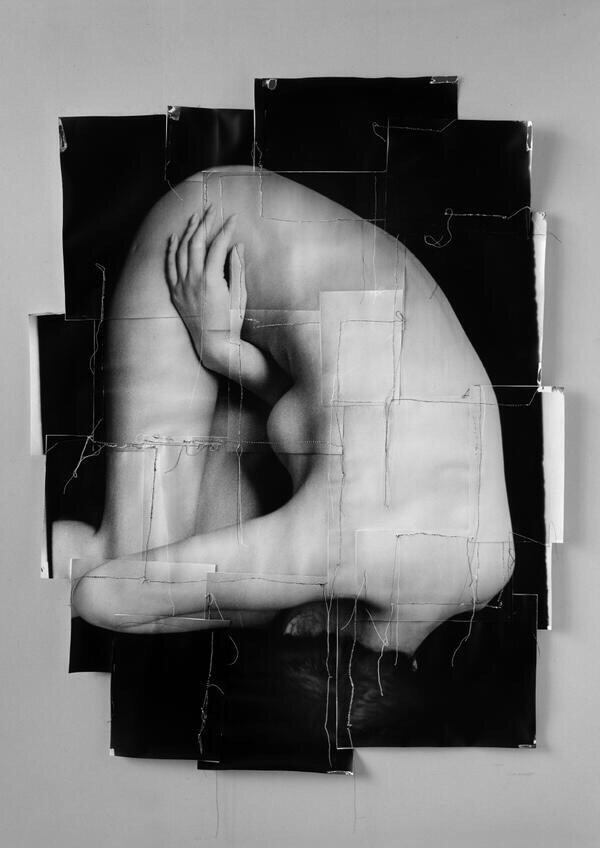
Koo BohnchangIn The Beginning #41 (1995)

It occurs to me that maybe what separates an aesthetically pleasing image from Art has something to do with connectivity–how carefully it is stitched together and to the world surrounding it.

For example, Bohnchang’s body of work entitled Soap, is clearly an exercise in typology. It’s antecedent being the preeminent practitioners of photographic typology Bernd and Hilda Becher. Followed by Ed Ruscha’s Every Building on the Sunset Strip and Chuck Close’s portraits and Sugimoto’s luminous Seascapes.

The thing is: once you start considering typology as a motivation for image making it’s difficult to know where to cease application. In effect, I can’t think of a single so-called fine art photographer whose work in terms of genre, subject or process can’t be interpreted as a inherently typological. (Francesca Woodman would perhaps provide the exception that proved the rule.)

There is something obsessive about typology. So what separates a genuine work of art from something compulsively collected–and I acknowledge the distinction between making the thing you collect and simply acquiring an object.

Bohnchang, in his own words, describes his motivation to make images as being driven “not [by] flinging a camera over my shoulder and heading off to some
unexplored place. For me the thing of real value is looking for what is
inside of me.

I could take the easy way out here and attribute this sentiment to a sort of process as an act of mindfulness. And while I think it is, at least in part, exactly that, there’s also something of an underlying awareness of the connection between that mindful exercise, the form taken by that exercise and the historical interpenetration.

The Becher’s work is genius not because of obsessivenes, it’s brilliant because it finds dignity and beauty in the ugly and ordinary; Ruscha’s efforts and not extraordinary because of their comprehensiveness, they are vital because they expandied the way that photography can present the world as continuous within the scope of singe, static frames; Sugimoto’s ocean as landscape are straight up hypnotic as fuck.

Though I don’t love all Bohnchang’s work, it’s definitely Art. And the reason it is comes as a result of the way his work always contorts in on itself to draw attention to the process that brought it about.

I feel that Matthew Weiner‘s–despite how horribly enormously problematic I find him is as a creator–oft trotted quote fits here:

Artists frequently hide the steps that lead to their masterpieces. They
want their work and their career to be shrouded in the mystery that it
all came out at once. It’s called hiding the brushstrokes, and those who
do it are doing a disservice to people who admire their work and seek
to emulate them. If you don’t get to see the notes, the rewrites, and
the steps, it’s easy to look at a finished product and be under the
illusion that it just came pouring out of someone’s head like that.
People who are young, or still struggling, can get easily discouraged,
because they can’t do it like they thought it was done. An artwork is a
finished product, and it should be, but I always swore to myself that I
would not hide my brushstrokes.

The difference between Weiner and Bonchang is that the former’s brushstrokes point self-consciously to the creator whereas, the latter’s seams point to the historical context, the process of creation and the work itself.