
Bruno De Palma – “Prayer” Revisited {A Freestyle Tribute to Man Ray} (2006)
Divine am I inside and out, and I make holy
whatever I touch or am touched from;
–Walt Whitman, Song of Myself
Bruno De Palma – “Prayer” Revisited {A Freestyle Tribute to Man Ray} (2006)
Divine am I inside and out, and I make holy
whatever I touch or am touched from;
–Walt Whitman, Song of Myself

Source unknown – Title unknown (201X)
Originally, I had some profound notion I wanted to share re: this but whatever connection I made has gotten scrambled by the worst sinus infection I’ve had in probably a decade. (I’m miserable–feel free to send coconut seltzer, bulk cannabis or one of those fancy original hitachi wands.)
The only thing I can think to say about this now that this post is a Damocles sword swaying over my head: I like the way her vulva/labia are the exact same color as his foreskin. There’s some extra magenta in that same area but mostly the rest of her skin is more orange and yellow while his skin is more orange and red.
Also, something I’ve noticed from the overlap between still photography and cinematography is that the way things are arranged in an image suggests something about a relationship with time. If a character walks from left to right across a frame, this usually relates to a passage of time from the present into the future. (With some exceptions in Japanese film–and they are less exceptions than complications) The tendency is movement from right to left in a frame suggests either a movement back in time or a restatement, clarification or some sort of nostalgia.
The balance of suggested motion in this–regardless of what is transpiring (probably a creampie, knowing porn)–is right to left; which contributes a contemplative cast to the image. At least to me–in my current state of nanobots raised by weasels sloshing around in my sinuses.
“It’s worth thinking about the etymology of curating. It comes from the Latin word curare, meaning to take care. In Roman times, it meant to take care of the bath houses. In medieval times, it designated the priest who cared for souls. Later, in the 18th century, it meant looking after collections of art and artifacts.”
— Hans Ulrich Obrist: the art of curation
http://www.theguardian.com/artanddesign/2014/mar/23/hans-ulrich-obrist-art-curator

Özlem Altin – Untitled (Opression) from Glow in the dark installation (2014)
One thing folks who interact with me AFK know about me is that I’m rarely at a loss to explain my impression of something and to explain in excruciating detail why I had such a response.
I suspect this is something by which frequent readers will be less than surprised… however, the truth is while I generally do know whether I dig something or not, I’m not always correct in my initial classifications (for example: last year’s stand out funeral doom release Bell Witch’s Mirror Reaper was something I didn’t like until I suddenly did and then I was total enamored with it) and I’m not always able to offer as definitive of an explanation as to why I like something than I would prefer (that’s one of the reasons I’ve kept up this project–to force myself to do something that isn’t always easy or comfortable).
I like this. A lot. I’m not exactly sure how to explain that reaction though…
The harsh flash is definitely suited to this sort of scene. If you’ve got a good TTL setup that’ll do the flash math for you so you don’t have to think about it working in low/limited/difficult lighting situations in monochrome will generally always look appealing. (There is the fact that the flash is properly metered off of the subjects back instead of the floor–which makes the floor look even more dingy.)
I’m typically not fond of the inclusion of distracting detritus in a the frame either (the boxes in the upper portion of the frame and the chair leg protruding into the upper right corner are a touch distracting).
I think it’s the gloves resting on the subject’s shoulder that are what I keep tripping over. They seem flat–almost like patches or bandages. Then there’s the discoloration: you might think it’s some kind of pattern except that it doesn’t match between the gloves; suggesting the gloves are wet or otherwise soiled.
There’s also the configuration. It could be that there are two right hands pressing into her shoulder–two folks comforting? Or: two folks holding/trying to push her down?
Also: it could be one person–left hand palm up resting knuckles down on the skin while the right hand is palm down. (A configuration which suggests both intimacy and control–which feels to be especially in keeping with the duality of the specific absence of a title and a parenthetical contextual addendum.)
I’m not sure I know how to connect all the dots between this impression and what commentator Lieneke Hulshof has written about Altin’s work:
The installations of Özlem Altin are based on her extensive photographic
archives. She presents her own photographs alongside those of other
artists, her own drawings alongside objects she has found and her own
videos alongside photocopied pages. The collection exposes her
fascination for representations of the human body. ‘In fact I am always
searching for the moment at which a sort of transformation or change
takes place, for instance, when a body no longer represents an
individual, but has become more abstract, almost object-like.’ These are
images of people who cannot be recognised, who are hiding behind
something: an averted gaze, a body that has almost dissolved into its
environment or become one with its shadow. Altin’s work emphasises how
our perspective is never permanent, but always fluid, reproduced by
means of constantly repeated re-interpretations of past events. She
shows how all of us constantly re-interpret our own memories.
But it does feel like the mix of intimacy and oppression is actually very much what this piece is interrogating.









[↑] Source unknown – Title unknown (201X); [↖] Source unknown – Ariel (201X); [^] Source unknown – Title unknown (201X); [↗] Rosario Gallardo – Title Unknown (2012); [←] Source unknown – Addie (201X); [→] MetArt – Sweet Bites feat. Jia Lissa (2017); [-] Source unknown – Ariel (201X); [↙] Source unknown – Title unknown (19XX); [↘] Alessandro Ruiz – Title unknown (2017); [-] Paul Beel – The Amazing Birth of Box Girl (2007); [↓] Atisha Paulson – Gabriela Bloomgarden (2016)
Follow the thread.
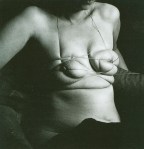

[←] Hans Bellmer – Unica Zürn from Unica Tied Up (1958); [→] Source unknown – Title unknown (2015)
Juxtaposition as commentary

Janine Antoni – Loving Care (1993)
Antoni’s work is interested in not only commenting on what goes into the making of something, she’s also preoccupied with feminine embodiment and commodification of bodies, objects and processes.
Loving Care was performed at the Anthony d’Offay Gallery in London.
On her hands and knees, Antoni dipped her head into a bucket of Loving Care hair dye and used her head/hair to mop the gallery floor.
There’s a number of things at play here–most notably: subversion. The beauty standards of western culture being founded upon notions that as a woman–you as you are naturally is not enough, you need to diminish signs of aging or invite attention through drastic changes to hair color.
Using it against its intent, there’s an emphasis placed on its ability to alter semi-permanently. This is again tied into the stereotypically notion of men as being preoccupied with higher considerations so that it’s women’s jobs to worry about things like ensuring the floors are clean–only in this case, the act of cleaning is transgressed and subverted.
An interesting facet of the conceptualization is–as anyone who has ever mopped a space knows–you work in such a way that you have an exit behind you. Antoni did exactly that but this meant that as she mopped/painted the floor, she pushed the people out of the gallery behind her. By implication: everyone could see the beginning of the labor but that scope dwindled as the work advanced towards completion. (The notion being that we all know the floor gets cleaned but even if we bother to note that it’s clean, we are programmed to not really bother to follow that through to any sort of appreciation for such completion.)
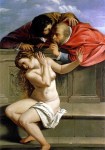


[←] Artemisia Gentileschi – Susanna and the Elders (1610); [+] Kathleen Gilje – Susanna and the Elders {Restored) (1998); [→] Kathleen Gilje – Susanna and the Elders {X-Ray of Restoration} (1998)
There’s another post featuring the restoration and the subsequent x-ray–specifically additions regarding the biographical details surrounding Gentileschi that are making the rounds on art history nerd tumblr. However, the original post is not as clear as it could be so I’ve tried to clarify that here.
Alright, just so we’re all on the same page: the left-most painting above is Gentileschi’s original (circa 1610–bear in mind she produced multiple iterations of this same story throughout her life). The middle painting is Gilje’s painstaking copy of Gentileschi’s painting. The right most image is an x-ray of Gilje’s restoration; wherein Gilje originally painted Susanna caught in a scream of rage holding a knife which was subsequently corrected. Painting something and then painting over it would’ve been a contemporaneous exercise during Gentileschi’s career and x-rays are frequently employed on such work to see what the artist was originally thinking. This restoration and x-ray are an attempt to connect the narrative of the story of Susanna and the Elders to Gentileschi’s lived experience.
Now some context provided eloquently by @rgfellows:
Oooh my gosh this is rad. This is so rad.
For those who don’t know about this painting, the artist was the Baroque artist Artemisia Gentileschi.
Gentileschi
was a female painter in a time when it was very largely unheard of for a
woman to be an artist. She managed to get the opportunity for training
and eventual employment because her father, Orazio, was already a well
established master painter who was very adamant that she get artistic
training. He apparently saw a high degree of skill in some artwork she
did as a hobby in childhood. He was very supportive of her and
encouraged her to resist the “traditional attitude and psychological
submission to brainwashing and the jealousy of her obvious talents.”Gentileschi
became extremely well known in her time for painting female figures
from the Bible and their suffering. For example, the one seen above
depicts the story from the Book of Daniel. Susanna is bathing in her
garden when two elders began to spy on her in the nude. As she finishes
they stop her and tell her that they will tell everyone that they saw
her have an affair with a young man (she’s married so this is an offense
punishable by death) unless she has sex with them. She refuses, they
tell their tale, and she is going to be put to death when the
protagonist of the book (Daniel) stops them.So that painting
above? That was her first major painting. She was SEVENTEEN-YEARS-OLD.
For context, here is a painting of the same story by Alessandro Allori
made just four years earlier in 1606:

Wowwwww.
That does not look like a woman being threatened with a choice between
death or rape. So imagine 17 year old Artemisia trying to approach
painting the scene of a woman being assaulted. And she paints what is
seen in the x-ray above. A woman in horrifying, grotesque anguish with
what appears to be a knife poised in her clenched hand. Damn that shit
is real. Who wants to guess that she was advised by, perhaps her father
or others, to tone it down. Women can’t look that grotesque. Sexual
assault can’t be depicted as that horrifying. And women definitely can’t
be seen as having the potential to fight back. Certainly not in
artwork. Women need to be soft. They need to wilt from their captors but
still look pretty and be a damsel in distress. So she changed it.What’s
interesting to note is that she eventually painted and stuck with some
of her own, less traditional depictions of women. However, that is more
interesting with some context.(Warning for reference to rape, torture, and images of paintings which show violence and blood.)
So,
Gentileschi’s story continues in the very next year, 1611, when her
father hires Agostino Tassi, an artist, to privately tutor her. It was
in this time when Tassi raped her. He then proceeded to promise that he
would marry her. He pointed out that if it got out that she had lost her
virginity to a man she wasn’t going to marry then it would ruin her.
Using this, he emotionally manipulated her into continuing a sexual
relationship with him. However, he then proceeded to marry someone else.
Horrified at this turn of events she went to her father. Orazio was
having none of this shit and took Tassi to court. At that time, rape
wasn’t technically an offense to warrant a trial, but the fact that he
had taken her virginity (and therefore technically “damaged Orazio’s
property”. ugh.) meant that the trial went along. It lasted for 7
months. During this time, to prove the truth of her words, Artemisia was
given invasive gynecological examinations and was even questioned while
being subjected to torture via thumb screws. It was also discovered
during the trial that Tassi was planning to kill his current wife, have
an affair with her sister, and steal a number of Orazio’s paintings.
Tassi was found guilty and was given a prison sentence of…. ONE. YEAR…….
Which he never even served because the verdict was annulled.During
this time and a bit after (1611-1612), Artemisia painted her most
famous work of Judith Slaying Holofernes. This bible story involved
Holofernes, an Assyrian general, leading troops to invade and destroy
Bethulia, the home of Judith. Judith decides to deal with this issue by
coming to him, flirting with him to get his guard down, and then plying
him with food and lots of wine. When he passed out, Judith and her
handmaiden took his sword and cut his head off. Issue averted. The
subject was a very popular one for art at the time. Here is a version of
the scene painted in 1598-99 by Carivaggio, whom was a great stylistic
influence on Artemisia:
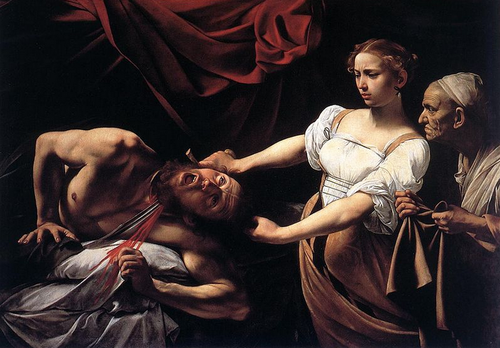
This
depiction is a pretty good example of how this scene was typically
depicted. Artists usually went out of their way to show Judith
committing the act (or having committed it) while trying to detach her
from the actual violence of it. In this way, they could avoid her losing
the morality of her character and also avoid showing a woman committing
such aggression. So here we see a young, rather delicate looking Judith
in a pure white dress. She is daintily holding down this massive man
and looks rather disgusted and upset at having to do this. Now, here is
Artemisia’s:

Damn.
Thats a whole different scene. Here Holofernes looks less like he’s
simply surprised by the goings ons and more like a man choking on his
own blood and struggling fruitlessly against his captors. The blood here
is less of a bright red than in Carrivaggio’s but is somehow more
sickening. It feels more real, and gushes in a much less stylized way
than Carrivaggio’s. Not to mention, Judith here is far from removed from
the violence. She is putting her physical weight into this act. Her
hands (much stronger looking than most depictions of women’s hands in
early artwork) are working hard. Her face, as well, is completely
different. She doesn’t look upset, necessarily, but more determined.It’s
also worth note that the handmaiden is now involved in the action. It’s
worth note because, during her rape trial, Artemisia stated that she
had cried for help during the initial rape. Specifically she had called
for Tassi’s female tenant in the building, Tuzia. Tuzia not only ignored
her cries for help, but she also denied the whole happening. Tuzia had
been a friend of Artemisia’s and in fact was one of her only female
friends. Artemisia felt extremely betrayed, but rather than turning her
against her own gender, this event instilled in her the deep importance
of female relationships and solidarity among women. This can be seen in
some of her artwork, and I believe in the one above, as well, with the
inclusion of the handmaiden in the act.So, I just added a million
words worth of information dump on a post when no one asked me, but
there we go. I could talk for ages about Artemisia as a person and her
depictions of women (even beyond what I wrote above. Don’t get me
started on her depictions of female nudes in comparison to how male
artists painted nude women at the time.)To sum up: Artemisia Gentileschi is rad as hell. This x-ray is also rad as hell and makes her even radder.
I love art history.
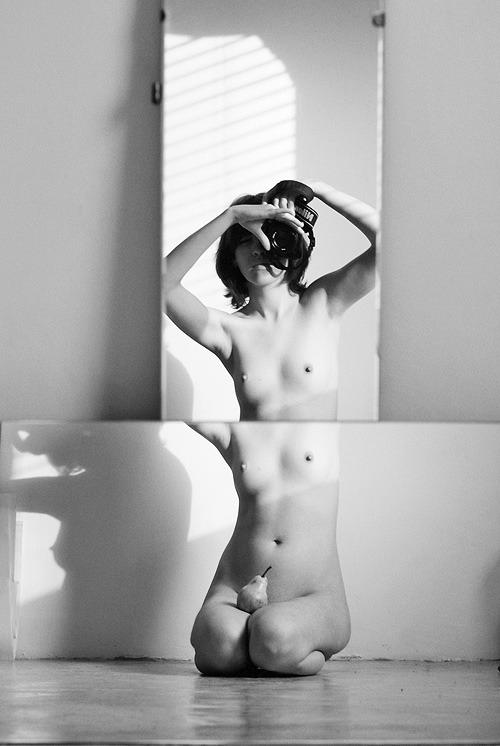
(via girlswithcameras)
Nastasija Trill’ – Parts (2009)
As an image this doesn’t completely work. (Based on the way she’s holding the camera, this was taken at a cant and then cropped in post. This positioning was likely a result of wanting to keep her arms in this particular pose–which makes sense because check out the exquisite shadow that’s cast by her right breast on the wall behind her. Proper landscape orientation would’ve de-emphasized the up-thrust of the vertical mirror, drawn more attention to the angled light slanting through the slated shades and just overall made better balance between positive and negative space. I’ll stop short of labeling this #skinnyframebullshit, however–given the custom of horizontal orientation being a code for depicting secular conventions and vertical orientation being favored for spiritual consideration/prompting worship, this fits like a glove with the latter.)
It’s also a clever visual pun. There’s the pair in her lap and the pairing of a pair of breasts via the reflection. (My brain then subsequently rockets on to relating this to that bible story about Jesus allegedly feeding a multitude with only a small quantity of fish and loaves of bread and wondering if it was like a modern magic trick that used mirrors onto the statement about illusion smoke and mirrors… each and ever step of the way seeming to fit the image’s implications a little too astutely.)

 Acetylene Eyes