
Robert Mapplethorpe – Champagne (1977)
The truth is not always beautiful, nor beautiful words the truth.
–Lao Tzu
Robert Mapplethorpe – Champagne (1977)
The truth is not always beautiful, nor beautiful words the truth.
–Lao Tzu

Rudd – Title unknown (2017)
I love this even if the composition is somewhat funky. (Yes: the ottomon and her arm draw the eye at a diagonal up and right toward her sternum, the equal yet opposite angle of the couch pushes the eye past her face to the hand thrown behind her head; the mass of negative space is like the tension of a bowstring when the arrow is loosed and the gaze spans back to where he’s feasting upon her desire–this subsequently then causes the eye to shuttle back and forth between him and her.)
It works but the layout is just strange and if I had to guess I’d say that this is a drawing made from some sort of image reference. (This would explain the strange layout because when you’re drawing you can put a camera anywhere but in the real world their are limitations on where a camera will fit.)
Still: I really do like the fact that the way the illustration scan preferences her pleasure above its catalyst. And when you subsequently realize the cause of the pleasure, the connection sharpens her experience somehow.
There’s also the little things–like I don’t exactly understand if it’s a stylistic contrivance but both of them appear to have their nails painted black. It’s small but it’s not a bad tact to remind you that her extended right arm is still part of the composition despite the way the viewer’s gaze is encouraged to loop between her face and his.
Lastly, it’s great that below his left armpit and her right inner thigh you can see a puddle of vaginal mucous and presumably saliva spreading on the couch. Good times.

Joana Choumali – Untitled from Emotions A Nu series (2013)
Choumali is an Ivorian image maker who focuses primarily on work featuring African woman.
Her focus is primarily vibrant, super-saturated color (and she’s really fabulous as using the intersections between non-complimentary colors to flatter her subjects.
She also works occasionally in monochrome–and her work here is rather audacious.
I’m not really a fan of studio work. And although that’s what Choumali does more or less exclusively and while I do consider her color work both incisive and bold, it is her monochrome stuff I can’t shake.
Part of it is that I will always be a fan of complication. By that I mean studio photography allows for more control. You can set up in advance, orchestrate the lights, get everything just so and then you can invite the subject and focus on interaction as opposed to juggling 18 other things at once.
Unfortunately, this tends to mean that studio work is pristine and allows for the setting to be decontextualized in favor of allow a laser sharp focus on the subject. Choumali pushes things–ambitiously–in quite a different direction.
Here the almost Pollock-esque speckled backdrop both separates the subject from the backdrop (enhanced with some perhaps less than as subtle as you’d really hope for dodging along the subject’s back and hips. It contributes a solidity to this woman that the shadow her body cases flattens back out.
The solidity is counter balanced expertly by an ephemerality that is echoed in the pose is the subject kneeling or rising? Is her pose contrite or self-accepting and joyful?
I speak virtually on the daily with photographers who are interested in shining a light on the notion of vulnerability with their work. Choumali does exactly that magnificently.

Mary Ellen Strom – Nude #5, Eleanor Dubinsky and Melanie Maar (2005)
Mary Ellen Strom’s meticulous restaging of Gustave Courbet’s The Sleepers (1866),
a classic depiction of lesbian sexuality for the benefit of the
heterosexual male viewer, is projected at the size of the original
painting. Strom’s intent is to re-embody, literally, a territory that
was not only the location of male desire but also the prerogative of
male artistic production. Strom’s models are her peers – contemporary
women artists. Her nudes have names. They collaborate with Strom in
making lesbian pleasures available to lesbians, among other viewers.–Catherine Lord, Art & Queer Culture (New York: Phaidon, 2013), 219.

Franz Kline – Intersection (1955)
Kline was a bit of an oddball.
He’s usually considered an abstract expressionist–specifically: an action painter (aligning him with Lee Kresner, Williem de Kooning and Jackson Pollack–among others).
Yet, unlike most his peers (both action painter and abstract expressionist): he was adamant that his work was less concerned with conveying meaning and more preoccupied with drawing attention to concerns regarding form: composition, color (or lack their of), brushstroke, etc. (In this he was actually a prophet of minimalism.)
A further difference between his work and other action painters is that very little of Kline’s oeuvre was in any way improvised. While he did put brush to canvas, he moved quickly using the same type of brush you’d use to painting the exterior of your house, he frequently sketched and re-sketched his ideas (frequently using the pages from old phone books.)
Bonus fact: Kline was a professor at Black Mountain College where he taught Cy Twombly.
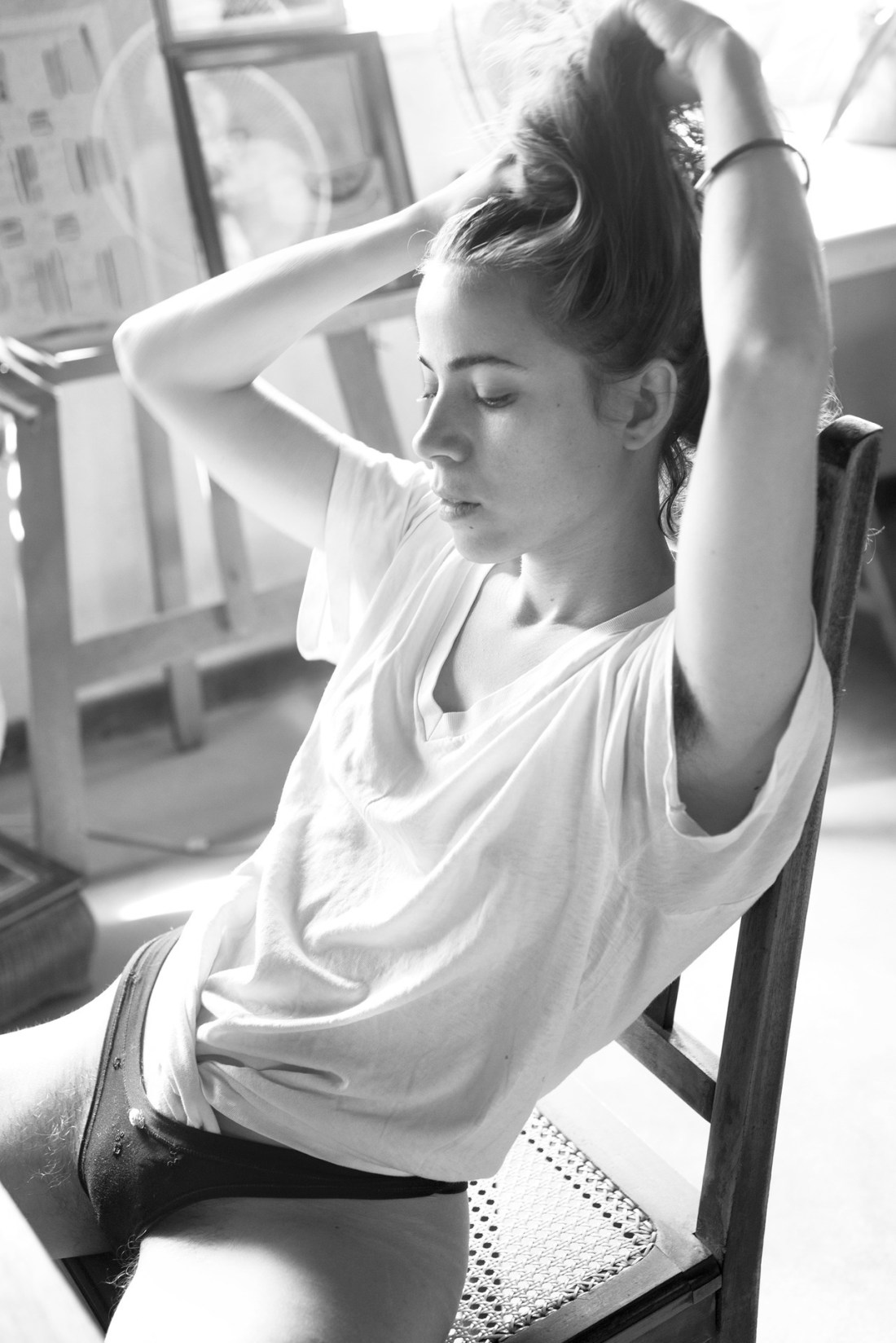
Paula Aparicio – Inés en casa, buenos aires, Diciembre (2017)
Aparicio is a fantastic photographer and image maker. (The above is digital; but she also works in analog.)
I’ve been working out how to tell you something about this for several days now. It’s not easy–not for lack of things to say but in the saying of something there is all too often an effort to demystify. Aparicio’s work resists that approach.
It occurred to me that although this is monochrome–it’s actually not dissimilar from the selection of Polaroids made by Andrei Tarkovsky’s released through Thames and Hudson entitled Instant Light.
My copy of that book is currently in storage–so I searched for some samples to include side by side with other work by Aparicio to illustrate similarities. Except the site I landed on was this and well, I’m inspired to run in rather a different direction.
As Michelle Aldredge points out–Tarkovsky was extremely anti-Hollywood. He felt that there were two predominant means of expressing ones vision: the descriptive and the poetic. He opted for something that was both third option and middle ground: metaphor.
Yet, he was adamant that what he was doing had little to do with symbolic coding. What he meant by metaphor was something along the lines of this:
I think people somehow got the idea that everything on screen should be
immediately understandable. In my opinion events of our everyday lives
are much more mysterious than those we can witness on screen. If we
attempted to recall all events, step by step, that took place during
just one day of our life and then showed them on screen, the result
would be hundred times more mysterious than my film
In other words, he sought to present the world of his films not as a story or exercise in formal decryption. It wasn’t even really supposed to mimic the function of dreaming, it was more an effort to use the immersive nature of cinema to convey an approximation of an experience that while not the whole experience might be somehow more than experience.
That’s what I admire so much about Aparicio’s work. The way it hones in on the magnificence and mystery in the mundane of lounging around on a sunny morning in a way that feels both foreign and familiar all at once.
Also: the lighting here is excellent. It appears almost backlit but the light is actually slanting left to right across the frame. The flattens Inés right arm against the overexposed backdrop, while emphasizing her face in profile and lending her body more solid dimensionality. (It also has the effect of making it seem as if she’s tilting towards the camera a bit.)
This would’ve been a good image without any other additions but there’s also the way the light catches her eyelashes and what look like burns from cigarette ashes on her underwear that makes this thoroughly mesmerizing.
(It’s also a bit like a Vermeer where you think that if you watch it long enough the picture will come to life and you’ll get a glimpse of what happens next–even though the medium makes that impossible.)

Janice Guy – Untitled (1979)
Murray Guy is one of the most preeminent galleries for photography, film and video.
Janice Guy is the co-founder and co-owner through March 2017.
She founded the gallery in the 1990s after moving to NYC from Düsseldorf, Germany.
In Düsseldorf, she studied photography at Kunstakademie Düsseldorf, working closely with Bernd and Hilla Becher.
Being a woman and a photographer preoccupied with self-portraiture, she’s frequently lumped together with folks like Ana Mendieta, Cindy Sherman and Francesca Woodman–the operative framing being fixated on artists as both simultaneously author and subject.
To think of it that way strikes me as a bit lazy. It fits–with certain limits–for Sherman and Woodman–less so for Mendieta; however, most of Guy’s photos feel less like self-portraiture and more like proto-selfies.
If one were to describe Guy’s work she documents herself as a photographer considering herself in a mirror–i.e. she’s not setting up the camera like Sherman or Woodman and then positioning herself in front of it; she’s interested in including considerations of process in her product (if you subtract capitalist connotations and instead consider the term in a more mathematical sense).
She’s nude in most of her work–except for a utilitarian wristwatch.
Her work wasn’t really exhibited until the late aughts–but there continues to be interest in it to this day and I suspect that interest may even grow down the line.

[←] G. Bovier-LaPierre – Fig. 100 {Edit} from L’astronomie pour tous (1891); [→] Gaetano Previati – Danza delle ore (1899)
Juxtaposition as commentary


 Acetylene Eyes