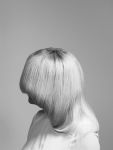
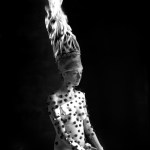
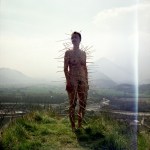
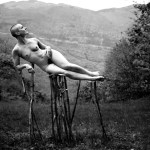
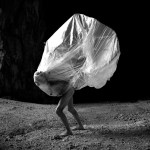
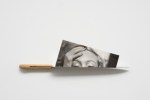
Brandy Trigueros – [↑] Untitled from The Dadabyte Theater (2017); [↓] Untitled from There’s No Other Like Your Mother (201X)

A while back a dear friend introduced me to Trigueros. I knew she was a photographer/image maker but our mutual friend didn’t show me her work until after we’d met.

Uh, she’s ridiculously talented y’all. Like woah!

Above, the topmost image is from her series The Dadabye Theater. It’s heavily informed by the visual aesthetic of Fernand Léger and Dudley Murphy’s avant-masterpiece Ballet Mécanique.

The lower image is from There’s No Other Like Your Mother–a series preoccupied with the death of both the artist’s parents as well as her own questions regarding whether or not to become a mother herself.

To appreciate the genius of the former you have to pay careful attention to the latter–I’m personally uncertain whether to term the work oneiric vs surreal but there is something preternatural familiar about the scenes. The compositions are clean with strong attention paid to conveying a totality of environment.

There’s also a killer eye for unity between form and function–a hallmark of high end design. (Her work reminds me a lot of Storm Thorgerson, actually.)

There’s also a lot of sort of kitschy, nostalgic and slightly off-kilter props. (My friend told me that she collects them specifically to use in her work.)

So while they are always used to excellent effect, there’s a way in which the kitsch, nostalgia and off-kilter fit even better within the frame of dadaism.

In my experience, it’s rare to encounter someone with such a strong sense of their own visual language. Trigueros has it in spades. But it’s quite another thing to be able to adapt your style to fit a particular framework. To me it’s incredibly astute that she decided to apply her preoccupations to an art movement where her interests not only fit but expand the original concept via their application.

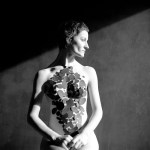
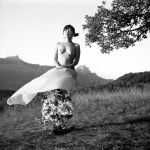
Jouk Oosterhof – [←] Hanneke from Women with Vaginismus project (201X); [-] Emma from Women with Vaginismus project (201X); [→] Bertine from Women with Vaginismus project (201X)

I first encountered the portrait of Emma via @thephotoregistry–which continues to be one of the best things on Tumblr.

I liked the way that the texture of Emma’s hair is set off against her blouse as well as the smoothness of the background.

Upon closer reading: I realized the nature of the project–relating to vaginismus, a condition wherein an sort of vaginal penetration causes intense pain. (I have two friends who have this condition and what they’ve told me about it sounds absolutely heinous.)

Via Oosterhof’s LensCulture profile, she says of her process: “I carefully build the image, staging all details.”

That actually tracks given these works. Note: the lighting on the background alone is drastically different between the three images. The lighting on the women is less different but there’s still some variation. I’m especially fond at the way she’s both used the lighting to separate the women from the backdrop while also playing the background lighting against the foreground lighting to dramatic effect given the positioning and pose of the subject.

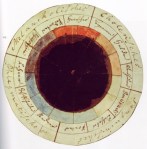
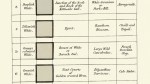
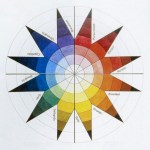
[↑] Johann Wolfgang von Goethede Farbenlehre (1810); [↖, ^, ↗, +]  Abraham Gottlob WernerSelections from Werner’s Nomenclature of Colours (1814); [↙] Johannes IttenColor Sphere in 7 Light Values and 12 Tones (1921); [↘] Yves KleinBlue Circle (1957); [v] Cy TwomblyUntitled (1970); [↓] x-riteColor Checker (201X)

An Illustrated Chronology of Color Taxonomies: 1810 to Present (Incomplete)

Stéphane Fugier – [↖] Kashka from Studio series (20XX); [↗] Ludivine from Couleurs series (20XX); [<] Anne Laure from Studio series (20XX); [+] Sang Mee from Couleurs series (20XX); [>] Jean Marcel from Extérieur series (20XX); [←] Thierry from Couleurs series (20XX); [→] Sang Mee from Extérieur series (20XX); [↙] Delphine from Extérieur series (20XX); [↓] Jean Marcel 2 from Extérieur series (20XX); [↘] Hélène from Studio series (20XX)

I’ve been giving thought to the re-emergence of surrealism–particularly in photography/image making; I am less interested in distinguishing between ‘oneiric’ and ‘surrealist’–this may have been a utilitarian distinction at some point; however, it now seems to be a feature more of photographers/image makers vanity than anything which actually contributes to greater depth of understanding.

It’s possible that my familiarity with photo history a decade ago was of such limited scope that it might be realistic to think that I was just unfamiliar with examples of surrealist photography. While I’m sure there are scads of folks who have forgotten more about the history of photography than I’ve ever known, it seems that Joel-Peter Witkin and Jerry Uelsmann were the only game in town when I first test the waters of photography with an extended toe.

And surrealism is exactly the right distinction in both cases–since as Wikipedia astutely observes: surrealism was fixated upon creating illogical scenes borne out by photo-realistic depictions as well as a preoccupation with “creat[ing] strange creatures from everyday objects[.]”*

The above definition pretty much encapsulates Fugier’s work. Sticks, plastic bags, apples, fire and apples all employed in an exceedingly unconventional manner. I’ve not be able to find much on Fugier–even his website takes a bit of digging to uncover. However, apparently NY Arts magazine said of his work:

The viewer sees what [they] wants to see, the context contracting and
orienting the possibilities. There is no correct interpretation and
nothing that must been seen or understood. The photographic experience
(experiment) is first and foremost an encounter with a person.

This seems to be pushing back against the notion that the work can or should be deemed surrealist. I see it another way: as a shift from an object focus and a movement towards a consideration of subject. Another good question: what context informed ‘strange’ and ‘everyday’ as far as the original instance of surrealism. How have those contexts shifted in the intervening century. But I digress…

I opened this post by saying that I’ve been thinking a lot about the increasing preponderance of surrealism. It’s basically a crap shoot these days w/r/t whether or not photographers/image makers are surrealist or not–red or black, place your bets and spin wheel.

Why is that?

It strikes me that Dada was a response to the horror of WWI; and: surrealism emerged from the Dadaist milieu. There’s a tendency to see these movements as steps forward in advancement of culture. (I mean they were also EXTREMELY problematic and should be criticized, but again: I digress…)

Loosely, one might argue that dadaism and and surrealism were an effort at a binary response to The Great War–a resounding: no! Keep in mind that Dada emerged almost as if it were twinned with the emergence of fascism–a term few people understand as evidenced by folks who insisted Obama’s regime was both simultaneously fascist and socialist.

Fascism basically said liberalism and democracies are bad, social is bad and totalitarian dictatorships are good. (You’ll already see where I’m headed with this but one personal point first: one thing which never ceases to incense me is the way generally the same folks who critiqued Obama’s regime as simultaneously fascist and socialist are the same people who accuse those of disagreeing with them as being fascists. And slightly more intelligent–and therefore more offensive are the folks who use the term SJW or refer to things as PC. Yes, there are some overzealous progressives–I interact with a half dozen every week. It’s not fascist to denounce someone who is displaying bigotry as a bigot. Especially given that if you do not want to be termed a bigot, you know: stop being a bigot, perhaps? But the thing that folks who throw around the word SJW don’t like is that there perspective is not tolerated, lauded and accepted by others in direct proportion to their own estimation of their intelligence.

Which brings us back to fascism as a the opposite response to WWI from the Dadaist and subsquently surrealist–a sort of this is the way the world works, suck it up and learn to live with it.

Militarism was nearly universal during WWI–there were those horrified by it and those who in what I can only think to term and egregious nihilist sentiment believe that something of human potential was unearthed by wholesale carnage and living (or feeling more fully alive) when faced with death.

Dada and surrealism didn’t stop WWII any more than conceptual art or postmodernism prevented the global war on terror. But were’s still enacting the same cycles over and over. And I’m not sure if that’s a good thing or a bad thing. And while I think Fugier’s work could be more contemplatively realized, his shifting from considering of object to a presentation of humans as subject is at least conceptually satisfying.

P.S. My deepest and most sincere apologies for how things have been on autopilot with this project for the last couple of weeks. My final MFA application was a goddamn doozy–and while I was able to get it in just under the wire, the way those things forcibly constrict your vision is not something I care for and I’ve been struggling to get my head back into the game with this. Not sure I’m totally there yet–but my hope is to extend things out to having a queue again over the next two weeks. That should help. Thank you for your patience and for those of you who wrote in with encouragement–whether or not I responded: your words were greatly appreciated.

*Given an opportunity, I would quibble with the insistence on ‘creatures’ as it contributes undue preference on folks like Ernst; alternately, I do at least understand why the insistence is there–given that once you make it about using everyday objects in unusual ways, you’re practically demanding that someone insist that Dada and Surrealism are not separate movements.

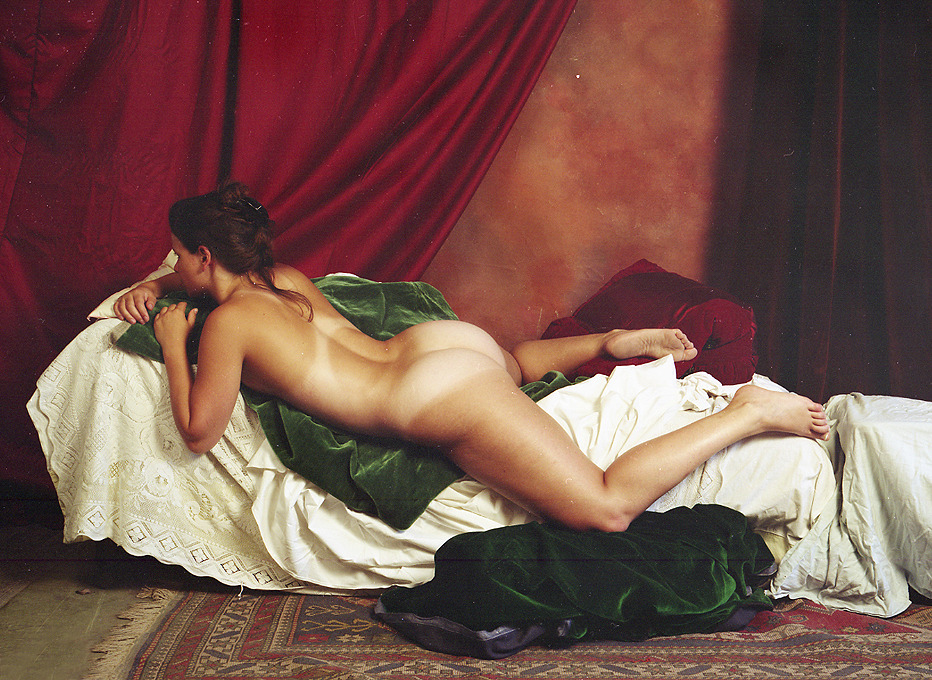
Stéphane LallemandOdalisque brune (2009)

The Ballad of the Lonely Masturbator
By Anne Sexton

The end of the affair is always death.
She’s my workshop. Slippery eye,
out of the tribe of myself my breath
finds you gone. I horrify
those who stand by. I am fed.
At night, alone, I marry the bed.

Finger to finger, now she’s mine.
She’s not too far. She’s my encounter.
I beat her like a bell. I recline
in the bower where you used to mount her.
You borrowed me on the flowered spread.
At night, alone, I marry the bed.

Take for instance this night, my love,
that every single couple puts together
with a joint overturning, beneath, above,
the abundant two on sponge and feather,
kneeling and pushing, head to head.
At night alone, I marry the bed.

I break out of my body this way,
an annoying miracle. Could I
put the dream market on display?
I am spread out. I crucify.
My little plum is what you said.
At night, alone, I marry the bed.

Then my black-eyed rival came.
The lady of water, rising on the beach,
a piano at her fingertips, shame
on her lips and a flute’s speech.
And I was the knock-kneed broom instead.
At night alone I marry the bed.

She took you the way a woman takes
a bargain dress off the rack
and I broke the way a stone breaks.
I give back your books and fishing tack.
Today’s paper says that you are wed.
At night, alone, I marry the bed.

The boys and girls are one tonight.
They unbutton blouses. They unzip flies.
They take off shoes. They turn off the light.
The glimmering creatures are full of lies.
They are eating each other. They are overfed.
At night, alone, I marry the bed.

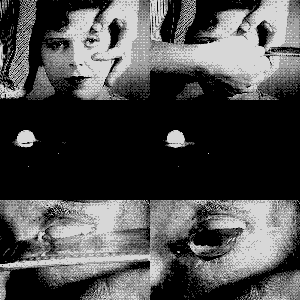
Nawa-ArtErika Yukio (1961)

It’s difficult to untangle all the various threads with this–largely because I read zero Japanese; also: it’s weird to me that while translations for Romance languages via Google Translate have improved marked over the last three years, it’s still only the babiest step above word salad for ideogrammatic languages. (I know ideogram is not technically the right term but I can’t think of the right term at the moment–I’m essentially pointing to the way romance languages group characters that make particular sounds in particular situations into words which name things, convey concepts, etc. vs. languages consisting of characters which a vaguely pictorial and convey concepts, i.e. Mandarin and Japanese; although it seems to me that kanji is maybe intended to be closer to the an alphabet? Don’t quote me on any of this–linguistics is one field where I will readily admit a complete absence of any sort of even baseline understanding.)

Anyway, as best as I can tell: Nawa Art is a site where someone–who seems not to want to be viewed as a collector–has archived pornographic BDSM materials that are apparently from brochures disseminated via a secret club in Japan circa 196X.

None of it is even half as edgy as what your average kink-focused Tumblr curator includes on the reg. But to my naive eye–it’s fascinating to consider the effect such material likely had in shaping the overarching vision of someone like Araki.

I really appreciate the presentation of this–there’s a physicality to it: the four holes at the right margin (seemingly from two staples), the way that it both simultaneously seems xeroxed + the way that the strips of black and white (in concert with the thin margin between the images) makes the photos appear three dimensionally stacked; additionally, I really dig the simplicity of the layout–the top half mirrors the bottom half with only a horizontal mirroring (the black and white strips makes it seem far more complicated than that but it’s actually a solid tact for making something simple look more complicated than it really is–good design usually flips that script; however, it can be used to strong effect if it’s used sparingly and in a conceptually resonate fashion).

Two other observations concerning layout: not how the upper left and bottom right image are connected by the inclusion of the dark ribbon looped around her neck, whereas the top right and bottom left are both square (vs. rectangular) and were almost certainly taken in sequence; there’s also the way what appears to be the drain of a bathtub behind Erika Yukio’s head in the top right, top left and lower right frame managed to break up what would’ve been a cloying repetition of fours (staple perforations + photos).

The other thing about this that appeals to me is that as put off as I am by mainstream porn of any kind–I am especially put off by depictions of BDSM in pornography. There is–in my experience–this fixation on both extremity and humiliation that just doesn’t appeal to me personally. (I’m not about to kink shame anyone though–you do you and know that as long as you have the utmost respect for consent; then I support your kinks).

I think it’s because I grew up in such a repressive community that I really don’t enjoy being made to feel dirty about physicality–I struggle with that enough already. But it’s more complicated than that, honestly; as much as I’m not at all into humiliation, testing boundaries is something that I crave.

I think that’s what I appreciate about this–there’s a sense of discomfit paired inextricably with a curiosity. That appeals to me greatly.

Georges Thiry – Title unknown (195X)

Thiry was Belgian and worked with a 6×6 Rolleiflex.

He demurred that his photography was little more than a lifelong hobby–yet there aren’t many hobbyist photographers who managed to make portraits of the likes of René Magritte.

The image above was part of a long running series where Thiry took photos of sex workers. He was not in the least bit shy about availing himself of their services–yet his photos focused less on their status as sex workers and instead presented them more in their own element–preferring to depict the women in their various domiciles.