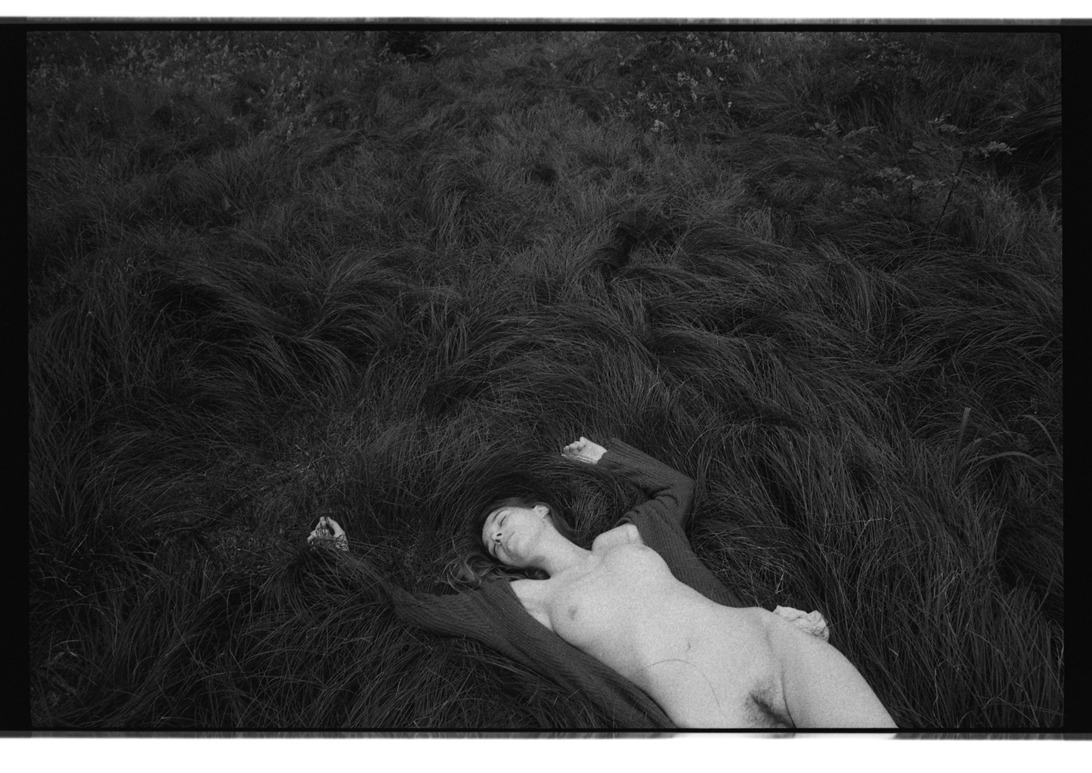
Rebekah CampbellGrace Hartzel for Odda Magazine (2017)

Hartzel is a fantastic model. (I’ve featured her work with Roe Ethridge previously.)

However–although I definitely dig this image–I’m posting it primarily as a means of correcting something I realize I fucked up a while back; namely: I referred to the gesture in classical oil paintings that was used as a shorthand to indicate the person making the symbol as Jesus.

It occurred to me that the gesture–although based upon anointing parishioners with consecrated oil–is actually also startlingly similar to the configuration commonly used to stimulate the G-spot.

In my cursory research, I noted that the positioning of the fingers was supposed to spell ICXC–which is the ancient Greek abbreviation for Jesus Christ.

Well, I was incorrect. There are two gestures–one associated with Catholics, the other localized to Greek and Eastern Orthodox.

The gesture that Hartzel is making is the Catholic variation–it does not spell out ICXC. (And it is definitely the same gesture most commonly associated with stimulating the G-spot.)

The Orthodox gesture is actually comparable to what the kids these days call The Shocker–or two in the pink, one in the stink.

I vaguely remember reading somewhere that frequently–Xtianity, esp. Catholicism, appropriated it’s symbols from various cults, frequently doing little beyond futzing with their orientation before deploying them. (The essay I’m thinking of mentioned how the upside down cross is actually the original orientation–as it was associated with a decidedly anti-Roman fertility cult; however, Catholicism–being linked with Rome–inverted the symbol to reorient things in line with the Roman context of Christ’s Crucifixion and ‘resurrection’. Thus, the cross in the upright orientation is actually the perverted symbol with regard to the context of its place in ecumenical/liturgical usage.)

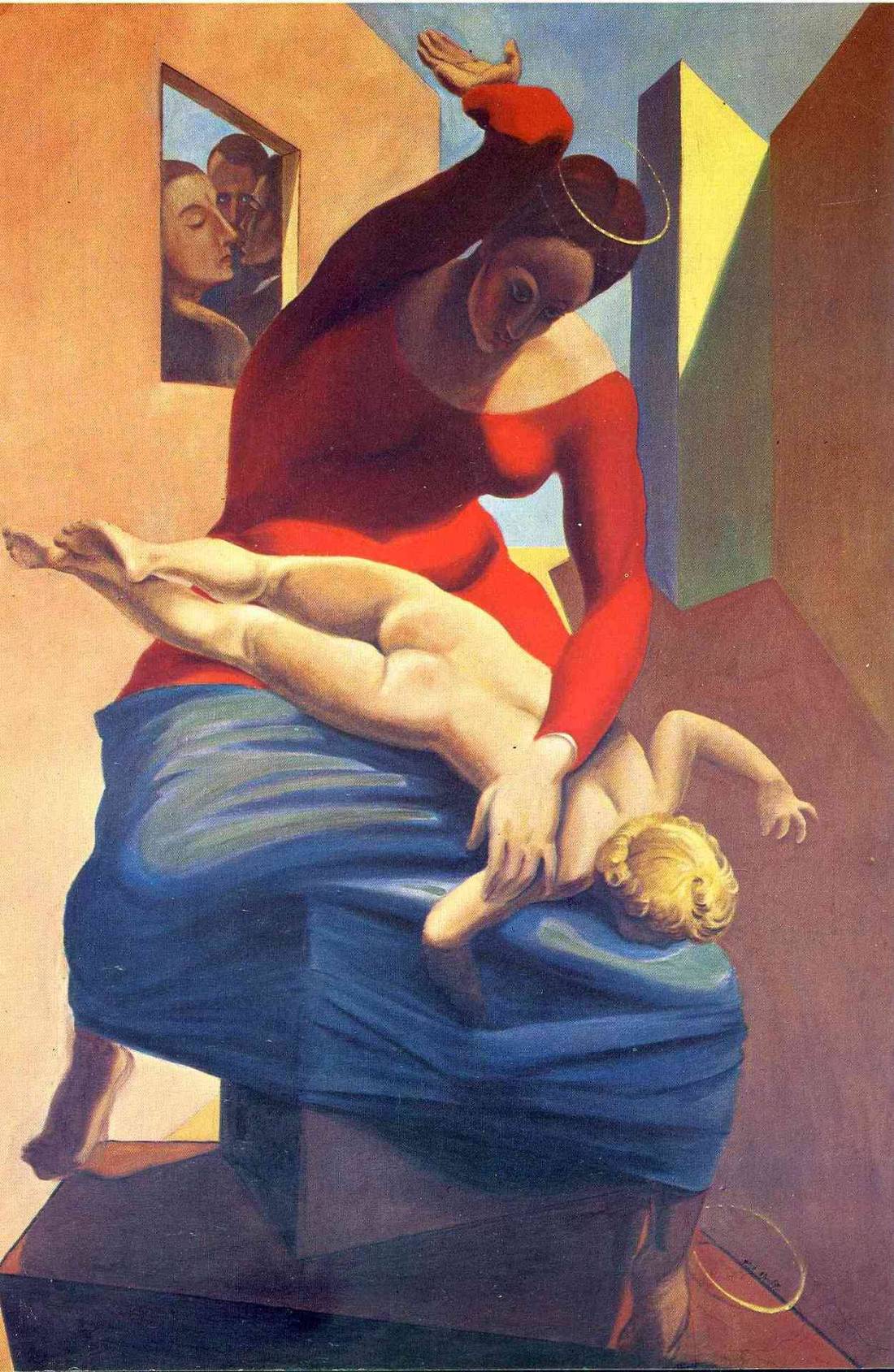
Max ErnstThe Virgin Spanking the Christ Child before Three Witnesses: Andre Breton, Paul Eluard, and the Painter (1926)

As far as differentiating between Dada and Surrealism, the rationale is more or less that Dada:

  • embodied a visceral revulsion to the violence resulting from The Great War,
  • was vehemently anti-art in conceptualization and execution, and:
  • emphasized nonsense whether by flouting symbolic convention or thwarting efforts to untangle meaning through analysis.

Surrealism might well be described as dadaism that was decidedly pro-art (Margritte, for example, was a painter of extraordinary talent and sensitivity) and who instead of embracing nonsense, took the domain of the unconscious human mind as its inspiration.

Personally, I’ve only ever managed to link Duchamp with Dada. I’ve read a number of things that argue–with luminous insight–that Matisse and Picasso out to also be considered under the Dada umbrella. But I always sort of shrug and wonder what the point is in going to that kind of trouble? Essentially, Picasso is cubism, so why shuffle him into a movement that he–judging by the modern western art historical canon–far eclipsed as a mature artist. (Matisse is another story for another time.)

For some reason, the other way I think about it is that Dada and Surrealism are not unlike the so-called Meeting of Waters in South America–where the dark waters of the Rio Negro meet with the chalky brown waters of the Amazon. The two rivers come together and fly several miles side by side without mixing.

Looking further down stream you can see the way the impetus for Dada leads to Yves Klein–yes, his Leap into the Void but even more than that his Zone of immaterial pictorial sensibility which prefigured both conceptual and performance art.

Whereas Surrealism and it’s all but universal preoccupation with Freud’s banal bullshit and wish to uphold the sanctity of Capital A art as a medium–has infused virtually every discipline and genre of creative expression.

None of this is news. But I do think it’s interesting to consider Ernst as the great fence straddler–half Dada provocateur, half Surrealist impresario.

In the scene above, Ernst depicts himself alongside writer André Breton and poet Paul Éluard, both pointedly surrealists. They are seen through a window–not unlike witnesses to an execution–except that can’t seem to be arsed to bear witness so much as be seen as present.

The room is incongruent, seemingly not held to laws of perspective or expectation. (Although–it does absolutely suggest a stripped down version of what Margritte would posit in his own style shortly after.) In the foreground, the holy mother hold what appears to be a five or six year old nude Christ child on her lap–cheated with his ass  positioned so that the viewer gets an optimal view of it. The holy mother has her hand poised over her head–clearly preparing to bring it down soundly against the bare ass of her holy progeny. (And everything about Mary and Jesus is a logical predecessor to Bathus’ work.)

There’s also the fact that the holy mother’s head is surrounded by a halo, while the child’s has tumbled onto the floor.

It’s depiction of not sparing the rod and therefore not spoiling the child is entirely in line with Xtian precepts. Yet, what about the tumbled halo–the holy in guarding the boundaries of holiness creates through discipline and punishment that which it seeks to prevent: unholiness? (Also, I think it’s funny that I look at it and see a great advertisement against corporal punishment in child rearing… how time marches on and how cultural contexts shift.)

I sort of view it as cheap, unconsidered blasphemy as a means of positioning Dada–which would’ve already been fundamentally anti-Xtian–and Surrealism in a sort of conversation with regard to the futility (or non-sense) inherent in interpretation.
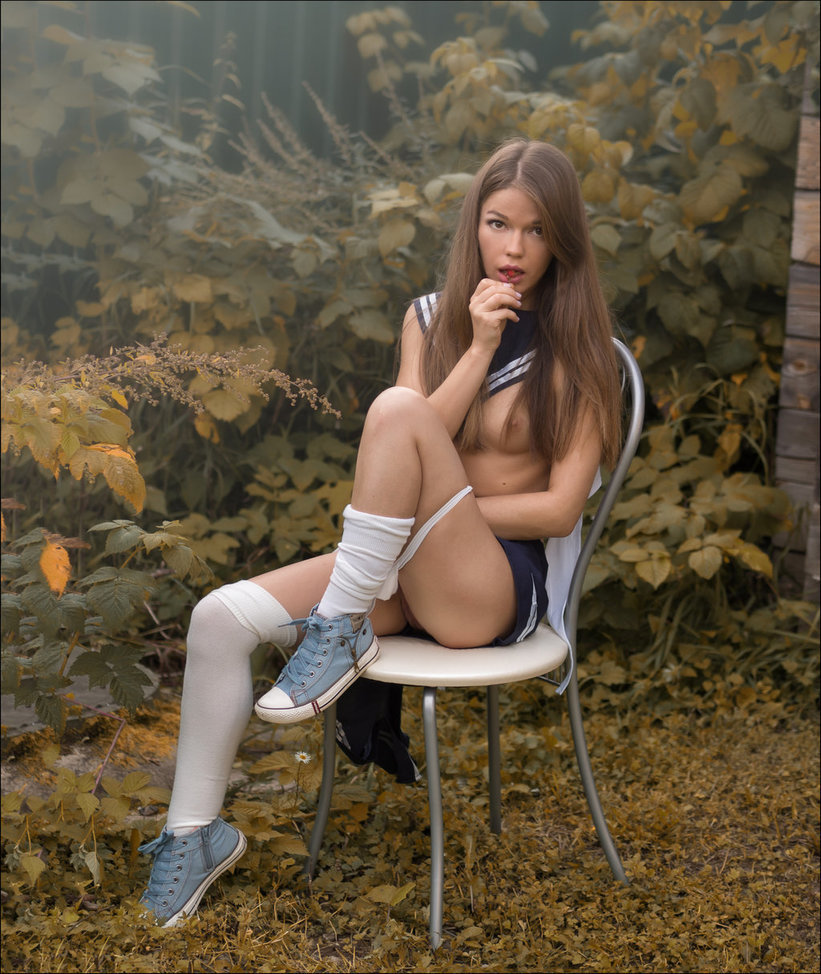
Pavel KiselevKate (2017)

If you’ve spent any time plumbing the depths of :::air quotes::: fine art nude photography/image making on the Interwebz, you’ll be familiar with Kiselev: he made a bunch of images of women lounging around in various stages of undress inside a cabin on a sleeper car aboard a train. He eventually edited these images down and released them as a photo book called Railway novel.

His work has always been interesting in a knee-jerk, voyeuristic fashion–he’s clearly most comfortable when his work pursues a measured but by no means reserved eroticism.

This portrait of Kate (above) is surprising for a number of reasons. The eroticism is understated. Yes: there’s the cherry pinched between her teeth, hair partially obscuring her left nipple and her knickers pulled down and up draw attention to the shadowed cleft between her thighs.

The way she meets the gaze of the camera though suggests–to me at least–that it’s all a carefully constructed ruse to command attention. I mean: leaving the eroticism and voyeuristic impetus for a minute–the use of color is actually effing fantastic; the dark navy of her sailors collar, the matching skirt (darker for less lights reflecting off it) and the darker blue of her denim shoes.

And the blue is perfectly balanced by the green brown to yellow motif of the autumnal leaves. (Hell, the attention to texture is even hitting and sticking: the brushed chrome of the legs on the bistro chair, the vinyl of the white seat cushion–even the texture of her stockings registers.

I am not 100% sure what the haze in the upper left corner is exactly. I’m guessing it’s supposed to look like fog–or, what in painting is termed: sfumato. It’s not evenly applied across the area, however; and my gut says it’s that thing you see often in documenting products for commercial campaigns where you reflected light directly into the lens. (You can do this with a white sheet of paper or the blade of a knife held at an angle just on the periphery of the lens’ angle of view.)

I’m bothering to point this out for a number of reasons but mainly to demonstrate that if you keep making pictures–merely the act of continuously creating will improve your work.

However, those who both consistently create work and consume work will always progress faster and more organically than others. Like I’d put money on the fact that Kiselev knows the work of the Ninja Turtles namesakes. But, looking at this, I suspect he’s also familiar with Otto Dix. (This portrait of Kate reminds me of Dix’s 1926 Portrait of Sylvia von Harden–I suspect that’s not an accident.)

Rimantas DichavičiusUntitled from Žiedai tarp žiedų (1965-1989)

When my absence doesn’t alter your life, my presence has no meaning in it.
–Unknown

If I say of myself that it is only from my own case that I know what the word “pain” means—must I not say the same of other people too? And how can I generalize the one case so irresponsibly?
Now someone tells me that he knows what pain is only from his own case!–Suppose everyone had a box with something in it: we call it a “beetle”. No one can look into anyone else’s box, and everyone says he knows what a beetle is only by looking at his beetle.—Here it would be quite possible for everyone to have something different in his box. One might even imagine such a thing constantly changing.—But suppose the word “beetle” had a use in these people’s language?—If so it would not be used as the name of a thing. The thing in the box has no place in the language-game at all; not even as a something: for the box might even be empty.—No, one can ‘divide through’ by the thing in the box; it cancels out, whatever it is.
That is to say: if we construe the grammar of the expression of sensation on the model of ‘object and designation’ the object drops out of consideration as irrelevant.
Ludwig Wittgenstein, Philosophical Investigations §293

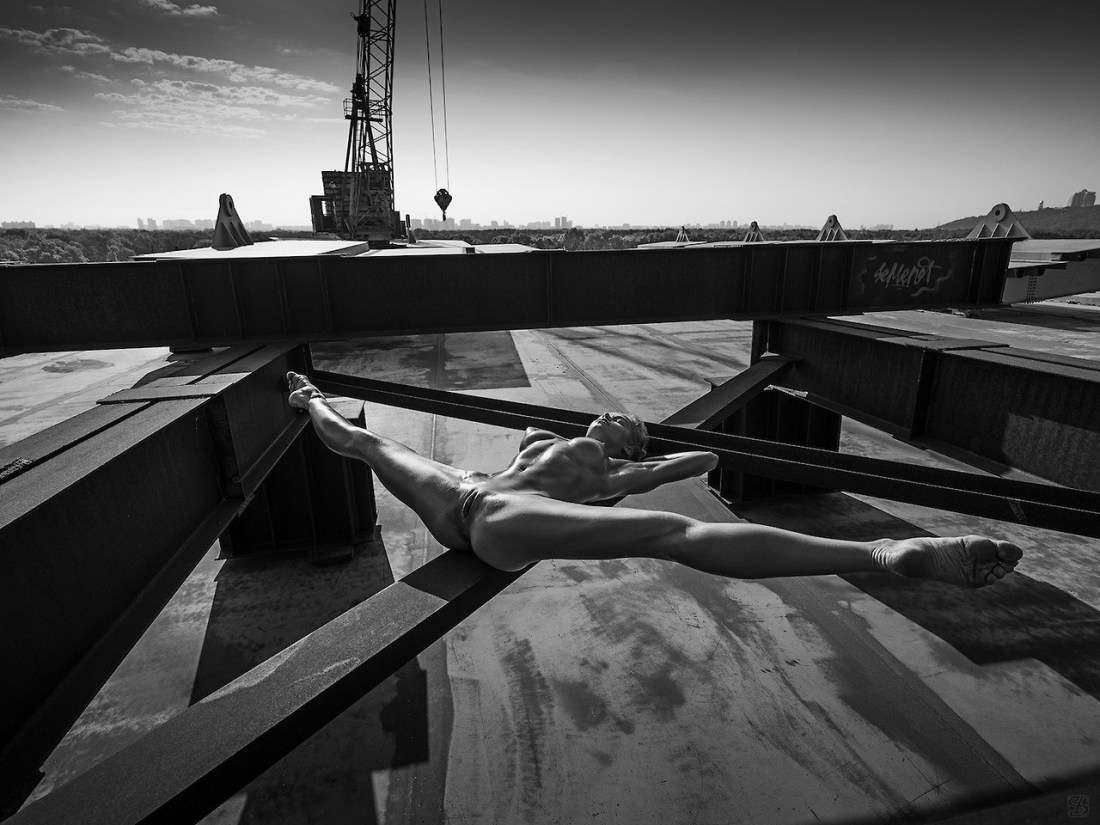
Davide PadovanSara Pavan (2016)

I feel like photos/images–and just to clarify this blog strives to counter the current conflation of analog processes (photography) with digital media/methods (images) of lens based visual representation–of nude/semi-nude woman reclining supine amidst lush vegetation are a dime a dozen these days.

That being said, there’s something special about this… I want to say ‘photo’–the shadows appear thicker and more viscous than I’m accustomed to seeing from digital–but the beveling at the lower frame edge seems indicative of some sort of post-production intervention… so we’re going to go with ‘image’ in order to exercise appropriate caution.

I feel like representing nude bodies in or against the backdrop of a landscape is a fairly common motif throughout art history. I feel the justification for this ranges from an urge to envision a sort of utopian realm, a preference for timelessness, a juxtaposition between the predictable solidity of the body contrasted with feral flora variegation.

Hopefully, you’ll excuse* the trotting out my overused example of Edward Weston’s famous nude surrounded by desert sand–however, I think one of the reasons they are so memorable to me is because these photos employ more than one justification for their existence:

  1. An interest in contrasting the texture of flesh with the grain of sand;
  2. A sort of vague narrative insinuation that the woman is sunbathing instead of posing for a camera.

The second notion is important because it’s a way of thwarting criticisms of catering to the art historical (lecherously entitled) male gaze.

(I’ve also suggested previously that a figure in a landscape is intrinsically narrative by default.)

Anyway, what I like about this is that it’s doing something I can’t recall ever seeing before: as the industrial world becomes more and more ‘technologically advanced’, there are increasingly insurmountable barriers between humans and the natural world–we don garments to protect against the elements, design and build structures to shelter and protect us. In effect, we are separating ourselves from the natural world of which we are an inherent part and function of.

This image seems to be embodying the same sort of openness to the environment that inspired Walt Whitman to personify nature as if it were his beloved when he wrote in Leaves of Grass: I will go to the bank by the wood and become undisguised and naked.

*The laziness in recycling this example is due to the fact that I am feverishly working on applications to a handful of MFA programs and I am honestly spread far, far too thin. (But I am committed to keeping this project up and running even if I am thoroughly overwhelmed; thank you for bearing with me.