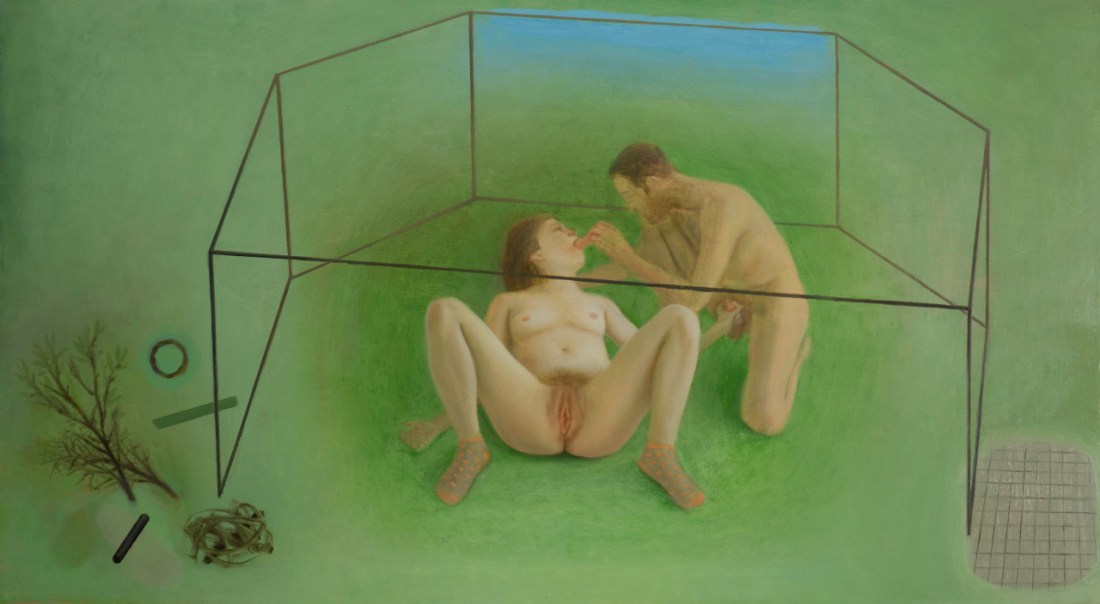
Marion Bataillard – Study of a Loving Couple (2015)
There’s more than a passing resemblance here to Beatrix Mira’s 2014 the normativity parchment.
Marion Bataillard – Study of a Loving Couple (2015)
There’s more than a passing resemblance here to Beatrix Mira’s 2014 the normativity parchment.

Source unknown – Title unknown (19XX)
Homoerotic imagery in
the visual arts has historically been hidden, destroyed, and censored –
so too the documentation of artists’ sexuality when that includes the
possibility of same-sex relationships…
Documentary evidence of a person’s sexual activities is, in many cases,
rare, regardless of the personal’s sexual orientation. In the face of
little or no information, everyone is assumed to be heterosexual unless
proved otherwise. When asked Can you prove she was lesbian? why do we
not respond, Can you prove she wasn’t?
— Jim Van Buskirk, “Between the Lines: The Often Fruitless Quest for Gay and Lesbian Materials,” Art Documentation 11, no. 4 (Winter 1992): 167-170, 167. (via lesbianartandartists)
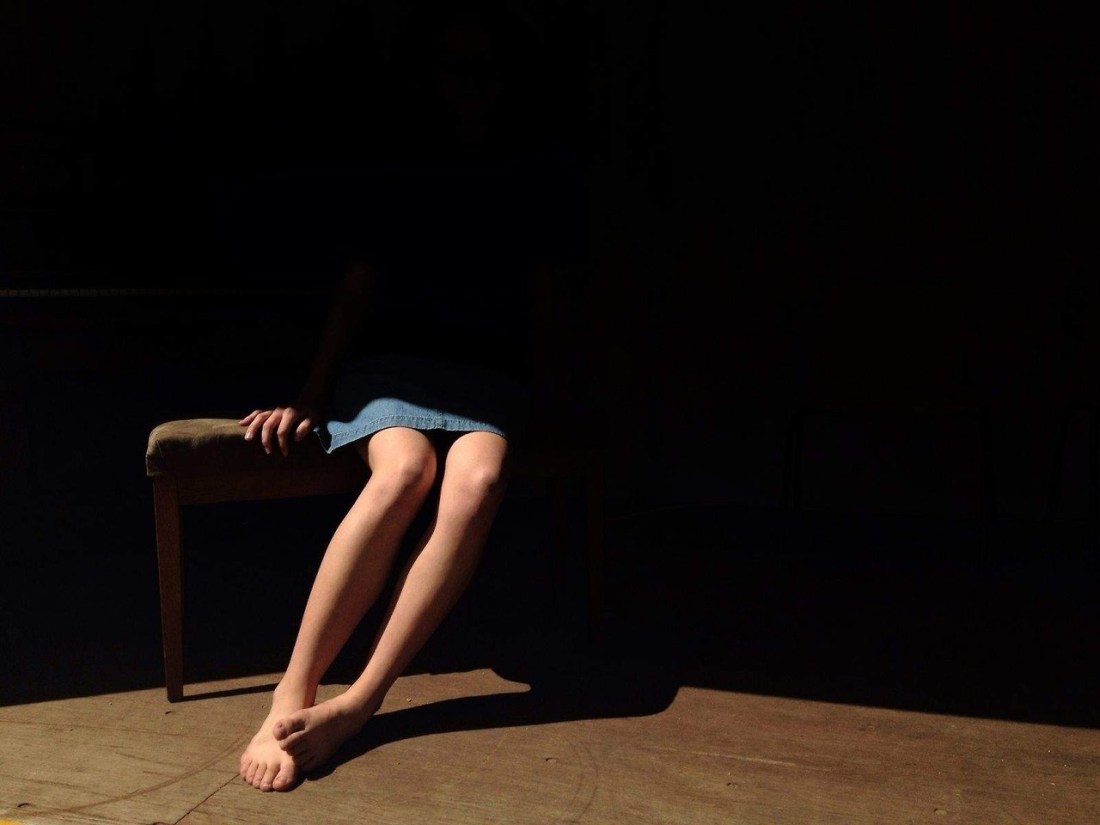
Mariela Angela – Pear Tarts, Melbourne, Australia (2014)
I have this irritating habit of becoming obsessed to the point of hysteria with certain photos/image and/or photographers/image makers. Above is the latest in a long line.
It started off with Kim Eliot Fung. Continued when I stumbled onto Lynn Kazstanovics’ brillaint work. Again, same with Mathilda Eberhard– seriously tho, if any of you knows Mathilda or could pass a message to her from me, please get in touch. See also: k.flight, Alison Barnes and Sannah Kvist. (I have reason to believe that Mathilda and Sannah are acquainted. But again, I’ve contacted Sannah twice with no response and so anything further seems a bit too close to harassment.)
Anyway, I’ve actually interacted with half of these people. Lynn and I are friends. Kim and k.flight were much more cagey. I both cases part of my interest in them was the way their work seemed to spring fully formed from an internet persona that was almost wraith like in it’s enigmatic as it’s presence as an exercise in absence. Like I still don’t have the first fucking clue who either Kim or k.flight are and I’ve met Kim in person once and k.flight and I were planning to collaborate on something.
The point of all the preamble is that I know absolutely nothing about Mariela Angela except that the above image was made with the camera on a mobile phone. (I know. I’m with you but it’s legit.)
She won an award the previous year for a photo called The Waitress Viola. Again, made with a mobile device and staggeringly well thought out and executed.
She has an Instagram, but it’s private. (Also: fuck Instagram.) Still, if anyone knows more about her and her work, I’d be over-the-moon for more info. The two images I’ve seen of hers are fucking exceptional.

Judy Dater – Self Portrait Salt Flats (1981)
One of my all time favorite photos by Dater is her Self Portrait with Snake Petroglyph:

I don’t know how I’ve never made this connection before but it’s entirely possible–quite likely, actually–that this is was intended as a sort of paean to Francesca Woodman.
After all, Woodman took her own life in January of 1981–the same year that Self-Portrait with Snake Petroglyph was created.
There are other similar features–the camera anchored firmly on a tripod while the photograph positioned herself in the scene. There’s the similar sort of motion blur Woodman deployed so often. (Although, it is important to note that: here it used much differently.)
A common critical and art historical question centers less on whether Woodman was an important artist–the interest in her work certainly continues unabated–but there is a lingering question of whether or not any of her mature work would’ve incited the intense reverie and devotion. With notable exceptions, her oeuvre (as it is), has been culled almost entirely from work produced before she was even 20. And there’s an argument to be made that after her year studying abroad in Rome, she never managed to rediscover the same sharpness in conception and execution again. Her foray into fashion photography was incalculably heinous. (Although in fairness, my favorite photo of hers was made during her last year of life.)
I adore Woodman. There’s only a handful of artists whose work I’ve spent as much time with as hers. (When I’m feeling especially full of myself I tell people that we’re involved.)
But I think that Dater’s work from from the year Woodman died–whether she meant it to or not–suggests that perhaps Woodman had, in fact, peaked and was past her prime.
Even in Self-Portrait with Snake Petroglyph, the framing is pretty much just about as wide as Woodman ever got. In her later work, in fact, she retreated–favoring the more intimate close-up style that prefigured the age of the instagram selfie by nearly three decades.
Dater very much went the other direction. Pushing the camera further and further back. (Anyone who is an actual photographer will appreciate the way this increases the difficulty and risk of the composition–the eye is more willing to forgive a composition that almost works if it’s shown something interesting in the bargain.
With the image above there’s also references to Wythe’s Cristina’s World as well as both a reference and a feminist critique of Edward Weston‘s strident male gaze-i-ness.
Also, it occurs to me that although we can with hindsight see the link between Woodman and Duane Michals now, plain as day: I feel like it was perhaps problematic for a straight, cis, white girl to be appropriating so whole cloth the work of a gay man?

[↑] Jeff Wall – Milk (1984); [↓] Kristyna Dankova – you are beautiful, through and through (2011)
Juxtaposition as commentary
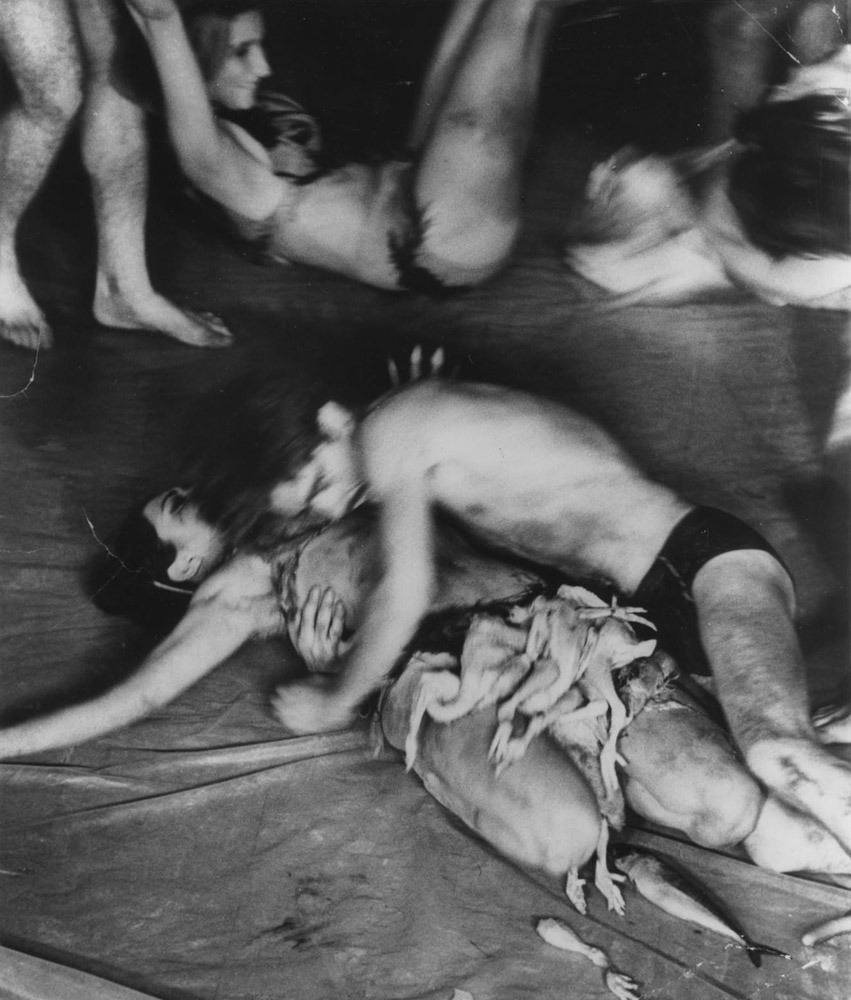
Carolee Schneemann – Meat Joy (1964)
Most people associate Schneemann with her 1975 Interior Scroll piece–wherein she entered where a coat, disrobed to reveal herself wearing a smock proceeded to paint an outline of herself before stripping naked and unspooling a scroll from inside her vagina and reading off a litany of negative reactions to her work by (mostly male) art critics.
Before seeing this photo, I was not familiar with Meat Joy–wherein eight people dance and play with paint, sausage, fish and raw chicken in an improvised erotic rite.
I’ve always had mixed feelings about Schneemann. Interior Scroll is one of the great performance pieces ever conceived, that’s not open to debate. However, as so much of her work is based in responded to rigidly ingrained misogyny in both art history and modern art criticism, her work frequently fails to engage beyond reactionary machinations. (Meat Joy for example is seemingly simultaneously critical of while also building upon Yves Klein’s Anthropometries–and I love Klein just as much as the next art nerd girl but his work is enormously problematic.)
What I learned in researching this post is that Schneemann is likely a victim of her own success in many ways. From very early in her career, she was interested in reclaiming her own nude depiction from its cultural and art historical appropriations.
Also, I learned that in 1964 she filmed herself and her boyfriend having sex and then painted, cut and defaced the 16mm footage before editing it into a piece she titled (in a brilliantly multivalent way) Fuses.
It’s all very Stan Brakhage with whom she was friends. Apparently, she was also super interested in avant-garde music. (These two things hit very close to home for me because I was trained formally as a film maker and one of my primary motivations to create arises as a result of being completely enamored with music but a garbage musician.)
So I suppose it shouldn’t surprise me that Schneemann alleged impetus for making Fuses was (according to her Wikipedia entry) “motivated by Schneemann’s desire to know if a woman’s
depiction of her own sexual acts was different from pornography and
classical art[.]”

Vincente Silva – Atora feat. Gracie for Sex Art (2016)
God wants to give us something, but cannot … because our hands are full – there’s nowhere to put it.
—Saint Augustine (via arterialtrees)


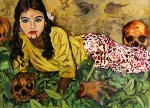
[↑] Kerbcrawlerghost – Detail from cover art for Weregoat’s Pestilential Rites of Infernal Fornication (2016); [-] Christian Martin Weiss – Untitled (2017); [↙] Source unknown – Title unknown (201X); [↘] Chitra Ganesh – Girls with Skulls (1999)
My initial thought had been to just throw this out there as an Acetylene Eyes All Hallow’s Eve themed post. But I’ve been pondering transgression a lot lately, so…
If you consider the Xtian belief that humans were given free will but in order for us to truly be free we had to be presented with the option to choose slavery by eating of the fruit from the Tree of the Knowledge of Good and Evil…
Except that’s already functionally wrong. The notion that freedom is less than intrinsic and is instead given or revoked suggests an overarching framework of command and control structures–which isn’t freedom, it’s authoritarian.
After the Biblical Fall, humanity is supposedly saddled with a sinful nature. (Again, logically this doesn’t track given that evangelical theology posits that Jesus was the both God and Man but if by being born he became human, then his sinful nature would’ve precluded his distinction of being without sin. The idea that Jesus was born with a sinful nature but never surrender to its temptations is truly a semantic dodge for the ages.
But what interests me is the inter-penetrative nature of sin and salvation–the latter both precludes and is necessitated by the former. If you remove either concept, the other becomes essentially meaningless.
There was this enormous tug-of-war in the Evangelical community when I was in high school in the 1990s. The notion of once saved always saved–by which rational I am still a Xtian–and the sin and salvation two-step (commit a sin, ask for forgiveness, sin again, ask for forgiveness again).
I don’t know how that ever shook out because I 100% stopped caring shortly after I became aware of this schism. (Judging by most Xtians these days, I’d say things landed decidedly on the side of once saved, always saved but that’s not at all scientific.)
But it occurs to me that sin is such a prerequisite for salvation, that perhaps sin is salvation.
The assertion seems like pablum until you stop and carry out a grammatical investigation of the way the concepts are used in context. A sin is wrong doing or making a mistake. I prefer the latter way of framing it. Because when you make a mistake–you either learn from it or continue making the same mistake. (There’s that famous criteria for insanity–wherein someone performs the same action again and again each time expecting a different outcome than the one that manifests.)
I don’t like the way that Xtianity situates sin as something motivated by guilt instead of a desire to learn and grow. (This manifests in other ways–where Xtians believe the world is going to end soon and do not really give more than half a shit about what they leave in their wake for subsequent generations.)
And I guess that’s my point here–I wish you all on not just today (but especially today) that you may not be afraid to trangress in favor of discovering that what you’ve been told isn’t a transgression or that it is and why it is so that you can learn and grow–so you become more instead of less.

Juan Stevens – Untitled (2014?)
I feel like I need to say about this upfront that while I think it’s deeply flawed, I do also think it’s a splendid image.
The points of criticism I have are that with the frame of the window in the background and the positioning of the woman, the composition does not suggest extension beyond the frame edges–thus her feet are essentially amputated, relegating her to the position of a signifier for both physical desirability and carnal accessibility. (I also love that the sharpest point of focus is slightly behind her head.)
That being said it is countered somwhat by the backlighting which controls what is concealed vs revealed (identity vs graphic depiction of erogenous zones). That aspect of the image is impressively sensitive and astute.
From the standpoint of visual grammar, this is a mess. The strident blue cast is beyond over the top.
Although that cast does contribute an undeniable tonal immediacy to what is depicted, it’s overly stylized in a way that isn’t justified by the context suggested from the frame.
It’s clearly full day-light beyond the blinds–pro-tip: as much as you think those standard issue Venetian blinds in your suburban cul de sac community can be made to recall Sin City, you’re dead wrong.
But let’s stick with the idea of Sin City for a minute because there’s something worth teasing out there. Sin City hinges on a visual conceit–a world embodying the overly stylized tropes of film noir.
Hollywood studios and backlots allowed filmmakers access to almost unlimited lighting and control over that lighting. So in most B&W movies through the early 1950s, you can tell whether a scene is happening at night or in the daylight just by how it’s shot. It’s not always convincing but it is consistent.
But as people moved towards shooting on location, this shifted. You can’t haul unlimited equipment all over town, obvs.
When I used to teach a crash course in lighting for cinema to undergrads, the question I always got was how to shoot exterior night scenes. And that’s a good question that lacks an adequate answer.
I think when people ask that they mean: how do I shoot something so it looks like Taxi Driver or Blade Runner or Collateral? And the truth is: you don’t shoot something like that because only Scorsese, Ridley Scott and Michael Mann are going to be able to command that kind of perfection in craft–and they can’t even pull it off every on every project they complete.
The prevailing idea has been based off the notion that moonlight is blue–it’s not really but it is perceived as such. Thus you had a period of shooting day for night where you shoot something in the middle of the day, underexpose by 2 stops and use a special filter–if you’ve seen an American B movie with exterior night scenes from the 1970s, you’ll know this because while it’s clear that they mean for you to think it’s night, it’s all very heavy handed.
I’m pretty sure it started on TV but the first time I remember seeing it was in an early Guillermo del Toro movie where a lot of bright lights were gelled blue and the scene was flooded with light to suggest night.
Film stocks and sensors have improved dramatically since the early 1990s, though. The issue is that with the move toward digital and the fact that digital formate fundamentally does not have the dynamic range to render vivid much less true black, the blue as indicator for night has become more or less codified.
I’m willing to give this a partial pass, however. I think that you could actually selectively darken the window so that the bed linens are brighter. Point is: that as a sketch this is top notch. I see high end fashion shit that costs thousands of dollars that doesn’t have a tenth of the diamond-in-the-rough insight as this. I just think that a great idea deserves to be revisited until you do the idea justice in execution.
As far as what I told those beginning filmmakers. How important is it that the viewer knows that it’s night. Is that all that matters? If so, then you can absolutely steal a page from Chantal Ackerman’s eternally underappreciated Jeanne Dielman, 23 quai du Commerce, Bruxelles–where mother and sun go walking every day after dinner in the pitch dark night. Or, with the improvements in film stocks you can go murky available light like Kiarostami’s Where Is the Friend’s House? Whereas both David Fincher and Paul Thomas Anderson deploy tactics similar to noir to different effect–the former is all about including practicals in the frame to suggest the source of the light and then using that a means of distracting from the staged lighting that is meticulously pieced together; the latter uses only just enough light to carve the scene out from shadows. (You won’t ever get quite the same effect, but it’s absolutely possible to improvise something in keeping with the principles guiding both of their decisions in your own work.)
Also, although I personally loathe his aesthetic, Hype Williams is someone with nearly endless versatility in his approach to low-light shooting.
Why do you never find anything written about that idiosyncratic thought you advert to, about your fascination with something no one else understands? Because it is up to you. There is something you find interesting, for a reason hard to explain. It is hard to explain because you have never read it on any page; there you begin. You were made and set here to give voice to this, your own astonishment. “The most demanding part of living a lifetime as an artist is the strict discipline of forcing oneself to work steadfastly along the nerve of one’s own most intimate sensitivity.” Anne Truitt, the sculptor, said this. Thoreau said it another way: know your own bone. “Pursue, keep up with, circle round and round your life…. Know your own bone: gnaw at it, bury it, unearth it, and gnaw at it still.”
 Acetylene Eyes