Source unknown – Title unknown (201X)

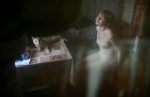
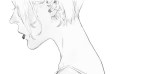
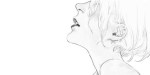
The use of line in this is truly exquisite–the way outer edge of the body is firm and between subtle shading and softer lines, a sense of the softness of the feathery hair and skin are embodied.

Compositionally, I’m not sure the top drawing works on its own. There’s too much negative space to the far right of the frame–the eye scans past the face and doesn’t return.

Yet–in combination, as a diptych–there’s a range of strangely authentic, unselfconscious experience presented that is fascinating.

A strange thing that I experience is there are times when my empathy is running hot or something and an scared emoji can make me worry about the poor thing’s well being. Most of the time–I really am phenomenally bad at interpreting expressions.

However, looking at these I’m certain that the top drawing might best be a depiction of the feeling we term ‘pensive’; while the lower one is almost certainly ‘abandon’–in the sense of something letting go as opposed to being let go of. (’Abandon’ a strange word that encapsulates both the experience of the subject and the object, depending upon contextual deployment.)

I sort of feel like this is an accurate depiction of the extreme poles of the spectrum upon which my own feelings exist.

Source unknown – Title unknown (201X)

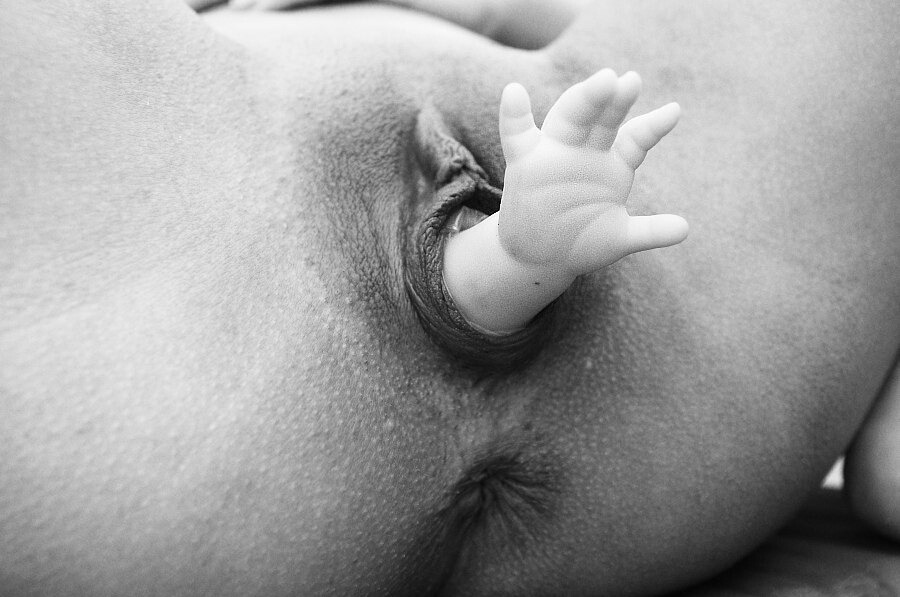
Usually, I’m a hard pass when it comes to close-ups.

It has to do with a certain lack of subtlety–like an insert shot in a movie where a character is shown gathering her things in order to leave the house and we see a shot of her grabbing her phone off her nightstand. It’s a knee jerk way of saying PAY ATTENTION TO THE PHONE, IT’LL TURN OUT TO BE IMPORTANT LATER.

A better example might be the detail in insert in an Art History text. You see Van Eyck’s Ghent Altarpiece in all it’s grandeur and then a close-up examination a of the strange fruit Eve is holding in it. Essentially, a close-up only really works/is necessary when it is presented in spatial and temporal context–i.e. cinema; or, it is intended to draw the viewers attention to something they might not otherwise notice.

And therein lays my beef with close-ups in still photography/digital imaging: unless the author is using polyptychs (and I can’t picture a way that would work off the top of my head), the close-up only functions when it conveys both its own context as well as clearly depict that to which the viewer is supposed to attend.

I like to think this is what Baudrillard had in mind when he noted (in Why Hasn’t Everything Already Disappeared?): “Behind every image, something has disappeared. And that is the source of its fascination…“

In the case of the above image–the scene has been reduced to two hands and –while I try very hard not to comment on the attractiveness of genitalia, these are some effing gorgeous gonads. (In the interest of equal representation, I’ve had this image sitting in queue for months. It’s a bit on the nose with the flower tattoo echoing Bailey Rayne’s labia–but it’s also an example of aesthetically breathtaking nether bits.)

What’s interesting here–at least for me–is that when you see ostensibly one body (the dangling balls and spread legs) with two hands there’s a tendency to attribute the scene to one person. And, actually, that isn’t the case here: this image shows a minimum of three different people.

It reminds me of the only David Foster Wallace book I’ve ever attempted to read. No, not Infinite Jest–I’m the only trash hipster girl who has never so much as pretended to read that one. I’m talking about Everything and More: A Compact History of Infinity.

The first 100 pages are breathless in their lucidity, wit and intrigue. The between the theoretical math and the footnotes I get completely lost.

But one of the things I learned is that we think of infinity as n+1 where n is any positive integer. But infinity is also n-1 where n is any negative integer. And! there is an infinite number of intervals between 1 and 2 and between -1 and -2. Infinities upon infinities.

Hold onto that bit for just a second. I’ll be getting back to it in a second.

I’ve also talked before about how there are times when the composition and order of a frame call for the viewer to consider what’s beyond the edge of the frame. Others, less so.

I’d venture to say that an effective close up is almost required to cause the viewer to consider what was cut out of the frame. (The above does this with aplomb.)

So I guess a good close up is kind of like infinity in that it finds a way to point to both the macro and micro. So, like David Foster Wallace, it’s not only interested in large and small, it’s interested in the infinite number of ways you can slice up the space between any two numbers.

Really, it’s not that close-ups are intrinsically bad–it’s that it requires a great deal more work to get them to operate with sensitivity, grace, subtlety and nuance.
Otto MuehlOh Sensibility (1970)

My response to this was what the fuck is even going on here? (See also: is that a real live fucking goose?)

I
was intrigued enough to look into this a bit and my initial curiosity
now makes sense. It seems Muehl was–at least initially–a sculptor
preoccupied with “overcom[ing] easel painting by representing its destruction process.

That was the early 60s, by the 70s, Muehl shifted his efforts so that they were more inline with NY style happenings–a
very particular flavor of performance art. (I won’t pretend that much
of it hasn’t dated poorly but I do think that young artists–especially
photographers/image makers–do themselves a service by becoming familiar
with the tradition.)

Muehl pursued what he called Viennese
Actionism–essentially happenings in and around Vienna. (The influence
of Fluxus on Viennese Actionsim should absolutely be noted–as the
action from which the above photo emerged was apparently filmed. You can
watch it here.
Full disclosure: I’ve tried to watch it twice and just can’t get beyond
the pantomine of a painfully self-conscious orgy aspect of it.)

A
decade later he renounced Viennese Actionism as painfully bourgeois (a
paraphrase) and began the Friedrichshof commune–where he behaved more
or less like a authoritarian David Koresh.

His behavior at the
commune landed him in jail in the 1990s. The commune he built fell apart
and by the time he was released from prison, he moved to another
commune in Portugal.

Source unknown – Title unknown (201X)

I think this video may be the porn clip that I have watched the most in my entire life.

Technically, it’s flawed. But the technical doesn’t matter so much when the sex is so thoroughly and legitimately haute.

From their seemingly coordinated ink: his Judge me, her Justice; to the inversion of the porn trope where the starlet furious rubs her clit while a muscle-bound stud uses his erect cock more like a gas powered chisel than a tool meant (among other things) for providing sexual pleasure; and–my personal favorite, the way she licks his semen off his tummy and then gives him a sample of the mess he’s made.

Unffff. (Also, this clip gave me a thought for a performance piece I’d like to enact at some point. I think it could be positively scandalous…)

Olivier KervernParis (2010)

I know the saying: those who can’t do, teach; those who can’t teach, teach Phys. Ed. But I’ve always loved teaching–that moment where the light bulb suddenly illuminates. I don’t know…it always feels like you’re doing something that actually makes a difference in some small, concrete way.

I daydream a lot and a frequently recurring motif is being a photography teacher. I coach imaginary students and construct pithy activities.

One such activity would be for each student to bring two contact prints of one roll of 35mm film to class. (Of course contact sheets, it’s foolish to attempt to teach students photography by allowing them to substitute a completely different standard–i.e. digital imaging.) On the first sheet, the student will have indicated their choice for the best 3 frames on the roll in white grease pencil; the second sheet will remain pristine.

The pristine copies will be reviewed by their classmates. Everyone–except the photographer–will vote to choose the top three images. Subsequently the student will reveal their picks and share why the picked them. The class would have a chance to respond and then I would inquire if the student agreed or disagreed–and to provide an accounting of their considerations in making their final decision.

In my head, there’s usually some overlap between what the photographer selects initially and what the class chooses. It’s all intended to be a valuable lesson in considering the reaction of your audience and standards and expectaitons with regard to interpreting visual grammar.

But as a teacher, as a photographer and as an individual, I’m always going to be interested in the discrepancies.

If you placed Olivier Kervern in this scenario, I’m pretty sure there would be zero overlap between his selections and the class’.

Given Kervern’s body of work I’d be inclined to not let him join the class. It’s really not very good. Except… this is extraordinary. And it’s never something I’d pick off of the contact sheet assignment.

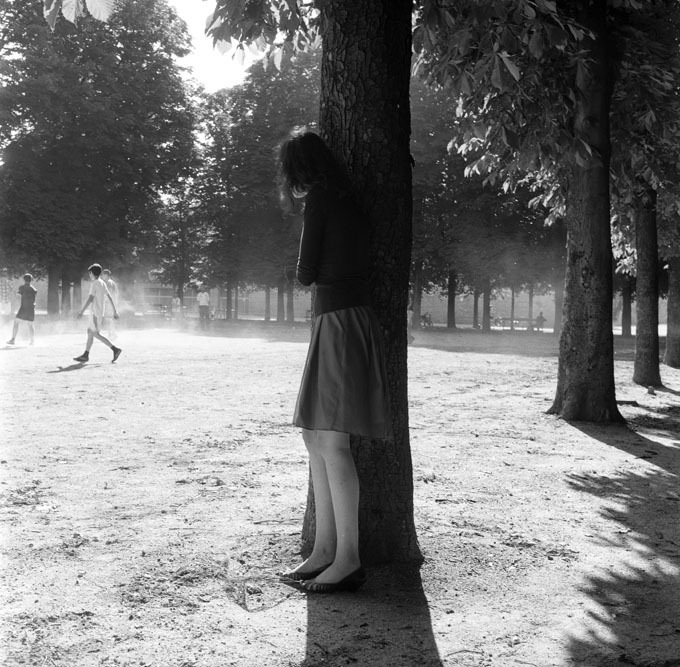
Look at the photo. Seems pretty balanced between light and dark, doesn’t it. It’s not. Highlight tones make up roughly 2/3 of the frame, but the shadows seem to dominate–mostly because they control the foreground.

Then there’s the young woman–who appears to be simultaneously a part of the tree and a figure hiding behind it watching the boys playing on the field–a feeling of quite literally being rooted in the shadows, while also stepping out into the light. (This is part of why I’d never pick this based off a contact print, the fusing of the woman and the tree is almost certainly something done via post-exposure means.)

I also freaking adore the way that her voyeurism is not open to any sort of interpretation. There’s not enough context but even if you assume–which I don’t think is incorrect–that she fancies a boy on the field (who likely doesn’t even know she exists), the focus is too sharply directed towards the implication of the viewer’s voyeurism. In the watching her watching, we have more access to our own motivations than we do to hers.

Finally, there’s my empathic response. It’s very rare that I see a work of art and am willing to assert that the author understands what it is to be as lonely as I am. Pretty sure Kervern is an exception that proves the rule.