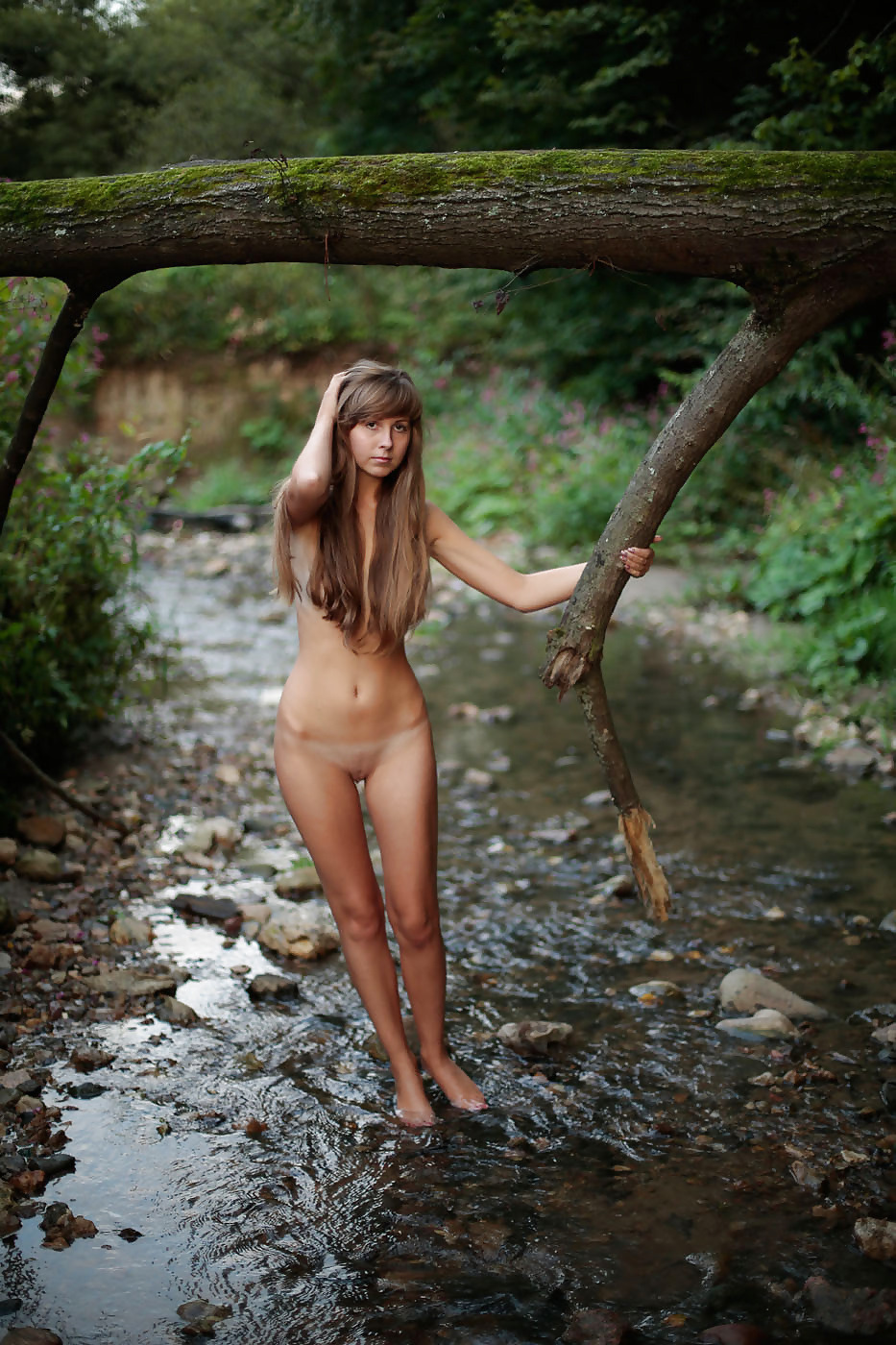
Author unknown – Catherine from Summer Stream series (2013)

This features a solid concept. Like I’m fairly certain anyone who has spent any kind of time behind a camera, would’ve absolutely seen this as a shot if the tableau were unfolding before them in the moment.

And I don’t actually have any of my usual #skinnyframebullshit qualms with the vertical orientation here–you want to emphasize the way her pose is echoing the shape of the branch onto which she’s holding. (A horizontal frame would necessarily privilege the fallen tree.)

The extremely shallow depth of field recalls Mona Kuhn–except she’s working analog (which features an automatically shallower DoF, with much better lenses, and you know uses bokeh to dimensional effect).

The bokeh in the above is super digital artifact-y and not especially flattering; I’d also argue given the frame that it’s a mistake as the lighting being as it is, the eye would naturally bestow a much larger DoF on the scene since Catherine is clearly aware of being seen and the expression on her face makes it clear that even if she is a wood nymph, she’s being witnessed by a human watcher).

So while I don’t think this is exactly well-executed, it still fundamentally works based on the premise it conveys.

That feeling that causes a photographer or image maker to raise the viewfinder to their eye and try to feel what they did when they saw something that captivated them is something I’ve been thinking a lot about–usually while high as fuck on extremely potent marijuana edibles.

I’m not a linguist–not even close. But it occurred to me that ‘optical’ and ‘option’ feature the same root: opt-.

Optic is from the Greek by way of Medieval Latin; Opt would’ve been emerged in Latin about 50 years after optic.

I’m not sure how to rigorously go about it, but it seems to be that there is likely some conceptual underpinning of language that understands seeing and choosing as related and frequently overlapping processes.

So yeah, those are my cursory notes for a future first day as a beginning photography teacher lecture.

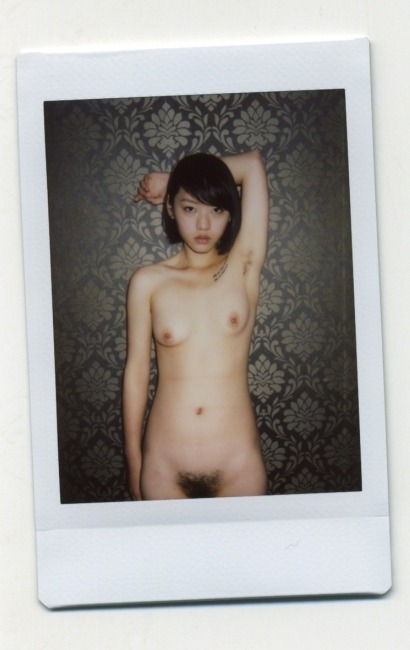
9mouthUntitled from Instax Love series (201X)

The Sino photographer identifiable by the moniker 9mouth is hugely problematic. (I won’t repeat myself: you can read my previous thoughts on his process here.)

Still he does manage to produce some truly breathtaking photos–seemingly in spite of his galling misogynist bombast.

Here the interplay between the flash and the semi-reflective wallpaper renders an incrementally overexposed skin tone–not only flattering but also steeped in an almost tonal patina of late night in a seedy love motel vibe.

The model’s expression is an inscrutable defensive wall–is she bored? annoyed/impatient? judgmental (of the photographer? Or the viewer? Little of column A, little of column B?)

I get the sense that this is very much front loaded with ambiguity. There is a very compelling feeling of intimacy; yet, also a sense that the intimacy is forced–not exactly contrived or coerced but conditional somehow.

That conditional consideration and that it is effectively what makes this image so successful is more than a little discomfiting. (At least to me.) So while I am willing to acknowledge that this is an astute image–I think it functions in a fashion that operates in a sort of beyond good and evil approach to broader issues of consent and visual representation. Another way to say it might be to say that if mainstream porn shifted its model to produce art, it would likely come off much like this.

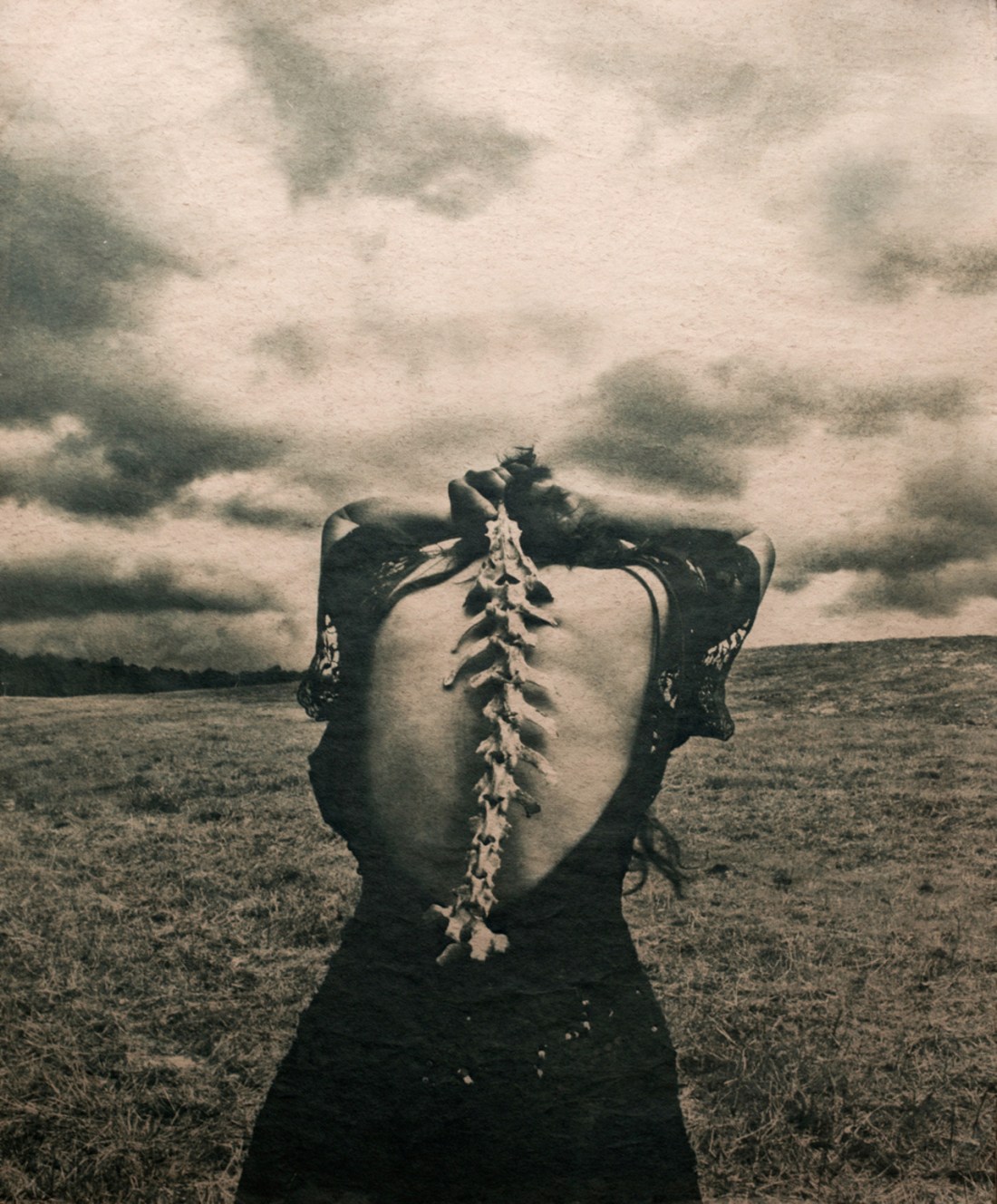
Jaime Erin JohnsonSpine (201X)

Everyone is familiar with the experience of seeing something and swearing they’ve seen it before even though they have never seen it–the experience of déjà vu.

Somewhere exactly halfway between the inverse and opposite of that is what’s called jamais vu–seeing something known as if for the first time.

For me, this photo sits somewhere between déjà vu and jamais vu: I am reasonable certain I’ve never seen it.

..yet I’ve had a notion of making a stunningly similar scene for a while now…

The great photography as fine art curator John Szarkowski maintained that all photos functioned as either windows or mirrors–respectively: showing the viewer the world around them or showing them something about themselves.

I tend to get tetchy about either/or dichotomies. (Or, as the joke goes: there are two types of people in this world; hard working decent folks and assholes who go around sorting everyone around them based on arbitrary bifurcative criteria.) However, I think for the epoch in which Szarkowski worked, windows and mirrors were arguably better criteria than might’ve otherwise be employed.

The thing I wonder is if maybe they no longer apply. I mean photography as a discipline has been predominantly focused on The World As It Is ™ for much of its formative years. (Arguments about the potential for a photograph or image to be subjective, notwithstanding, of course.)

Something I do that I’m not sure whether actually trained art historians do is the tendency to extrapolate based on trends that have already run their course.

There’s the interpenetrative history of dadaism and surrealism–and I’d argue that dadaism arguably better earns the surrealist designation, while surrealism was something more interested in toeing the line of what these days gets termed: oneiric.

As I’ve pointed out David Lynch has made a career out of sometimes skillfully, other times clumsily conflated surreality and oneirism. (In fact it occurs to me that his best work occurs when he actually distinguishes between the two with some sort of logical system–that no matter how difficult it is to parse, keeps these differing impulses in their own respective lanes. And, here I am thinking explicitly of Mulholland Dr. Although if you’d prefer me to restrict things to the realm of photography, I’ll see you Josef Koudelka and raise you Arno Rafael Minkkinen.)

Also, photography doesn’t really have a surrealist branch of practice. I mean you’ve got Joel-Peter Witkin and Jerry Uelsmann–and I’d place both closer to say whatever the hell it was H. R. Giger was on about than of a piece with Salvador Dali.

My point is merely that I don’t think Szarkowski’s windows/mirrors bifurcation works any more–except maybe in oneiric deviations of photography/image making.

It seems like surrealism is invested in showing us a world that is enough like our waking world that were it possible we could step into it and ‘inhabit’ it. Oneirism reintroduces us to a world we already know–but may have forgotten upon waking.

In effect: surrealism is a window, whereas oneirism is a mirror.

And what I adore about Jaime Erin Johnson’s image here is that the experience I have looking at it is virtually identical to encountering a word in The Dictionary of Obscure Sorrows that describes something I’ve felt is an experience only I have ever had–only to discover that a language I don’t speak or know found that feeling important enough to name.

It really doesn’t matter whether I’ve ever seen this image before–it works because it taps into a sort of archetypal symbology to convey the reality of an emotion that has been if not fully inhabited, then at least methodically studied.

[↑] Adam MillerFallout from Compositions series (2012); [+] Akseli Gallen-KallelaBy the River of Tuonela (1903); [↓] All Fine Girls – Vika (201X)

I save things as drafts thinking to myself: self, this belongs here.

Unfortunately–often when it comes to composing some sort of accompanying text, my thoughts scatter like roaches when you flip the light switch.

Dredging through drafts, trying to figure out items to post–it occurred to me that it’s the expressions in these that appeal to me.

In the top image, the woman has an expression which–independent of the title–comes across as mismatched with her surroundings. She looks wild-eyed and terrified except at the same time she’s more engaged than those around her. When I discovered the painting is titled ‘Fallout,’ something finally clicked for me: she’s one of those people who only ever feels fully alive responding to and thrilling in abject chaos and catastrophic tumult.

The second painting is based on a the Kalevala–roughly like a cross between the Aeneid and the Icelandic sagas except being fundamentally Finnish (as best as I can tell). The subject of the painting consists of the hero being tasked with completing three difficult tasks, the third of which is slaying a swan on the river Tuonela.

In the painting, the hero (Lemminkäinen) departs in his canoe.

Additional context: this painting was a sketch for a fresco in a mausoleum dedicated to the memory of the daughter of a prominent businessman who died at age eleven. It’s presumably her with the braid trailing down her back and her budding breast exposed, invisible to the other gathered onlookers.

Everything about her suggests that although she does not know what she has lost, she understands what the loss has cost her in a way that no one else can or will.

I am unbelievably conflicted about posting this image. It’s porn and not even good porn. Further, I think it is unspeakably heinous when grown ass men refer to women they are attracted to or wish to pursue romantically as ‘girls’–it’s gross and a huge red flag. (And I absolutely judge men I hear do this as total creeps.)

In my experience, to achieve orgasm, you have to stop thinking, stop trying to get off, let go and surrender to an unmediated experience of physical sensation.

By letting go, you can just kind of float there and wait for it like a wave rolling in from the sea. But in letting go, you can also reach for something.

I won’t presume to know what this young woman is experiencing but she is reaching–and with this stunning, febrile desperation. It’s breath-taking to stare at, honestly.

When it comes down to it, these expressions are all unusual to witness in person–let alone in visual media. What impresses me and caused me to eventually put them all in the same place is that they are all expressions I’ve seen in the mirror, especially Vika’s desperate reaching. That’s so close to home, I have trouble fighting to urge to claim this as an ersatz self-portrait.

Joseph KosuthArt as Idea as Idea {Meaning} (1967)

The above is one work referenced in art historian Terry Smith’s essay One And Three Ideas: Conceptualism Before, During and After Conceptual Art for E-Flux #29. (November 2011)

It’s written in an overly academic style–that I find supremely off-putting. Usually, that style of writing has the advantage of being nominally clear. This gets damn near tautological in places.

It does make some interesting points, though. The notion that the term ‘conceptual’ was in place and fairly well codified ahead of its critical deployment is well taken.

I was unfamiliar with any of the works he chose to feature–and I’m intrigued by his thesis regarding the far ranging impact of Moscow Romantic Conceptualism on modern Russian Art.

The other issue is that I am not convinced you can talk about the ‘conceptual’, conceptual art and/or ‘conceptualism’ without a broad cross genre analysis–for example there’s parenthetical mention of Acconci, but little else along that track. Also, he rightly includes Jeff Wall–but overlooks Alfredo Jaar.

I recommend it–even if it’s only for the myriad points of departure it offers. (And that’s the only thing I really miss about academia…)

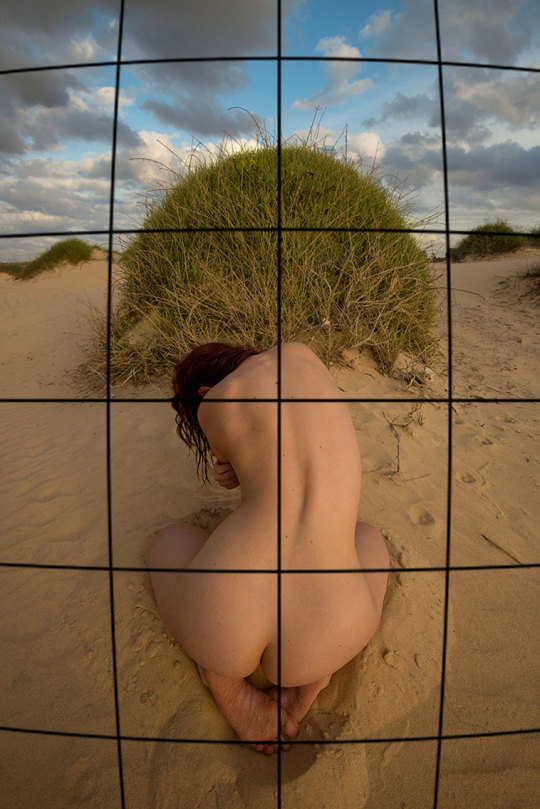
Dejan Dizdar AKA CDAstudioD0215 (2013)

If
not exactly a good image, it does feature several noteworthy facets: it
bears the blanket blessing bestowed by dwindling golden hour light, the
pose imposes an intriguing sculptural form against the sand, sky and I
suppose you’d term that grassy mass ‘a tuffet’.

What is extremely
cool is that the camera is essentially pointed up hill–giving a view of
both the ground sloping upward as well as the clouds strewn all about
overhead.

However, unless I’m mistaken, part of what makes this work is a feature of optical distortion–specifically what’s
termed barrel distortion; basically, horizontal and vertical lines only
run truly side to side or up and down, respectively, at the center of
the frame. The further you are from center frame the more they bulge
outward. Like so:

Not how this visual aberration creates and illusion of bringing the model closer while pushing the sky further back:

Ellsworth KellyCité (1951)

Lying in a Hammock at William Duffy’s Farm in Pine Island, Minnesota
By James Wright

Over my head, I see the bronze butterfly,  
Asleep on the black trunk,
Blowing like a leaf in green shadow.  
Down the ravine behind the empty house,  
The cowbells follow one another  
Into the distances of the afternoon.  
To my right,
In a field of sunlight between two pines,  
The droppings of last year’s horses  
Blaze up into golden stones.
I lean back, as the evening darkens and comes on.  
A chicken hawk floats over, looking for home.
I have wasted my life.