Aino Kannisto – [↑↖ ] Untitled {Launderette} (1999); [↑↗] Untitled {?} (20XX); [↖] Untitled {White Tub} (2008); [↗] Untitled {Stripey Curtains} (2013); [↙] Woman Washing Herself from Delicate Demons {collaboration with Satu Haavisto}; [↘] Woman on a Hospital Bed from Delicate Demons {collaboration with Satu Haavisto} (2014); [↓↙] Untitled {Shower II} (2000); [↓↘] Untitled {Bathtub} (2015)
Um… so… :::looks down at toe of boots and kicks clumsily at imaginary dirt::: this is like really, really, super, above-and-beyond, over-the-top phenomenal work.
Kannisto’s a member of The Helsinki School and fucking A, if you want to you yourself a jealousy aneurysm–go ahead and check that out. (It’s EXTREMELY rare to find a group with this much stellar work to their collective credit.)
Her use of color is more understated that Prue Stent–but understated color that still is integral to the work is actually incredibly difficult to manage.
Plus, I’m always gonna go gaga for any artist that is intimately familiar with both Uta Barth and Johannes Vermeer.
But what I think is most impressive about her work is how she fits so much narrative potential into such minimal and unadorned frames.
God, it is really unnerving to look at work that this incredible–because it’s a rare occasion and it’s happened maybe three times in the almost six years that I’ve been running this blog that I’ve seen indications that what I feel is important to photography as a form is something other artists are also tuned into/turned onto.
Thanks so much to @absolution-v, for his post featuring Kannisto–without it I’d probably have gone another five years without knowing about her. (Also, if you aren’t already, you should definitely check out Absolution-V’s blog–it’s offbeat and eccentric but I’m routinely introduced to work I’d otherwise miss.)
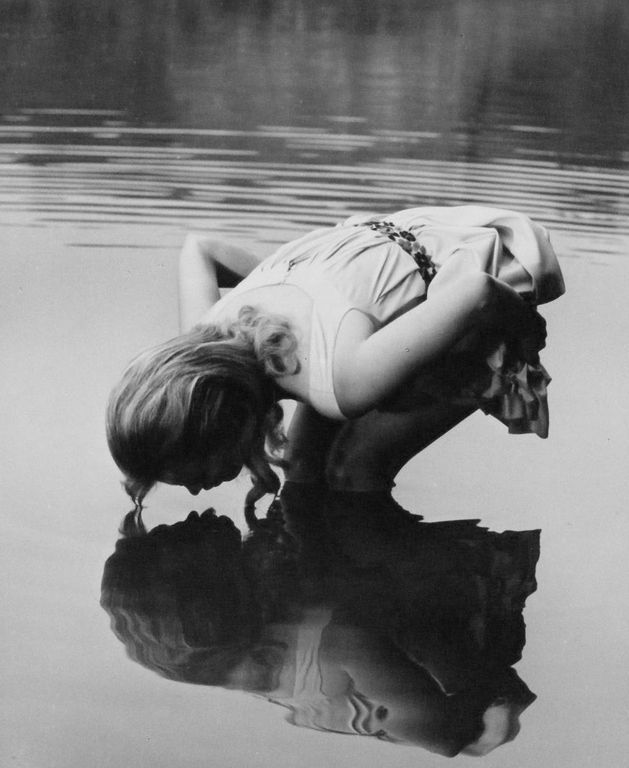
I know nothing about Rossen and precious little about Seberg.
I’m posting this because damned if this isn’t a precursor to, like, a third of Arno Rafael Minkkinen’s work.
What interests me more has to do with the title: Lilith.
Thanks to the Lilith Fair, I think most people know that Lilith was the Adam of Biblical myth’s first wife.
The details of her story are wonderful. Unlike Eve, she was made from the same dirt as Adam–instead of a pilfered rib. She refused to be subservient to Adam and eventually departed the garden of Eden, had an affair with an angel and refused to ever return. As such: Eve was fabricated.
Another post that I saw this morning mentioned the story of Susanna and the Elders–expurgated from The Book of Daniel. Essentially, two total creep see Susanna bathing in a garden and approach her saying that if she doesn’t surrender to them sexually they will publicly impugn her virtue. She doesn’t go along and so she is put on trail.
Daniel is like–well, let’s interview them separately and compare their stories. One says she was bathing under a mastic tree; the other an Oak. The size difference in the trees means that neither is telling the truth because one tree is small and another is enormous.
I went to a parochial school and I find these stories fascinating because the world in which they take place is familiar but these take on a slant that make them more relateable, they are also somehow more believable.
Also, I’m curious what other sort of ‘aprocryphal’ stories like these with which I am unfamiliar. I’m starting to think it might be worth building a body of work based around these strong women who were deleted or marginalized (looking at you Bathsheeba) by The Bible and creating photographic icons for them. So what about it? What other similar stories about strong women am I missing, should I consider?
To find a honey tree, first catch a bee. Catch a bee when its legs are heavy with pollen; then it is ready for home. It is simple enough to catch a bee on a flower: hold a cup or glass above the bee, and when it flies up, cap the cup with a piece of cardboard. Carry the bee to a nearby open spot—best an elevated one—release it, and watch where it goes. Keep your eyes on it as long as you can see it, and hie you to that last known place. Wait there until you see another bee; catch it, release it, and watch. Bee after bee will lead toward the honey tree, until you see the final bee enter the tree. Thoreau describes this process in his journals. So a book leads its writer.
You may wonder how you start, how you catch the first one. What do you use for bait?
You have no choice. One bad winter in the Arctic, and not too long ago, an Algonquin woman and her baby were left alone after everyone else in their winter camp had starved. Ernest Thompson Seton tells it. The woman walked from the camp where everyone had died, and found at a lake a cache. The cache contained one small fishhook. It was simple to rig a line, but she had no bait, and no hope of bait. The baby cried. She took a knife and cut a strip from her own thigh. She fished with the worm of her own flesh and caught a jackfish; she fed the child and herself. Of course she saved the fish gut for bait. She lived alone at the lake, on fish, until spring, when she walked out again and found people. Seton’s informant had seen the scar on her thigh.
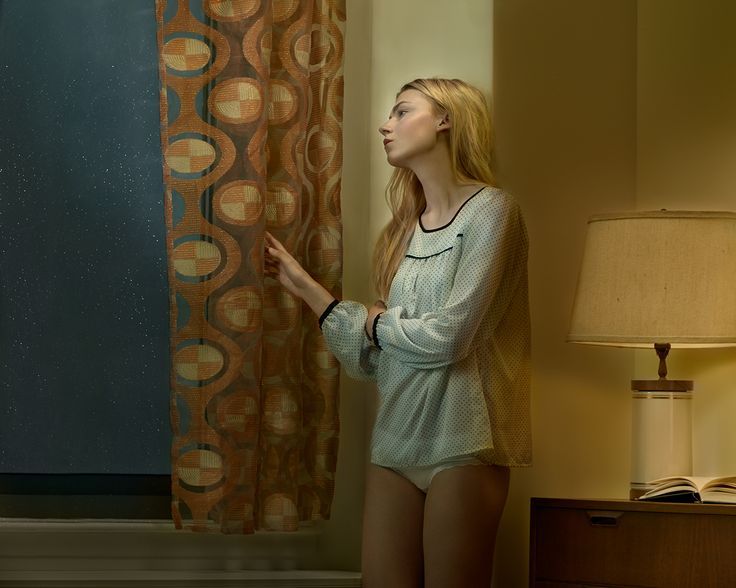
muse-of-maestro – I’ve been lost in my own skin lately. The season is about to change and so, to, must I. (2017)
I see literally hundreds of boudoir selfies and self-portraits slide across my Tumblr dash every damn day–the idea is painfully self-same; the execution is almost universally shitty.
This, though? This is effing intriguing.
Yeah, you’ve gotta ding some points for the camera not being exactly level–but neither are the frames on the wall, so it could feasibly be that. (I’d bet that it’s both, fwiw.)
Also, it’s overexposed by more than a stop–the adage for analog being expose for shadow, develop for highlight gets reversed with working with digital; in other words: expose for the highlight by making sure the brightest area of the frame is what your exposure (when something digital is overexposed it leaves you zero data to work) and then add shadows back in post. (I’ll never be an adherent when it comes to digital but having just returned from Iceland where I shot an equal amount of film and digital for the first time ever, I can say that if you abide by this dictum, you’ll be able to correct things enough to get a usable shot in post.)
I actually copied this image into the iPhone editing interface–which is infuriating until you realize that the engineers have built out the workflow in such a fashion to teach the user through repetition how each adjustment interacts with the base image and subsequently applied adjustments. (Getting the hang of this will actually sharpen your Photoshop chops immeasurably.)
But yeah, I corrected the overexposure as best I could. (The rainbow artifacting along the left edge, near the middle is a result of the lack of data from overexposure.) Adjusted for a more balanced skin tone–added some shadows (if I was doing it in Photoshop I’d have gone back and selectively dialed back the shadows on the right most frame–which go too dark in this edit.)
Pushed the color just a little and then added a bit of a warmer cast.
And viola! You can see that although it’s imperfect there’s a bit of the feel of a Flemish oil painting to this–which is likely what I responded to upon seeing this.
I like to revisit things, dwell with them for long spells. It’s why I travel to the same places over and over again. Relisten to the same albums for the 400th time. I like things that unfold over-time; that still reveal new things to me, after years of time, effort and energy invested in them.
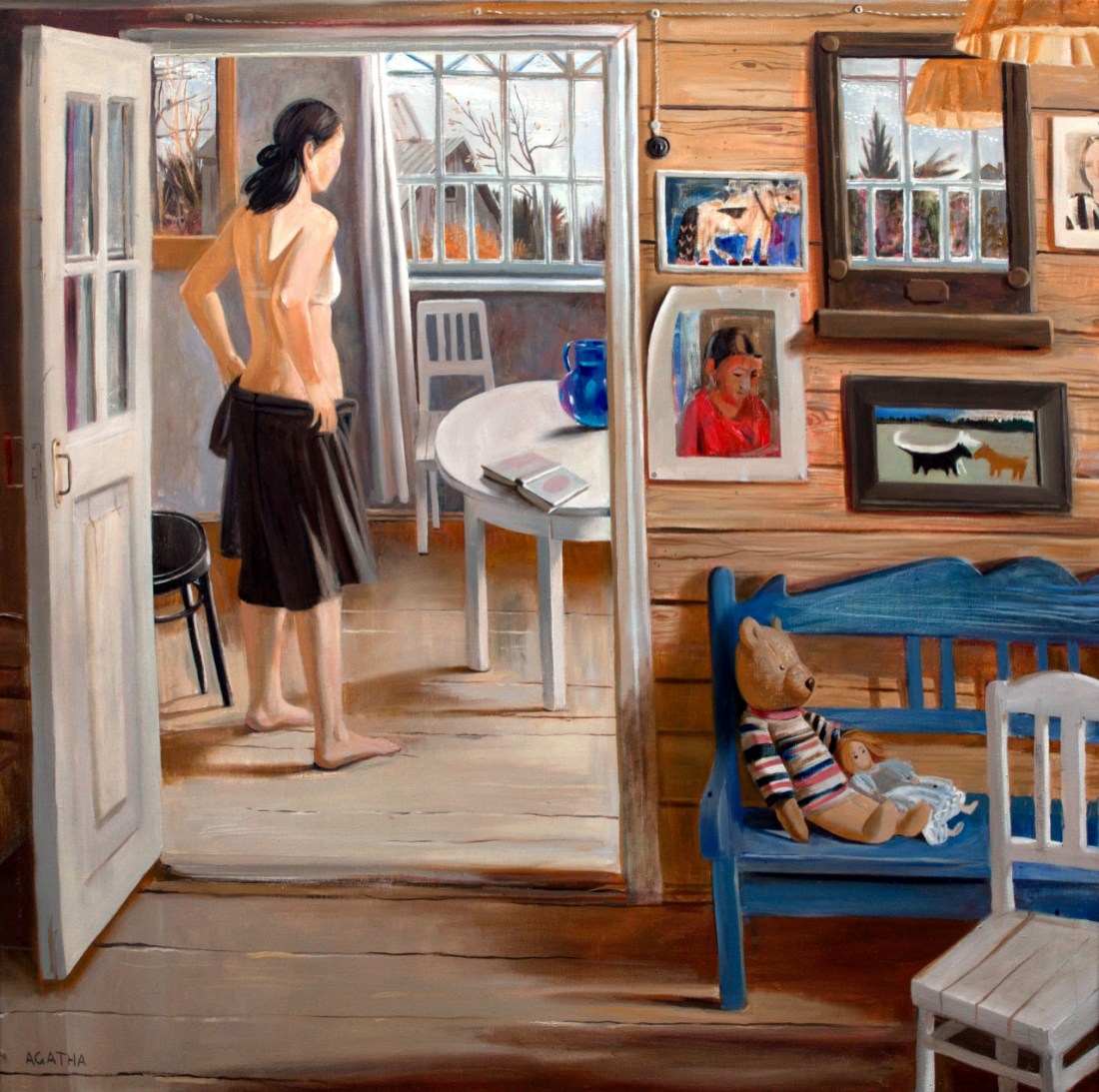
I first saw this image while I was in Iceland. I knew immediately that the artist was located in some Nordic clime–in this case Saint Petersburg.
So many people go to Iceland because of how wild and alien it is. But part of what makes it so astonishingly magical is the arctic light–and what this painting manages to capture stunningly is the grey-on-white-on-blue color cast of that light.
As I’ve returned to this–knowing I want to post it, but not knowing what I want to convey about it–I keep noticing new details. For example: check the mirror on the wall in the upper right third of the canvas–you can see the shade of the hanging lamp reflected in it; also you get a glimpse of a window along the fourth wall.
This is brilliant for a number of reasons. It opens the frame. It implies the viewer as voyeur. It also cleverly enhances the direction of the light. For example the light in the reflection of the window along the fourth wall is brighter than the light seen through the window in the background–which would be what you would expect given the angle of the shadow the woman is casting.
The thing I just realized though is why things look a bit wawkerjawed. There are definitely some minor issues with scale. (I would conjecture that they are intended to convey a sense of oneirinism not unlike the rotoscoping in Waking Life.)
My mom has these antique-y wood block landscapes by this artist Theodore Degroot that she adores. (I’ve always found them positively garish.) But the floor in Belaya’s painting resembles them. And for whatever reason my rotten brain got on the subject of perspective.
Belaya’s painting is implicitly one point perspective. (Let go of the white chair in the foreground for a bit, I’ll get back to that…)
I can illustrate what I mean better than I can describe it. Here’s a drawing in one point perspective:
Now consider this detail:
In the master frame, it’s fine. But in the detail, the scale seems exaggerated, things seem a bit off.
I think this is a function of a number of things. It is possible to render something in one point perspective with the vanishing point either within the frame or outside it. It strikes me that when viewing things that are ordered and linear, we accept images where the vanishing point is within the frame as being more realistic in appearance to our eye (because we notice what is closer and more detailed and since the pattern essentially repeats as things move from foreground to background, the shift in scale gets glossed over.
More often than not–architectural order does not prevail, however. The majority of the world does not conform to the specifications taught by visual perspective.
And here let’s return to that white chair… what happens if you have an object oriented in two point perspective in an otherwise one point vantage?
It almost works but there’s always going to be something off about it.
So yes, with Belaya there’s a dream-like feel to things. But also, she’s definitely playing with the tension between the order of squares and rectangles in architecture but she’s also acknowledging that sometimes living in a space necessarily imposes a disorder to it.
Also, I think here image is actually in a more rigid perspective than you’d otherwise notice, except we’re getting a Matisse view instead of a Bruegel view. (Given the Bruegel view, it would be easier to see what I mean but the point isn’t to spell it out. It’s to get you to see it for yourself. Which reminds me of Borges story about the map so detailed that it became larger than the area it depicted and it end up folded up and moldering in the desert–there’s something about the contentious relationship between photography and fine art here that someone brighter than myself might try to tease out.)
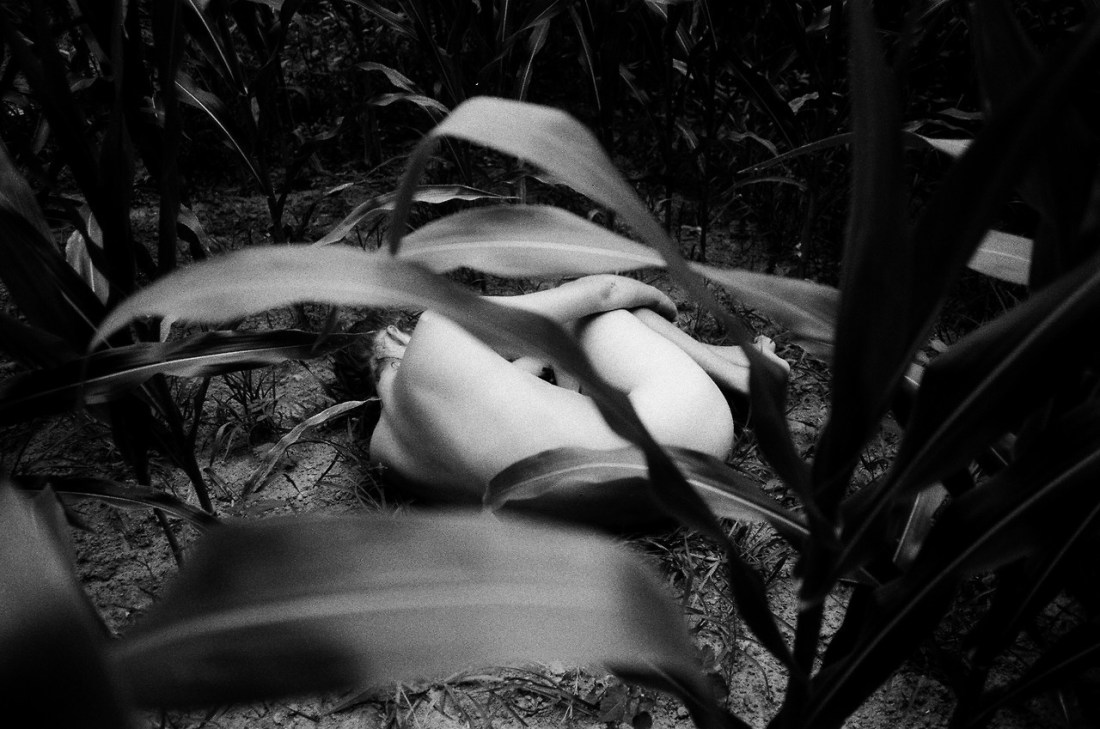
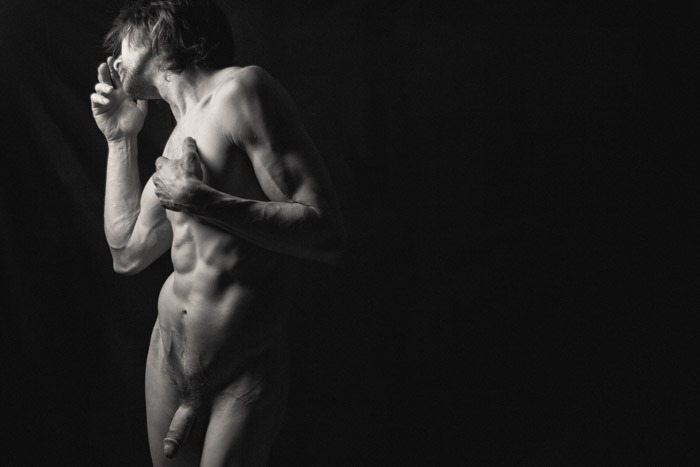
DearIndifference – Untitled from Out of The Shadows / Into The Light series (2013)
Chiaroscuro is the art historical term used to indicate work–predominantly oil paintings–which feature a strong divergence between light and dark.
A lesser known term that is frequently used interchangeably is tenebrism.
The two terms are not interchangeable.
When you’re discussing, say: Rembrandt, you’re firmly in the realm of chiaroscuro–contrast between light and shadow used to pointedly dramatic effect.
Tenebrism is less dramatic and more outright violent–in fact, it’s a term that might as well be reserved for the work of Caravaggio.
…
The confusion in application seem to mostly post-date the work which was foundational in illustrating their attributes. Chiaroscuro was a product of the early Renaissance; Caravaggio was either late Renaissance or post-Renaissance, depending upon whom you ask.
In the early 17th Century, a bunch of Dutch painters traveled to Rome and became insufferable Caravaggio fanboys. They returned to Holland and dubbed themselves The Utrecht Caravaggisti. (The work of these folks with which I am familiar is decidedly chiarscurous–as opposed to tenebristic–in nature.)
I am hardly an art historian–although I had an extraordinary Survey of Western Art I & II professor–but I can’t look at the work of these Caravaggisti and not see how it shaped Rembrandt’s style. Yes, Rembrandt can be gloomy and murky–but with a few exceptions (The Night Watch being one), Rembrandt dwelt in shadows and mid-tones; his work lacks the riotous gambit from light to dark that I see as a prerequisite for application of the term ‘tenebristic’.
(Add to the list of essays I’ll never get around to writing an analysis of how the film theory pissing match over where noir officially ends and neo-noir begins is actually staggeringly interrelated with the considerations of chiaroscuro vs tenebrism.)
…
I would unequivocally take about the above in terms of tenebrism. Further, I think its texture, scale and nuance are effing extraordinary.
It’s also audaciously brash in a very quiet way–typically, with so much negative space you’d want to position the subject so that the position of the head and neck invite the viewer to consider the negative space. The negative space here feels holistic. The pose is such that the body not only balances the frame so that your eye scans and rescans everything whether there’s something to see there or not–but there’s a way in which the subject ignoring the massed darkness, seems to create this tension between light and dark. Is his body emerging from it or being swallowed by it?
Also, it’s as if the raised left hand, the tilted head and the unseen eyes are actually more focused on the shadows than if the viewer were allowed to see the subject gazing into the darkness.
Since we last checked in with the world beyond the art-porn-iverse, a lot of super shitty shit has shit everywhere in the bed.
There have been not one (Harvey), not two (Irma), but three (Maria) catastrophic hurricanes. (Nothing at at all to do with climate change. That’s just a dumb librull conspiracy theory.)
The U.S. ‘President’ and Kim Jong-Un, the dictator of N. Korea–continue an idiotic battle of insults which could very well end up having very real and potentially nuclear consequences. (John Oliver scooped every other media source by delivering one of the most clear-eyed and thoughtful analyses of the state of things inside N. Korea.)
45 promised to rescind protection for so-called Dreamers–children of parents who entered the country illegally but who have grown up in the country more or less as citizens. (Honestly, there’s been so much back and forth on this that I don’t know where it stands now. However, unconscionable deportation efforts continue apace.)
Speaking of Dreamers, one of the activist networks I’m engaged with sent a document around advising folks how to react/respond. It was interesting because it included a reminder that while marijuana may be legal in certain jurisdictions, it is still very much illegal at the Federal level. This was–once more–a potent reminder that decriminalization/legalization efforts haven’t really achieved their goals if folks of color and other minorities are still being penalized for possession and use.
That being said: if you are a fellow Weedian, remain vigilante. @tanyadakin posted about her experience with a massive undercover sting in Philadelphia. Rumblings I’m hearing are that this is going to be become the new normal under Sessions DoJ watch. Please be careful out there.
But let’s end with something I don’t usually do–accentuate the positive.
A nazi got knocked the fuck out in Seattle. There’s video. It’s delightful.
Also–on a more personal note: I’ve seen the aurora borealis once, five years back. It was stunning the first time. But September is early in the season so you don’t expect more than a few swirls and curlicues. I noticed–almost by accident–that the Aurora forecast for the evening of Sept. 7th was a 5 (the scale runs from 0 to 8). I’ve never been in Iceland when there was a 5. My BFF and I decided to go on a tour and well, OMFG!!! It started as soon as we got of the bus… just streaks here and there and then for 25 minutes the entire sky was alight with shimmeringly undulating waves of dancing light. The guides were stunned and kept saying they get way brighter than this but they are NEVER this active. I stood turning in circles (you had to, there was too much to take in from a stationary vantage) in a lava field for the better part of an hour.
How wonderful was the experience? Put it this way, I was one of the the fifteen hundred some folks who sat with Marina Abramovic when she did her The Artist is Present performance. It was 100x better than that. (I also learned that in extremely desolate and uninhabited climes, you can hear the northern lights. Needless to say hearing this has become a new item on my bucket list.)









 Acetylene Eyes