The only way to bear the overwhelming pain of oppression is by telling, in all its detail, in the presence of witnesses and in a context of resistance, how unbearable it is. If we attempt to craft resistance without understanding this task, we are collectively vulnerable to all the errors of judgement that unresolved trauma generates in individuals. It is part of our task as revolutionary people, people who want deep-rooted, radical change, to be as whole as it is possible for us to be. This can only be done if we face the reality of what oppression really means in our lives, not as abstract systems subject to analysis, but as an avalanche of traumas leaving a wake of devastation in the lives of real people who nevertheless remain human, unquenchable, complex and full of possibility.

Aurora Levins Morales, Medicine Stories: History, Culture and the Politics of Integrity (via theoceanwithin)

Source unknown – Title unknown (1959?)

I’m intrigued by this photograph. (So much so, in fact, that I’ve spent several hours I don’t really have right now trying to learn something about it’s provenance; sadly, there’s nothing.)

The curious thing is that a lot of the blogs that have posted this generally have a lot of overlap with my own personal interests. And I have some–if we’re being polite–offbeat interests.

As far as just looking at the photo as it’s presented, I feel a lot of the things about controlling context with regards to Valerie Chiang’s All info is in the image applies equally here–even if it does work to a different end, i.e. in this case the control of context isn’t in service of clarifying anything, it’s intended to emphasize a certain enigma.

Like what I do know is that this is most likely a photo made with a 50mm lens–based on the angle of view–operated at a narrow aperture. (The focus between her chin as it’s tilted back and the ridge line in the distance suggests a wide depth of field & imposes on her a sense of being a part of the landscape a la Duchamp’s Étant donnés.)

It’s either a page from a photo album or is meant to resemble one. The 9659 is unusual. It could be a date. Sept. 6, 1959 in the US or 9 June 1959 in Europe–and to me the landscape looks straight out of central casting for Alpine Europe.

Beyond that I haven’t the foggiest. However, I do think what I find some mesmerizing about it is the contradictions it contains. There’s a level of very personal and therefore privileged/private intimacy occurring–yet the viewer is asked by the photo to bear witness. There’s the way that there is a sense that the grassy slope and trees are in the distance but with her head back like that, the distance is compressed substantially.

Also, compositionally this is absolutely the opposite of #skinnyframe bullshit–it’s intended to be read up and down and is arranged in such a fashion as to facilitated the parsing of such a reading. consider how it’s divided into five distinct horizontal bands: the sky, the trees, the area between the crest of the hill and her shoulders, between his middle finger and pinky finger with his pinching of her nipple drawing attention to both nipples and the area below watch band wrapped around the wrist of the intruding hand.

It’s a really compelling construction. And although I can’t find fuck all out about this I would very much love to know more if anyone has any pointers.

Helix Studios in collaboration with Matt LambertFlower (2017)

(The link for the title connects directly to the clip. The comments below refer more to the video than the above stills.)

Okay, so the trend where image-makers place some object super close to the camera so that it blocks part of the scene but is so completely out of focus that you can’t tell what it is–I guess it’s supposed to contribute a fly-on-the-wall immediacy?– is really super irksome to me.

Moving beyond that: I don’t understand 90% of the composition choices in this video. Don’t get me wrong it looks reasonably good–a broad dynamic range between shadows and highlights, naturalistic color fidelity and an attention to enhancing light to set the tone for scenes. (Erika Lust could learn a fuck tonne from this–although admittedly her compositions tend to be far more thoughtful.)

I do like the attention to sound design–the way heavy breathing was recorded and mixed is awesome. I don’t like the unnecessary fragmentation–I think it’s supposed to be diegetic; I think the scenes that don’t happen at the party, in the bedroom (the night exteriors) represent fantasy that one of the participants in the foursome is having. (Formally though that doesn’t work since all the participants are featured more or less equally, there’s no way for the viewer to identify who is experiencing the fantasy.)

This clip also ties into something else I’ve been realizing recently: visually differentiating between celluloid and digital. It’s a bit like the question of whether a zebra is black with white stripes or white with black stripes.

The emulsion on a film strip is exposed to light, creating a photochemical reaction where darker areas appear brighter (on the negative) and brighter areas appear darker. Essentially what the emulsion does is burn away where things are brightest–leaving only a thin layer of textured residue, if any, behind. Similarly, where things are dark, the emulsion experiences less of a photochemical reaction, leaving more of the emulsion in place.

When you pass light through the film strip the places where there are still emulsion block light passing through–thus looking at the film strip it appears that light and dark are reversed. But when you shine light through the image onto a sheet of photo sensitive paper, light shining through the thinner patches of emulsion appears brighter than the darker areas where the emulsion blocks light passing through the film. (Also, because most modern film emulsions utilize some sort of layering in their manufacture, an expertly exposed frame possesses a dimensionality in the grain structure formation that if one is an astute printer, can actually contribute a nearly impossible depth to the printed image.)

Or, to be succinct–something at which I am almost always abyssmal: photography studies light by documenting shadows.

In digital formats, you have 255 gradiations between your brightest highlight and darkest shadows. Thus, when you are shooting any scene, you are essentially recording the available light by placing it into whatever cubby hole between 0 and 255 the pixel on the sensor deems the light to be.

As such, digital is a record of luminosity (light).

Back to the zebra analogy: A simple way to discern celluloid from digital is to ask: whether black dominates or whether white dominates–the former is a indication of film, the latter indicates digital. (The exception to this is Jonathan Glazer’s Under the Skin.)

The above video is a great example of highlights being dominant because that vast majority of the scenes are brightly backlit. But, if you are interested–and keep in mind that it’s less clear watching a digital version of something as opposed to going to a screening where film is projected–compare this video with Blade Runner and my point will become astonishingly clear to you.

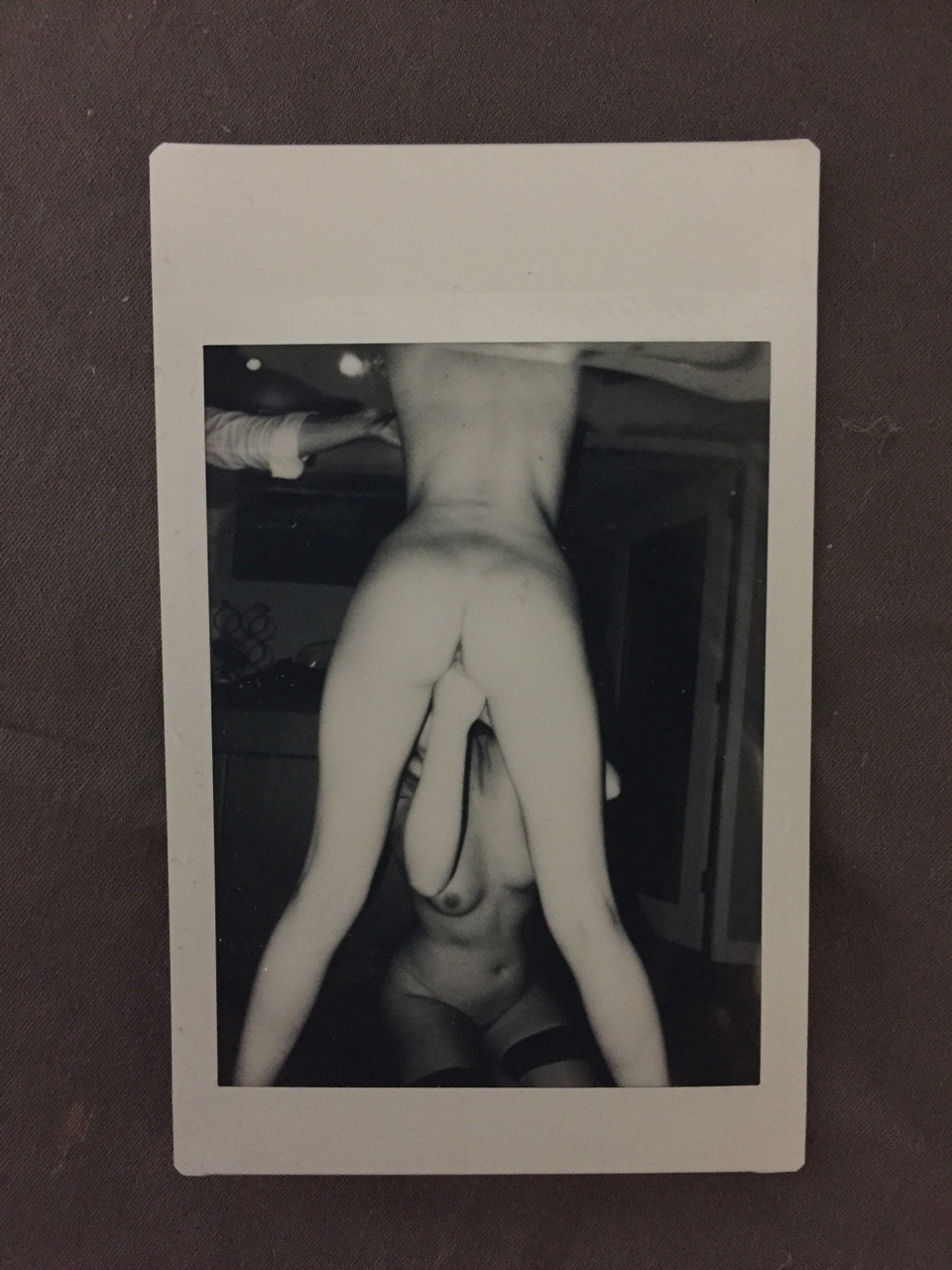
defiantly-yourssSome friendly fingers 🐶 (2017)

The above is a Fuji Instax Mini Monochrome instant photograph.

I’ve always been a fan of instant film–the unpredictable peccadilloes of the process contribute an unmediated in-the-momentness to them. It’s partly the singularity of the original–yes, you can scan them or snap a picture of them with your phone (but that one be the same; essentially, there’s only one true original.

Whether it was intended or not, this has always facilitated a special relationship between instant photography and DIY porn making.

(Honestly, if there was a browser plugin that filtered out mainstream pornography and only allowed DIY work through, I’d be thrilled. Diminish the profit motive and it seems like this girl’s enjoyment of things increases, but also ostensibly there’s less premeditation on what will sell the most units, earn the most clicks and it’s focused on what the producer likes and perhaps also what the target audience–whether a person or a small community–enjoys just seems to me to come across as not only more immersive but more authentic.)

Yet, of all things this also got me thinking about the received wisdom that art and pornography are mutually exclusive. (There’s a stellar piece, Museums, Urban Detritus and Pornography, written by Paul B. Preciado (formerly Beatrix), which has been seminal influence on this blog.)

It’s been a bit of shit week for me and I was wracking my brain for something to say about this. (A common misconception is that I just find something I like and then spew convincing BS about it and call it a post. I won’t deny that that happens on the off occasion. But for the most part, the stuff I post is posted because I have something to say about it.)

With this I knew I wanted to post it–that it belonged here–however, I wasn’t sure what I was supposed to say about it.

Then it occurred to be that while this is an explicit image, it’s not especially graphic. Genital penetration by multiple fingers is clearly implied but not graphically illustrated. And that’s kind of the strength of the photo: the basics are clear but the specifics are amorphous.

This encourages the viewer to fill in the blanks–and I use that in spite of the clumsy pun.

I started to wonder how many fingers are inserted. You can’t tell but it specifically says fingers plural. For some reason I thought of the tradition of depicting Christ in oil paintings–with his thumb extended and index and middle finger raised in a sign of blessing. (Bonus points for the art history nerds out there: apparently this was because this finger placement is like a gang sign that reads IC XC–the first and last letters of ‘Jesus’ and ‘Christ’ in ancient Greek.)

It being a sign of blessing is definitely in keeping with the above image. And that got me thinking about how ecumenical tradition tends to take extant symbols and appropriates them for religious use. Xtianity is all but a carbon copy of the ancient Mithras cult, for example.

The Xtian cross symbol originates from what is termed a Roman or Latin cross and became–after the apostle Peter demanded to be crucified upside down to prove his piety and that he was not anything like Christ–the Petrine Cross. Thus a symbol of imperial violence is appropriated by early Xtians, then appropriated again by the Catholic Church (in it’s upside down variant) before being flipped right side up again only to be re-appropriated as a bit of anti-Xtian imagery nowadays.

I realize this isn’t the most un-specious of arguments but I think it works given the way the majority of wisdom traditions have de-emphasized individual experience of the divine with a sort of ersatz groupthink instead. The fact that drugs and sexuality can–given the right environment–be a stepping stone to self-transcendent experience. The powers that be are very much invested in using religion to wall off that option from the majority of people.

Lastly, I’ve had this notion for a while that landscape oriented imagery tends to be secular in nature whereas vertical oriented stuff tends to be more liturgical–I think this digression is actually very much in the spirit of the original Instax.

wonderlust photoworks in collaboration with @kattruffautPersonae obscura (2017)

The process for this was: It was the strangest week in L.A. it rained every day I was there. It had cleared up a bit but not enough to keep us from losing the light early.

I love working with Kathleen, so we kept things going trying to do the best we could with truly deplorable lighting.

This was the last thing we did. It was just an notion: a figure behind the glass casting a shadow–I’d been thinking about the opening to the Pang Brothers’ The Eye (it’s extremely well done).

My film was massively underexposed. You could only see the vaguest hint of separation between three frames. I thought about just using the one with Kathleen pushing against the glass but it seemed underwhelming being just a minimal element amidst a sea of inky black.

The inspiration for these shots had been something moving–so I thought maybe that’s what I’m missing. (Also, I’m interested in a lot of what

I’m really piss poor when it comes to Photoshop. @jacsfishburne pointed me in the right direction and I was able to put this together. It’s the best I can do right now. And that’s probably a good thing because I see it as sort of in the same vein as Inside Flesh; I wanted it to appear interlaced and glowy. But that’s a couple instances of glitching pretty much an exact quote from them, and why would I do that. This can be better. It was an exercise. Still kinda better than I thought I’d be able to do–and that’s the secret (the longer you do it the better you get at it.)