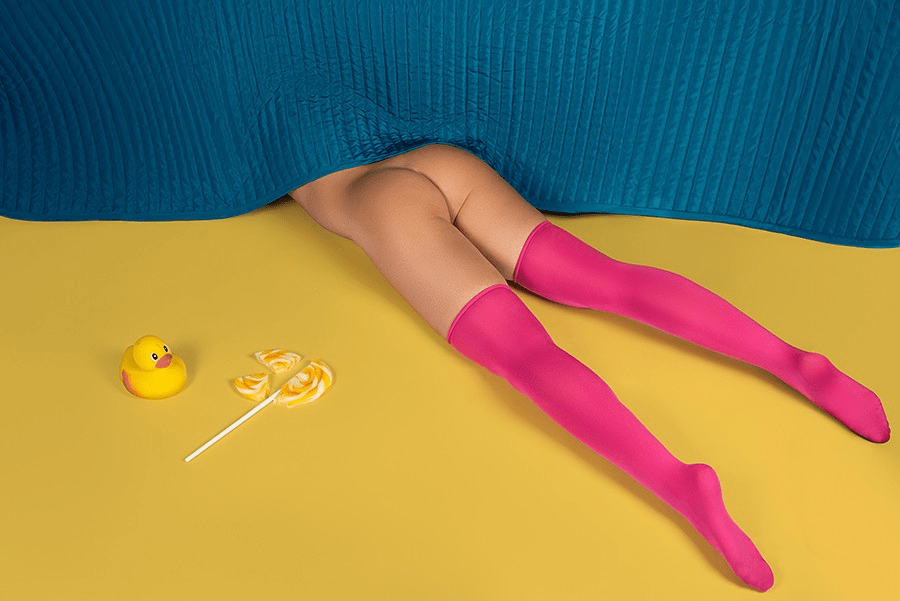
Olga Zavershinskaya AKA Armene – Hommage to (201X)



Rogier Houwen – [↑] Women Kiss (201X); [↓] Title Unknown (201X)
The second photo here dates from late 2012 at the latest. I suspect the upper photo was made around roughly the same time.
Houwen’s style has morphed–with his more recent work focusing on interrogations of photographic process and deconstruction of traditional darkroom technique. It’s not exactly original or even innovative but it’s still interesting. (For example: I unfortunately can’t access the sectors of my memory banks where the name is stored but there is a notable fine art photographer who worked in almost exactly the same vein as Houwen is now who was active primarily in the mid-aughts. That artist’s work is of a much higher quality but I still appreciate Houwen’s soulfulness–it contributes a vitality to his work that I always found lacking in the work of the hot shot photographer whose name I can no not even remember.)
I’ll stay in my lane though. Houwen’s work–at least circa the epoch of the above work–is reminiscnet of Patricio Suarez. Not how both skew darker in terms of dynamic range and both feature a strong preference for backlighting. (This allows them to do some fascinating things with the boundaries between shadow and light, i.e. the way the woman in the lower photo above is separated from the background by a halo of mid-tones around her right shoulder, neck, hair and back.)
It’s not exactly correct but I think the difference has something to do with the raison d’etre for the photo. In Suarez’s case the photo is indicative of a feeling–the chicken hatches the egg. Whereas with Houwen, the feeling is the egg from which the chicken hatches.
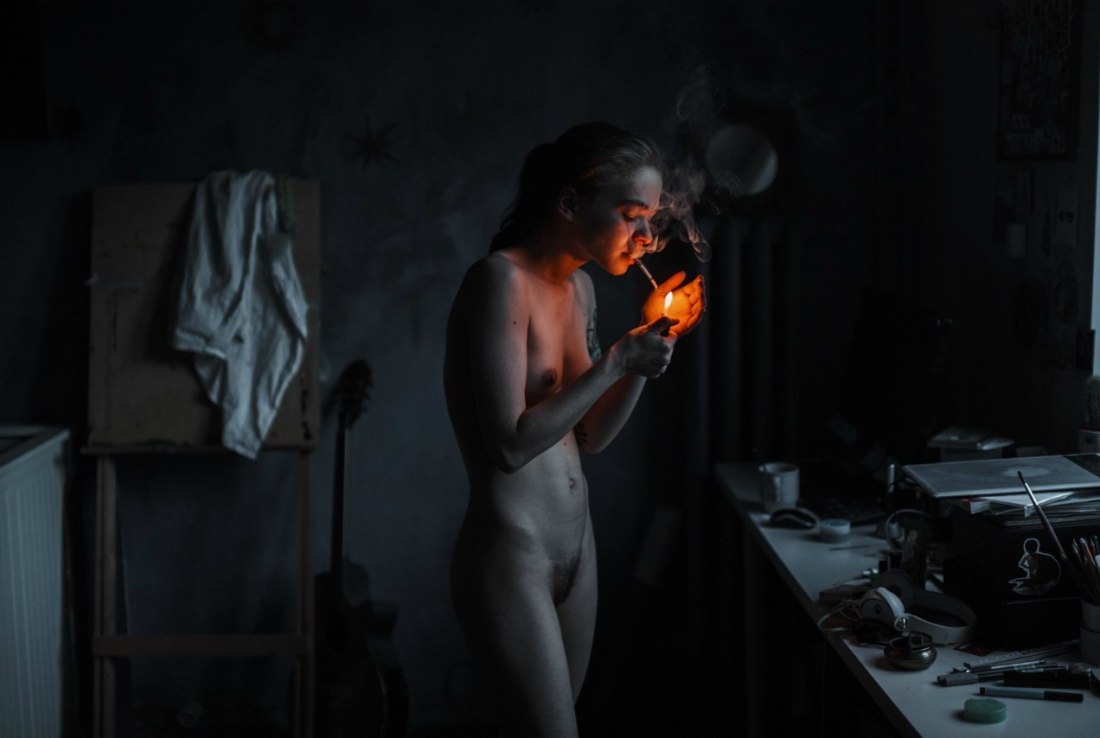
Marat Safin – Untitled (2015)
سأصير يوماً طائراً ،
One day, I will be a bird,
وأَسُلُّ من عَدَمي وجودي .
and will snatch my being out of my nothingness.
كُلَّما احتَرقَ الجناحانِ اقتربتُ من الحقيقةِ ، وانبعثتُ من الرمادِ .
The more my wings burn, the more I near my truth and arise from the ashes.
—Darwish – دَرويش (via m7madsmiry)
Davide Rossi – Alice Daniele (20XX)
Learning is a bit like a hat hook.
Say I’m wearing a knit hat–this one for example.
Further, say I’ve been trudging around in a snowstorm and it’s rather damp, so I peel it off and go to hang it up.
I can attempt to hang it on the wall all day but unless there’s a hat hook, all my efforts to hang it up are doomed to failure.
Learning is sort of like a hat hook. You can’t learn something until you have a place for what you learn to go–for lack of a better way of saying it: counter-intuitively, the learn something you have to already have some idea of what to do with what you are being taught.
I first encountered the notion of the Zone System in a cinematography workshop back in 2004. In hindsight the teacher was awful–he introducing it as a system of determining exposure codified by Ansel Adams and read this section from the Wikipedia article on the Zone System to us pretty much verbatim.
My response was well what the fuck does this have to do with fuck all else? (I lacked a hat hook (place) for my hat (what I was ‘taught’.)
Now that I do get the basic parameters of the Zone System, I have changed my tune a bit–it is EXTREMELY useful when producing a print or critiquing/responding to monochromatic work to employ the Zone System as a framework for analysis.
The image above is actually the first time it’s clicked in my head that the Zone System has application to not only printing and analysis/criticism, it has applications to the creation of the image itself, too.
Let’s back up a wee bit to get a nice running start. If you’ve ever taken a picture with any sort of attention, you’ll know that while modern cameras can do a reasonably good job left to their own devices. BUT! Should you want something a little more polished, you have to provide the camera some information. You can roughly encapsulate such information by suggesting the camera needs to know what’s white and how much light from the scene it should capture.
Modern cameras are super super smart about identifying what’s white–auto white balance is damn remarkable. The reason that we have manual white balancing functions is because you can creatively fuck with color by say holding a green sheet up paper in front of a sensor and telling the camera to recognize green as white. (As an example, the ubiquitous cinematography trend in the late 90s and early 00s, was to call pure white, white and then shoot under fluorescent lighting–which gives everything this nauseated green cast; think: Fight Club and to a lesser degree The Matrix.)
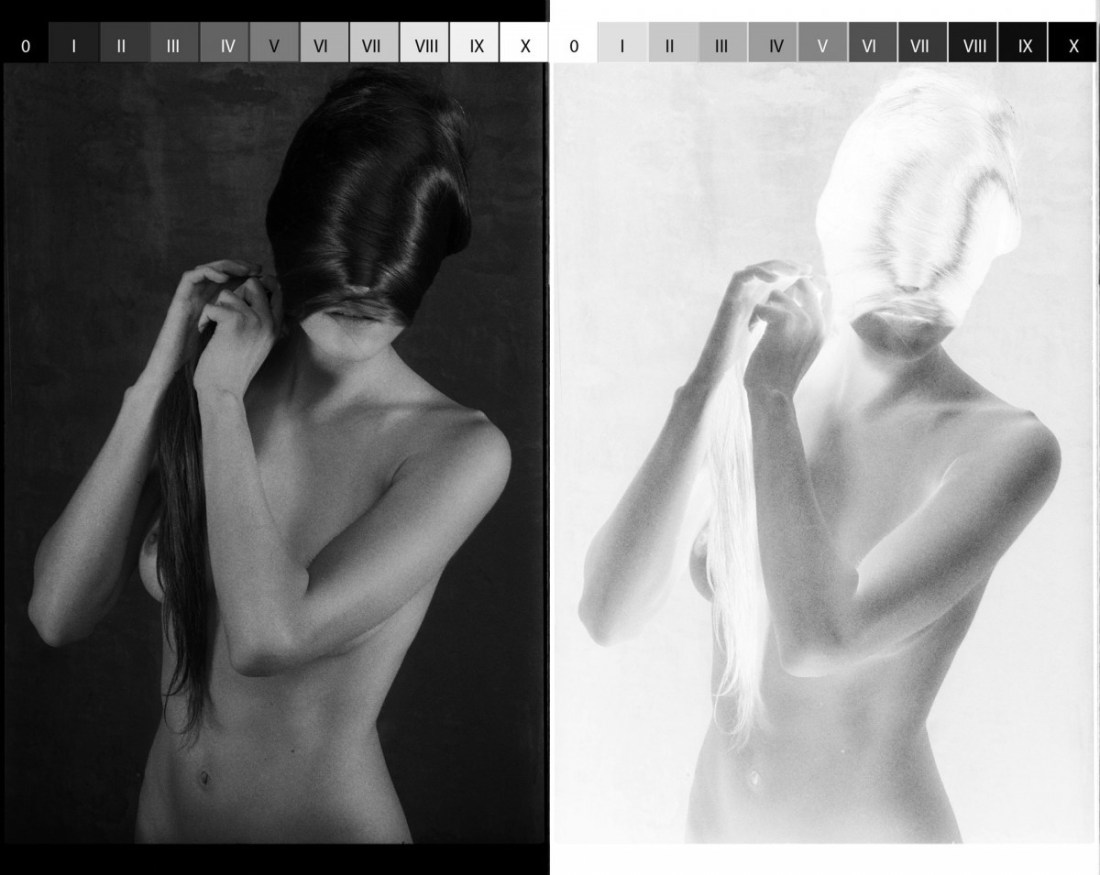
With B&W analog–everything is based off the notion of middle grey. (Zone V in both of the above images.)
In analog photography, you aren’t able to pre-visualize or relay on a histogram to determine optimum exposure (although if you’ve got megabucks like Daddy Warbucks, you can do Polaroid test shots… sigh, if only…).
In order to judge exposure analog photographers use a light meter. That light meter can be built in to the camera itself or be an independent handheld device–either way, it conveys what the optimum setting is to render an 18% middle grey value depending upon where you are taking the reading.
That last part is important. Like White Balance, you can selectively manipulate your image depending upon what you decide the camera should treat as middle grey.
I actually took the above image and chromakeyed out the tonality of all of the zones, individually. It looks like this:


Note: the fact that Zones VI-X are not represented within this image. (This would indicate that at the time the photo was made, an 18% grey value was attributed to a tone a good bit darker than actual middle grey.)
And while this is super useful in explaining the relationship between the negative (in this case Kodak’s Tri-X rated at 320iso) and ostensibly a print, to be ideally illustrative you’d want the image on the left above to appear all the way to right and to add a photo exposed to provide maximum dynamic range. Although that might end up detracting from the point since a pristine exposure will absolutely allow a talented print maker to replicate this effect in a print; however, a less than pristinely exposed image loses some of that latitude. (It’s hard to tell because I’m looking at a scan of a negative and not an actual negative and the relationship between the value of middle grey in digital vs what the human eye interprets is fundamentally different, still, it appears that this photo was underexpose by several stops from square one.)
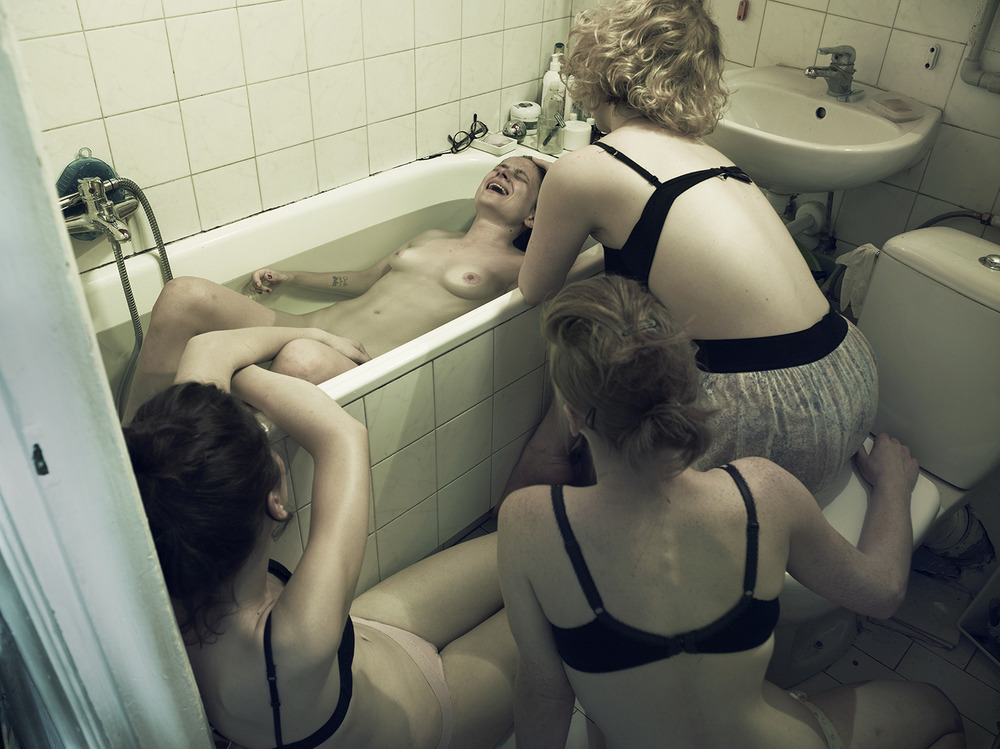
Zuza Krejewska – Anastasia, Hysteria, Warsaw (2013)
I have some quibbles with this from the standpoint of composition–it’s super challenging to have a door jamb that features so prominently and at such an cant and have it not ultimately distract from the image. (Flipping the image along the x-axis would help but it’s still not entirely workable with those tiles.)
it makes sense, though: the down tilt of the camera and the down thrusting lines in the frame all direct your vision. (Another benefit of the landscape frame–you can arrange it so it’s read side to side and up and down; the same can’t be said of vertical orientation.)
What I think this is great at is illustrating something about the number of things in a frame.
The received wisdom is that it’s easier to work with an odd number of things.
The problem is that two things is just fine. (If you can’t think of ten famous images which feature two people, objects or what-have-you, then it’s really time to start upping your game.)
Three is great. Four is workable. Five is great. Six, you would think wouldn’t work but it does because six is two groups of 3 regardless of how your arrange them. You would think 7 would be great–but it’s actually challenging because you’ve got a triangle and a square. (Da Vinci handled a similar challenge with 13 stunningly in his depiction of Christ’s Last Supper.)
(I remember reading that it also has to do with the ability of the human mind to visual numbers. One is easy enough: I. Two is great: II. Same with three and four: III and IIII, respectively. And groups of five: IIIII. Register without us having to stop and count. Six gets confusing but we tend to be well versed at groupings of three, so six scans instinctively: IIIIII.
IIIIIII is nearly impossible to parse without stopping to count several times.
And that’s honestly what this does well is that it breaks down the frame into visual groupings you can understand. I and III.
The I is naked. The III are all wearing black bras. I is in the tub. III are gathered around it. The III form a natural triangle which points away from the one–adding an extra sense of loneliness and isolation to her plight.

Crina Prida – Forms of life (2017)
The term form of life (lebensform) emerges from continental philosophy but is mostly tied up in the work of Ludwig Wittgenstein–specifically, his later work: Philosophical Investigations and, to a lesser degree, On Certainty.
It’s not at all a straightforward endeavor to explain what Wittgenstein means when he employs this term. Not because the concept itself is difficult to grasp–it’s not, it’s actually disarmingly simple; instead: it’s just that were in such a habit of thinking about things in a very proscribed way that seeing the point that Wittgenstein is making is unbelievably difficult. Probably the best way to think about it is: there is no conclusion that you’re being led toward, Wittgenstein is merely reminding us that when we philosophize we frequently mistake process for product–and that causes all kinds of difficulties.
So, in a nut shell: Wittgenstein takes aim at René Descartes–specifically Descartes’ Meditations on First Philosophy.
That’s the one where Descartes famously pronounces cogito ergo sum, or I think, therefore I am.
There’s no arguing that Descartes was brilliant. (And it should be noted that even though Wittgenstein is disproving Descartes, the former clearly still respects the latter’s rigor as a titan of philosophy.)
Anyway, the way Descartes arrives at his monumental pronouncement is he asks himself–how do I know, I mean really know, anything?
He proceeds to test what he can doubt–and proceeds to make a ridiculously compelling argument that everything can be doubted. He does run into a little bit of a hitch, though–he cannot doubt that he’s doubting. He takes this as the bed rock upon which he builds a world view.
In extremely broad strokes, the resulting world view solidifies the centrality of the mind-body problem in western philosophical tradition.
Descartes was so convincing in his argument that this notion of two discrete worlds–the physical and the mental has become known as Cartesian dualism.
Wittgenstein’s response is implicitly focused on blowing all of Cartesian dualism out of the water but he focuses on one point in particular. In Meditations of First Philosophy, Descartes famously asks how we can know for sure that some evil genius isn’t fooling us, i.e. just because other people move like me, act like me, etc., I can’t know what’s going on in their mind so they could be automatons for all I know.
Wittgenstein calls bullshit. But he does so in a very interesting way–by encouraging his reader to think about a quote from Augustine’s Confessions:
When they (my elders) named some object, and accordingly moved towards something, I saw this and I grasped that the thing was called by the sound they uttered when they meant to point it out.Their intention was shewn by their bodily movements, as it were the natural language of all peoples: the expression of the face, the play of the eyes, the movement of other parts of the body, and the tone of voice which expresses our state of mind in seeking, having, rejecting, or avoiding something. Thus, as I heard words repeatedly used in their proper places in various sentences, I gradually learnt to understand what objects they signified; and after I had trained my mouth to form these signs, I used them to express my own desires.
Wittgenstein takes Augustine at his words but encourages his reader to consider that if this is–in fact–how we acquire language, how might that proceed.
Thus, what Augustine has in mind is something not unlike the mythological naming of the animals in the Garden of Eden–as if names are labels for things. But then what about verbs and other more difficult parts of speech. Labeling doesn’t work so well for those.
To combat this it’s easy to say we point to indicate what we mean. In other words, the big lumbering animal with the rough skin and the long nose is an elephant and we know it’s the elephant we mean because we point at the elephant to our right as opposed to the large cat with the beard sitting around looking board to our left. We mean elephant and not lion.
Right now I’m sitting in my living room. There’s a coffee table. I can point to it and say: coffee table. But unless you already know something about what a coffee table is, how do you know that I’m pointing to the table and not to it’s color (brown), or it’s shape (rectangular), or what it’s constructed from (press board).
So what seemed fairly straightforward, isn’t. What we really mean by pointing out at something, we must modify if this approach is to work: by pointing I am not so much indicating the object for which the word I speak serves as a label but I’m pointing to some sort of internal experience. Some essentially mental essence that conveys coffee-table-ness.
How does that work? Are words like keys on a piano and by mashing a certain combination we summon the meaning we want?
That seems hell of problematic. I mean: what if I’m really color blind and I see the grass as red and the sky as green but because I’m taught that the sky is blue and the grass is green, I call them that without any way of knowing if what I see matches what everyone else sees?
That question makes a huge mistake by overlooking the fact that when I am speaking I don’t stop to question whether or not the grass is actually green. I accept that it’s green because green has meaning due to the fact that humanity has come to a consensus that a cloudless sky in a non-polluted environment appears to be the color we know as blue.
This is the idea that meaning isn’t labeling or pointing (externally or internally) it is instead words used in a particular context and the use in that given context is what bestows meaning upon the word(s).
I’ve glossed over one important point because it doesn’t really fit in the progression of this explanation but it is important so I’m going to jump tracks here for just a minute.
Initially Wittgenstein compares learning language to learning to play a game–specifically: chess. This is actually one of the more ingenious metaphors he uses.
I’ve taught dozens of people to play chess. And you usually start out with an empty board and you show the other person how each piece moves, i.e. the pawn can move two spaces off the line and then every other move it can move one space forward; it attacks diagonally. Whereas, the rook moves in a straight line left and right or forward and back; it can move as far in any one direction as their are open squares. The knight moves in an L-shape, etc., et al.
You can explain the objective–what check and check mate entail. But as check mate is something that is no one single set of moves (it’s contextual), you eventually have to play the game. (And whoever you are teaching is going to do very poorly their first couple of games…)
Language is like this but it’s also not like this. In chess a bishop can’t move like a rook, but in language a word can function in two different capacities simultaneously–think of puns, double entendres, etc.
Thus, the notion of a form of life. It’s a stunning metaphor because it emphasizes an anthropological perspective–what is the environment like, what are the cultural customs that inform the use of particular words, etc. But there’s also no form of life that doesn’t intersect with other forms of life–think about rabbits being introduced into Australia. Language–unlike rules to a game like chess–changes as it is used (similar to how life evolves).
So Wittgenstein’s trip is basically that when we think about how we do something as opposed to doing it in the stream of things, we are likely to over-complicate things in a way that we don’t when we’re speaking. (Consider the zen proverb that admonishes against putting a second head on top of the one you already have. That’s the other fascinating thing when you really dig into Wittgenstein is that you slowly begin to suspect he was actually a Zen master.)
It’s like Borges map that is so detailed it becomes bigger than the area it’s designed to survey. (It ends up moldering in the desert, as I recall.) We know how language means when we speak, it’s when we stop to think about how language means that we make mistakes like believing that I can doubt everything but that I’m doubting seems profoundly empirical but is, in actuality, something that tells us nothing about metaphysics or minds and instead merely reminds us that the if you’re doubting of course you can’t doubt that you’re doubting because that’s inherent in the concept already.
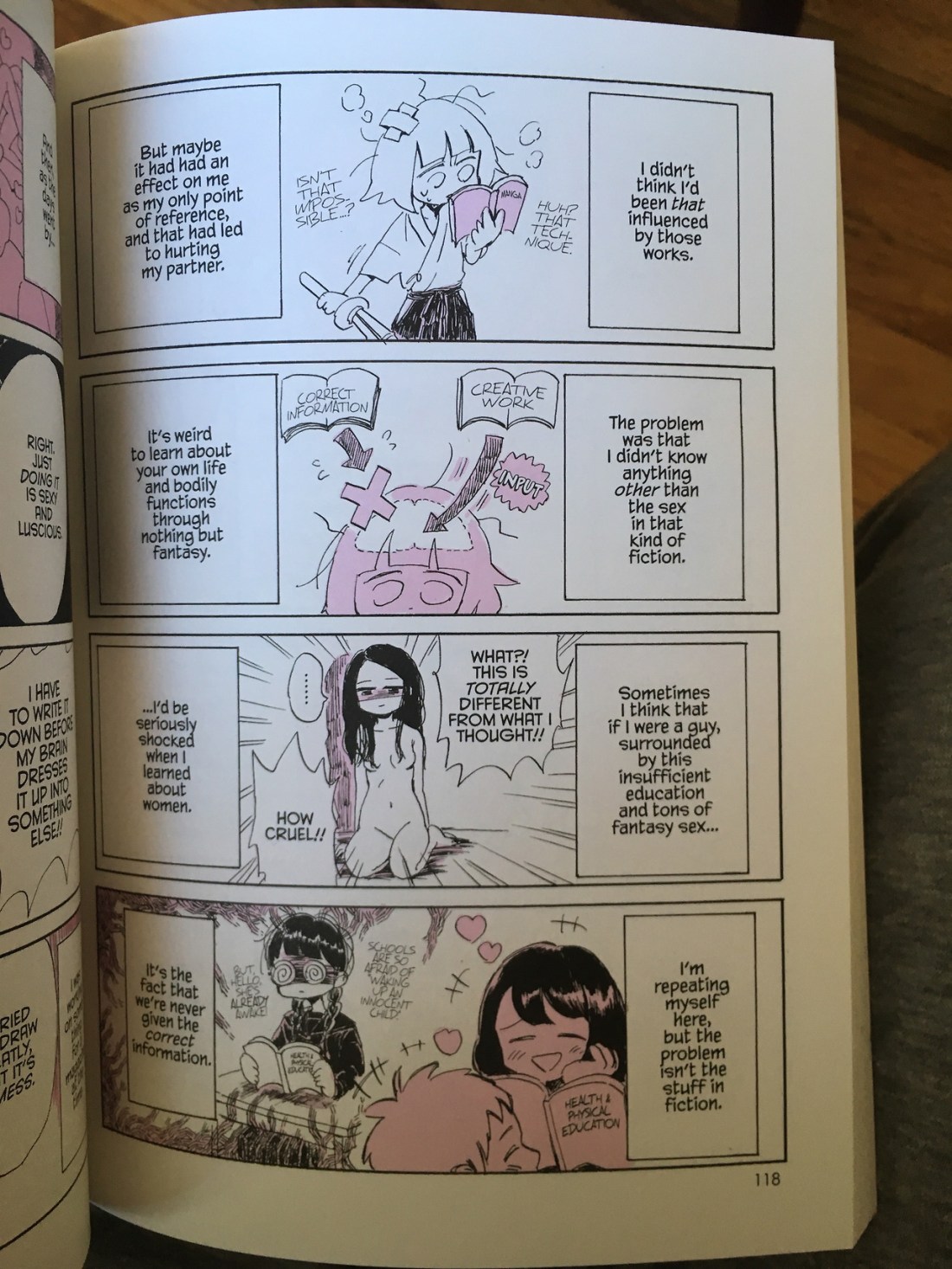
Nagata Kabi – Page 118 from My Lesbian Experience with Loneliness (2016)
I am not at all into manga.
How then did I happen on this? Well, it seems that Kabi posted this one the internet last year and it subsequently blew the fuck up. So much so that several of my LGBTQ foix raved about it to me and I ended up picking it up and reading it last week.
In some ways its better than the hype. I don’t think I’ve ever encountered something so casually at home with its naked vulnerability.
That unchecked honesty does cut both ways a bit. Some of the unpacking of neuroses and self-diagnosing psychology only just ever so barely tracks.
It’s a small shortfall really because everything else it nails, especially mental illness and how isolating that can be. (As someone who is so alone as to be bereft, if you allow yourself to empathize with the protagonist at all you’ll feel the pangs of actual physical pain that can come with intense loneliness.)
I was deeply touched by the sensitivity with which the premise is executed, i.e. when she realizes she doesn’t have any friends. Yeah, honey, I know those feels. Hard same.
But I was actually stunned by this sequence. She talks about how in order to learn about sex she consumes gay boy manga. And she goes on to extrapolate something profound about the dangers of pornography.
Porn, in itself, in theory, is value neutral. In practice, and in the absence of any means of distinguishing between fantasy and reality, is when it becomes detrimental.
I don’t know, I’m posting this because I think it’s worth the time and energy to track it down and read it. But also, because this one page is perhaps the most clear, concise and straightforward interrogation of the influence of pornography on humanity.
Source unknown – Title unknown (201X)
“Maybe I’ll be able to look harder at the past by getting some experience in the present.”
–Nagata Kabi, My Lesbian Experience with Loneliness


Marie Tomanova – [↖] By the Waterfalls (2016); [↗] Green Tenderness (2015); [↓] Untitled (2016)
The Museum of Sex here in NYC (as opposed to the one in Amsterdam and there may be more I don’t know about) is running an exhibit called NSFW: Female Gaze.
I’m not a fan of the venue or the current bandwagon curatorial trend otherwise known as ‘the Female Gaze’–it’s generally preposterous (at best) and mistakes inversion for subversion (at worst); also, the people who actually go out of their way to embrace the notion pretty much to a one make godawful work. (However, like the term ‘post-rock’–which operates similarly: a pretty reliable shortcut to some great music when you weed out the bands who refer to themselves as post-rockers and focus on the bands who eschew the distinction.)
(And to be clear–I don’t object to women who are photographers. This blog strives to favor women photographers and image makers in such a fashion that 60% of the posts are created by women; what I object to is the idea that we can correct for the art historical problematics of the male gaze through nothing more than paying lip service to more diverse representation without actually acknowledging a multiplicity of factors beyond just male photographer vs female photographer….)
What appeals to me about Tomanova is the quality of her work. She’s working with a Canon dSLR and a hotshoe flash. Yeah, I know… her results are pretty incredible.
But in the video trailer for the exhibit, she mentions that her motivating notion is the idea of “how nude is too nude?”
It’s an interesting question. (That is supported by her work, incidentally.)
The other thing I notice from her video is that her way of working is much more unrushed. As someone who is also interested in notions of public vs private and nudity, I have to say that I find her process fascinating. Usually, if you’re shooting nudes in public, you set up the shot, strip and get the shot as quickly as possible–so that you can get dressed again before anyone stumbles upon the scene uninvited.
You get the feeling Tomanova sets the camera up, gets undressed and then experiments. Trying out a bunch of different poses and frames before getting dressed again and breaking things down to move on.
There’s something very audacious about her work. (I would LOVE to be able to work that way, honestly. It’s not that I’m worried about people sneaking up on me while I’m naked and more what happens as a result of someone potentially stumbling upon me…)
I recall how Szarkowski divided fine art photography into two parts: mirrors and windows. I’ve never really agreed 100% with him but I do at least see the utility of his taxonomy. It strikes me that there’s another dichotomy in photography: reproduction vs discovery.
Reproduction would be where you have a very clear picture in you rmind of something you want to make into a photographer or image whereas discovery is more organic, you don’t know what you want but you are aware that you’ll know what you’re looking for when you see it.
I think the best work does both at the same time. But I think Tomanova is decidedly in the discovery camp. And honestly I think if it’s a choice between the two, I’ll take discover over reproduction any day of the week and twice on Sunday.


 Acetylene Eyes