topoftheshaft:

Time Seems Like a Blur When You Cum

Bill in Exile – Load Dump (2010)

Let’s consider the previous poster’s comment because I think it’s actually insightful af.

It’s impossible to describe the taste of coffee to someone who has never had it. But you don’t try to describe it, you brew a cup and say: taste this, it’s warm and delicious. (Or, if you’re me and can’t stand warm beverages, you break out the Chameleon Cold Brew.)

It’s interesting: before I ever used marijuana, a number of people had explained to me what it was to be stoned. I remember being like uh, wait, I don’t get it.

After I smoked up, I totally got it. There’s no way to describe it. It’s like the taste of coffee–once you’ve had it, you’ll never forget what it tastes like. But you also don’t ever remember not knowing what it tastes like.

Literacy is probably a better example. Once you learn to read you know–practically–that at a certain point you didn’t know how; but the knowing overrides the memory of not knowing. (Like I’m a bit precocious in that I remember very specific things from as young as six months. So I can remember seeing signs before I was able to read and being able to read them in my recollection even though I couldn’t have read them at the time.)

Again, that only works ex post facto. You sort of have to walk to the edge and jump.

Consider this scenario: you’re sitting in your room and suddenly the brightest red cardinal darts in through the window and lands on the back of a chair. The incongruity is stunning to you and the surprise of it shakes your brain out of it’s perpetual classifying and organizing: this is inside, this is outside; me vs. not me, when do I need to leave to meet Su for dinner, etc. But in that moment of unplanned surprise, there is the briefest of moments where you are too surprised to label or otherwise interpret the scene.

And when you tell people about it your explanation will last ten times longer than the moment did. Our eyes see and even though we can’t see the act of our eyes seeing, that is how our brain processes it–we see routinely as if through a mirror darkly. But in moments of self-transcendence it’s like the experience of needing glasses and never having had them and then when you put them on you’re just like OMFG at all the details you’ve been missing.

Interestingly, virtually every account I’m familiar with as far as mystical/self-transcendent experience involves the distension of time. You can see 100 things for every one you’d normally notice and because your brain is too shocked to filter any of it, it just all comes in and you absorb it.

So the person who posted this image is actually very much on point with their observation. Orgasm does share a number of points of commonality with transcendent experience in my… er, experience. And if I’m not mistaken that’s why church and state are so down on drugs and an openness to sexual expression–when you realize the kingdom’s keys are within your grasp why would you give the first half a fuck about an institutional intercessor?
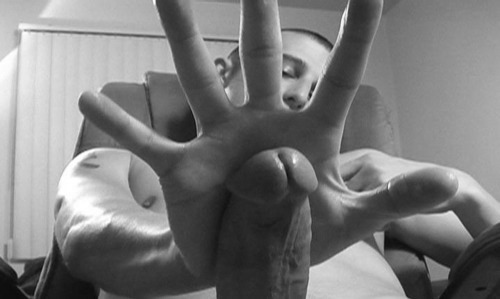
Source unknown – Title Unknown (201X)

I’ve yammered on at great length before about distinguishing between selfies and self-portraiture–but where is the line?

Strictly speaking, this isn’t a selfie. Except… the process that went into making it is almost certainly comparable. I mean the view could be a screen cap from chaturbate that’s been desaturated…

I think anything where you’re consulting a live view in order to compose and frame the image counts as a selfie. Thus: if you’re composing your shot and then setting the self timer before running to get into position–that’s a self-portrait. A micro 4/3 camera with a flip around screen that you can just look at to position yourself in the frame without getting behind the camera is a selfie still.

The question of whether selfies can be art is mired and wrapped round and round with barbed wire because the context is tied up in the context of selfies, where one is trying to appear a certain fashion aligned with their digital curation of self. Not that an artist can’t do that, it’s just that it’s been done already–so that means do it better than Cindy Sherman or go the fuck home. (Sherman was a self-portraitist, so there’s that, too.)

The context of selfies hinges almost entirely on authorial intentionality–and that’s a totally BS line of questioning. Was the selfie an ontological virtual back of the memory of an event–I know I was here because pics, it did happen. Or, is this the version of myself I’m aspiring to be and the selfie is part road map, part fuel for the trip ahead. (Baudrillard would have a freaking field day.) Is it a form of self-care–a radically body positive reclamation of creating a new context wherein you exert a degree of agency in how you are seen by the world (which you may not have recourse to in your day-to-day)? Is it about saying: sharing something with others instead of insisting upon digital attention in the form of likes, regrams/reblogs, etc.?

And please don’t mistake me: I’m not willing to say oh, vanity, vanity all is vanity and dismiss something as art due to a concept that is so steeped–historically–in misogynistic fervor. Whereas I do believe that Art is more about what’s given than what’s taken.

I just worry that so many of the impetuses for selfies are centered upon style over content–essentially canceling out any sort of compositional logical or visual grammar in a quest for something that is on-brand (stylistically consistent) and on fleek (immediate and attention inviting).

I think this is nowhere less front and center than with dick picks. I mean any photo or image that is erotically charged is already fueled by the dichotomy between what looks good and feels good. Models don’t point there toes because it makes it easier to hold a position, they do it because it slims and shapes the body in ways that have come to be accepted as aesthetically desirable.

It seems there are two kinds of dick pics, generally speaking: the look how hard I am help me out type (which the above is not) or the I was really turned on and felt attractive.

This is definitely that latter type but it’s interesting because it is unified in content and form in such a way that it doesn’t seem to be making a choice between what looks good and what feels good. It’s played toward the camera but in a way that conveys a lot about the subject.

Or, perhaps, I’m just once again reading entirely too much into random porn on the Interwebz.

Witchoria – Cancel from Human Error series (2016)

What else is going on
right this minute while ground water creeps under my feet? The galaxy is
careening in a slow, muffled widening. If a million solar systems are
born every hour, then surely hundreds burst into being as I shift my
weight to the other elbow. The sun’s surface is now exploding; other
stars implode and vanish, heavy and black, out of sight. Meteorites are
arcing to earth invisibly all day long. On the planet the winds are
blowing: the polar easterlies, the westerlies, the northeast and
southeast trades. Somewhere, someone under full sail is becalmed, in the
horse latitudes, in the doldrums; in the northland, a trapper is
maddened, crazed, by the eerie scent of the chinook, the sweater, a wind
that can melt two feet of snow in a day. The pampero blows, and the
tramontane, and the Boro, sirocco, levanter, mistral. Lick a finger:
feel the now
. [Ed: emphasis added.]           
               
                   —excerpt from Pilgrim at Tinker Creek by Annie Dillard (via house-of-fortitude)                

The Monochrome Idattempting wonder, being watched (2016)

There are a host of problematic aspects with this:

The light is flat/dead, akin to the sort of light you get from a side table lamp where you have the hot hour glass spot pattern caused by the way the lampshade shapes the light but also as the diffuse spill the shade itself transmits.

The dynamic range is noticeably compressed–the darkest area being the shadow cast by the young woman’s chin; the brightest area is the triangular reflection (a skylight, would be my guess) in the mirror behind her right shoulder.

It’s some EGREGIOUS #skinnyframebullshit, too; further, the problems are compounded by the fact that– as I’ve talked about before: a frame’s functions is either restrictive or indicative (and really it’s at it’s best when it is a bit of both.)

The trouble here is that this frame is restrictive–with the exception of what I’m calling the reflection from the sky light–there is no sense of space beyond the frame being relevant to the information in the frame. This being the case, the frame lines are amputating the young woman’s legs rendering her immobile and unable to get up and leave the frame if she chose to do so.

I do have to give the image maker some props, though.  Despite the awkwardness of the angle of the young woman’s head there is a sense conveyed that she wants to be here and seen like this–the shadow cast by her eyelashes against her cheek, and the way her mouth (whether or not you can clearly see it) suggest her lips are ever so slightly parted and that she’s trying to tune into the sensations of the vibrator pressed against her subtly glistening clitoral hood.

Despite the numerous technical flaws, this does deserve some praise due to the fact that it manages to capture the vulnerability that comes from letting go of any sense of self to grab onto the visceral experience of pleasure with both hands. That aspect of it is crystalline in it’s clarity here.

Life is boring, except for flowers, sunshine, your perfect legs. A glass of cold water when you are really thirsty. The way bodies fit together. Fresh and young and sweet. Coffee in the morning. These are just moments. I struggle with the in-betweens. I just want to never stop loving like there is nothing else to do, because what else is there to do?

Pablo Neruda, Twenty Love Poems and Song of Despair (via blackshivers)

Lee KrasnerUntitled (1953)

I’m not in a very good place mental health wise right now. And I don’t know whether it’s in spite of this fact or because of it that–for once–I’m going to walk you through my thought process upon encountering this image for the first time and subsequently engaging with it.

I guess, we need to start with the fact that I’d never seen it before and I have no idea who Lee Krasner is but it reminds me of Jackson Pollock if he’d spent ten years obsessively studying the futurists.

As it turns out, Krasner was not only familiar with Pollock, they dated.

My Survey of Western Art I & II professor was enamored with Pollock. I never saw it but I am the type of person where if I respect someone and that person consistently raves about an artist I don’t give two shits about, I’m inclined to give said artist a great many chances than someone without that sort of reference attached.

Thus, shortly after moving to NYC–I spent a Saturday roaming around in The Metropolitan Museum of Art.

I spent a good half an hour each with the three Vermeer’s–and wrenching my attention from them felt disorienting, like waking from an afternoon nap and finding it’s well after sunset.

I ended up in the Modern Art wing towards the end of the day and spent a half an hour examining Pollock’s Autumn Rhythm (Number 30).

It did not have anything like the effect on me of the Vermeer’s; studying the lines felt tedious and unpleasant–as if I was doing something not for the pleasure of it but for the edification it might contribute to me.

I walked away nonplussed.

In the course of my third and final old college try, I found both praise and criticism of Pollock to be startling half-assed.

And here I really need to bring in reinforcements. Consider this write-up on a 1999 Pollock retrospective at The Tate in the Socialist Review. (I don’t necessarily agree with anything in this piece; however, it does–in broad and clumsy strokes–address the criticisms with regard to Pollock; namely: the fetishization of the drip method of his paintings.

A second piece goes on to excoriate art history for something mentioned in passing in the first piece: the notion that Pollock never intended there to be any nationalistic fervor in his work but we’ve come to attribute it to the work unfairly.

This second piece hinges upon the notion that our appreciation of Ernest Hemingway has fuck all to do with knowing he operated his type writer standing up.

I find this comparison to be incredible disingenuous and intellectually dishonest. (And I suspect the author of this piece went out of his way to avoid literature classes in college–’cause if he’d taken them he’d know that posture is not technique and that an understanding of technique is integral to coming to terms with both Hemingway and Pollock–who are both incidentally cishet white men (and as such as much as the piece vamps it up when summarizing feminist criticisms of Pollock “[that look] askance at the machismo of the ‘hero in the studio’ and
tends to see the whole drip and flick performance as the acting out of
the phallocentric male fantasy on the symbolically supine canvas,” is at least a good faith engagement with the fundamentals of culture in context).

The other problem with the second piece is that it says that the cult of celebrity has been unfair to Pollock. Arguing that we view his Life Magazine photo of him painting as more central than the work itself. I have a really difficult time with that proposition. I mean did someone hold a gun to Pollock’s head and make him do the interview and allow a photographer into his studio? It’s sort of saying that history acted unfairly against him because of his greatness–and isn’t that the biggest load of bullshit white man claptrap you’ve ever heard.

There’s the argument that a Ukrainian woman (Janet Sobal) was the progenitor of the drip painting style. I don’t know if it’s a straw man argument–it certainly operates like one–that feminists feel that a white male appropriated the work of a woman and got accolades for it. (And although this has happened all throughout history–Sobal’s work, although not uninteresting lacks the depth and dynamism of some but definitely not all of Pollock’s work.)

(For example: I’ve become rather fond of Blue poles (Number 11), less as a result of the drip method than the use of color and line to draw attention to the use of color and line.)

But back to Krasner, because I have regretably spent most of this article talking about the person she dated instead of her.

Consider the work above. Now consider these paintings Pollock made during 1953–where he noticeably diverges from the drip method:

Portrait and a Dream, Easter and the Totem, Ocean Grayness, and The Deep.

The Deep is exquisite but the rest are blase, at best. And I feel objectively that Krasner’s image above is just objectively better than most of Pollock’s work. Yet, I know who Pollock is and I’m comparing Krasner’s work to his when really the comparison is probably closer to the truth to say that when his work worked it was taking after hers.