Untitledhttps://embedr.flickr.com/assets/client-code.js

Emily WhiteUntitled (2016)

My life is so weird sometimes and the truth is I don’t even really think about it. It’s sort of like stepping onto a scale to check your weight everyday. If you do it–which I don’t recommend–then any weight loss or gain is gradual. You don’t think you’re making any progress, even though (over time) you are. (Similarly, when someone sees you in person and you haven’t seen them in a while and they’re like, gurl, you’re hair has grown so long! And you’re like, oh yeah, I guess it has… I see it every day so I lose track.)

(Bear with me, I’m taking the scenic route back to the above image.)

In the weird thing that is my big gay life I’m actually internet friends with my favorite photographer. Mostly she shares pictures of her adorbs daughter, we kvetch about sexist men/how much bullshit this patriarchal society is, etc. She’ll remind me that I still need to see that Diane Arbus documentary she’s been recommending to me for months. I make sure she doesn’t miss new Björk videos when they drop–we both are perpetually stumped on the question of whether we want to be Björk or be with her…

Anyway, I showed her Emily White’s work and overall she was underwhelmed/dismissive. We’re usually so in sync–it was strange to have such differing perspectives.

One of the things I’ve always been adept at is explaining why I appreciate something. It’s rare that I’m ever going to say: I don’t know why, I just love it. I can usually give you half a dozen extremely concrete reasons even if you put me on the spot about it.

With White–for example: there’s a sense of narrativity. A bit like Lauren Withrow–whose aesthetic I dig but the impetus in her work is always so unequivocally narrative driven that I often fell that the work is more aspirational than accomplished. Like it’s open ended. Withrow cultivates a young, haute and rebellious cast of characters because she’s hoping that the people she’s making her work for will relate and sort of super impose their experience and expectations upon the characters in an effort to relate to what they are seeing.

It’s a narrative tact. But is it a good one? I’m decidedly in the detractor camp. I have this idea that every story contains a moment where if that moment is photographed you can even though you only see a fraction of a second in time you can extend a cinematic timeline in your mind that reaches forward and backward. You can tell how you arrived here and discern a bit of what is going to happen next. It’s a bit like Cartier-Bresson’s decisive moment–which I’m also a detractor from: it’s all too fatalistic for me. I prefer the latitude for various interpretations in Vermeer’s decisive moments that use universal tropes and familiar experiential anchor points to suggest a tonally cohesive narrative arc with multiple potential readings.

Withrow’s characters are effectively cardboard cutouts for what she feels are her audiences projections. Therefore it’s only narrative post-active engagement by the viewer. Whereas Vermeer is narrative to start.

Back to White: I find her work audacious because whether it intends to or not it presents a critique of both Withrow and Vermeer’s implementation. Intentional ambiguity and a range of universal and certain interpretations are replaced with uncertainty. (And I think there’s something that could be written on how she’s effectively deconstructing the Lynchian conflation of the surreal and the oneironautlical as interchangeable–they aren’t and shouldn’t be but Lynch has made a spectacular career out of playing fast and loose with the blurring of those boundaries.)

In her work, we know how we got up to the point in time we are asked to bear witness to. How? Well, if you’ve followed Deviant Art and Flickr famous young women photographers–the angst, alienation and efforts to exercise individual autonomy all resound. But what makes the work effect is that it avoids the ubiquitous exhibitionism for something that reminds me of something I read recently in a novel titled Black Mad Wheel (the second novel from Josh Malerman who wrote the incredible Bird Box–which I highly recommend; BMW, is largely and unfortunately execrable.)

Some cultures believe that when you take a photo, you’re saying this period, this phase, is over with, [s]o if you enjoy your life as it is, mourn.. Because now it will be as it was.

There’s this weird way that White’s images are cut off from the history which clearly informs their construction. And although there is not a sense within the image of anything sinister, the prevailing feeling of uncertainty with regards to where things go from here contribute both a beauty and terror to the bodies she trains her lens upon.

White’s work is–I’ll concede to my friend–not yet fully formed. And it does suffer from nearly a decade of angsty undergrad grrrl art. But if you can look past that, there is something ridiculous precocious in her work. Also, it’s nuttier than squirrel shit and probably has more to do with her going to a WASPy liberal arts college, but I swear to fucking Christ that I’ve been to several of the locations she’s uses in her more recent work. I know I haven’t but the sense of familiarity is utterly unnerving–and I like it very much, that feeling…
7906https://embedr.flickr.com/assets/client-code.js

Yung Cheng Lin7906 (2017)

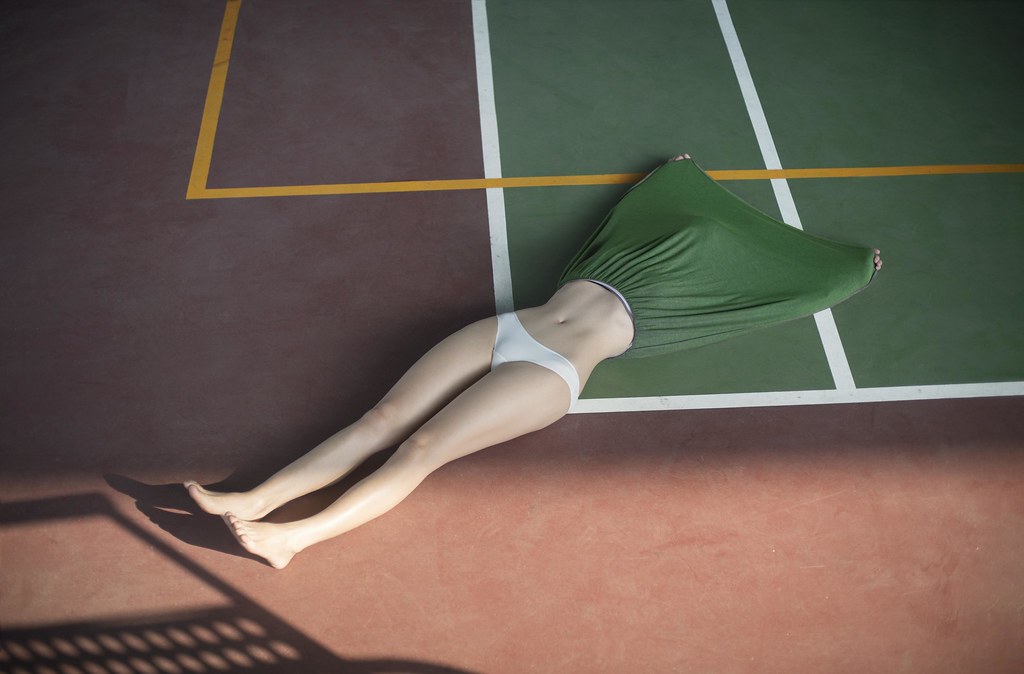
At first glance, it’s stunningly obvious that the composition here was guided by the rule of thirds.

Here are super-imposed rule of thirds guidelines for reference:

I was expecting to discover when the lines on whatever sort of court this is are askew.

Interestingly, it turns out that it’s a bit different than I thought. The rule of thirds lines relate to the positioning of the subject. (Also, the angle of the demarcation between light and shadow is very nearly at the same angle to which the painted lines on the court are wawkerjawed.

What I didn’t expect was that the models knickers are so well matched to the white paint on the court. Subtle and at very nearly dead center in the frame, it’s easy to miss.

It’s also a brilliant move to position the model so that her body is ever so slightly positioned toward the bottom of the lower left to upper right diagonal to balance out the paint (positive space) vs the unpainted area (negative space).

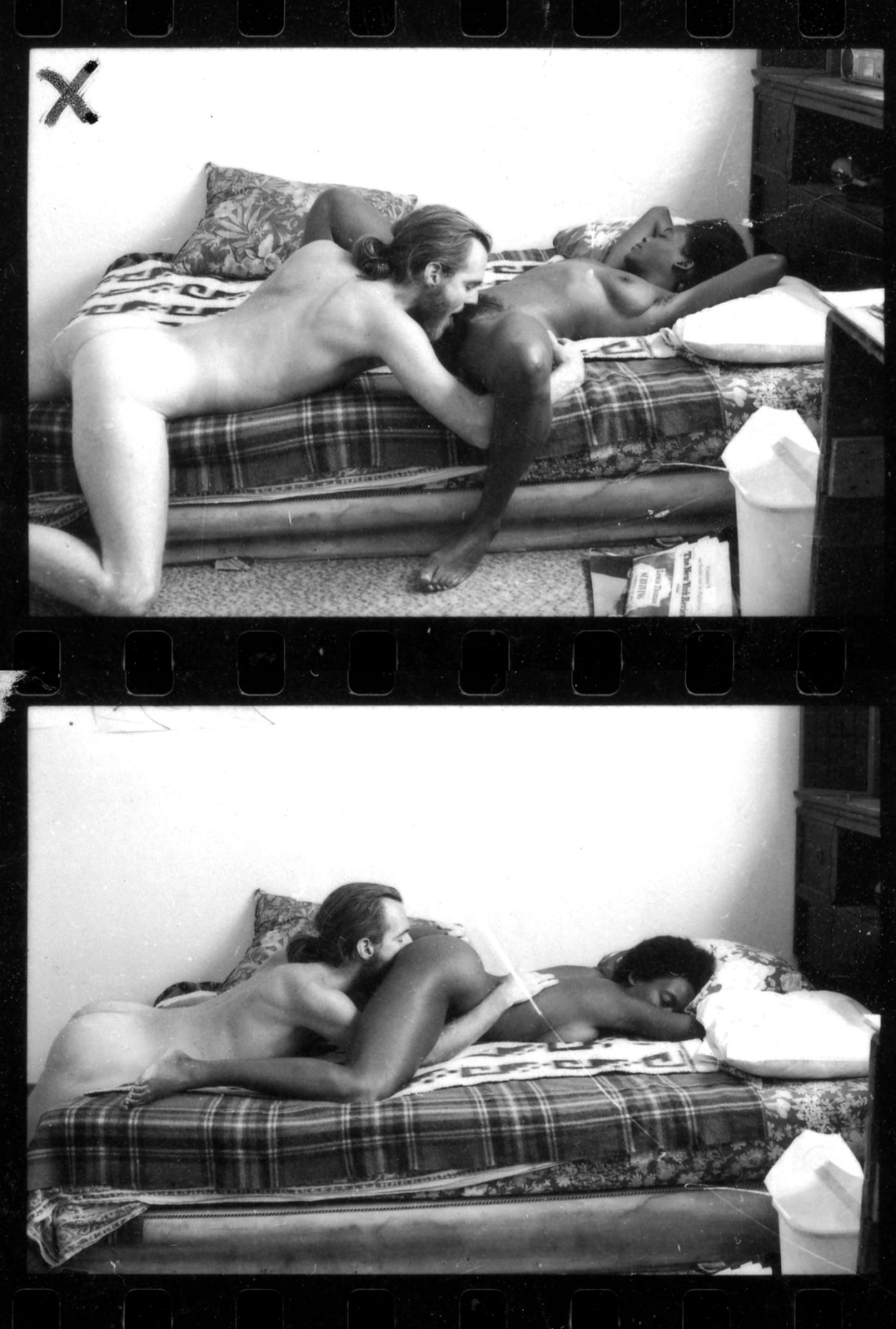
Source unknown – Colorado cunnilingus (1980)

There is a language
older by far and deeper than words. It is the language of bodies, of
body on body, wind on snow, rain on trees, wave on stone. It is the
language of dream, gesture, symbol, memory. We have forgotten this
language. We do not even remember that it exists.
                   —

Derrick Jensen, A Language Older Than Words

Source unknown – Title unknown (201X)

Regardless of what you think of my notion of #skinnyframebullshit, there is never, under any circumstances, ever any justification for capturing video in portrait orientation. None. Period. End of story.

That I’m giving this a pass should signal just how amazing I find this clip in spite of the shitty execution and poor quality this is one of those rare moments when porn bothers to show not only how I like to fuck but how I like to be fucked (and in the same video, OMFG). But it also makes me feel seen and like my sexuality isn’t just something that’s impossibly inconvenient to 96% of the rest of the world.

Also, trying not to come, coming anyway and then being so at the mercy of your feelings and connection with the other person(s) that there’s no time for  a break or respite and you end up coming again quickly and with such force that you literally feel the strain from how hard you clenched up for days afterwards.

Swoon. (To whoever made this–thank you. Also, please keep making stuff like this. It matters.)

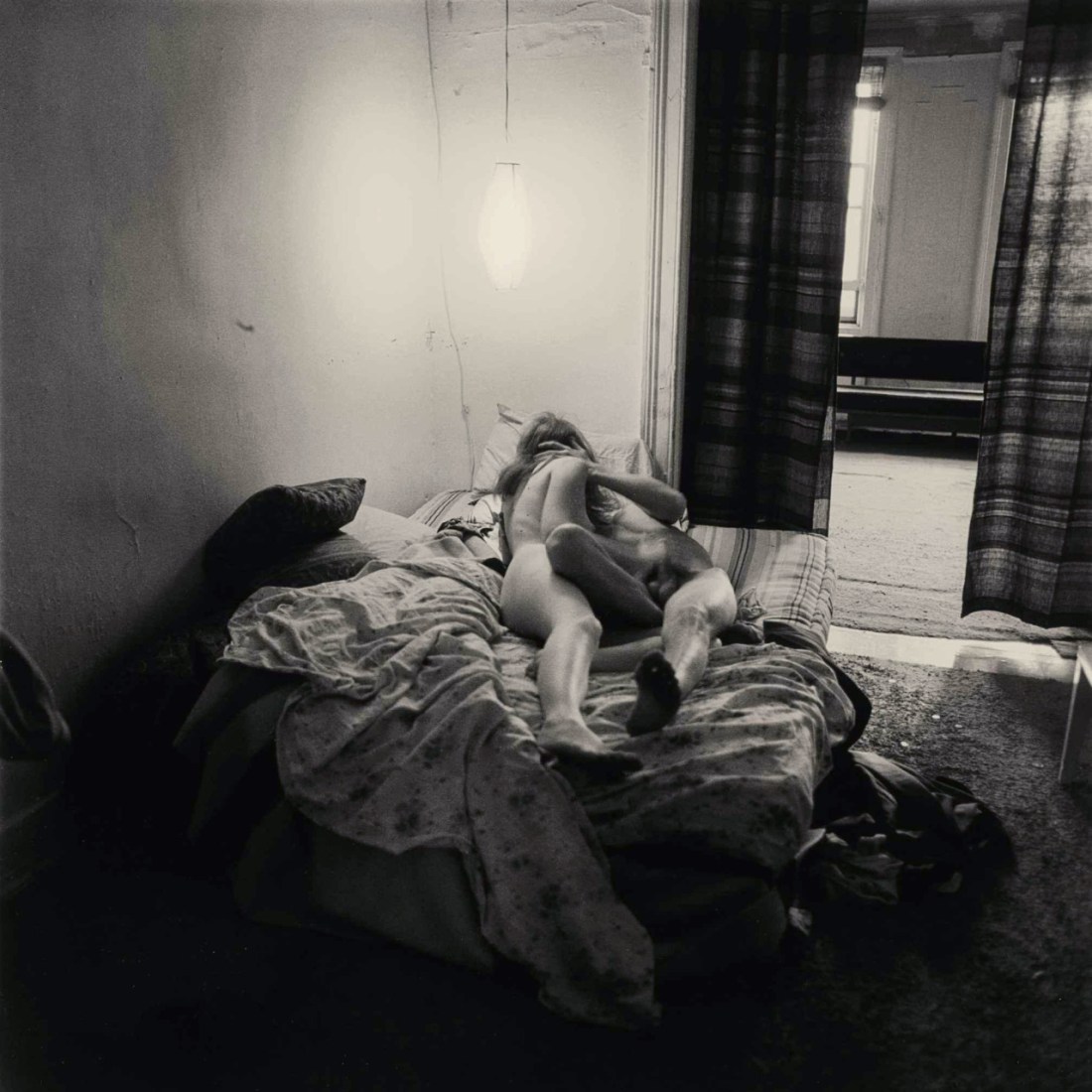
Diane ArbusCouple in Bed Under a Paper Lantern, NYC (1966)

I’ve maintained for years that reading something on a screen vs on a page effects how you process the information. (My recall for printed materials is generally better-than-average; via digital interface noticeably less astute.)

As far as Arbus goes, I’m not a fan. Yes: Child with Toy Hand Grenade in Central Park is one of the all-time best street photography portraits. (And one of the reasons it’s so brilliant is because it was made as things started to escalate in Vietnam–intuitively connecting wars overseas with their psychic impact closer to home.)

I never knew what I didn’t like about her work–and here it’ll become clear why I started with memories formed reading something off a page vs on a screen–I remember reading something on the Internet, a criticism of Arbus that associated her well-known quote: I really believe there are things nobody would see if I didn’t photograph them.” with her interest in social outliers and the stigmatized.

I look at so many of her pictures and there is this circus side show feeling to them–an I’m going to show you what you don’t want to see. That’s maybe okay: spectacle sells, after all. (But also: maybe don’t rely on solely that?)

Her images always leave me with this feeling that she was far more interested in what made someone a freak than how such social castigation impacted a person’s humanity.

So while I’ve seen this image a dozen or so times before it wasn’t until I saw it in the context of Tumblr porn reblogs that I realized what it depicts–a couple making out while a vigorous handjob is administered.

There’s something more disarmingly honest about it for it’s focus on the familiar–Arbus being ostensibly white (Jewish), cisgendered and heterosexual.

Further–and again, now that I need it I can’t find it–there is a similar post-coital image of Sally Mann with her husband Larry that actually is almost certainly influenced by this Arbus’ image.

Hiroko Shiina AKA C7Conium maculatum (2015)

I could opt to digress about the gorgeously filigreed line work (which to my eye is on par with Albrecht Dürer); or, I could rant about Shiva‘s multiple arms.

And speaking of multiple arms–it’s wonderful and rich with meaning the way the hands embracing her for a second appear as if they are hers but at least two of them belong to the person holding onto her (in a mix of comforting or perhaps more accurately sharing of sorrow) but also at the same time there’s a unsettling fondling feel to things. (The two hands on her body are clearly signaled as masculine.)

But what transfixes me, I’m talking hypnotically mesmerizes me is the way she’s catching her heart with her dress–her heart appearing as if it’s exploded out of her chest in a bursting bloom of Baby’s Breath, looking less like an organ and more than a little like a plant trimming left soaking in water long enough to begin to form root structures.

The way she’s catching the heart reminds me of that scene early in Twain’s Huck Finn where Huck dresses as a girl to attempt to gain information from a local farmer, his disguises is quickly seen through thanks to the gender essentialist tests of Mrs. Judith Loftus. (In particularly, the woman asks Huck to thread a needle–he fails; hit a rat with a lump of lead–he succeeds; and, to catch something tossed toward his lap–he slams his legs together to protect his testicles, whereas a young lady would spread her legs so that the surface of her dress would act as a trampoline to aide in catching the object.)

But really I’m kind of just so completely in awe of this because everything about it speaks to me on so many freaking levels–especially as a non-binary trans girl who (personally) has no interest in medically transitioning. I suspose that means I’m officially out to you, dear followers…

The resonance is so strong, in fact, that I am seriously thinking about getting this as a tattoo on my left tricep…