Source unknown – Daizha Morgann AKA Octoscphincter  (201X)

Even thought it’s extreme, I’d post this for how beautiful the tattoo is independent of anything else. But there’s something deliciously subversive about this that I can’t quite shake.

I know it’s an octopus and not a squid but I can’t help but thinking of that Matt Taibbi line comparing Goldman Sachs to “a great vampire squid wrapped around the face of humanity, relentlessly
jamming its blood funnel into anything that smells like money.

That’s something I’ve always found and continue to find curious about Xtians: they vociferously advocate for capitalism freely admitted that the profit motive is another name for greed. (As you’ll recall greed is one of the seven deadly sins.)

But as the progressive rejoinder goes once it solidified around Obama as the last battlement against the far right: A brown skinned man that’s an anti-war socialist, who gives away free health care and feeds the hungry? You’re thinking of Jesus not Obama.

Jesus was most definitely a socialist. But Xtians believe that their reward waits in another life. So if the world is going to be destroyed, why not just let man succumb to his baser instincts and indulge greed–instead of you know the more Xtian approach.

So I see this image as an intendend comment on the hypocritical links between Xtianity and capitalism.

Alessandro Ruiz – Untitled (201X)

I think spending approximately 25 hours a week keeping this blog running has perhaps warped my brain to a greater or lesser extent–you know kind of like that joke Bill Murray tells in What About Bob?

Bob Wiley:
[telling a joke]
The doctor draws two circles and says “What do you see?” the guy says “Sex.”

[everybody laughs]

Bob Wiley:
Wait a minute, I haven’t even told the joke yet! So the doctor draws
trees, “What do you see?” the guy says “sex”. The doctor draws a car,
owl, “Sex, sex, sex”. The doctor says to him “You are obsessed with
sex”, he replies “Well you’re the one drawing all the dirty pictures!”

Like I can’t tell you how many times I’ll be looking at something and be like wait, is that what I think it is? (It almost never is what I’m thinking, unless I’m on Tumblr and then it’s usually worse than I thought it was.)

Like with the mussed hair and pose and position of the hand above, there’s something both suggestive of masturbation and self-conscious demurring. (I can’t ascertain if Ruiz continues to have a web presence outside Model Mayhem but his work suggests that either of these readings–at a minimum–fit his works’ comportment towards eroticism.

If I were feeling pedantic I might draw a comparison between Ruiz and Erotobot–the latter is technically the superior image maker in sum but it’s a question of carefully considered composition vs. visceral immediacy. (I prefer both in tandem but since you rarely find that, I tend to favor the latter over the former.)

But while I don’t agree with the composition of this image–I do like her against the dense black background, I’d just have framed it wider than this. It did actually make me question something; namely: the notion of demureness as it pertains to social expectations placed upon women.

I’m thinking here about the religious notion I was raised with wherein the body/flesh is the locus of sin and therefore the genesis point of shame. I mean as far back as The Creation myth we see that Eve is tempted by the snake, she in turn tempts Adam and then they realize they are naked and try to cover themselves.

And it occurs to me that in the art historical, phalleocentric history of art there is a tendency to conflate a post-orgasmic languor in much the same fashion as what is the expected behavior of the properly demure.

I’m also curious as to the restraint in this image with regards to graphically explicit presentation vis-a-vis the rest of the work.

Not sure if pressed I could prove this thesis but it’s what I’m thinking about at the moment, fwiw.

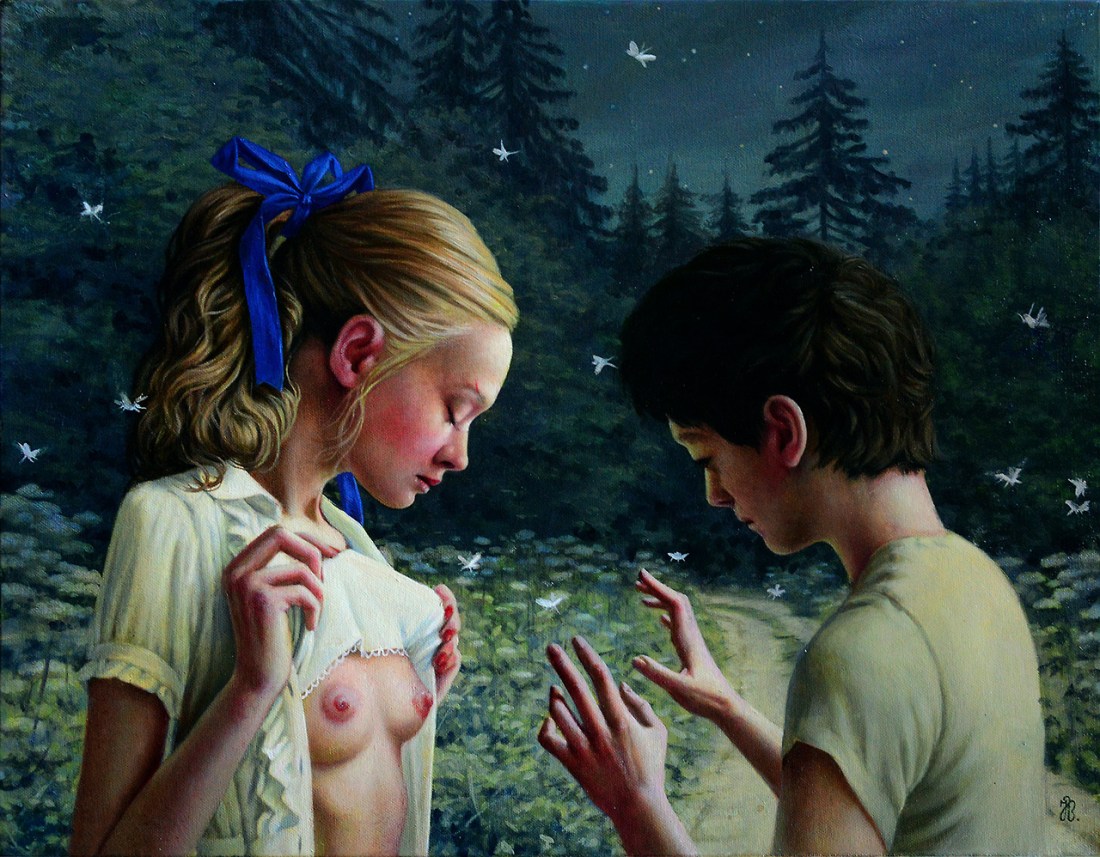
Jana Brikefirst love on the edge of a deep dark forest from Anatomy of Innoncence series (2015)

This is not Brike’s best painting but it resonates with me more intensely than the rest.

In overview, Brike’s is a painter. Her work features pubescent characters with oversized heads–presumably to draw even more attention to her grasp for conveying uncanny nuance of expression.

The duality of innocence and curiosity is her conceptual prima materia. Her scenes often play out in or near bodies of water–i.e. Two Wound Angels on the Beach and Goldilock’s Holiday.

She trades in a number of thinly veiled tropes–masturbation (Gardener and the Centre of the Universe), sensuality (goodbye, Eden, Snow White and when I kissed the teacher), lesbian experimentation (anatomy lesson) and tangentially the girl-girl solidarity that is at once not sisterly, platonic or romantic but is simultaneously each of those things all at once (holiday at grandma’s place).

It’s also worth noting that while she’s always preoccupied with the first flush of physical lust, the occasionally presents it in very concrete ways. There’s an honesty to the diptych little miss sweetheart/gardener’s son that is the most concrete and unassuming depictions of nascent paraphilia this side of the girl with chapped lips from Tarkovsky’s Mirror.

A lot of her work appeals to me for these reasons. But the image I’ve chosen to post here does two things better than I think all the rest of her work combined. Too often, female sexuality potential is painted as an incitement for male sexual arousal. It’s a very heteropatriarchial framework.

This portrays something that is different. A wanting that is both a giving and a taking. The blush on her face and the demure way she is leaning in slightly while waiting for it to happen conveys a desire for what is happening to transpire but also presenting it as a choice that is completely lost on the shy but eager boy. There’s a sense of knowing there will be a debt entered into the ledger that will come due in time.

I don’t think it’s just my gender stuff; I think the audience is supposed to empathize with the young woman here. (My gender stuff just makes it more resonant for me because I have a thing where I want my lovers to see me completely, unhidden, naked and vulnerable while they are still safe and clothed.

I don’t know if it’s that I want them to have a chance to know what they’re getting into so that they can walk away if they want. So much that I know any dalliances with me are things I’ve been taught over time to accept cost far more than anyone really deems worth it.

Richard AvedonAndy Warhol and Members of The Factory, New York (October 30, 1969)

If I were more ambitious/less of a lazy layabout, this is the sort of work that I would summon David Foster Wallace-esque footnoted footnote levels of ‘scholarly’ exegesis. However, I’m in a an unusually clearheaded place today–I’ve absconded to a more temperate clime where spring is very much in the air + it’s having a restorative effect.

Thus the only things I want to address related specifically and concretely to a direct interpretation of this large format triptych are as follows:

I tend to be resistant to spending time with the work of iconclastic. This is actually the height of irony–given my own iron clad anti-authoritarian bent. But I do possess strong enough of post-left anarchist pretenses that I rankle in the presents of efforts to make outsiderness a sort of new status quo.

As such I’ve been a late subscribe to folks like Robert Frank–if you want to be a photographer of any consequential merit you absolutely need to know The Americans like the back of your hand. (Yes, it is actually that crucial a work.)

I’ve only recently began flirting with Avedon’s oeurve–largely due to how smitten I am with his portrait of Sandra Bennett from In the American West.

I’m still on the fence when it comes to Warhol–although I am intrigued by The Factory (more on that in a bit).

I think of how the first panel is obviously riffing on art historical depictions of Adam and Eve–except with the implication of queerness in the pair of two men with a trans woman. The way the center panel captures a sort of sex, drugs and rock and roll vibe that subsequently transitions into a sort of art star as cultural gatekeeper/philosopher king trope. (And conceptually, everything that is read before you reach Warhol, essentially emerged from his efforts.)

I also think about how this is one of the earliest examples I can call to mind of fostering the illusion of a panorama across multiple frames. (And  here I would be remiss if I didn’t take the chance to point you in the direction of folks who’ve continued in that tradition, a la:  David Hilliard, Accra Shepp and Tom Spianti.)

Yet, just as how the progenitor of all that precedes is the last thing you encounter, these observations are really the last things that come to mind for me when I look at this triptych. What I’m really thinking about is a sort of melange of thoughts and impressions.

I guess first off I think about a chat I had with a close friend where she mentioned that although she is not queer, her understanding of queer experience is that you feel a profound sense of not belonging from a young age. And as someone who identifies as queer, my own experience is not so clear cut. I did feel I was different but growing up in an Evangelical milieu, I viewed that as an advantage for many years. I had no desire to be like those who surrounded me/to fit in. In my late teens this bearing became and increasingly dissonant point. I craved love and acceptance from someone/anyone and I was surrounded by people who insisted that I accept their general framework to receive love and affection. So what I wanted/need stood at cross purposes with what I knew to be my own personal truth; I learned to a large extent you have to play a part and/or lie to get what you want. I’ve never been able to manage that feat. (For someone who can at times be a pathological liar, I am honest to a fault.)

Honestly, art is the only thing in my life that has ever even tried to meet me halfway. (Actually, that’s not entirely true. My 30s have been a super mixed bag but increasingly there have been folks with whom I’ve shared + continue to share a mutually cultivated middle ground.)

However, in that there is a danger of building a monument to outsider-ness, an echo chamber. I’m reminded of one of the best things Brain Pickings has ever posted: The Paradox of Active Surrender: Jeanette Winterson on How Learning to Understand Art Transforms Us.

One passage in particular resonates with me:

There are no Commandments in art and no easy axioms for
art appreciation. “Do I like this?” is the question anyone should ask
themselves at the moment of confrontation with the picture. But if
“yes,” why “yes”? and if “no,” why “no”? The obvious direct emotional
response is never simple, and ninety-nine times out of a hundred, the
“yes” or “no” has nothing at all to do with the picture in its own
right.

“I don’t understand this poem”
“I never listen to classical music”
“I don’t like this picture”
are common enough statements but not ones that tell us anything about
books, painting, or music. They are statements that tell us something
about the speaker. That should be obvious, but in fact, such statements
are offered as criticisms of art, as evidence against, not least because
the ignorant, the lazy, or the plain confused are not likely to want to
admit themselves as such. We hear a lot about the arrogance of the
artist but nothing about the arrogance of the audience. The audience,
who have not done the work, who have not taken any risks, whose life and
livelihood are not bound up at every moment with what they are making,
who have given no thought to the medium or the method, will glance up,
flick through, chatter over the opening chords, then snap their fingers
and walk away like some monstrous Roman tyrant.

As much as I’m intellectually against dismissing something without thought, I’m not super good at practicing what I preach. I tend to develop intractable opinions on the merit of certain work vs. other work I deem to be less meritorious. It’s not that I don’t think about these decisions, it’s that I maybe don’t think enough about them before dismissing them.

That’s one thing I adore about Tumblr–and too all the folks claiming this forum is dying, I see you and feel you, it’s not what it was (that’s for sure). But I keep being confronted with things independent of any prejudice to whether I’ve made up my mind about them yet. It’s why my opinion on Avedon has changed from I don’t care for his work to an awareness that I haven’t really explored it in enough depth to have an informed opinion on it. Also, I’m excited by the prospect of engaging with his work. This wouldn’t have happened if I were part of an ostensible community that insists upon work I would otherwise ignore.

And that’s the other side of things, the community that Tumblr provides not only causes me to reconsider my own assumptions on established artists and canonical art, it also introduces me to stuff I wouldn’t otherwise have encountered.

I’m thinking here of one of my favorite posts of all time on this blog: a documentary still from FeminismoPornoPunk’s staging of a porn variation of the experimental theater piece Public Domain.

And I feel like that’s something Warhol got right with The Factory. It wasn’t sex, drugs and rock ‘n roll for the sake of excess–although that was almost certainly a byproduct. Instead, it was about the potential in that milieu to construct a sort of interpersonal space/a ad hoc community of lived experience as informative and educational and evolutionary. A catalyst for exploration whether that exploration was transgressing boundaries or creating art. (I don’t think it’s an accident that so many art world luminaries emerged from this scene, actually.)

And I guess that’s what I am grappling with how to achieve: making this blog a sort of space not unlike The Factory. Except I don’t want to be the Warhol figure. I’d rather be just another faceless participant.

Jack Welpott – [←] 65 Ave Paris (197X); [→] Elle se lave (1973)

For all I know about photography, I have some enormous lapses. (One of the only lasting + pervasive drawbacks of being an autodidact.)

I had never heard of Welpott until I encountered Elle se lave this morning.

The first thing I noticed was the two mirrors like eyeglass lenses. (It reminded me of one of many breathtaking shots in Raw–specifically the bifurcated bathroom mirror after Justine vomits, where another girl overhears her and assumes she’s purging instead of legitimately ill.)

I popped over to Welpott’s website and immediately took note of the first photo above. It’s interesting because in both images the camera has a noticeable down tilt. I’m normally not fond of this. I prefer interior scenes like my web design: clean and minimal.

As such, I’m inclined to read the camera here as self-conscious. (To my mind, the downward angle eventually draws attention to the camera. Also, angling down when the photographer is made by a cishet male and the subject is a woman are über problematic given you know centuries of entitled patriarchal hegemony and the dependence of such modes of command and control on the subservience of women..)

Yet, the ambiguity between authority and self-doubt actually comes across in these. So there’s that. (Also, I was able to go for a walk this morning and I walked eastward with the sun in my eyes the entire way. I noticed the way I looked at the ground in front of my feet–there are sometimes snakes chilling out on this trail, so you have to watch out; and it feels to me like these images have a similar privileging near as opposed to far–which adds a-whole-nother level of ambiguity to the proceedings.)

But then I read in his bio that Welpott played jazz piano and said of his photography:

When I’m working behind a camera, I feel like I’m trying to achieve something like a jazz musician does.

(This resonates with me because one of the reasons I’m a photographer is because I lack any sort of innate sense of rhythm and that ruins my chances of being a musician. I love music. In fact, I’ve gotten higher off of experiences of sonic immersion than I ever have on drugs. Also, I’ve been actively listening to more music than I have in years–it’s a really great time to be a metal lover, tbh.)

And that makes me wonder if I find these mirrored resonances in other peoples’ work because I’m attempting to feel less alone or if assiduous efforts to understand one’s self actually causes you to see yourself in the other?

Also, I’ve been doing a shit ton of drugs… so it could just all be in my head. (Yep, it’s probably that. But–in the same breath: I do think it’s interesting that the downward angle is paired with landscape oriented frames. I think if I was a little bit more together, I’d actually be able to sharpen this into another reason why there really isn’t a justification for #skinnyframebullshit more often than I am inclined to call #skinnyframebullshit.

Valerie ChiangAll info is in the image (2017)

This is really effing fabulous, y’all.

It’s a solid image. There’s a sense of person and place, the pose is dynamic and it’s an image that would lose whatever It-thing renders it so damn visually compelling were it B&W instead of vibrantly full color.

Compositionally, the original image had some issues. Kacy is presented slightly left of center. From the standpoint of the way the eye scans this isn’t ideal. Were this digital, you could flip the image so that the top of the juke box/deli-display counter lines the eye up to scan to Kacy’s face and then her gaze back at the camera and through the camera the photographer/audience.

But this is an actual snapshot. So it is what it is.

Cutting a strip from the right and then appending it to the left is a solution that is elegant in its simplicity and stunningly effective. It moves Kacy to the center of the image, yet breaks up the composition in a way that makes the centering non-obtuse and perhaps even a bit enigmatic.

Then there’s the physical tactility of the way it’s presented. The composition book page and tape with a caption added; a caption that serves the same function as most titles for fine art photographs–it tells you what you’re already looking at.

(Let me digress momentarily here to say that after trolls, the most common asks I get are people pissed off when a title controverts their interpretation of an image. On one level I understand the frustration; on another–I think although it’s more challenging a title can actually contribute additional poetic resonance to an image. I always refer people pissed off about titles to Joel Sternfeld’s On This Site… which presents gorgeous large format landscapes and then with the title reveals a horrific crime that took place in that exact location years ago.)

What Chiang appears to be doing here is pointing to this tendency in a super meta fashion that sort of undercuts the logical underpinnings of this tendency.

I mean she’s basically presenting a photo and giving the photo a context–i.e. as something visceral but also as something diaristic (the notebook page, which should also be noted that by using the back side of the page instead of the front gels nicely with the compositional flaws in the photo as well as the fix.)

It’s all very elegant. But it’s interesting because the caption in the image: Kacy Hill, Cafe 50s, Los Angeles, CA merely describes what is been depicted. (That does provide some clarity at least for me because to my eye this could be a Brooklyn bodega deli for what I see of the background but the light is decidedly not east coast. The caption clarifies that.)

The title All the info is in the image is effectively illustrating what any fine art photographer does when the push work out of the nest into the world–where it will live or die on its own. The notion being that you convey enough of a context where the work can make a life independent of its creator. So it’s educational but I also feel like there’s a bit of an urge to proclaim that titling images is important and maybe we can do it in new and different ways just so long as we remember to enliven the context enough to justify such largess when it comes to authorial license.

Either way, I think Chiang’s work is several cuts above most of the stuff floating around the Interwebz these days. Definitely check her work out. It will reward your time and energy richly.

Gregoire Alexandre – [←] Fer 1 (2012); [→] Fer 2 (2012)

You attend to the shape, sometimes by tracing it, sometimes by screwing up your eyes so as not to see the colour clearly, and in many other ways. I want to say: This is the sort of thing that happens while one ‘directs one’s attention to this or that’. But it isn’t these things by themselves that make us say someone is attending to the shape, the colour, and so on. Just as a move in chess doesn’t consist simply in moving a piece in such-and-such a way on the board-nor yet in one’s thoughts and feelings as one makes the move: but in the circumstances that we call “playing a game of chess”, “solving a ches problem”, and so on.

                –Ludwig Wittgenstein, Philosophical Investigations §33

We don’t know what’s
going on here. If these tremendous events are random combinations of
matter run amok, the yield of millions of monkeys at millions of
typewriters, then what is it in us, hammered out of those same
typewriters, that they ignite? We don’t know. Our life is a faint
tracing on the surface of mystery, like the idle, curved tunnels of leaf
miners on the face of a leaf. We must somehow take a wider view, look
at the whole landscape, really see it, and describe what’s going on
here. Then we can at least wail the right question into the swaddling
band of darkness, or, if it comes to that, choir the proper praise.
                  

                —Annie Dillard, Pilgrim at Tinker Creek