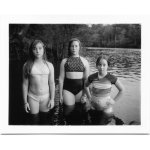
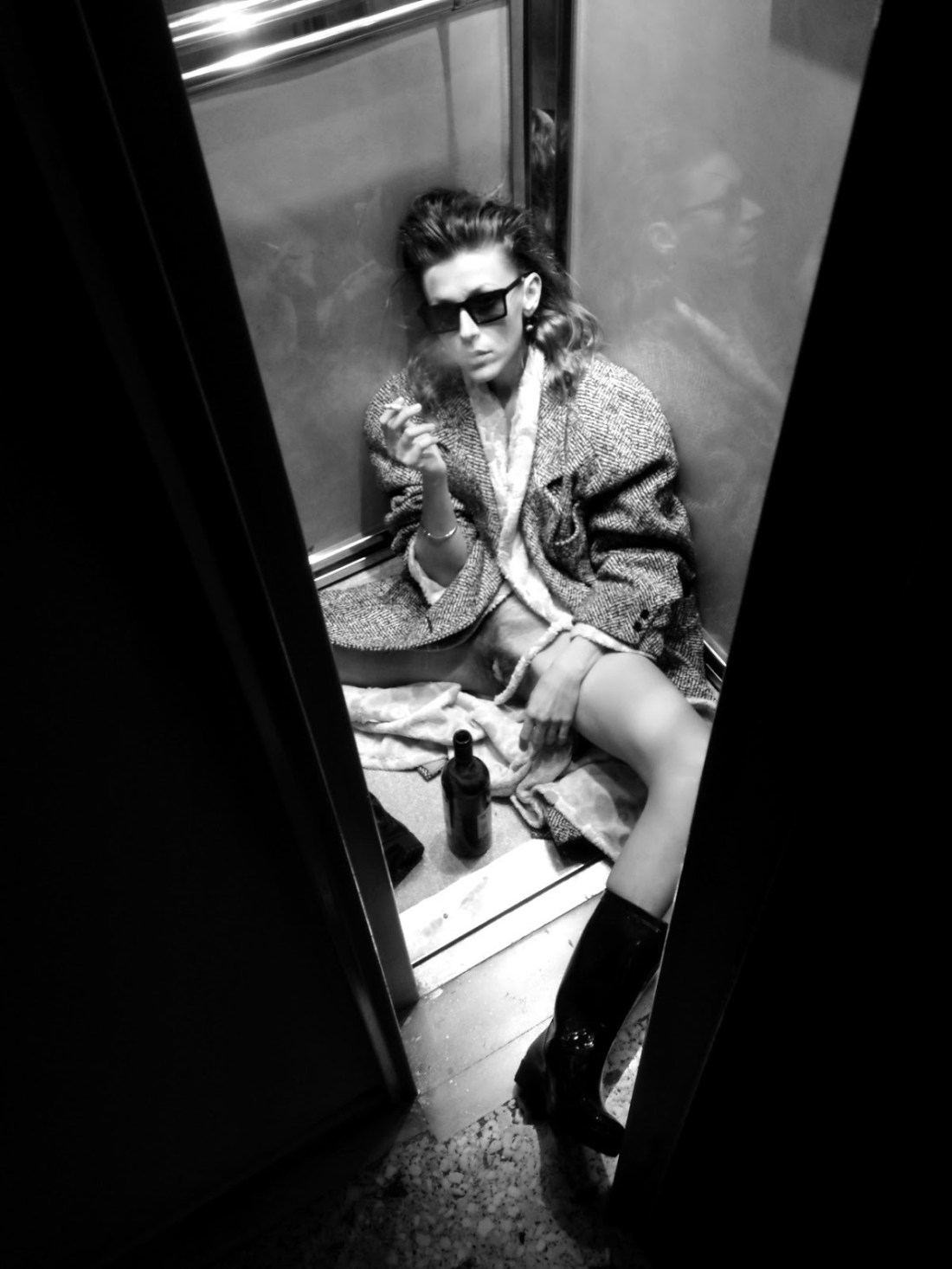
wonderlust photoworks in collaboration with @marissalynnla – [↑] Marissa Lynn (2017); [↓] Pellucid (2017)

As I’ve mentioned, I had two photo collabs while I was out in L.A. last month.

It’ll be another three weeks or so on the B&W–I use a specialty lab that I ADORE (but they are impossibly slow).

Anyway, so for now here’s the edit of the color stuff from the afternoon I spent with Marissa.

I was extremely nervous about the lack of light. (In an irony that wasn’t lost on me, it rained almost the entire time I was in L.A. while it was 60°F back in Brooklyn…)

But it just goes to show–trust your materials, measure twice, cut once and things have a way of sorting themselves on their own.

(I’ve clearly been thinking about Alexander Bergström & Akif Hakan Celebi more than I realized…)

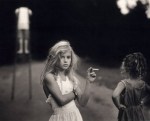
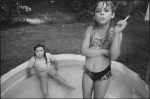
[↖] Sally Mann – The Last Time Emmett Modeled Nude (1987); [↑] Mary Ellen MarkAmanda and her cousin Amy, Valdese, North Carolina (1990); [↗] Sally MannCandy Cigarette from Immediate Family series (1989); [↓] Jen ErvinUntitled (2015)

Follow* the thread.

* There’s a photo that featured on a poster in my undergrad dark room–by an American woman circa the mid-to-late 1990s; it’s a B&W photo (a platinum print?) of a girl–perhaps 9 or 10–standing in dripping wet one-piece swimsuit next to a split rail fence (I think?). Maybe one of her siblings is climbing on the fence, I think there are two other people in the photo. The girl is making eye contact with the camera and is mugging a bit. The surroundings scream American suburbs. Also, I think the title of the image possibly has something to do with summer in Connecticut and it was on a poster from either a gallery or advertising a book (I can’t remember which). I am more than a little irritated with myself for being unable to remember it. (I swear it was Corinne Day but I’ve been unable to find the same photo in anything of hers online.) If anyone has a clue what I’m referring to–please for the love of all that is holy, drop me a line. The point of this post was supposed to be how young photographers don’t even necessarily have to be familiar with the full history of fine art photography because frequently the work that influences them draws influences from folks that are even more prototypically working within the same conceptual realm/with a startling overlap in their creative concerns.

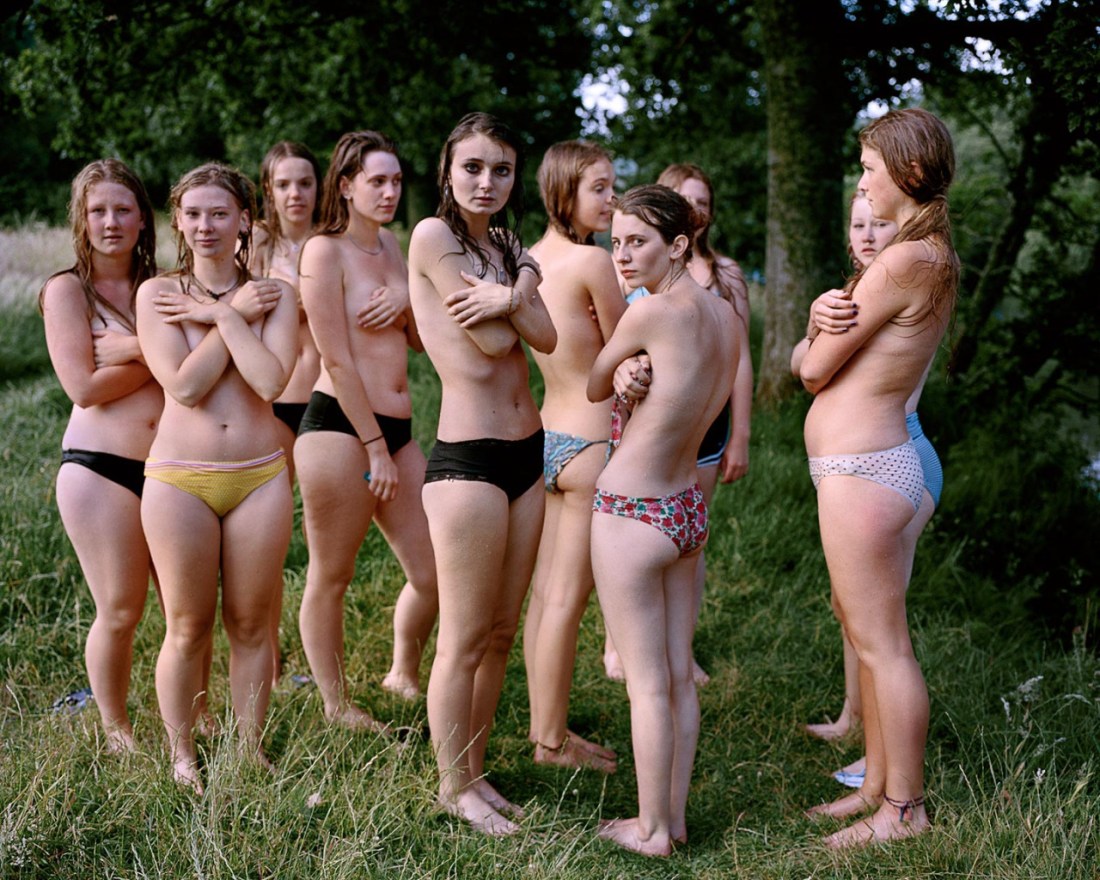
Siân DaveyTitle unknown from the Martha series (2016)

If you are at all political these days, you–like me–are learning that the 24/7/365 news cycle never allows you to take a minute and catch your breath. It’s like that stupid (and apparently immortal battery) operated rabbit…

There are only so many hours in the day and as I learned during my time as an undergraduate, I max out at around 1200 pages of reading in any given week.

Frequently, I find myself reading headlines and if you’re lucky the first couple of paragraphs before moving on to the next thing screaming for my attention.

All that is by way of introduction to the above photograph by Siân Davey.

I encountered it via @nevver (aka this isn’t happiness) who harvested it from a FotoRoom interview with Davey’s about the Martha series.

The background runs like this Davey produced a body of work focused on her younger daughter Alice–who was born with Down’s Syndrome.

Her 16 year-old step-daughter Martha eventually confessed that she felt a bit ignored and a new body of work was begun.

There are a veritable raft of things that interest me here w/r/t this project. But I am presently extraordinarily self-conscious about all the rambling diatribes I’ve posted recently so I am going to make and effort to stick with the richer considerations.

And first off, it really needs to be said that whomever selected the 10 photos from Martha to be featured along with the FotoRoom interview has no business curating.

I am not being bitchy here: review the FotoRoom selections first and then visit the full series. What in the former case seems to be an overly contrived fly on the wall, fetishization of youth becomes in the latter case, something much more fraught with ambiguity and complexity. (Also the focus in the FotoRoom piece presents the results as if Davey splits her time shooting between disposable film camera–an aesthetic I despise–interspersed with more technically accomplished/mannered portraits.)

Really the variance in quality is far more controlled, organic and immediate than is conveyed in the FotoRoom feature.

Based solely on that feature I was prepared to compose a catty missive bemoaning the execution while praising certain aspects of the photo above’s conceptual acuity. However, after actually spending some time with the whole body of work, my objections have pretty much evaporated.

Although I do have a bit of a nagging quandary that still lingers: It has to do with the fact that while I thoroughly adore the more fine art minded photos in the series. There is something uncomfortable about this image that I think causes this photo to actually rise above every other inclusion in the series.

It’s partly the fact that the camera isn’t a fly on the wall–not really. There’s the two boxes of Kodak Portra not entirely obscured by the the Budweiser beer and sea salt and balsamic vinaigrette Kettle Chips. (As well as the two young women chipmunking at the back of a dSLR–a snarky aside commenting not only on generational differences but also the immediacy of adolescence vs the mired trudge that is being right smack in the middle of adulthood.)

The full series is actually extraordinary at following the betweenness of not quite an adult but also no longer a child and the way that performance and community inform the inevitable and irrevocable transformation.

I have questions about some of the other photos. Why are so many of these kids smoking cigarettes? Why is a step-mother privy to these kinds of events her teenage step-daughter? (I suspect the answer is that she can only dictate to an increasingly limited degree what choices her daughter makes, so she prejudices being able to be present and ready to protect if necessary–which I admire and feel would probably be more take if I were ever to have kids: unlikely but two years ago I would’ve said it was never a possibility and now I am much less certain on that count.)

But what I want to know about the photograph here is: did the young woman cover themselves because the camera was aimed at them? Or were the directed to cover their chests because the camera was aimed at them?

I would bet it’s the latter. But even if that is the case, there’s still a wonderful mediation between being aware of being seen but pretending not to care but in a socially appropriate manner.

I love the you’ve got to be kidding me look of the young woman in the black undies with the black eye make-up and the friend she is facing in the rose print bikini bottoms with the matching top pressed incredulously against her chest and radiating feral fury at the indignity of her position.

You were made and set here to give voice to this, your own astonishment. “The most demanding part of living a lifetime as an artist is the strict discipline of forcing oneself to work steadfastly along the nerve of one’s own most intimate sensitivity.” Anne Truitt, the sculptor, said this. Thoreau said it another way: know your own bone. “Pursue, keep up with, circle round and round your life… Know your own bone: gnaw at it, bury it, unearth it, and gnaw at it still.” Write as if you were dying. At the same time, assume you write for an audience consisting solely of terminal patients. That is, after all, the case.

Annie Dillard, The Writing Life (via fork-tender)

Virginie KhateebUntitled from the series A crowd of people turned away (2016)

The two words I’d use to describe the emotional state that precedes composing posts like this are: uncertainty and dread.

I’ve said it before but the not dead yet horse can use a few more lashes–writing is an intensely painful undertaking for me. (All my writer friends would be quick to console me that such a feeling means I’m ‘doing it right’.)

But I never feel like I’m doing it well, let alone ‘right’–whatever the hell that might entail.

I just know that this belongs here. It’s a less preternatural awareness and more obsession–I just read this as being staggeringly perverse. And I can say that and merely by asserting the point, disengage and leave you, dear reader, to unknot my meaning through your own meditative contemplation.

But to do so would indicate an intellectual disingenuity that I can’t really abide.

I guess the first thing I notice about this image is that the staging of it seems intended to convey more than anything the relationship between these two women. In other words: maternal (mother or grandmother) figure and progeny (daughter or grand-daughter).

And the thought reminds me of a conversation I had recently with an acquaintance about how all relationships are–by their very nature–a sprawling mess but that mother-daughter relationships are far and away the most fraught and messy.

Add to that the way that just barely visible in the background is ruined building in front of which these two women are standing. It’s almost as if the world behind them is collapsing as they look towards the future.

The younger woman is slightly closer to the camera. Her body is angled so that she is both perhaps about to walk forward and positioned in such a way to minimize the parts of her body that can be touched by the older woman. In other words, her body language speaks of trying to make herself a smaller target while still behaving as is expected of her.

I am inclined to suggest the older woman is supposed to be her mother and not her grandmother. (I’d expect a grand mother to either stand at slightly more of a remove; or, to be less demanding in the way she’s forcing physical contact.)

The older woman is positioned in relationship to her daughter and the ruins behind them. There is a very profound sense that this scene will not last long and that if the older woman moves, she will retreat not follow the younger woman as she moves closer to the camera.

I adore the texture of the sweaters and how with selective contrast control, the boundaries between their body are clearly delimited but there’s still a connection between them.

I look at this and I almost hear my own mother ordering me to not slouch and to do people the courtesy of looking them in the eye. (Eye contact is unbelievably difficult for me and I think there are maybe four people I know whose eye color I can tell you when asked.)

But none of that is really perverse. It’s loaded with pathos and highly relateable, yes. So what makes it perverse?

It’s partly the way she’s forcing her head into this haughty, regal posture. It’s also the way the sweater has fallen around her right shoulder revealing her camisole. And I can’t help but see the sort of dichotomy mothers must face with their daughters where they want them to be self-possessed, independent and strong–while also not cold and unappealing.

Also, the way the older woman is more concerned about the way her daughter has positioned her head as opposed to the unsightly fallen sweater, suggests a bit of the adage where women are socialized to leave something to the imagination.

All that makes me uneasy. But then there’s a fact that this photograph is part of a series borrowing it’s title from lyrics to The BeatlesA Day in the Life.

As I’m sure you know that song includes the infamous line “I’d love to turn you on.” Which is supposed to be a reference to the famous line from Timothy Leary advising folks to turn on, tune in and drop out. (But you can’t overlook the more obvious meaning, especially in light of this image.)

So I really think this image is about how parents dedicate their existence to providing a better life than they had for themselves. It’s well intentioned enough but it contributes a lot of baggage when kids don’t necessarily want a life similar to their parents.

It’s like at what point does the task of raising a child end as does a certain level of at least indoctrination, if not straight up brainwashing occur?

There’s a feeling–to me, at least–that things don’t necessarily end well for either of these women. The younger one maybe still has a chance. But what I think makes it interesting is that although there’s a sense of foreboding, there’s a humanity to the older woman that saves her from being read as a unyielding crone.

Source unknown – Elle (201X)

These images were harvested from a Tumblr called I Can Resist Everything Except (Temptation)–a reference to a quote from Oscar Wilde.

‘Temptation’ is presented parenthetically due to the fact that it’s not part of the URL but features prominently in the page header.

Also, since the blog takes a sort of Lou Bega Mambo #5 approach–the implicit notion being that temptation can be used interchangeable with the names of the nubile young women the curator favors. (For example: these images have no information about where they originated; all that’s included (sometimes) is the name of the model. In the case of the above–Elle.)

A both prominent (and cynical) Tumblr rejoined is: but is it art?!?!??

Personally, I find it annoying simply because most of the time it’s deployed, it’s rhetorical.

I’m not about to suggest these images of Elle are art. And although I’m probably alone in thinking it, why they aren’t art and how the context within which they are presented impacts that conclusion are much more interesting to me.

There are two huge problems with these six image. They are archetypal examples of compositionally illogical, #skinnyframebullshit. But an even bigger problem is the inexcusability of the over-the-top male gaze-y-ness they suggest.

Elle’s acknowledgement of the camera contributes a self-consciously, coy vamping quality to the proceedings. I straight up don’t know a woman who is going to Donald Duck in a crisp pink blouse on a nice couch with her saucer and tea cup–undies and a sweater? Check, yep and yep. Sounds cozy as fuck.

Even if Elle were ostensibly snapping sexy photos to share with a romantic partner–there’s a way in which the images as they appear strain the credulity of the images. These are very specifically staged in a fashion to suggest that the images themselves represent a record of calculated flirtation, if not straight up seduction–where the image maker encourages the audience to view him as a cooperative surrogate.

Cishet dudes love to castigate me every time I mention the art historical male gaze. They opine about how documenting the wonder of the naked body of a woman is somehow beyond reproach within certain parameters to which they–of course–adhere rigidly.

And I don’t think there’s anything inherently wrong with close-ups of erogenous zones of the human body. In fact, given the time and motivation to do it, I’m pretty sure I could come up with a top 10 of art historical instances of the intersections of porn and art.

What frustrates me is the way art is used as a key to access situations you might not normally be granted entrance. The sort of I know how to use a camera, so let me take pictures of you naked. And then the subsequent built in audience–since a great many folks love seeing other people naked, the endless demand justifies the continued supply and we just lazily call the whole thing art and wonder why there are so many gross predators in this ‘community’.

Let’s return here to the question of context. My thought is that in a century give or take a decade or two, a great deal of the work I’ve featured here and the work that the community around which this project hovers will be forgotten. I don’t think that’s necessarily a bad thing.

That of it which stands the test of time will most likely be work made in good faith between the author, subject and audience and/or will be work that was made without any pretext to artistry but instead sought to convey an immediate and overwhelming passion to be truly seen. (Basically, I’m of the opinion that there’s probably better selfie sexts floating around in the cloud than 90% of the stuff that gets posted to art ‘facilitating’ sites like Tumblr or Flickr.

Anyway, once again I’m all over the place. Back to Elle and I Can Resist Everything Except…

ICREE is super male gaze-y. But there is something interesting about it if you dig through the archives. A surprisingly consistent aesthetic–I’d term it a fetishization of quality. (Or, to be more fiercely specific: the blog runner favors a more even illumination provided by strobes more reminiscent of late 80s haute couture mixed with digital age-ready tone mapping; it screams QUALITY in your ear with a megaphone at full blast standing right next to you.)

More accurately it’s an approximation of quality. The above images of Elle aren’t intended to be contemplated for long stretches. For example, note that distracting something or other in the upper left corner of the right topmost image, The shadow case by her right arm in the image on the lower left. The inconsistency between the illumination on the background wall behind Elle but the more or less consistent exposure to optimize her skin tone.

(It’s clear the image maker is chasing–but never really catching up with a look not unlike this image by Australian image maker Andrew Harewood.)

A lot of hay gets made over Duchamp’s signing of a urinal. And I’ll admit that there are glaring holes in my art history knowledge when it comes to the latter half of the 20th Century.

I’ve straight up never understood the popularity of Andy Warhol. But it just seems like an application of Duchamp’s ready made to pop culture appropriation. Commerical art–transformed back into art by transmutation by art celebrity authorship.

I’m not going to give anyone a pass on misogyny. Ever. Still, I think that overlooking the massive lack of any sort of citation and the fact that the material ICREE posts appears to come from copyrighted sites posted without permission, there is a surprisingly astute eye governing to cohesion of what gets posted over there.

And although it’s arguable that it succeeds, I do think there is something like a Warholian effort to reappropriate the work in a way that diminishes content and emphasizes the broader context of the images presented in relationship to one another.

Source unknown – Title unknown (200X)

It was the perfect picture of utter spirituality
and utter degradation. I was fascinated and could not turn away my eyes.
By watching them I in effect permitted their mating to take place and
so committed myself to accepting the consequences—all because I wanted
to see what would happen. I wanted in on a secret.

–Annie Dillard, The Force That Drives the Flower