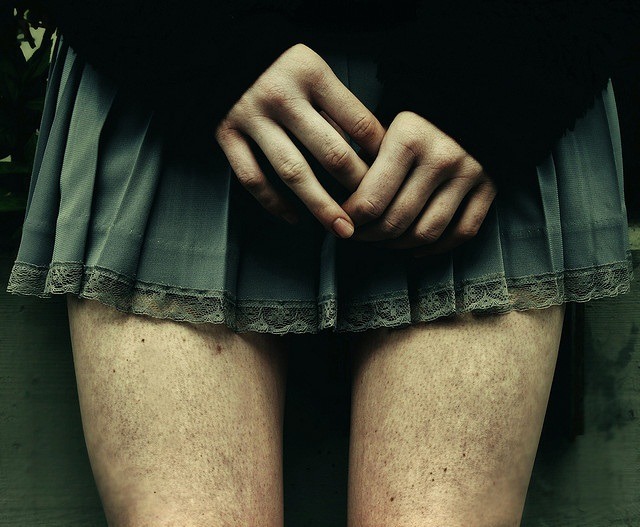
Federica ErraBlack Cloud (2009)

I’m not on board with Erra’s image making efforts. Her compositions are all too busily askew and impose a highly-contrived restricted palate upon the work which comes across as less considered and more reaching toward a sort of Brooke Shaden filtered through a ‘soft grunge’ aesthetic.

I’m posting this simply because despite the above criticisms–that apply here just as much as elsewhere in the work–I’m always fond of things that fuck with the idea that gender is strictly an either/or proposition.

The incomparable @knitphilia, who ran one of my favorite Tumblrs ever would’ve labeled this with the tag #pretty_masculinity. (She also had a #handsome_femininity tag that is equally if not more dreamy.)

Sebastián GherrëFirework cum (2016)

Revisiting the first instance of Gherrë’s work I posted, I realize I equivocated a bit too much.

Further encounters with his work have caused me to warm to his so-blunt you can only call it heavy-handed and acontextual style.

I’m not usually a fan of the throw everything at the wall and see what sticks approach. (My nemesis when I was a photography MFA student had exactly such an approach–in the interest of full disclosure, she’s one of two people in a class of 17 that is paying her bills with her creative endeavors.) But with Gherrë there’s a sense of both openness to experimentation that is damn near playful more often than not wed to a commitment to an unflinching and omnivorous eye.

It’s a little too pat to compare his work to someone like Ren Hang–an artist whose is equally out and who works with similar prolific profusion. (In fact, lately I find myself rather put off by what I feel are Hang’s tendency to be casually shallow, mean-spirited and cruel in his work.)

But it is an interesting comparison, in so far as Gherrë‘s photos show ever sign of becoming less focused on provocation and more focused the inherent provocation in moments presented without context and therefore rely upon success or failure with what the convey about immediacy.

The above print is actually enormously clever in it’s composition. The viewers eye follows the boys white inner right thigh down into the frame at a diagonal. A lesser talent would’ve sought a bilateral top-to-bottom symmetry, but they inner left leg juts off at a different angle, pulling the dick in hand off a rigid top-to-bottom mid-line. (The frame is bottom heavy, but the angle of the blanket manages to tie everything together so that it doesn’t feel unbalanced.)

There’s also the way the slight curve of the boys erection and the way it forms a sort of ever so subtle s curve from the base of the cock through the spurting line of ejaculate–allowing for one of those serendipitous moments where things line up almost magically and the lead semen globule floats perfectly aligned with the boy’s suprasternal notch.

And honestly, this is the closest I’ve seen to a photo I’ve been trying to make for almost a decade now.

igorpjorrt:

Igor Pjörrt for Hunger Magazine Issue 11

I spend 2 hours every day looking at photos/images–that’s approximately 750 hours this year.

Given that someone might think of asking (trust me though, no one will): what one up and coming photographer or image maker completely leveled you this year?

I’d need to expand the parameters to two–but with two I can do it: Igor Pjörrt and Sannah Kvist.

I’m going to circle back to Kvist in a later post but for now let’s consider Pjörrt.

I’ve compared his use of light to Lina Scheynius–and to be 100% clear Scheynius is done no favors by this comparison.

His work takes risks: scenes go far, far too dark but somehow maintain the trappings of narrative context, light seethes and bleeds. He has an innate sense of how to convey a simultaneously concrete and miasmatic sense of space–creating an uneasy oneiric balance between dream space and the hollow conventions of pop culture. (I mean his images are clearly informed by the orange approaching and blue receding that’s become the rage, but he uses it more like a master oil painter than a digital cinematographer.

His work tends to feature erotic edges and a pervasive sense of balancing a sense of purpose against sometimes overwhelming melancholy.

Yet what excites me most about his images is his sense of color. It’s brash and loud and in your face but this undercuts that fact that it’s deployed with contemplative restraint.

It’s rare to see someone so young producing work that is so sure of itself, sophisticated and just so completely effing elegant.

Victoria Baraga – [←] Self-portrait (2012); [→] Self-portrait II (2012)

I could’ve sworn I posted the Self-portrait II previously–but I’ve spent the last half-hour trying to find it and I see no trace, so…

It’s possible I had it saved as a draft and subsequently opted not to post it.

There’s not one but two layers of ubiquity working against these images. The TLR, waist level finder in the mirror trope deserves every bit of shit the bathroom mirror selfie gets. (Folks who pursue the former tend to get a pass they shouldn’t because they’re doing it the old-fashioned way and it’s not as straight forward was aiming the camera and pushing a button–but both tend to be devoid of any vivacity.)

There are exceptions of course. Laura Kampman does some exquisite things within very narrowly circumscribed margins–i.e. there’s a ridiculous degree of technical mastery at work in her better photos. Baraga, on the other hand, tends to fixate on capturing herself in the act of watching herself.

The result is conceptual satisfying–the viewer watches her watch herself, while she watches herself experience intimacy. It’s a clever deconstruction of the triad where the photography use the camera in an effort to parse time and space in such a way that the viewer of the resulting photo see much in the same way the photographer did in the moment of making the image. In this case, the mirror is an impartial arbiter allowing her to focus on one relationship in the triad–photographer to subject and subject to photographer in a fashion that presumes an empathetic response from the viewer.

There’s life an artfulness to these images that far exceeds 98% of comparable work out there.

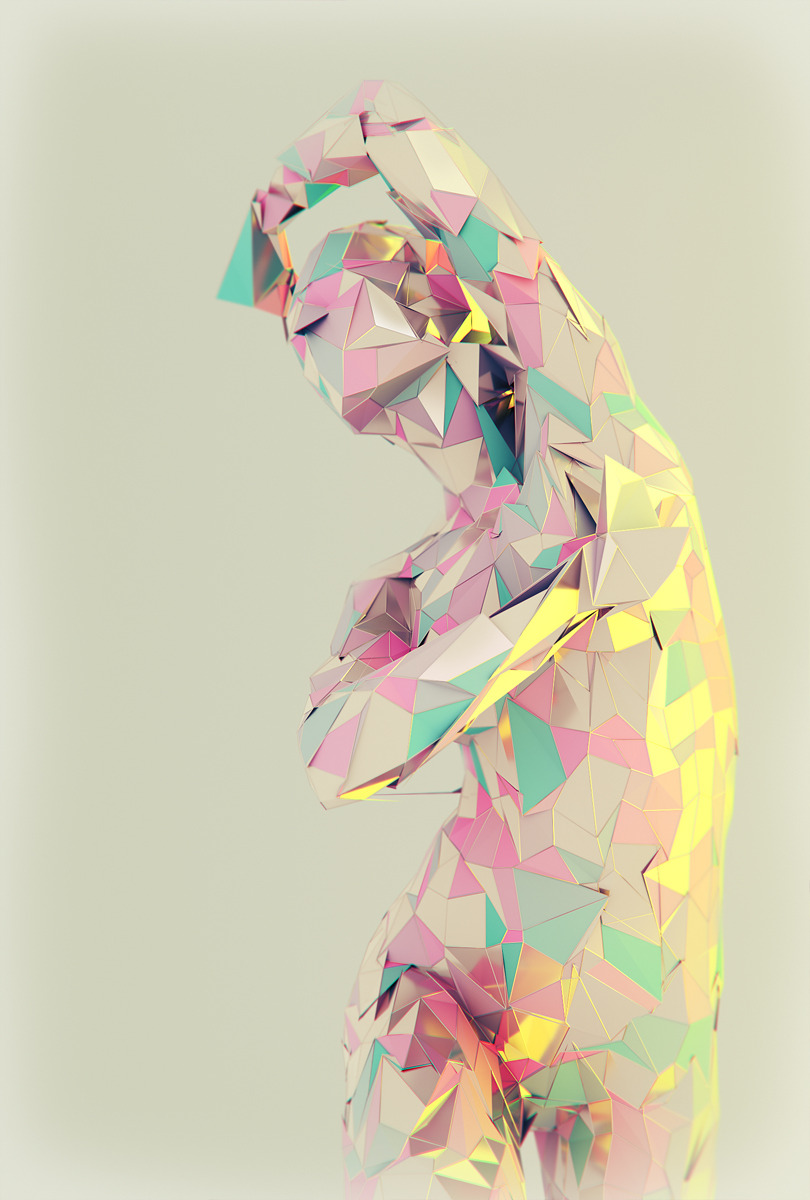
Benjamin WightSurfaces (2016)

There is something profoundly satisfying at this.

It’s partly the magenta dominant color scheme, partly the way there’s such a skillful balance between the secondary yellows which slightly outweighs the tertiary cyans–but the secondary and tertiary colors appear to balance, holding the figure together.

Also, there’s the illusion of a sort of sculptural dimensionality–it’s obviously a play on the reduction of form, movement and context to a series of layered and interconnected polygons, but to do it in such a way that recalls something tactile like origami is an interesting left turn.

The rest of the series is worth spending some time with. Wight renders a figure in the same pose from multiple angles with alternating color schemes–and not all of it is origami-esque. One looks like Sully from Monster’s Inc. dressed up like a storm tracker weather map, another: nanobotic renderings of neural pathways.

I wonder sometimes if there’s a difference in the way appreciators of art perceive various works vs how art makers process work.

Like I dig the above image. It’s something I’d see cold and be like: I really want to check out the rest of this guy’s stuff. But as an art maker (I hope), I see this and it resonates with my personal conceptual interrogations–I’m fascinated by texture, for example and given that I work primarily in an ostensibly 2D medium, I’m super intrigued by the way other 2D artists convey depth and dimensionality.

A lot of people much smarter than me have commented on how more often than not the urge to create arises in response to engaging with work made by others. I’m thinking here of that priceless Ira Glass quote about talent:

Nobody tells this to people who are beginners, I
wish someone told me. All of us who do creative work, we get into it
because we have good taste. But there is this gap. For the first couple
years you make stuff, it’s just not that good. It’s trying to be good,
it has potential, but it’s not. But your taste, the thing that got you
into the game, is still killer. And your taste is why your work
disappoints you. A lot of people never get past this phase, they quit.
Most people I know who do interesting, creative work went through years
of this. We know our work doesn’t have this special thing that we want
it to have. We all go through this. And if you are just starting out or
you are still in this phase, you gotta know its normal and the most
important thing you can do is do a lot of work. Put yourself on a
deadline so that every week you will finish one story. It is only by
going through a volume of work that you will close that gap, and your
work will be as good as your ambitions. And I took longer to figure out
how to do this than anyone I’ve ever met. It’s gonna take awhile. It’s
normal to take awhile. You’ve just gotta fight your way through.

But I think it’s too easy to lose sight of the fact that our creative processes contribute new ways of seeing to us, new ways of connecting with work that we might otherwise overlook.

It’s like we have this toolbox and the more work we make and the more we keep pushing passed obstacles and growing and evolving our process, the more tools we have in our toolbox. So whereas we may look at something once and dismiss it, ten years later we return to it and see it through completely different eyes. Or, to stick with the clumsy metaphor–we now have a number of tools in our tool box that allow us to engage with the work.

And it occurs to me that I guess I just don’t understand how you can truly engage with art and not feel compelled to make your own? (I think there’s something in that notion that applies to the mission of this blog insofar as I feel very strongly that there isn’t as hard and fast a boundary between pornography and art as most folks would like to insist… (But I’m not sure I can tease it out at the moment…)