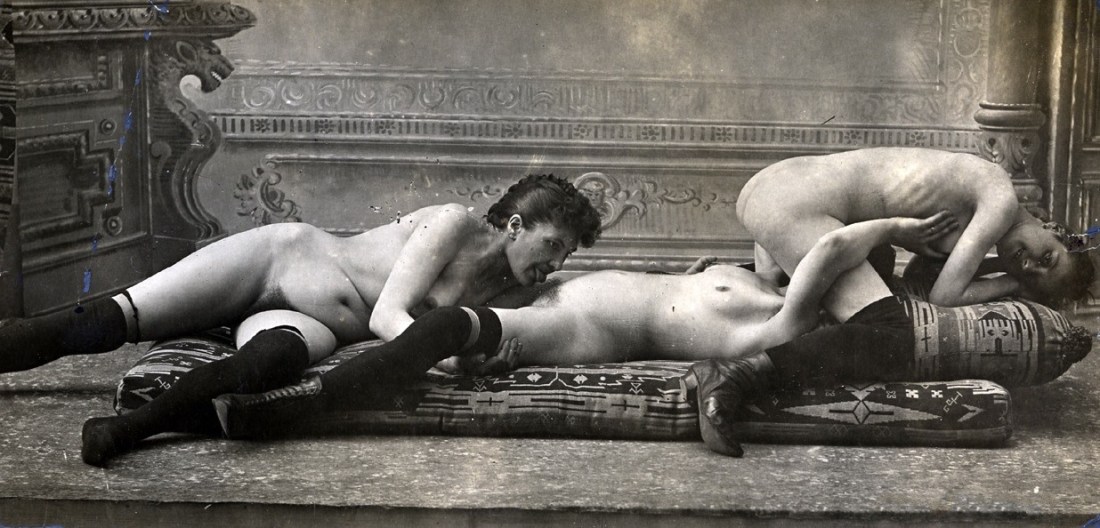
Source unknown – Title unknown (19XX)

Free love? As if love is anything but free! Man has bought brains, but
all the millions in the world have failed to buy love. Man has subdued
bodies, but all the power on earth has been unable to subdue love. Man
has conquered whole nations, but all his armies could not conquer love.
Man has chained and fettered the spirit, but he has been utterly
helpless before love. High on a throne, with all the splendor and pomp
his gold can command, man is yet poor and desolate, if love passes him
by. And if it stays, the poorest hovel is radiant with warmth, with life
and color. Thus love has the magic power to make of a beggar a king.
Yes, love is free; it can dwell in no other atmosphere. In freedom it
gives itself unreservedly, abundantly, completely. All the laws on the
statutes, all the courts in the universe, cannot tear it from the soil,
once love has taken root.

Emma Goldman, Marriage and Love

Dan Piepenbring – Writers, Start Writing for The Paris Review (2016)

Dear followers,

I am sorry that I haven’t been able to post anything in the last three days. With everything that’s happened–I’ve felt the need to speak some sort of frail, faltering truth to this ugly, ugly power.

But the truth is…. I’m really not OK. Not even a little. Not at all.

The last three months have been a literal living hell. I won’t re-sweat the details but it’s involved suicide, addiction, becoming a caregiver, losing my apartment, moving, infidelity, losing (probably) the love of my life…

I knew it was going to be bad by 7:30pm on Tuesday night. I could feel it like a frozen stone in the pit of my stomach. I got unspeakable high, turned my ringer to vibrate and passed out.

A bit before 2am, the persistent vibration of my phonehad skittered into a resonating position on the nightstand and each text message announcement and FB messenger ping were translated into a continuous clatter.

It was like waking into the nightmare where the doctor tells me I have a terminal disease and only six months to live. (To be 100% real, that’s one of my greatest fears; I want to just drop dead and be done–waiting on the inevitable is not something I do well with.)

The pain and terror (that is the right word, if you disagree fuck you and unfollow me–you are a part of the problem) expressed–I’m sitting here now crying so hard I can’t breathe–I’m sorry this is inarticulate, I have to say this. It has to come out; it will destroy me if I don’t name it–the most abject devastation I have ever witnessed first hand.

It reminded me of being tortured by my father as a child. Being paraded down to the unfinished basement (and those were the good nights–more often than than we were dragged or thrown down the stairs). And forced to stand at rigid, military attention barefoot–at least–more often than not naked–not the poured concrete floor. The temperature so cold you’d see your breath.

He’d threaten to kick or slap and if you so much as blinked, not to mention flinch, you would get hit. I remember sitting there staring hatred at him. I remember all his efforts to reach in and extinguish it.

The really bad times he’d grab me by the neck–and being trained–he knew to restrict blood flow at the sides of my neck not block the airway. The pores on the cinderblock walls would move like stars at night in desert skies. He’d say: this is dangerous if you fight me I can’t help you, you may die. And I would try to speak and he’d loosen his grip just enough for me to beg: Do it. Please.

This is what it’s like to be so phenomenally broken that my baseline experience just will never mirror Normals. I’ve come to close to the edge too often, stared to deeply into an abyss that has also stared into me.

I am who I am and every day is a fight–tooth and nail–to be authentically myself instead of someone who accepts and submits. I know the other life is easier. Has less heartache, less misery. But I’d rather be miserable and myself than complacent and compliant.

Sitting there reading through all the messages on my phone: I realized that many of my LGBTQ+ and PoC friends actually know more than I’ve given them credit for about what it’s like to live through real, honest to goodness horror.

But what I saw was my other folks I love being dropped first into a similar living hell. I said I love you and meant it more times in an hour than I have in the last four years. I talked to people out of suicide (and now I feel more than a little guilty about that because maybe they were right to hold that up as an option.)

I didn’t go back to sleep. I read as many things as I could. I’m going to post a few of the most meaningful things in the next couple of days. I got up, took a shower and went to work.

This woman I know who works in the building–we’re both book lovers and we exchange recommendations sometimes; she got into the same elevator. I could see she’d been crying. She leaned against the wall facing me instead of the door as the elevator rose.

Her: Are you OK?
Me: Not really. It’s scary. Most of my nearest and dearest are LGBTQ folks–they’re terrified.
Her: It’s not just them. It’s us. Those of us who have so little. We
understand: an existential threat to others is just as much a threat to
us. It’s like Viktor Frankl said about the surviving the concentration
camps: you have to find that one thing that you are and live for that.
Let’s live because love can never triumph over hatred.

Her, crying again, hugs me in the elevator: I’m glad you were the first person I saw this morning.

(And that’s why I love my city–even though the winters here make me want to die–if you walk around like you’re Jay-Z, this city will grind you down; but every once in a while, it finds ways of reminding you that there’s beauty in this world even though you don’t often see it.)

Shortly after @sporeprint posted the above statement to his Flickr page. I keep re-encountering it and each time I’m reminded of being in my first year as a film student after Dubya 2nd re-election.

The instructor of our class let us take the class to process as a group. (One of the biggest advantages of a liberal arts education is that you’re not merely a student doing work, you’re expected to be a philosopher in a philosophy class, be a filmmaker in a filmmaking class. We were all artists deeply disillusioned and anxious.

A fellow student and I ended up having an intense dialogue about the purpose of art. We end up leaving the class because others that we were going to far.

The general premise of the conversation was that art is one of the only venues where terrorism is appropriate. And that the purpose of art should be the equivalent of walking into a room with a suicide vest strapped to your chest and detonating it in the middle of a party for the latest and greatest the status quo has to offer.

So if you want to know where I am: I only know two things. The woman on the elevator was right. If I have to pick the one thing to survive for it will be love.

I feel I shouldn’t have to say it but this blog is a safe space. If you’re a woman, a survivor of trauma, a PoC, LGBTQ, undocumented, anything you’ve spent the last election cycle being told you are less for being, I am here for you. You are my family now.

They may think they can kill us all but if they touch one of you, the better be prepared to kill ever last one of us. Because I’m done being afraid. I’m done cowering.

Writers: write. Makers: make.

A samurai never draws their sword unless they plan to use it. Unsheath your swords. Show your teeth.

We can’t literally burn this mother to the fucking ground. But Art is the venue where we now have an obligation to do exactly that.

the tyrants coming
rising like the dawn of a red sun
if you fear dying, then you’re already dead.

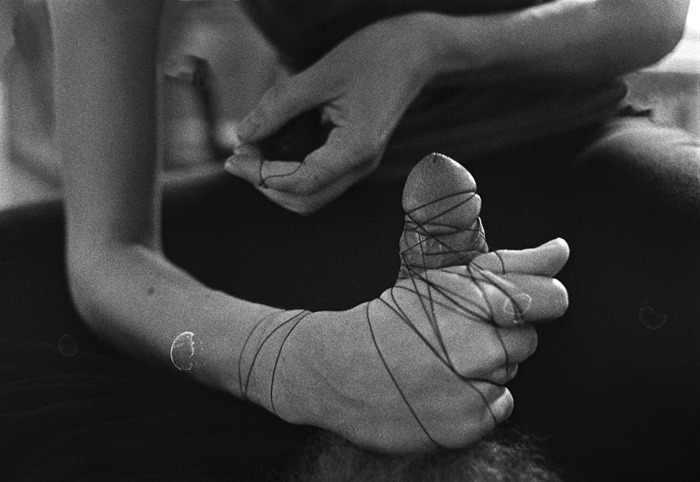
 Anna BlockUntitled feat. Konstantin Ladvishchenko from Black Red series (2013)

Block was born in an grew up in Moscow.

She’s currently pursuing a post-graduate photography degree in the Czech Republic.

I’m honestly struggling not to follow the rabbit trail of interrogating influences. Partly because I think of the three dozen or so folks whose names I could drop here–maybe four of them actually ‘hold up’ next to Block’s work.

I’ll let one slip…she shares an almost identical angle of view to Lina Scheynius, only I feel given the same space, Block does for more complicated and nuance things.

What’s much more interesting to me is to compare Block’s work with someone like Inside Flesh.

At first, that’s going to seem absurd. One is porn, the other is ostensibly art. (I’d argue that capital A is in order here; others might disagree.)

But, take this image and compare it with the one above. There are similar motifs–thread/wire, graphic depictions of sexuality: yes; however, the results couldn’t be more different.

Think of them in terms of an aesthetic of desire. If you are familiar with Inside Flesh’s work, you can spot them from twenty yards out. Same with Block. They diverge quite substantially in where they end up–but they’ve accomplished similar feats.

But there’s another difference I think that is also important to address. Of her work, block says:

I
use photography as a space where I can mix my fantasies and desires
with what is called reality. (via redeye)

I don’t think it’s necessarily as cut and dried but I do think that another crucial difference between Block and Inside Flesh is a matter of process ending in production vs product fueling further process, respectively.

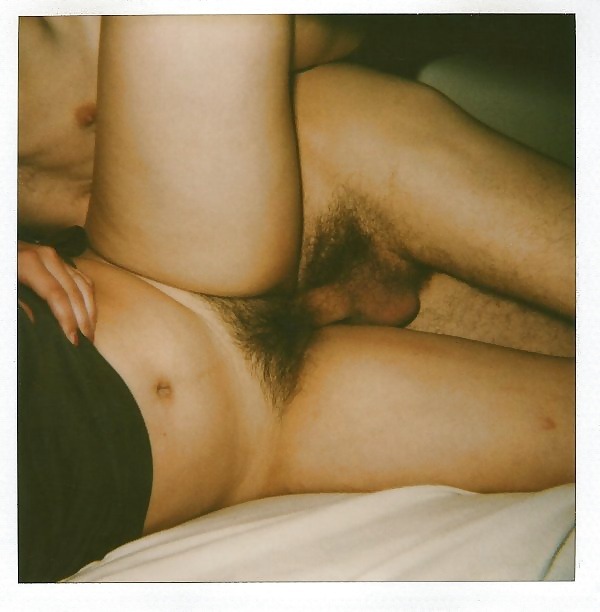
Source unknown – Title unknown (19XX)

There’s a very fine line between simplicity and knee-jerkiness.

This is a square frame. (Judging by the color and insinuation of texture in the border, I’d wager it’s Polaroid 600.)

The act of penetration is just ever so slightly above and right of center. And given most Polaroid cameras are technically TLRs.

It’s a good bet that whomever framed the image, intended to have the explicit action dead center. The discrepancy between the viewfinder and the taking lens due to parallax saves it.

Er… perhaps it doesn’t.

See: initially, I thought I liked the way that the frame is divided into implicit quarters by the L form of her legs. With more careful consideration, I’m not sure it’s such a great idea.

HOWEVER, it does work here–although it is less about the implicit parsing of the frame and more to do with the way the parsing flattens the frame.

Normally, I’m not someone for flattening the frame. But it’s interesting to note that the fellow here is almost entirely parallel to the focal plane. She’s actually every so slightly foreshortened. (It’s not obvious when you look at her abdomen but consider how her leg is straddling the crook of his hip and then trailing back away from the camera.

There are a couple of reasons this ambiguity aides the photograph. First, it draws in more context. There’s not a lot to take in and while I’m not all that big a fan of close-ups, this has the feel of a hotel room to it. But not in a way that makes you think… oh, hotel room. It’s not something you’d necessarily think of unless someone asked you directly where this scene was shot.

Also, while the subject is pornographic, there’s enough of an auspice of formality that renders the whole thing somewhat understated and demure even. (I’m thinking here of how you cannot photograph water. But you can make images of water when it is contained–in a cup, or a stream bed; or in motion, rain and you don’t show the essence of water so much as you can draw attention to certain characteristic attributes.)

The foreshortening also suggests overlap with the paintings of Caravaggio–in color and mood. But I’d be remiss if I didn’t point out how much the remind of Gauguin’s work from Tahiti. (I can’t explain why…just look at it and I think it’ll be plain as day… I just don’t know how to say it.)

Sanders McNewMelanie King (2014)

Often, I drone on and on about the notion of ‘composition’–as if y’all magically know what I mean.

I mean I do try to at least apply the term consistently, usually meaning something like the way visual information is arranged and presented within a given frame.

Unfortunately, such a definition is a bit too open and inclusive as to be functionally useless.

Interrogating matters of composition might be better separated into several congruent examinations. There’s the notion of the frame. This gets tied up in ideas of inclusion and exclusion. However, there are also tangential concerns about the way things like the angle of view and tilt/pan/cant of the frame subtly informs psychological resonance.

There’s also questions of space. This can pertain to depth of field. The way a scene or setting is depicted. (Generally, it’s this to which I’m referring when I mention composition–the way a photography parses visual information in space through a lens in an effort to not only show the viewer something but offer them a particular way of seeing it.)

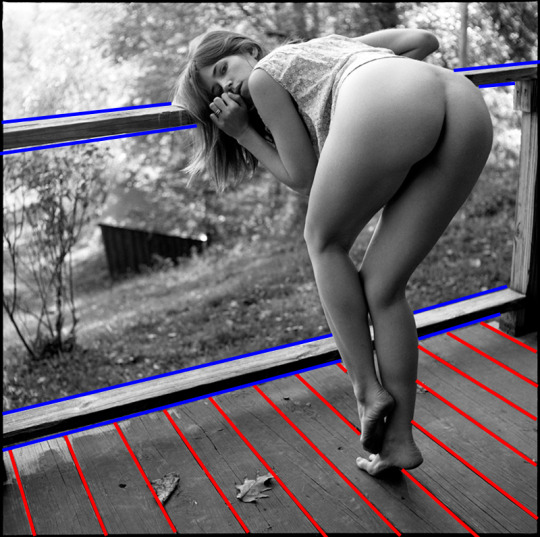
I’m not sure the above is a great photograph. I like it enough. But what I think is truly exceptional about it is how clear an example it is of parsing visual space for the viewer.

image

The default order of operation for reading images is left to right. Yet, that doesn’t always work. (As anyone fixated on making images exemplifying bilateral symmetry will tell you: it’s rare that things that appear symmetrical are truly and rigorously so.)

So one thing photographers do is to us contextual elements within the frame to guide the viewers’ eye over the frame.

The lines highlighted in red pull the eye upward and left and then the lines highlighted in blue shift the eye left-to-right. Melanie’s gaze directly into the lens closest the loop and the eye circulates following the lines highlighted in red inward, then the blue lines drift right and then we’re back at the beginning again.

What’s also skillfully applied here is Melanie’s position vis-a-vis the lines. She’s in front of them and therefore blocks them. That makes her the undisputed subject of the frame. (The DoF presents both her and deck in sharp focus but the scenery behind her goes soft and bokeh, further pushing her and the porch to the foreground.)

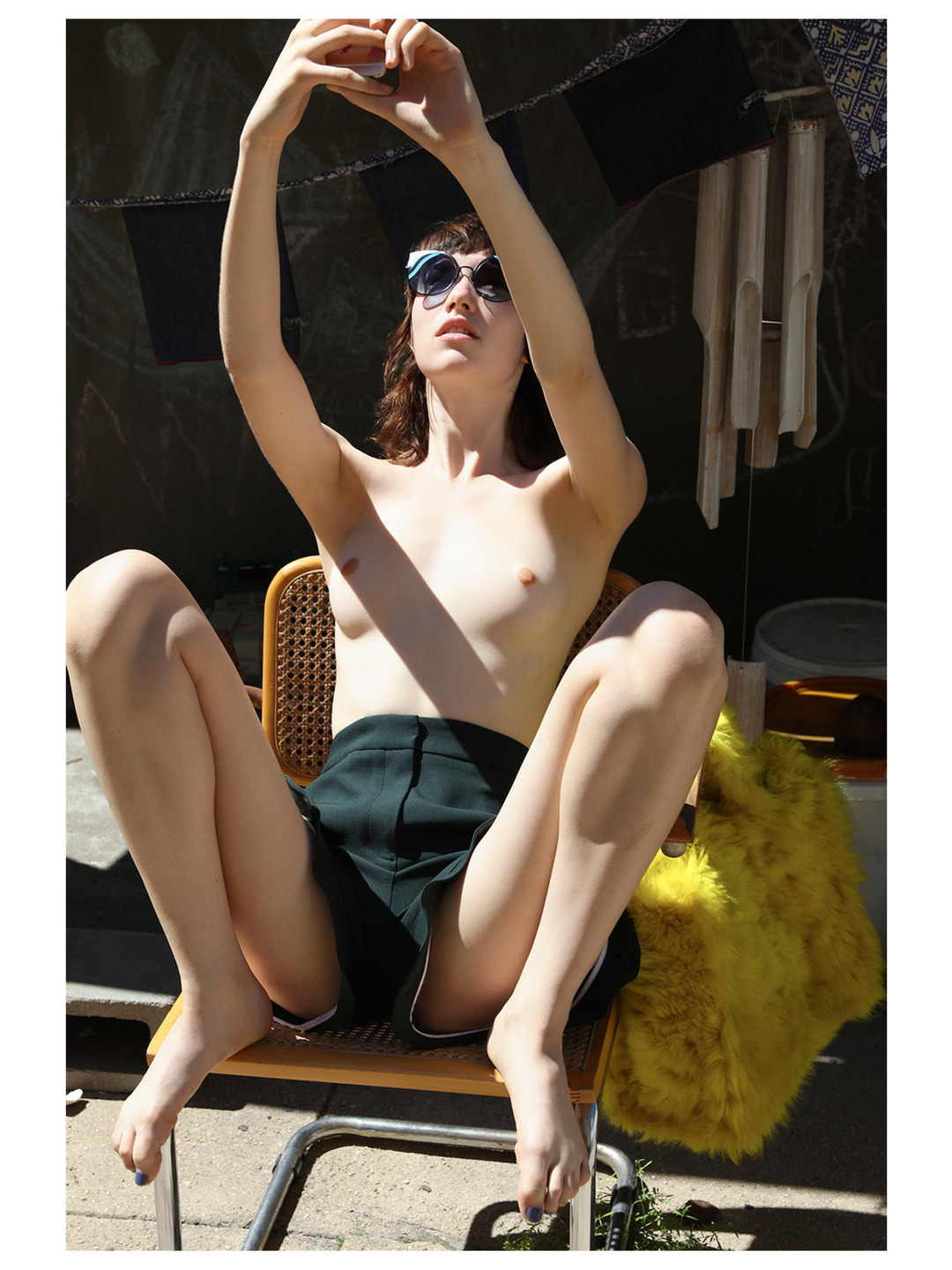
Roe EthridgeAmazing Grace feat. Grace Hartzel in collaboration with Fendi for Document Journal (2016)

You can’t dismiss the importance of the author in the case of this image. But it’s hardly the first place I even want to go…

I mean: it’s lovely. Someone should write a dissertation on the skin tone. (Most work with exquisite skin tone accomplishes it by an Albers-esque limiting of the color palate. For example: you frame things in such a way that the color palate is limited to two complimentary colors and you limit the range of those two colors and this allows you to stretch the range of subtle gradation and range within skin tone.

And that’s part of what’s going on here–the fuzzy yellow purse, the blonde wood on the chair and the bleached khaki color of the wooden wind chimes.

It’s the flourishes that separate this work from your run-of-the-mill fashion editorial. Note: the rose gold of Grace’s phone, the azure line reflected in her shades and the green grass pushing up through seams in the concrete underneath the chairs chrome legs.

One could argue that perhaps the concrete goes a touch too green around the gills–but it’s not that bad, really. And the dynamic range in the picture is insane–especially given that the aforementioned trick with good skin tone demands a better range of mid-tones through limiting areas of extreme over and underexposure where this has (I’m guessing) probably a 9 or 10 stop range.

Let’s back track and address the author of this image: Roe Ethridge. The gallery world really likes to bend itself into pretzel shapes to justify the art-worthiness of his work. A lot of it is found or appropriated work that is retooled to a specific conceptual end. A metric shit tonne of ink has been spilled on the topic and everyone is saying the same things poorly.

Too much criticism hinges on a sort of scientific-mathematical proof of a point. I think some of it serves a purpose. Most of it? Not so much.

I get a lot of shit for being a ‘colossal dick’ when I take a particular facet of something I post here to task. Here’s the thing: the sheer fact that I posted something here means that something about it struck me as meritorious. Frequently it’s one thing and I spend ¾ of the post playing whack a mole with the stuff I want to disavow from it, but that’s another story.

My point is–to quote El Duderino: It’s just like my opinion, man. You should take it with a Gibraltar sized boulder of fucking salt. Your mileage will vary, etc., etc.

The only rule is does it blow your hair back? If so, that’s great. And if you’re interested in going a step further, start asking yourself why it blows your hair back? That is all I’m trying to do here. I’m trying to point to concrete correlations whether they are technical bits or free associations from my own experience that enhance the impact of the work.

If you disagree with what I’m saying–I’m not right automatically and you’re not wrong by default either.

Like it’s fine if you adore something that no one else really cares for. But excepting my brother–who is an asshole–it’s fine if you like the musical stylings of Creed. I don’t and were never going to see eye to eye. But generally speaking, I know a lot of people who like Creed personally but do not feel the need to evangelize for them being the greatest thing that happened ever to music.

That’s really one of the only things critics are good for–keeping artists and their fans honest.