Sannah KvistUntitled (2008)

Sannah Kvist = newest image maker crush.

If you’re looking at this and thinking of William Eggleston’s The Red Ceiling, then you’re eye is totally on fleek.

And like Eggleston she’s doing fascinating things with color. (I’m still too blown away by her work to start processing my thoughts just yet.)

But what’s even more interesting is the way that she borrows heavily from Stephen Shore, mixing in some Paula Aparicio and Mathilda Eberhard to keep it fresh and on the bleeding edge.

These days it takes a lot to get me worked up over an entire body of work, but I’ve spent several hours looking through Kvist’s Flickr account and she really is effing amazing.

Alfred StieglitzGeorgia O’Keefe (1919)

I don’t especially care for Stieglitz.

I mean I recognize his contribution to the advancement of photography as an art form both within the US as well as around the world; yet his work–although frequently very beautiful–feels not flat, but affectless in a way that comes across as contrived. (It’s like he spent way too long reading Thoreau in his teens and latched on to the pretentious naturalism more than the admonishment to ‘live purposefully’.

His work with O’Keefe is a little different. Or, the better way to say it might be: what I don’t like about his work actually serves the work instead of undercutting it.

Take the image above: there are similarities in her pose to depictions of Eve in oil paintings throughout the western canon; a ruse meant to preemptively short circuit Puritanical objections to the more sensual facets of the composition. (Eve for example is unlikely to be depicted hold her breast in such an ambiguous fashion, but even that can be traced back to something in-line with the asp biting Cleopatra’s breast.)

I don’t think there’s any way you can wrap your head fully around the Steiglitz and O’Keefe collaborations without acknowledging that they were ravenous with carnal desire for one another.

I know the prevailing wisdom is that an artist should remain aloof and not become entangled with their subjects. But I don’t think you can deny that when a photographer is consensually involved with their subject, it absolutely complicates the work–usually in interesting and unpredictable ways. (Thinking here of Corwin Prescott and Nicole Vaunt as another sterling example.)

Andrew KaiserTitle Unknown (201X)

I dig Kaiser’s work. His B&W stuff is frequently good, sometimes great. (This image of Gwendolyn Jane from last year will hold its own against just about any other image made that year.)

He seems to prefer film and although I’m probably reading into it too much he seems to possess a better grounding than 95% of the quote-unquote fine art nude photographers out there–in that he appears to own that something isn’t just art because some schlep asked a a naked woman to stand on a bounder in a picturesque landscape.

I love this image, for example because there’s a stillness, a calming quiet around it. It feels uncontrived–the viewer is allowed to glimpse something that they probably wouldn’t otherwise be able to see. But the emphasis isn’t on the transgressiveness of the seeing but on documenting the immediacy of the experience. The current rippling around her fingers, the watery undulations of her reflection.

But the thing I like best about it is that her anonymity is preserved. No, it doesn’t look entirely natural–it’s clearly been burned in quite a bit. But the point is it is unequivocally bad craft/technique/etiquette to use the frame edges to decapitate a subject. It’s inherently objectifying, first off. Second off, it’s lazy and inexcusably sloppy. Yes, including the entirety of the body presents a litany of additional challenges that aren’t always easy to negotiate; but the result will always be superior to the alternative.

Sergei ShekherovI Hadn’t Anyone till You (2015)

This would be utterly unremarkable were it not for two things:

  1. The brazen placement of the two hands.
  2. The model bears an uncanny resemblance to Michelangelo’s David–the position of the arms is transposed but the likeness is otherwise flagrant.

Taken in the context of Shekherov’s status as a citizen of the Russian Federation and given that nation’s open hostility to LGBTQ+ folk, there’s a tension between the prosaic studio setting and the audacity of what is depicted.

The title speaks to something universal: the human feeling of being alone in the world and desperately seeking out a partner. Add the gayness of the work and the meaning deepens, encompassing the complexity of looking for someone when your experience and expression of sexuality is outside the mainstream norm–and how much more finding someone with whom you can share your authentic self means.

Then there’s the undeniable similarity to David along with the fact that unless I’m mistaken the clothed man is Shekherov–pointing to an experience of the erotic in relationship to masters and masterworks of art. (It reminds me more than a little of Luisa Terminiello work hard.

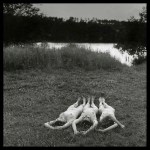
Vojtěch V. Sláma – [↖] Catherine in the Pond, Slatina, Czech Republic from Wolf’s Honey series (1998) [↗] Lucy, Jevišovice, Czech Republic from Wolf’s Honey series (2003); [↙] Ka. Te. Mi., Slatina, Czech Republic From Wolf’s Diary series (2006); [↘] On a Schooltrip, Stříbský mlýn, Czech Republic from Wolf’s Honey series (1999)

Is not the most erotic portion of a body where the garment gapes? In
perversion […] there are no
“erogenous zones” (a foolish expression, besides); it is intermittence,
as psychoanalysis has so rightly stated, which is erotic: the
intermittence of skin flashing between two articles of clothing
(trousers and sweater), between two edges (the open-necked shirt, the
glove and the sleeve); it is this flash itself which seduces, or rather:
the staging of an appearance-as-disappearance.

Roland Barthes, The Pleasure of the Text

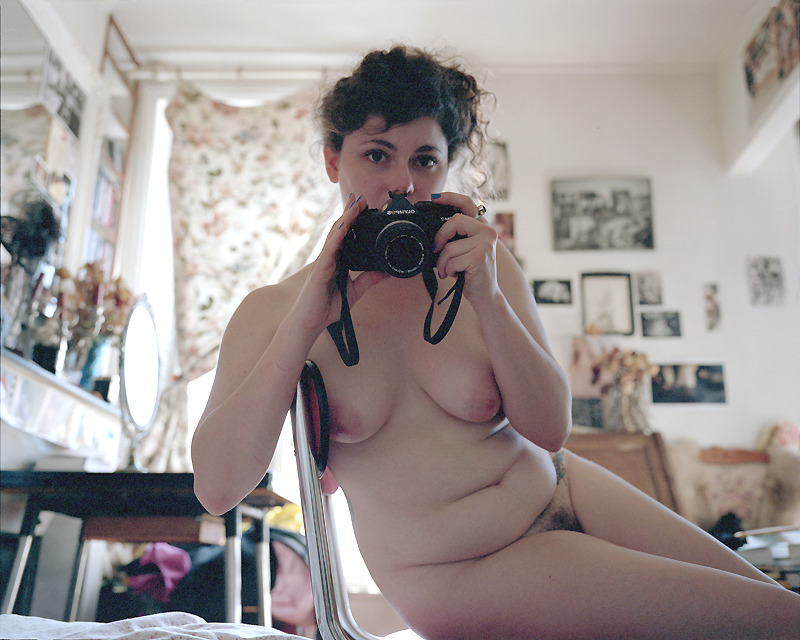
Natasha GudermaneRomy from Mademoiselles series (201X)

Mademoiselles feels like a complicated riff on Martin Gabriel Pavel’s Daily Portrait Berlin–probably better known as the naked Berliners 365 project.

Pavel took a picture of Elle and then gave the camera to Elle along with the challenge that she had to take a picture of a naked stranger the following day. Elle takes a picture of M and gives M the camera. And so forth.

As far as quality, the results are all over the place. I still love it because unlike the vast majority of stuff out there, there’s an fascination with context. You get to see not only Berliners but also a glimpse of them in their personal/private spaces. Since I feel an almost preternatural connection to Berlin and am myself so preoccupied with presenting bodies in context, I enjoy the project.

There’s a lot overlap between Daily Portrait Berlin and Gudermane’s Mademoiselles.

If you compare the two in terms of technical accomplishment, it’s not a contest: Gudermane wins hand’s down.

What’s odd is that while both projects feature inconsistencies, the inconsistencies of the Berliner project burnish the conceptual underpinnings. (Translation: of course, it’s gonna look different there’s a different person behind the camera each day.)

Whereas with Gudermane, there’s one person behind the camera but other than the content, I can’t say I’d necessarily be able to pick her images out of a line up.

One the one hand that’s suggests a more organic relationship between image maker and subject. Except there are a number of other disjunctions within the work.

First there’s quality. Some images are glossily picture perfect, others seem a little slap dash–like someone who knew their way around a camera took some OOTD pictures for a close friend.

Then there’s the ruptures between the subject acknowledging the camera and the subject depicted as if they are unaware they are being observed. And again, I think both approaches could probably fit within the parameters of this project.

They don’t though for two reasons: the edit is nowhere near tight enough and the discrepancy in approach and conceptualization through their inconsistency point to the fact that I can’t point to any sort of internal logic with regard to composition–for lack of a better way of putting it, it’s like Gudermane is less interested in how the frame is read by the viewer than that what the frame shows is deemed interesting by the viewer.

Take the above image. It’s designed to appear like a self-portrait snapped in a mirror where you can’t see the edges of the mirror. However, it’s really the the picture plane itself that is suggestive of a mirror due to how it’s arranged. (And here’s what I mean about the slight up-tilt in the frame. Yes, it’s clearly supposed to make you think of a large mirror sitting on a floor and leaned up against a wall. But the effect would’ve worked just as well without the tilt. There are little things in almost all of her frames that are similarly WTF? decisions.)

Yet, if you dive down to the most basic level of this, I do see her implicit removing of the image maker from the equation as a pretty precocious first step to addressing the objections I’ve listed here. If this wasn’t a one off–and unfortunately the rest of the images from Romy’s session appear to be just that–it would suggest that not only does Gudermane have a great deal of talent but she also has a keen understanding of her shortcomings as an image maker.

We’ll see. Her work has enough good to it that I’ll be checking in from time to time to see where she’s headed.

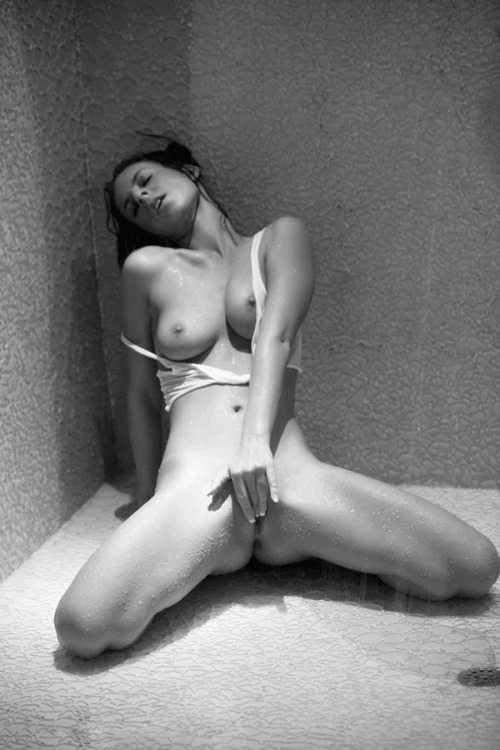
Penthouse – Presley Hart [de-saturated] (2014)

One of the most brilliant things I’ve ever heard about color vs B&W in image making was Mark Steinmetz’s observation that it’s like two sides of a street on a sunny afternoon: the side in the direct sunlight is ideal for B&W and the side in shade is ideal for color.

This image was originally in color. The former image is actually kind of heinous. The two tone cyan of the textured wall and the magenta skin tone–enormously overexposed by a strong overhead light source–renders the image positively garish.

However, some smarty loaded it into Photoshop, de-saturated it and the result emphasizes texture–falling water from the shower, water droplets on wet skin and the crater pocked wall. A simple edit that takes something that was crap and transforms it into something that is visually interesting as well as arresting.

Too often our concept of learning is to absorb ideas from books, to do what others tell us to, and perhaps to do some controlled exercises. But this is an incomplete and fearful concept of learning—cut off from practical experience. We are creatures who make things; we don’t simply imagine them. To master any process you must learn through trial and error. You experiment, you take some hard blows, and you see what works and doesn’t work in real time. You expose yourself and your work to public scrutiny. Your failures are embedded in your nervous system; you do not want to repeat them. Your successes are tied to immediate experience and teach you more. You come to respect the process in a deep way because you see and feel the progress you can make through practice and steady labor. Taken far enough, you gain a fingertip feel for what needs to be done because your knowledge is tied to something physical and visceral. And having such intuition is the ultimate point of mastery.

Robert Greene, The 50th Law (via jrmgh)