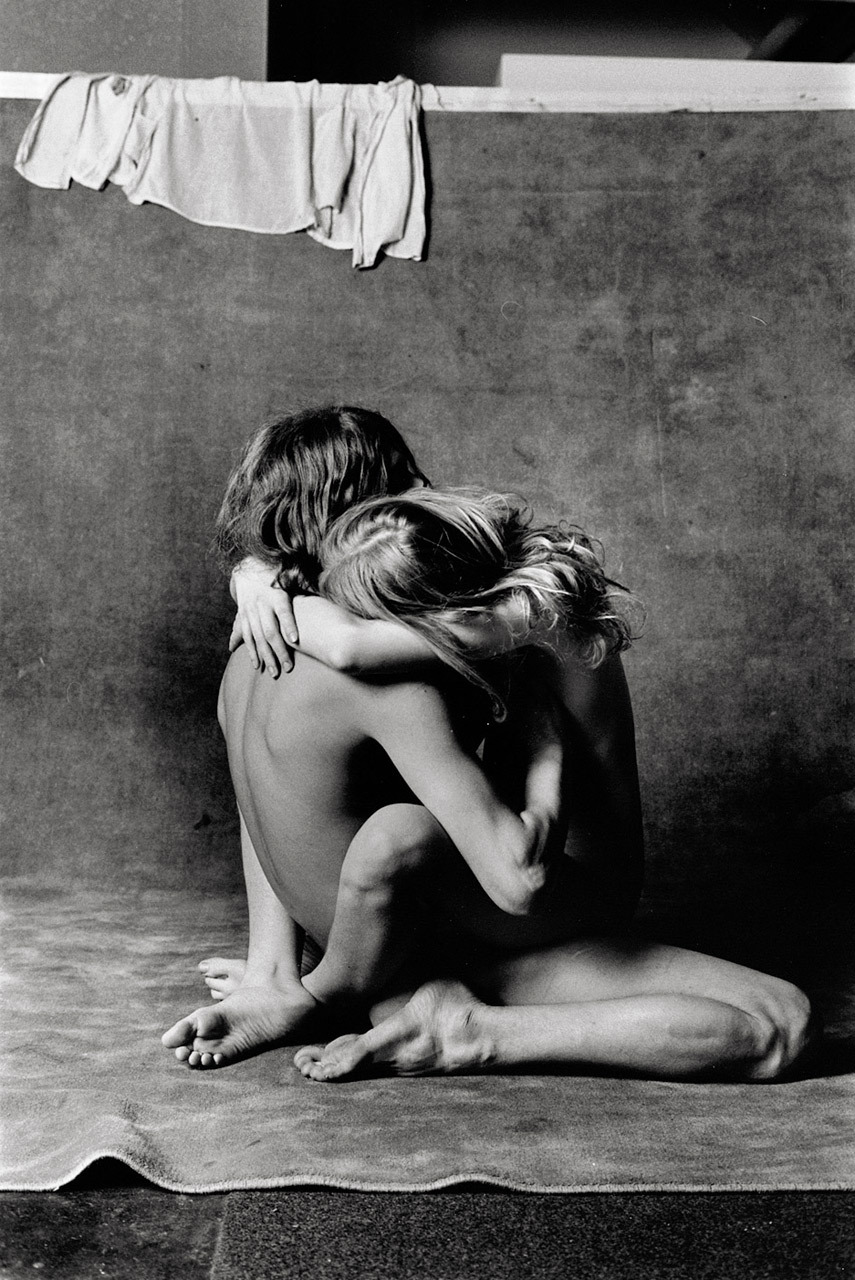
Will McBrideRocky & Julia (1972)

One of the most amazing teachers of my life taught Sociology 101 in community college. (She was breathtakingly brilliant and could’ve taught anywhere but as a committed Marxist, she viewed it as her duty to provide the same degree of academic rigor to students who might not necessarily have the resources to attend an Ivy League institution.)

I still refer back to notes from her class a handful of times every year. This time it was to remember the term cultural lag.

The gist of the concept is technological innovation moves at a much faster speed than cultural evolution. As a result it can take a really fucking long time for society to come to terms with advances in technology.

If you are unfamiliar with McBride, he’s notable for his collaboration with Helga Fleischhauer-Hardt, a psychiatrist, on a picture book designed as a resource to help parents educate their children about sex.

The book was called Zeig Mal! (or, Show Me!) and it included frank discussions about sex accompanying age appropriate images of nude children and graphic depictions of teens and adults engaging in sexual activity.

It was well received in Germany–and received a second printing. But it’s publication in the U.S. was more troubled. It was quickly libeled as ‘child pornography’–and despite the fact that it exonerate in court on four different occasions as not obscene.

However, there was a convoluted back and forth about whether or not distributing non-obscene depictions of nude children was protected by the first amendment. To be on the safe side, the publisher opted not to continue to publish the title in the U.S.

The notion of cultural lag doesn’t strictly apply to McBride–if anything the culture was fine until puritanical prudery arrived on the scene.

There is something potentially valuable to consider here; namely: that as long as we remain unclear on what constitutes pornography and what does not, we’re going to continue to have problems like this.

If you disagree think about teens who are getting added to sex offender registries for consensually sexting nudes to other teens.

The pervasive attitude of puritanical prudes is that education/preparation is implicit acceptance of the activity. (The reason so many idiots are against contraception is truly less out of any well-meaning desire to keep kids and teens safe and more born of the fact that “if we provide free condoms, then they’re certainly going to use them.” It’s entirely about control–no more, no less. Fear and coercion only work so long as they keep you from eating of the fruit of the tree of the knowledge of good and evil; once you’ve eaten, you want to continue to eat–you just have the associated guilt over eating in the first place to work through before you can truly enjoy the feast. (Sadly some people never make it.)

Consider another analogy: of the kids I went to a parochial high school with, only one never struggled with the sudden freedom of self-determination upon going off to college. All of them struggled with binge drinking and addiction except the class salutatorian–whose parents wisely allowed her to have a glass of wine with dinner and an occasional beer here and there from the age of twelve onward.

Similarly, the people I know with the healthiest attitudes towards sex are those whose parents refused to teach their children that some sort of shame surrounded their bodies/nudity and who modeled sexual attraction/behaviors in an open but appropriate fashion.

Or, to put it another way: in my experience if a child can formulate a question on a particular topic they are generally more than ready for an honest answer.

We–as a culture–really need to do better about this kind of thing.

Anyway, I have no idea from what body of work the above image emerged. It would’ve preceded Show Me! by half a decade. But you do have to appreciate the seemingly post-coital intimacy that manages somehow to avoid both sentimentality and salaciousness.
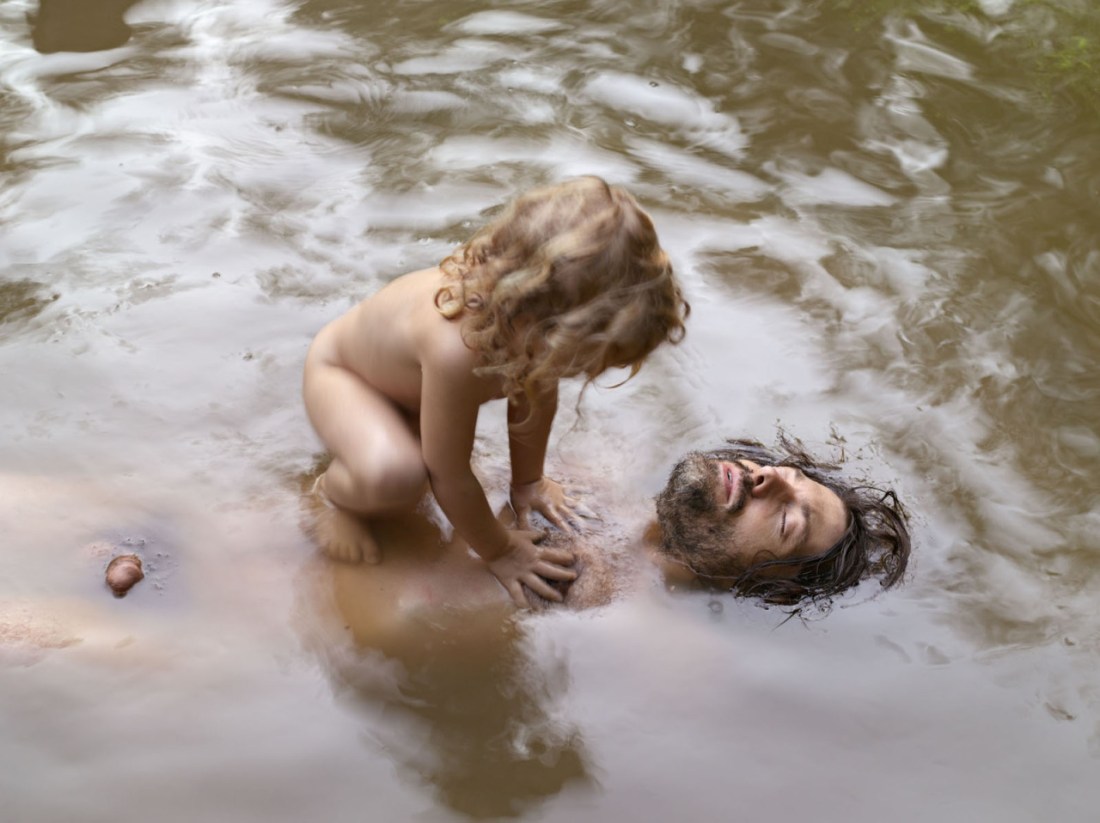
Lucas FogliaPatrick and Anakeesta, Tennessee from A Natural Order series (2007)

If you’ve studied photography at all, viewing Foglia’s work–besides being an utterly joyful proposition–is likely to be a bit like Where’s Waldo; except instead of finding the ambulatory nerd decked out in a red and white striped shirt, you’ll be registering the effing myriad of prominent photo-historical influences.

There are two influences that I think are especially relevant to consider in the context of this image: Sternfeld’s Sweet Earth–which might best be seen as an initial survey upon which the series which contains this image (A Natural Order) is a more focused examination with a decidedly humanistic approach; and Fred Hüning’s ground breaking handling of nudity as entirely common place, even as it forms a spectrum from incidental to overtly sensual.

On a personal note, this image in particular resonates with me fiercely. The reasons aren’t something I can share in their entirety due to matters of privacy but I’ve maintained in a steadfast fashion that I have no desire to reproduce. There are two factors informing this notion:

  1. The world is fucked up and bullshit and it seems to me the ultimate act of human arrogance and hubris–not to mention cruelty–to bring a life into this world as it is.
  2. Like most folks who come of age in staggeringly abusive environments, I worry that I am too fundamentally damaged to be a good parent. Not to mention irresponsible, immature and selfish.

However, during an intense conversation with a very dear friend–friend is nowhere near strong enough a label, perhaps ‘lover’ is closer were there a way to subtract explicit sexual intimacy from the term–she noted that she wants to have a child because while she understands and agrees with my analysis, the world isn’t going to improve unless people who care are willing to risk stepping outside of their comfort zone and try to build a better future. And the simple fact is: a better future requires the continuation of the lineage of people who believe in gentle dreams.

And in that moment and still in this moment, I felt a longing I cannot name and the only expression I can give it would be to have said to her: if it was with you, I would want a child, too.

Life is strange, yo; life is strange.

The answer isn’t to focus on the things you need to give fewer fucks about it’s to find the things that you need to give more fucks about and give all your fucks to those things so you don’t have any fucks left to give to the things that you shouldn’t give fucks about.

полезный дурак

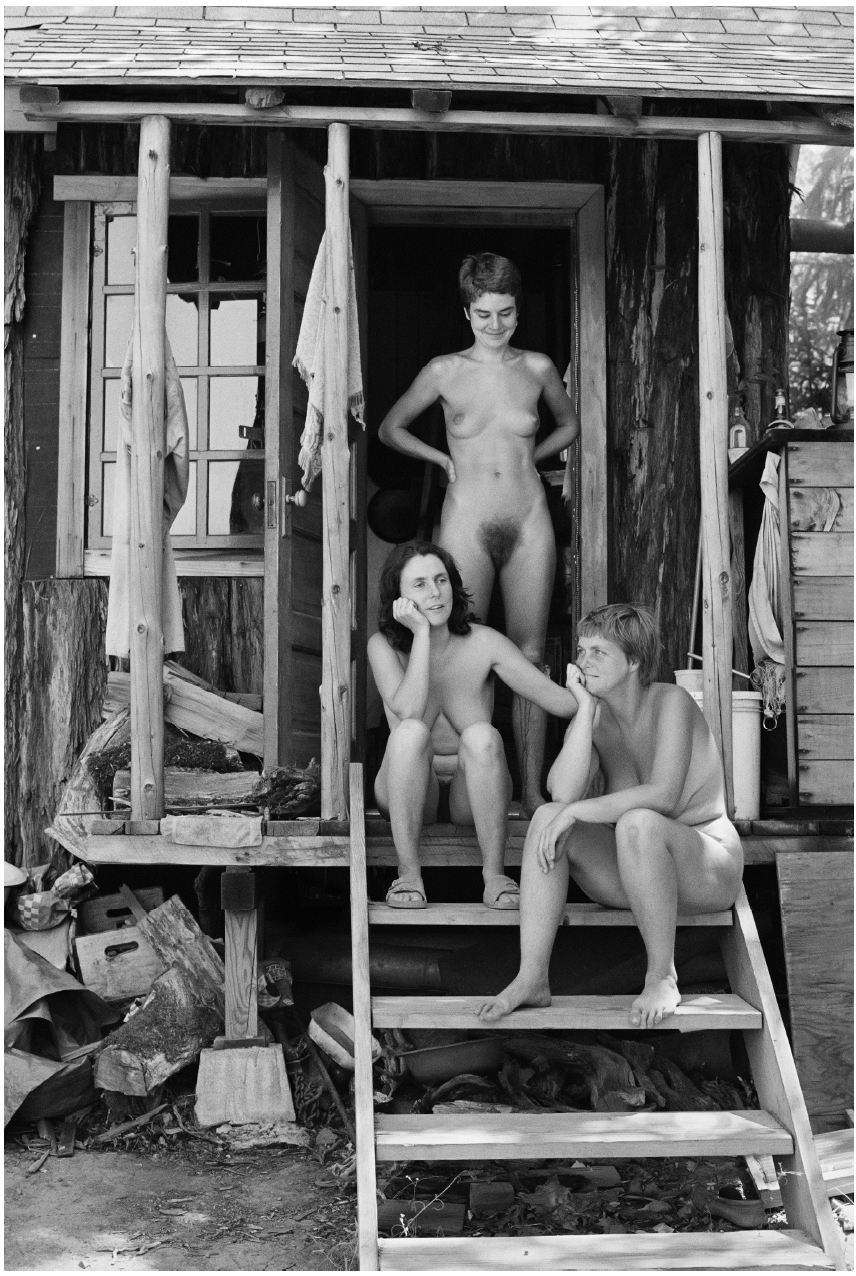
Joan E. Biren aka JEB – Summmer, Morning, Meadow, Willits CA (1977)

Without a visual identity, we have no
community, no support network, no movement. Making ourselves visible is a
political act. Making ourselves visible is a continual process.

— Joan E. Biren (JEB), “Lesbian Photography – Seeing Through Our Own Eyes,” Studies in Visual Communication 9, no. 2 (Spring 1983): 81. 
(via @lesbianartandartists )

Fernando Schlaepfer#353: canoas – joana (2016)

Generally: 365 projects–where an image maker posts one image a day for three hundred sixty-five days–are something I give a hard pass.

I recognize and appreciate the motivation, I guess–learn, grown and become better through actively doing. That’s certainly valuable.

However, the entire premise strikes me as nonsense in exactly the same sort of way the Gladwellian 10K hours to mastery is a garbage idea; namely: emphasizing the destination over the journey.

If the goal really is to motivate someone to become a better photographer or image maker, then the 365 model is effective only insofar as you make pictures ever day. The impetus to share at least one image a day on some social media site or another undoes any good that making pictures every day enables. It makes it not about the quality of the work or even the work itself it makes it about the motivation to gain attention through doing the work.

The truth of photography and image make is you’ll go for weeks, months and even years without making a single picture that’s worth two shits. Taking the picture is only ½ the equation and it’s actually arguably the less important half.

You can be the best, most accomplished shooter in the world but if you can’t edit what you shoot, then you are nothing more than a resounding gong or a clanging symbol.

All this is a prelude to say that Schlaepfer’s nude a day for 365 days project is an exception. Yeah, not all of the images work but a third are good and he does manage to produce at least one great photo once every couple of weeks.

It’s easy to look at his work and start addressing influences–Ren Hang and Akif Hakan Celebi; Schlaepfer is less brusquely transgression-is-serious-business than the former and nowhere near as ostentatious as the latter. It helps that Schlaepfer has clearly studied the cadre of West Coast lifestyle-oriented image makers with some attention and that manages to leaven his material, giving it some range.

The above image of Joana isn’t the best in the project but even if I’m not fond of how dark it is, there is something beguiling about how unassuming it is in its simplicity.

Mysterious CC – Misungui (2016)

@misungui‘s alias apparently means “spirit of the wild cat” and was prompted by a genie appearing to her under the influence of ibogaine.

I’ve followed her with something not unlike reverence ever since I first encountered her after stumbling onto the photographs Plume Heters Tannenbaum–whom I consider to be one of the most jaw-droppingly talented, visionary and thoroughly fucking brilliant people making pornographic Art right now.

She identifies as a performer, model, queer feminist and pro-sex, anarcho-communist activist. I frequently gush about her work and the work of artists in her orbit as this performance art writ large as a medium for educating w/r/t kink, genderfuckery, public vs private and just general debauchery.

A video from her birthday party showed up over on Vimeo and reminding me more than a little of the spirit of Maria Llopis’ Public domain porn versionwhich may be my single favorite thing I’ve ever learned about running this blog–except where for Llopis’ the politics of the performance seems to be the point, Misungui seems to sublimate politics in favor of the transgressive glee of pure, unmediated experience. (Also, the birthday video is the first time I’ve actually understood the draw to shibari.)

But the other thing that I want to draw attention to besides offering an introduction, is to point out a leitmotif in Misungui’s work that I appreciate immensely.

Although it’s not as true as it was a decade ago, it used to be that one of the main things separating mainstream cinema from the art house was–for lack of a better term: poetry.

Let me try to illustrate what I’m thinking. Consider the following scene as it might be written in a script.

EXT. Train Station – DAY

A uniformed soldier embraces his lover. She is tearful. He his strong and stoic. The train whistle sounds, people push towards the train climbing aboard. The soldier picks up his suitcase and moves to the train.

INT. Train – DAY

The soldier boards the train, finds his seat and turns to look at the window as the train starts to move. He waves at his love as she walks and then runs along the platform as the train picks up speed.

Forgive the fact that this portrays the woman as nothing more than her relationship to the male character. I hate that shit more than most people but I did it to illustrate a scenario we’ve all witnessed in one film/TV show/Etc. before.

Now in a mainstream movie, this scene will be broken down into a number of setups. An establishing shot. The couple on the platform together. Close-ups of their faces. Perhaps an insert of him picking up his suitcase. A reverse shot of him moving towards the train with her unsure of whether she should follow him or stay where she is so he’ll know where to find her once he boards the train and finds his seat. Not to mention various close-ups of their faces to convey their emotional state.

You can show him boarding the train–the question of whether you show him boarding from outside or move the camera inside has profound implications with regard to how the director and editor envision cutting the scene.

Inside the train though it’s the same thing. Establishing shot to provide a sense of the place. Him finding his seat. Perhaps checking his ticket to be sure of the seat number. Sitting and looking out the window while the train begins to pull away from the station.

In other words, the mainstream way involves all the information being conveyed in a cleanly parsed, easy to digest fashion. There’s nothing to linger upon. Nothing left for the audience to imagine. You don’t sense the impending separation because you’re too busy readjusting to knew sensory stimulation.

The arthouse way of shooting this scene would be something closer to a one shot. The camera framing an empty seat inside the train, the camera focused through the wind as the couple embraces on the platform. We see him pick up his suitcase, he moves towards the camera passes and we are left watching the woman not sure what to do, her face a mess of conflicting emotions. Rack focus as he sits, turns to look out the window, rack focus again to see her follow the train as it begins moving. Droplets of rain fall on the window, thicken, the train picks up speed. The woman falls out of focus, her blurry form stops running. Focus racks back to show the main staring out the window as more and more rain falls.

In this second version you’ve conveyed the emotional resonance of the scene in a fashion that is conceptually resonant with the information you are trying to convey. It’s not parsed, it’s not clean but it is clear in the same way a good poem evokes far more than what the words describe/explain.

All this is really by way of saying that Misungui’s work always strives for a more poetic approach. How cliche is the pornographic trope of a woman masturbating and licking her fingers when she’s done. This conveys the same sense but in a much more kinky and visually legible way.

I’ve never seen anything like it and it’s extremely impressive and hot.

bLod Lodblue (2010)

Okay… so I am 120% infatuated with this image even though I don’t think for even a second that it’s objectively ‘good’.

The light is nice and the limited palate–the white-white light falling through the window behind the sink with the white of the counters and sink, the red high heals and vermilion nail polish, the dark blue dish in the sink and the cerulean dress–are all extremely effective.

But the–what are those 3 inch heels–push things over the line into porn territory; while the carefully positioned right index finger seems less like an honest attempt to pull things back and more like a winking see-what-I-did-there?

(EDIT: a reblog called into question whether or not I’m implying that porn is objectively bad and suggested that I’m implying that based upon heel height. The suggestion is arguably missing the forest for the trees but I’ll admit that it’s possible to take things that way just based on the evidence that someone clearly took it that way. I was referring more to the porn trope where heels remain on in situations that are grossly unfit for heels. I mean I really can’t image climbing up on a counter wearing heels and not legit fearing about breaking my neck. So I was referring more to contrived artifice and less to the objective good or bad of porn. Alternately, I was absolutely imply that contrived artifice in image making is a godawful thing.)

And the framing is super problematic. The angle of view is awkward and the way her left knee, head and shoulders and right knee are cut out of the frame offers no suggestion that there exists a continuity extending beyond the frame edges.

But when I look at this I see the angle corrected so that the camera includes the entirety of the subject from head to toe and suddenly all the things that are problematic about it disappear and it’s a hauntingly perfect, narrative image.

Why narrative? Well, maybe not a detailed narrative but there’s a sense that the subject has masturbated to orgasm and is enjoying the post orgasmic afterglow. (The erotic is after-all the conceptual structure which most closely mirrors narrativity, i.e. attraction, arousal, negotion, climax, post-climax.)

I love the way that the water standing in the sink basin furthest to the right is poetically suggestive of ejaculation while the water filling the blue bowl in the sink suggests that the arousal has not yet been completely sated.

I’ve tried several times to recreate this image. None have succeeded. Largely because I can’t find a sink facing a window, partly because I can’t decide whether or not I want to take a picture of a friend and sometimes collaborator or if I want the same friend and collaborator to make a portrait of me like this.

Well see. Until then I hope you enjoy the potential of this concept as much as I do.