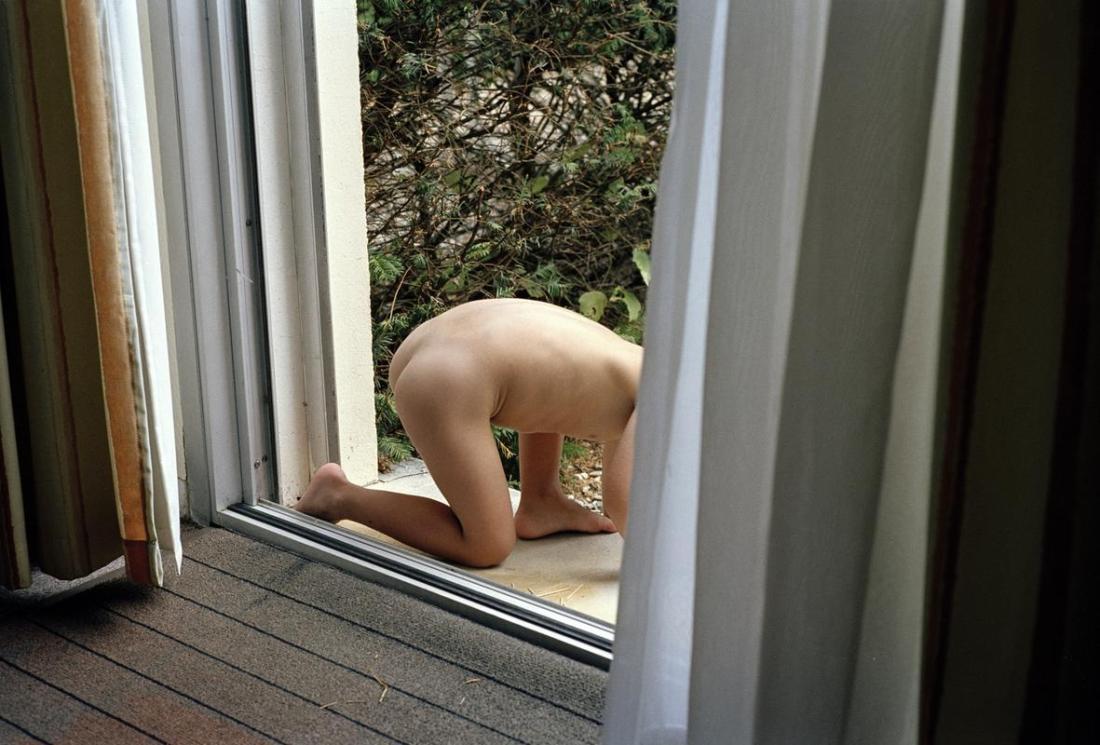
@sugarmagnohlia – mood indigo (2016)

For those of you who don’t know, Sugar (Magnohlia) is one-half of @slide-2-unlock–the best couples sex blog on Tumblr. (King is the other half; both are breathtakingly beautiful humans. Full disclosure: the linked image of King always makes me drool. ALWAYS.)

Following their story over the last year and a half or so has been a constant source of fascination.  Unlike most couples blogs, they relay the good, the bad and the ugly with the same careful, honest attention. It’s in this way that you’re truly able to see the breadth and depth of their commitment and passion for each other.

A while back King reported that Sugar was struggling with mental health issues and needed to step back from slide-2-unlock. It’s been inspiring and humble to watch her fight off her demons and slowly but surely emerge from the ashes of the way life can try to burn you to the ground.

I’m not 100% sure of this but it seems that Sugar has started to use her interest in image making as a tool to help beat back some of the darkness. Her work has evolved and improved at an unprecedentedly pace. (Really, her recent work with the incredible Kyotocat is among the best work from either.)

I love the way this image appears to be riffing on Duane Michals.

Also: I’ve featured one of slide-2-unlock’s photosets before. It resonated with me strongly because Sugar bears more than a passing resemblance to an erstwhile partner that I’ve never managed to completely get over. Given the intensely personal nature of that resonance, I was worried about appropriating the image. I reached out to Sugar and she gracefully allowed me to reblog the photoset with my personal commentary appended.

Anyway, by way of update, there’s still a lot to work through and figure out but my former partner and I are tentatively working on reconciling in order to get back together. I feel like I may be jinxing something but admitting it but it’s all so unexpected and disarming that I can’t help but shouting it from the rooftops–or in the case posting about it on Tumblr.

One strategy toward exposing the artifice of a unified, singular history is the privileging of gossip and rumor as valid forms of evidence. Among the many texts analyzing gossip as a form of truth telling is Lisa L. Moore’s Sister Arts: The Erotics of Lesbian Landscapes. In its preface, “Listening to Gossip in the Queer Archives,” Moore argues that the privileging of gossip is one of the few ways research can develop in response to what she calls the triple bind of issues facing researchers of the history of non-normative sexualities: limited archival resources, restrictive conventional readings of existing sources, and the distaste with which queer readings are often met.[7] She concludes by arguing that gossip, as a methodology, is implicitly queer, stating, “Listening to gossip means believing what you hear, see, touch, and feel; being unapologetic about what you love; and paying attention to what you’re scared of. It means trusting hunches, intuitions, gaydar. It means using the discipline, rigor, and patience of a dedicated scholar, a besotted fan, and an obsessed lover.”[8] As she writes, gossip is associated with “teenage girls, gay men, and dyke drama,” and stands in opposition to the rigidity of Enlightenment-based standards of knowledge. Its use in the creation of queer and lesbian history, therefore, is emphatically appropriate.

Alyssa Schwendener, The Most Fantastic Lie: The Invention of Lesbian Histories (Master’s Thesis, California State University, Long Beach, 2016), vii-viii.

7. Lisa L. Moore, Sister Arts: The Erotics of Lesbian Landscapes (Minneapolis: University of Minnesota Press, 2011), viii-ix.
8. Ibid., xi.

(via lesbianartandartists)

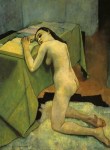
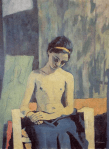
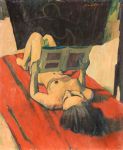
Felice Casorati – [↖] Vocation (1939); [↗] Ragazza di Pavarolo (1938); [↙] Reading a Book (193X); [↘] Nude Reader Reclining (1943)

Felice Casorati’s female nudes (c. 1930s) were known as shocking in
their time due to their unusual perspective. Whereas most female nudes
seem to dehumanize the female body by making it a subdued object of the
male gaze, here Casorati’s nudes are disinterested in their observer,
often seen occupied with other tasks like reading, reclining, or just
generally “looking away.” The unusual use of color also aids in turning
the female subject into a sickly/earthly figure whose existence is not
hypersexualized but instead becomes a source of uneasiness or intriguing
activity.

magrittee

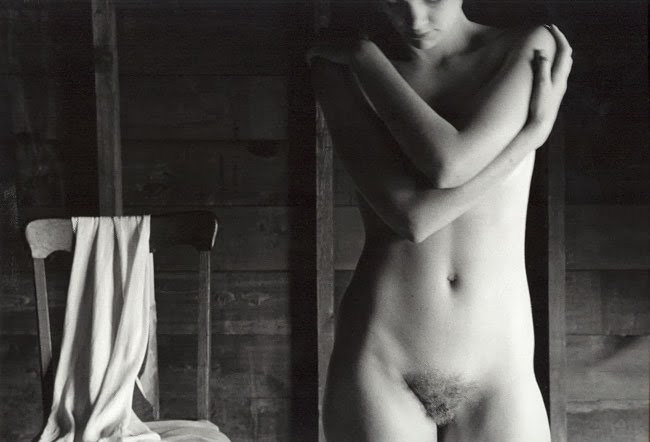
Eva RubinsteinJane Standing, Minneapolis, USA (1977)

This does several things very well.

First, it’s simple. Distinct foreground (Jane), mid-ground (the chair with a dress draped over it) and background (unfinished walls). The light travels from right to left–countering the art historical precedent established by the Dutch Baroque.

Second, while Jane’s position in the frame is governed by the rule of thirds, nothing else in the frame fits that mode.

Third, the lenses hyperfocal distance is set in such a fashion so that focus fully sharpens at the outer edges of her body. This accentuates the bright light and also manages to make her both disappear into the heavy shadows behind her while standing out from them–the placement of the chair keeps this optical illusion from becoming distracting.

Fourth, it’s not easy to see right away but the camera is angled downward ever so slightly–as if the photographer is adopting a posture similar to the model. It’s a small thing but it’s really what makes the image work so stunningly.

I was completely unfamiliar with Rubinstein before seeing this and I have to say her work is extraordinary–minimal without ever crossing over into minimalism as justification for vacuity.

10/10. Recommend.

Rosie Brock – [↖] Untitled from Lily series (2015); [↗] Untitled from Bone, Flesh, Memory series (2015); [↙] Untitled from Lily series (2015); [↘] Untitled from Lily series (2015)

Two days ago, Canon released the results of a survey where 1004 people were asked about their image making. A preposterous 80% graded their skills as excellent.

There are a veritable litany of problems with the methodology of this survey. The most pertinent is asking people whose only training to be an image maker is likely owning a camera to self-critique is a little like administering a multiple choice test and instead of checking it against an answer key, instead grading the test take on how they feel they did.

Really, it’s great that we can talk about the democratization of image making. I mean these days virtually any cell phone comes with a built-in camera that is superior to any standalone device under $1000.

Further, anyone coming of age from the 70s onward, grew up immersed in a culture steeped in a preternatural awareness of the impact of lens based visual media.

If anything, one would expect given the wide availability of quality equipment and an awareness of form and function that might as well be ingrained at a cellular level, you’d expect more and better work.

The truth of the matter is: you’ve got more people with better equipment making far less inspired, interesting and urgent work now than at any time in the history of the medium.

What does this have to do with Brock? Well, their are scads of young women making work with similar, perhaps over-earnest examinations of what it is to be young, female and visible in a culture dominated by notions of male entitlement and rote sexualization of women and women’s bodies.

Some of it is very good but by and large the majority of it is poorly conceptualized, executed and presented.

Not so with Brock. Part of it, I suspect, is that she’s shooting on film–specifically with a Hasselblad 500CM. It’s not just that with the ubiquity of digital, she’s willing to blaze a more solitary trail, it’s also that there seems to be an awareness that the square format is particularly well suited to portraiture.

And that’s the other fascinating thing about the work–it borrows tropes and traditions from portraiture–but it’s as if her images manages this delicate mobile-esque structure where each part exists able to be examined both as a part and as a part of the whole; everything is in balance and the balance is what activates the photograph.

For example, Brock has a patience with light that I haven’t seen many photographers bother with. She favors illumination just slightly beyond the confines of golden hour. At 19 she possesses an impressive familiarity with both form and composition, shaming the majority of folks who’ve been doing this half their lifetimes.

She’s presenting singular, indelible images with a seeming effortlessness that I know from experience takes endless work and fearless dedication. If she continues on her current trajectory, she will almost certain be a force of goddamn nature within the next decade. Thoroughly excellent and exceptionally noteworthy.

Géraldine Layjuillet from Un mince vernis de réalité series (2006)

A photography teacher introducing Lay to a room of undergrads might talk about the foreign in the familiar or refer to an unassuming eye. Perhaps, accompanied by explication relating the work’s influence to anyone from Stephen Shore to Jeff Wall to Paul Graham.

It’s not that I don’t think these points are extraneous–hardly; it’s that I think instructors need to vary their approach given the materials.

All too frequently, I think we reduce informed analyses to the presumptions of tradition. Painting is compared to painting; photography is compared to painting and cinema. It’s all really more interpenetrative than that.

We’d be better to look at modern art as a confluence of modern media, modes and methodologies–much in the fashion that the medieval cathedral formed the nexus between architecture, sculpture (broadly: masonry, woodwork, etc.), painting and even fiber based arts (liturgical robes, tapestries, etc.).

The best approach to Lay is, in fact, not visual–or only tangentially so; it’s textual.

Looking at the work is enough to justify this premonition, at least as far as in my own case. However, one needs look no further than the statement accompanying Un mince vernis de réalité to solidify this perspective–I understand not one lick of French but I’m guessing from context and Google Translate that it’s a section from Nabokov’s short story Transparent Things.

I’ve tried on at least half a dozen occasions to dive deep into Nabokov. He strikes me as a peculiarly brilliant mind more interested in conveying the form of his ideas than presenting them in a simple straightforward manner. His text is unnecessarily overwrought, at times serpentine and lacks the sort of glittering, glib irreverence of say Perec.

But the jist of the quote is a notion that’s not unfamiliar to me–Martin Buber makes it the singular focus of the second most influential book I’ve ever encountered: I and Thou.

The crux of the book is that there are two flavors of relationships between the individual and the world which surrounds them. There is the world of objects: subways, coffee cups, paper clips and xerox machines. We even see other people as perhaps not objects but ‘other’ in a similar fashion to objects we perceive in the world around us. Buber terms this relationship of our perception of objects in the world as ‘other’: I-It.

There is a second form of relationship. It is far rarer. Imagine: that you are standing on a bluff overlooking the ocean. A dear friend is facing you with their back to the ocean telling you a story–perhaps something to do with their misadventures traveling to Machu Picchu. Behind them the color in the sky shifts and you notice this devastatingly beautiful purple you’ve ever seen. You are utterly speechless at the site. You want to show your friend. But you know as soon as you spake of it, the spell of the wonderment will be broken. All you can do is point and hope that your friend will turn and see what it is you’ve seen in the same way. (And let me tell you, if you find that person who all you need to do is point: hold them close, not having to explain to someone why something is special is one of the greatest gifts you can share with another person.)

Buber terms this wordless wonderment, this transcendent moment of perfect, unmediated awareness: an I-Thou relationship.

Trying to explain it like this: a little like trying to explain to someone who hasn’t ever tasted coffee what coffee tastes like. It’s not something you can accomplish with words. Instead, you boil water, grind the beans and steep a cup for them saying this is warm and good, try it. If you don’t get it, spilling all the ink in the world won’t bridge the gap that you’ll cross once you know that to which you are being pointed.

The other curious thing though is that Buber maintains that there exists within every I-It experience the spark of moment of I-You relationship. I think most good image making centers on trying to document that spark.

What distinguishes Lay is that she’s not interested in the spark, she’s interested in the I-You moment. In effect, her camera is the same as the finger you are pointing so that your friend will see the purple tinged clouds hovering above and reflected in the ocean below.

It’s an unusual approach and while I don’t think it always works out for her, it works enough for one to see what she’s about. I’ll always respect work that attempts the risks failure in pursuit of an ‘impossible’ end. But the work that truly gets me fired up is the work that succeeds in accomplishing what we’ve heretofore accepted as impossible.