


[↑] Source unknown – Title unknown (201X); [↙] Source unknown – Title unknown (201X); [↘] redthreadtugs – 陪同 (2018)
Follow the thread.
[↑] Source unknown – Title unknown (201X); [↙] Source unknown – Title unknown (201X); [↘] redthreadtugs – 陪同 (2018)
Follow the thread.

Masao Yamamoto – 1270, from Nakazora (2001)
I’ve been on Tumblr pretty much every day since mid-to-late 2010. I’ve borne witness to a half dozen or so major changes that have infuriated users and caused folks to scream bloody murder about how they’re killing the site.
The last six months have been especially harrowing. Except… I’m not seeing a lot of screaming this time around. It seems like everyone who has been threatening to leave-has and that leaves two groups: folks like me who are too stubborn to quit and noobs who aren’t super hip to the way the platform words (or, more likely: don’t care).
It’s becoming increasingly challenging to keep this blog up and running, honestly. I mean: previously, I had more content I wanted to post than I had time to prepare posts. Now? Now, there’s still things I want to post–but it’s fewer and further between. I’m less able to pick what photo or image I’m most excited about and instead I’m having to focus more on curation. (This is probably a good thing for my brain but there are times when I feel like folks–in general–are less engaged with the proceedings.
Take the photo above. I’ve been wracking my brain trying to figure out what to say about it. It’s not that I don’t like Yamamoto–I’ve posted another of his photos several years back.
I know most of his work centers on landscapes and nudes. And that he uses tea to tone his prints.
I had some notion that there’s something of William Blake in his work. But, that’s not an assertion I can necessarily support beyond just saying it feels that way to me.
I reread his Wikipedia page and noticed this statement: “[he] makes installation art with his small photographs to show how each print is part of a larger reality.”
This suggests an interplay between images within a given context being important to understanding his work. I googled “nakazora”; it returned the following from the publisher of this work:
Dictionary Definition of Nakazora: The space between sky and earth, the
place where birds, etc. fly. Empty air. An internal hollow. Vague.
Hollow. Around the center of the sky. Or, emptiness. A state when the
feet do not touch the ground. Inattentiveness. The inability to decide
between two things. Midway. The center of the sky (the zenith). A
Buddhist term. Nakazora is our second publication on the work of
Japanese artist Masao Yamamoto. But this is no book: the artist has
designed a scroll measuring over eighteen feet long, beautifully printed
in process color on uncoated Japanese stock. The timelessness of
Yamamoto’s imagery is beautifully echoed in scroll presentation. The
scroll was one of the earliest vehicles used for storing and presenting
visual information. Nakazora combines the aesthetic and tactile
attributes of this traditionally one-off format with the advantages of
modern printing technology. A striking marriage of traditional and
hi-tech materials and production techniques, Nakazora redefines the term
‘artists’ book.’
I can’t think of scrolls in an art context without flashing to Caroless Schneemann’s Interior Scroll. But it seems that my initial instinct with Blake isn’t far off the mark–since short of illuminated manuscripts, Blake was kind of the progenitor of ‘artist’s books’.
I suspect that the similarities run deeper than that but at present I am too brain drained from once again packing all of my worldly possessions in preparation to move ¼ of the way around the world…
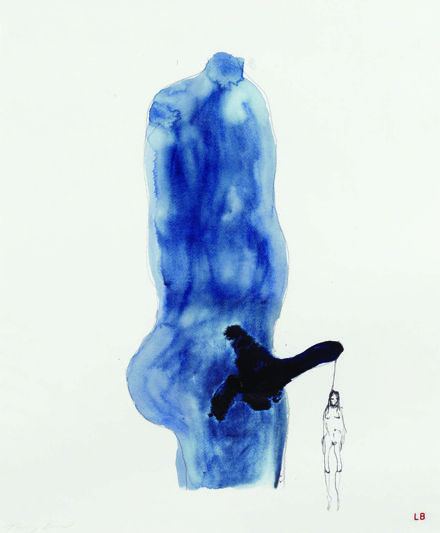
Louise Bourgeois & Tracey Emin – Just Hanging from DO NOT ABANDON ME (2009-2010)
Whether you think you know these artists or not, I’m pretty sure you do. Bourgeois was responsible for that unsettling giant spider sculpture Maman & you’ve almost certainly seen documentary photos from Emin’s Exorcism of the last painting I ever made (here and here).
In this collaboration between the two Bourgeois painted watercolors and then Emin added line drawings. (Interestingly, it took Emin two years to decide what to do with her part and then executed all the drawings in a single day.)
Originally, I was going to reblog this post from the always astute @psyche8eros. In the process off trying to figure out the date, I saw the above image and had a stronger reaction to it.
In the context of the image I was going to post and then this image and the title of the collaboration, there’s this sort of histrionic romantic fatalism. That feeling reminded me of a high school English teacher who found Romeo and Juliet “far-fetched” due to the fact that “no one ever died of a broken heart.” (This was the same teacher who informed me “life is a comedy for those who think and a tragedy for those who feel” to which I responded immediately: but how can anyone go through life without feeling?)
These are two questions I’ve carried with me ever since:
I saw this post the other day:
This living-with-myself is more than consciousness, more than the
self-awareness that accompanies me in whatever I do and in whichever
state I am. To be with myself and to judge by myself is articulated and
actualized in the processes of thought, and every thought process is an
activity in which I speak with myself about whatever happens to concern
me. The mode of existence present in this silent dialogue with myself, I
shall now call, solitude. Hence, solitude is more than, and different
from, other modes of being alone, particularly and most importantly
loneliness and isolation.Solitude means that though alone, I am
together with somebody (myself, that is). It means that I am two-in-one,
whereas loneliness as well as isolation do not know this kind of
schism, this inner dichotomy in which I can ask questions of myself and
receive answers. Solitude and its corresponding activity, which is
thinking, can be interrupted either by somebody else addressing me or,
like every other activity, by doing something else, or by sheer
exhaustion. In any of these cases, the two that I was in thought become
one again. If somebody addresses me, I must now talk to him, and not to
myself, and in talking to him, I change. I become one, possessing of
course self-awareness, that is, consciousness, but no longer fully and
articulately in possession of myself. If I am addressed by one person
only and if, as sometimes happens, we begin to talk in the form of
dialogue about the very same things either one of us had been concerned
about while still in solitude, then it is as if I now address another
self. And this other self, allos authos, was rightly defined by
Aristotle as the friend. If, on the other hand, my thought process in
solitude stops for some reason, I also become one again. Because this
one who I am is without company, I may reach out for the company of
others–people, books, music–and if they fail me or if I am unable to
establish contact with them, I am overcome by boredom and loneliness.
For this I do not have to be alone: I can be very bored and lonely in
the midst of a crowd, but not in actual solitude, that is, in my own
company, or together with a friend, in the sense of another self. This
is why it is much harder to bear being alone in a crowd than in
solitude–as Meister Eckhart once remarked.–Hannah Arendt, Responsibility and Judgement
“A true solitude is not unbearable since it allows for otherness.”
— Hélène Cixous, Readings: The Poetics of Blanchot, Joyce, Kafka, Kleist, Lispector, and Tsvetayeva
I‘m someone who requires a great deal of solitude in order to function; by the same token: I loathe loneliness. (I frequently refer to loneliness as being akin to buzzing florescent light tubes. You can tune them out and completely forget they’re there–but if someone says: hey, how do you stand that noise… it’s back and the only thing you can think about.)
It’s rare but there are several folks I’ve met that I can experience solitude with them in the same room. (Most people just make me feel increasingly alone the more time I am compelled to spend with them.)
That’s probably why this particular piece resonates with me so much: from one vantage it’s maudlin romangst–the idea that if you abandon me it will lead to my mortal undoing; it’s also, from another vantage: understandable given the losing of someone with whom you can share solitude.






[↖] Source unknown – Title unknown (201X) ; [↗] Source unknown – Title unknown {desaturated} (201X); [↑] Source unknown – Title unknown (201X); [^] Source unknown – Title unknown (201X);[←] Source unknown – Title unknown {desaturated} (201X); [→] Source unknown – Title unknown {desaturated} (201X); [↙] Source unknown – Title unknown (201X); [↘] Source unknown – Title unknown (201X); [-] Devils Film – Transsexual Gangbangers #19 feat. Annabelle Lane {desaturated} (2017); [↓] Source unknown – Title unknown (201X)
To be free of fear is to be full of Love.
–Adyashanti
It’s 100% understandable if you delete commentary added to images before you reblog.
However, when their is authorial attribution and you discard that when you reblog, you are an insufferable ass douche backwash Slurpee and I will block you.
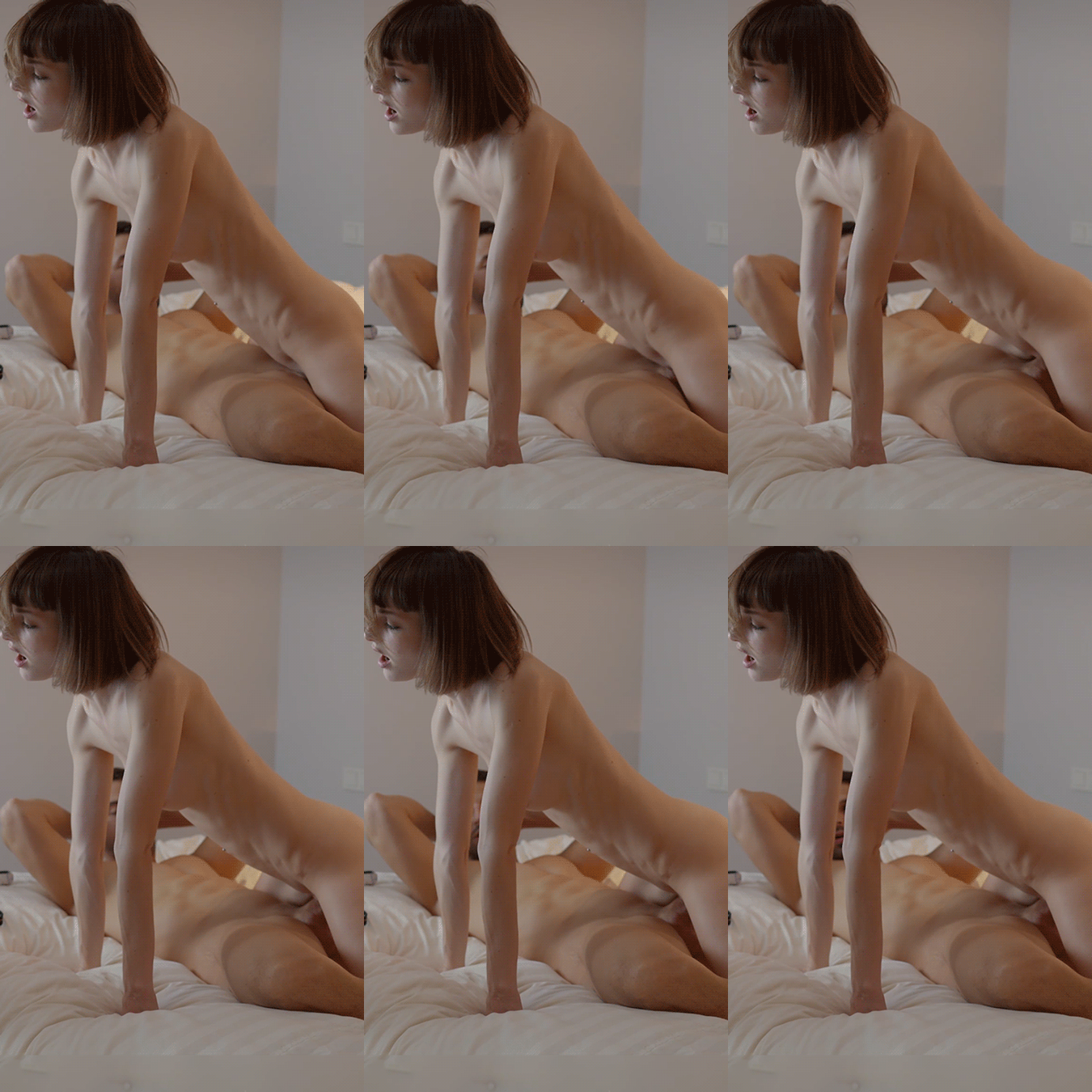
Source unknown – Title unknown (201X)
I don’t like that this is vertical. (Any moving image–be it a .gif or video clip–should always be landscape oriented.)
I do quite like quite everything else: she appears to be chasing her own pleasure’s flow-state so single mindedly, he seems just as intensely in his own body (it’s also interesting that his movement from left to right serves as an almost mechanical counterpoint to her thrust); the position (would you call that ‘side saddle amazon’?) is something I’ve never seen before–although it’s reminiscent of a position I have seen before which would involve the dude here pulling his right knee up and then her pulling her right thigh over his body so that she can hug his leg to her body and grind against his thigh while thrusting. (Granted that shift in position would erase another thing I like about this: that with the exception of the base of his cock and the edge of her left nipple, they are both clearly nude but the typical markers of nudity that social media discourages are otherwise absent.)
I don’t like the white duvet, white walls look but unlike most porn shoots that just pour watts and watts of dead white light onto a scene, this at least features more naturalistic lighting. The white light entering the frame from left to right and primarily illuminating her shoulders and arms vs the tungsten light coming from almost the same angle only traveling right to left suggests an overhead light in another room–perhaps from the open door or a hotel bathroom or something of the sort.

Yaroslav F. – aliona i. offside2016. lviv. {desaturated & cropped} (2016)
Whoever desaturated and cropped this is a colossal fucking asshat.
Consider the original:
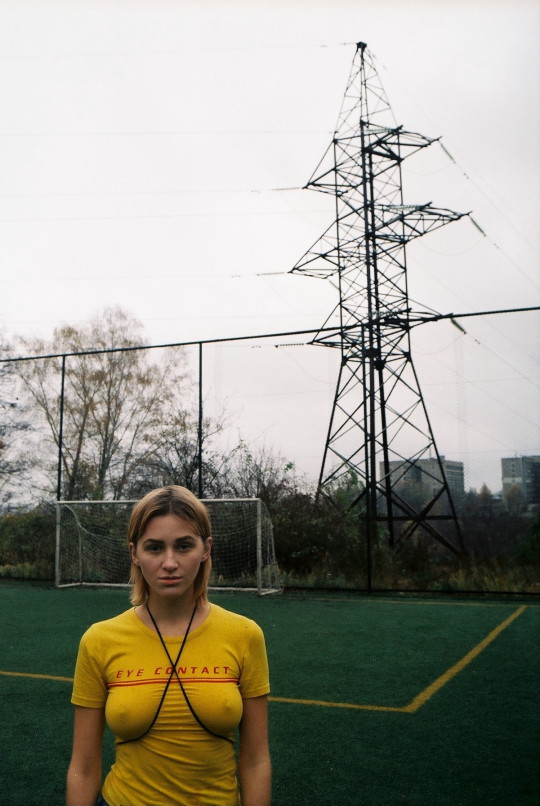
Yes, the original is far from perfect– the yellow t-shirt together with yellow line against the green field is a decently observant with regard to using color in composition. (I’m not sure about how the crossbar of the goal looks a bit like one of those prop headband arrows that makes it appear as if there’s an arrow sticking through your skull, the fence, the electrical line armature or apartment buildings in the distance add anything to the photo.)
But compare the original to the desaturated and cropped version: the former is a reasonable idea that suffers from a deficit of attention to all the details; whereas the edit reduces the portrait-esque aspect of the picture to a more overt provocation–the thin t-shirt sans bra presents a feminist tinged visual commentary, i.e. eye contact above this line and the crossed black cord either indicating a negation of the command or an insinuation of a preference for kink.
Further the focus on the setting is different. In the color original, there’s the emphasis on the soccer field within a larger context of the area immediately surrounding it. In the desaturated crop, the frame is centered on the goal and there’s a feeling that given that this is a soccer pitch and that this person is facing the camera (and ostensibly the viewer) that Aliona–and by dint of the ostensibly feminist message of her clothing–is an obstacle between the viewer and the goal.
In other words, the original picture is imperfect but it has a certain knee jerk charm but the edit is designed in such a way to sharpen a sexist narrative that is not present in the original.

Laurence Philomene – Untitled from Lucky: a star is born (2018)
This is already fantastic only accounting for how candid, playful and immediate it is.
But there’s also the way the sharp focus on Lucky’s gaze as a counter balance to the way their mouth is hidden in the crook of their elbow–creating a Mona Lisa smile level of ambiguity. (You can only go on what you see: humor and perhaps also touch of world weariness or melancholy. But really, it feels like the subject sees more of the viewer than the viewer will ever guess about the subject.)
And the depth of field is used to stunning effect–elbow & right hand out of focus in the foreground; the pink polished nails, bridge piercing, eyes in sharp attention commanding focus and then everything dropping out of focus at the sides of their face, reverting to magenta and blue (a motif echoes in the offset MUTANT tattoo on Lucky’s forearm, echoed again in the tattooed fingers and pink nails polished to a mirrored sheen.
This is freaking stellar portrait. And the rest of the series is just as worth your time. Laurence is staggeringly talented and I’m excited with the way they seem to be pushing themself and their work.
The beginning of wisdom, I believe, is our ability to accept an inherent messiness in our explanation of what’s going on. Nowhere is it written that human minds should be able to give a full accounting of creation in all dimensions and on all levels. Ludwig Wittgenstein had the idea that philosophy should be what he called “true enough.” I think that’s a great idea. True enough is as true as can be gotten. The imagination is chaos. New forms are fetched out of it. The creative act is to let down the net of human imagination into the ocean of chaos on which we are suspended and then to attempt to bring out of it ideas.
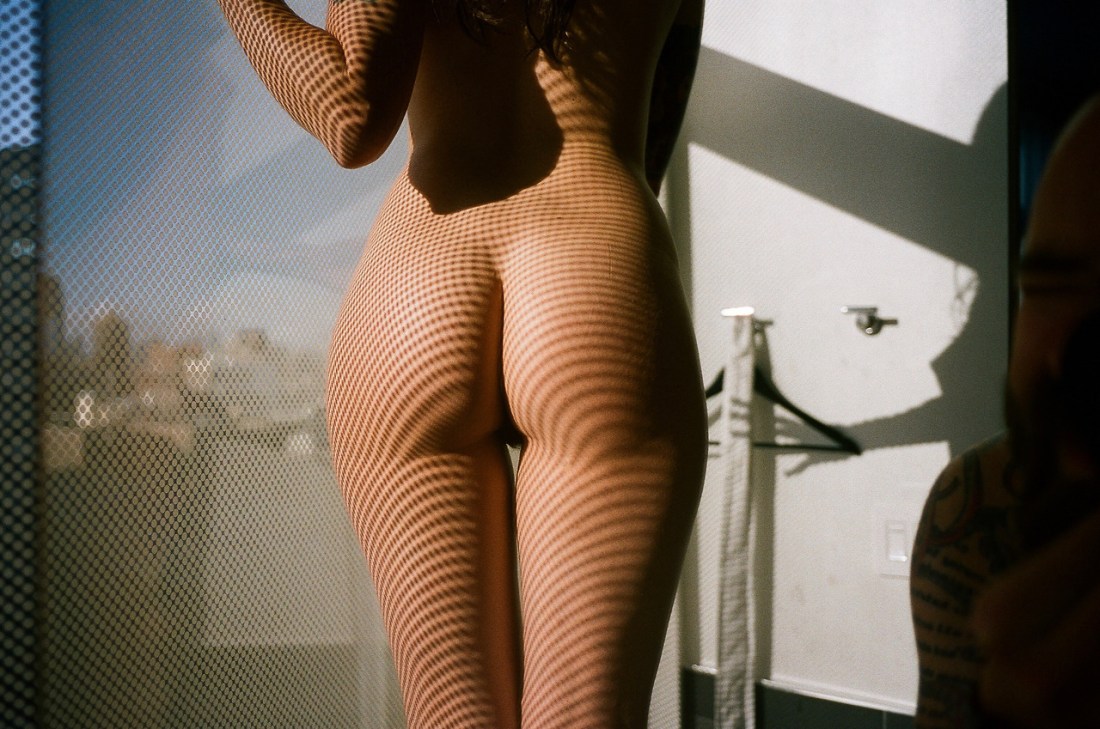
Julie. NY. 2017. Leica M6.

[↑] Derek Woods – Julie. NY. (2017); [↓] Frank Ockenfels – Thumbelina (2015)
Juxtaposition as commentary
 Acetylene Eyes