“True art, when it happens to us, challenges the ‘I’ that we are.”
I’ve been an shambled academic for almost two decades now. This may be the most on-point essay I’ve ever read. Absolutely mind blowing.
“True art, when it happens to us, challenges the ‘I’ that we are.”
I’ve been an shambled academic for almost two decades now. This may be the most on-point essay I’ve ever read. Absolutely mind blowing.
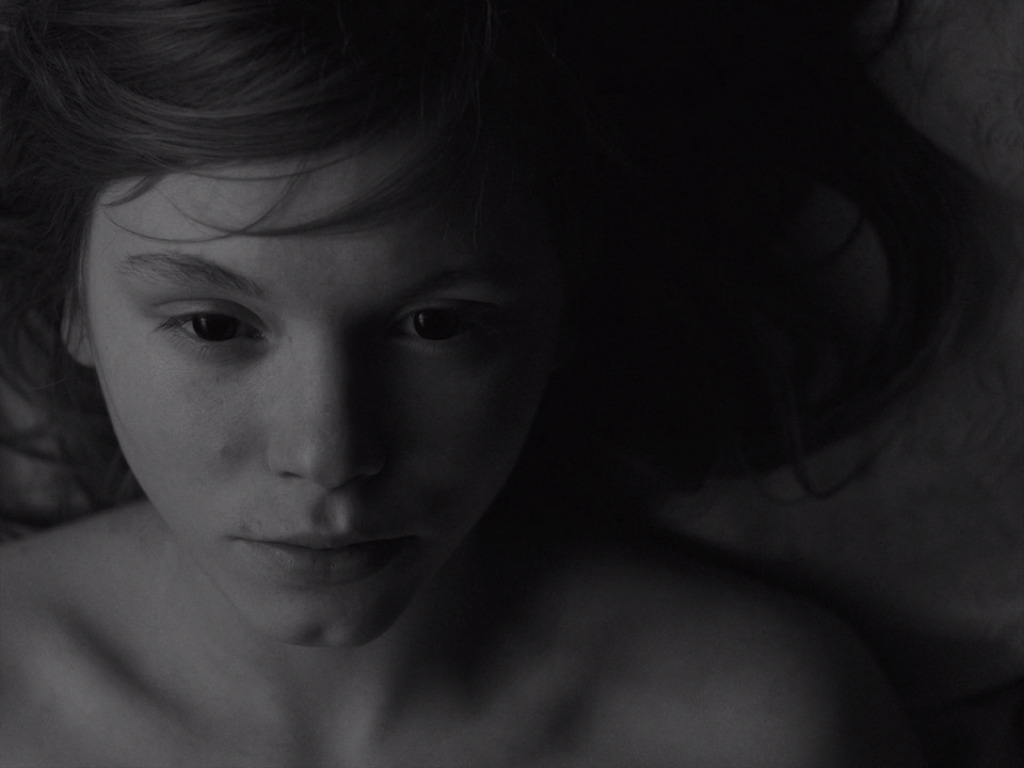
Paweł Pawlikowski – screen capture from Ida (2013)
Over the last three weeks, I have been geeking out over the im-fucking-peccable Every Frame a Painting series. (Seriously, Tony Zhou has forgotten more about film form than I’ll ever know.)
I’m curious what he’d make of Ida–mostly because I don’t know what to make of it.
For such an ‘uncomplicated’ movie, there are a metric fuck ton of unresolved contradictions.
Also, the compositions are just straight up weird. Not in a bad way–there is a rigorous logic informing them.
In other words: there is clearly a pervasive authorial design to the more outlandish decisions. But to me it reads as an effort to unnecessarily ‘artify’ the proceedings. I adore Ida’s vacillation between her vows as a nun and the carnality of the world inherent in Coltrane’s Naima far too much to hold Pawlikowski’s failings against the film, but still I can’t help wondering what could’ve been if he’d simply played it straight.
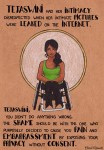
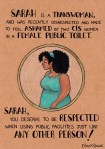
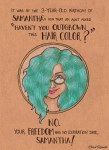

Carol Rossetti – selections from Mulheres (Women) series (2014)
Rossetti is a Belo Horizonte, Brazil based graphic designer.
In April 2014–a month ahead of the #YesAllWomen social media trend–she began making simple yet exquisite colored pencil drawings of women which included captions celebrating individual autonomy and personal agency.
The intersectional feminist/sex-positive/body-positive/anti-slut shaming perspective along with the carefully calculated non-confrontational presentation rapidly–and deservingly–went viral.
The first time I encountered her work I cheer aloud. I was so curious about her that I navigated away from my Tumblr dashboard to learn more. I remember seeing her response to someone deeply impressed by her illustration of Babi. It was so pitch perfect–I’m not going to lie–I teared up a little.
I’ve lost track of all the times since Rossetti’s radical empathy has floored me. I’ve wanted to showcase her work for months; however, I’ve been at a loss as to how I might do so in a way entirely respectful of such ingeniously subversive work.
Emboldened by the luck I’ve had in approaching folks whose work I dig, I wrote to Rossetti–who proved to be equal to the contemplative charm of her work. (Also, she was exceedingly patient with my scattered, free-form approach to interaction.)
Acetylene Eyes: I have this image of you as a bad ass, caped super heroine sworn to uphold intersectional feminist ideals while vanquishing sexist bullshit.
Carol Rossetti: Hahahaha! Super heroine, that’s something I’d never [thought] of me!
AE: A super heroine who loves dinosaurs apparently; Do you have a favorite? (Its stegosaurus, isn’t it?)
CR: I do love dinosaurs, and I truly believe in Spielberg’s versions. So, of course my favorite one is velociraptor, because they can open doors. Smart asses.
AE: Usually I have a zillion questions about creative process but you’ve addressed that topic assiduously in previous interviews. I’m not sure if it’s that the first image I saw of yours was Ana or if it is just especially resonant given my own experiences but it feels different than most of your other illustration. Did your approach differ at all in making it?
CR: Actually, it wasn’t different. I talked to some people who have been raped, and the illustration was based [on] a real person (changed the name, of course). But I haven’t been through this situation, so I pretty much tried to put some of the exact words she said to me there.
AE: You have noted: “none of my illustrations are made based on personal assumptions.” That’s an incredibly astute observation; one which started me thinking–a dangerous past time, I know–about the role of conceptualization in art-making. Are you familiar with Brandon Stanton’s Humans of New York (HONY) project?
CR: I like HONY, I think it’s a beautiful project.
AE: I feel as if your project and HONY share a sort of human interest angle. Thus, there’s a built in audience. Yet, unlike your willingness to listen to a multiplicity of experiences, HONY seems devoid of a similar openness.
CR: I understand the critics, I think they are valid, though. I’m not sure exactly how Brandon Stanton presents it, but I think sometimes people put a lot of expectations and responsibility on an art project. Don’t get me wrong, I do understand that expectations are natural and responsibility is something that does exist. But I guess what might have happened to HONY that also happens to my work is that people put it in some kind of pedestal in which it was never meant to be. Well, at least about my work I feel a bit this way. I identify myself as a feminist, but I completely refuse the idea that I would be the “new face of feminism”, as I’ve seen around. I am not feminism itself. I won’t tell anyone how feminism should be handled, what’s the “right or wrong” way to fight the fight. There are many ways to fight sexism, racism and many other kinds of oppression, and I am not a leader or anything. I have a language of my own, which is through colored pencils drawings of different women, each of them with a story, and a non-agressive friendly text. This is a way for me to express myself, express my ideas, invite people to identify, maybe (if I’m lucky) make some people aware that sometimes they say things that are really rude, even though they might not notice at first. However, there are people who are really angry, people who are tired, people who have been traumatized, people who don’t share even half of the privileged that I know I have, people who only have anger to keep them moving on. I won’t judge these people’s ways to fight the same fight, and I’d never tell them how to handle feminism. That would be very disrespectful. I thank you for your kind words about my work, and I’m happy that it touched many people so deeply in a very positive way the way it has. This is so much more than I could ever expect! But sometimes I feel the pressure of expectations in a way I’d never thought it would be. I’m still a human being full of flaws[;] I make mistakes the whole time. This project is about representing some women, but I don’t have the pretension to represent ALL women. It is about feminism, but it’s not supposed to be a guideline of how to do feminism. It’s about representation, but it doesn’t have the claim to being the “right” way to represent people.
So, sometimes I think something similar might have happened to HONY. It was supposed to be something, but people saw it a lot bigger than it really was meant to be, and then there were more expectations and more responsibility demands. I don’t know (really, I don’t know if that’s the case at all for HONY), but I feel a bit like this sometimes. We can control what we say, but each of us [has] our own cultural and experience background that will result in a different interpretation – and that is not controllable.
Anyway, sorry, I got carried away and ended up talking a lot about something else. Back to the point. I love dinosaurs, but I never liked drawing them. Pretty hard anatomy! I’ve always loved drawing women – and always found very hard to draw men. I’m not really sure how I got here… When I say this whole project was born in a very spontaneous way, I really mean it. It was just one more project I had in mind to keep drawing every day, and then people began liking and sharing like crazy on Facebook, and my life turned upside down. In a very good way! 🙂
AE: I want to jump back to feminism briefly. Did you have a feminist conversion moment—you know a sudden epiphany that the patriarchy was a total crock of shit?
CR: I’m not sure when I decided I was a feminist, but I know that I started getting to know feminism beyond stupid stereotypes with my husband. He started talking to me about it and it was great. I guess many feminists wouldn’t like that, but it’s true and I don’t see any problem with that. Of course it was not just him. I started reading things on my own, and finding out things for myself, and talking to people. And one day I realized I had always been a feminist. A clumsy one, for sure, but still a feminist.
AE: What artists light you up and why?
CR: Well, I do feel inspired by people in general. I think that if you learn to look around, you’ll see so many people with so many stories and so many points of view, and that’s wonderful. The human being is an endless source of inspiration. But, if we’re talking about famous people, I should probably start with Neil Gaiman and Amanda Palmer. I absolutely adore their work, they’re like amazing inspirations for me! I suppose inspiration comes from many different areas, like literature, cinema, music, photography… It’s all around. Every day I discover an artist I didn’t know before and I fall in love with them!
AE: In previous interviews you’ve mentioned enjoying music and TV series. What three albums and three series couldn’t you live without?
CR: Hm. Well, let me see. I guess Belle and Sebastian’s The Boy with the Arab Strap; First Aid Kit’s The Lion’s Roar and Banda de Pau e Corda’s O Melhor da Banda de Pau e Corda. But I feel like I’m being unfair not mentioning other thousand artists I love! And three series… American Horror Story, Doctor Who and Buffy the Vampire Slayer (guilty pleasure?).
AE: Have you heard of Emma Sulkwicz?
CR: Yes I have!
AE: She’s incredible isn’t she?
CR: I think she found a very powerful, personal and meaningful way to protest. And that’s amazing.
AE: Speaking of protest. I know Brazil is roughly the size of the US, but did the protests leading up to World Cup intersect with your life in any way?
CR: Those protests we had last year were quite a thing. It began as something, then it turned [into] something else, and then into something different. At first, I was with the protesters. Then, the whole movement was grabbed by right-wing parties and had a very bizarre speech, so I didn’t support them anymore. Anyway, it’s complicated. But the World Cup did affect everybody somehow, I guess.
AE: If you created a self-portrait in the style of your Mujeres illustrations, what would say to yourself?
This is a [tough] question. At the beginning, my drawings were about situations I didn’t live myself. It wasn’t planned that I wouldn’t talk about me, I just talked about issues I thought were more important. And I consider myself very privileged, so my own issues I was always leaving for later, you know? Then I decided to start making some about things I lived, and I found out that was way harder than I expected. So I made the one about not wearing any makeup, about cellulite, about the couple who decided not to be legally married, the one about tanning… I still want to make one about not wearing bras! 🙂
I didn’t know much about gardens, in general, but what I was working with seemed less like the married person’s vegetable patch the church described and more like a Narnian wonderland full of infinite magical possibility.
Midnight in the Garden of Good and Evil: Or How I Divorced Jesus and Learned to Love Sex
A profusion of apologies for my absence.
Contrary to my past MO, this pause is less due to the seasonal onslaught of depressive imps–although that is a factor–and more due to extenuating circumstances.
The hope is to be able release a handful of posts this week. However, my ability to follow through on that hinges on receiving clearance to post a new artist interview. (I am ecstatically excited about this one and I hope you’ll enjoy perusing it as much as I did chatting with the artist–who is a fascinating, astute, all around charming and incredible person.)
Thank you all–each and every one–for sticking with me. As I always say I’d be doing this regardless of whether or not anyone tuned in but that any of you can be bothered with what I try and more often than not fail to illuminate here contributes a small measure of joy to my existence.

Marcel Meys – Leda and the Swan (1920)
I have a very long list of scholarly essays I have half a mind to write. I know I’ll never write them but I think the concept is vital enough that someone should write about it–even if it’s not me.
One such essay has to do with understanding the mechanics or artistic influence using figurative painting as a microcosm. I think it’s interesting that it starts out as a system of patronage–artists accept assignments to depict certain stories and thereby practice their craft.
If you’ve ever spent any time studying 13th through 18th century painting–or spent an afternoon ambling drunkenly around the Gemäldegalerie (have done; plan to do again)–you know that regardless of historical merit, a fair portion of it is BORING AS FUCK.
Yes: there are exceptions wherein the practitioner’s craft is so clearly some next level shit that it shifts the way that myth is depicted henceforth. (Giotto and Masaccio being goddamn exemplars.)
Then there’s those that add not only staggering craft but who also manage to strip away any sort of superfluous decoration and get to the dynamic core of the image. That’s abstract… think of it this way given the established trope the artist finds a means of not only presenting the subject in a new, dynamic way but they do so in cuh a way that the render the title unnecessary. You look at the image and you know down in your bones, the story behind it.
My favorite example of this visionary work is Bruegel‘s Landscape with the Fall of Icarus.
But there’s also work that alludes to mythology in order to clarify or enrich itself. I had an example that was a painting but as I’ve been writing this I may have been drinking rye whiskey and now I’m just blasted enough that the only example I’m able to summon to mind is the fact that Ellen Page’s (who is fucking incredible, by-the-by) character in Inception is named Ariadne.
As with this example, the majority of such efforts end up knee jerkily hipster. But there’s the further complication when we are dealing with analog photographic or digital imaging processes. Joel Sternfeld did a a great project called On This Site: Landscape in Memorium that commented on how text informs images and images inform text.
I find this image to be an example of this last kind of image. I’m not the title necessarily detracts from the work… if you know anything about the history of the depictions of the story of Leda and the Swan then you can appreciate it’s cleverness.
My trouble is that I think the harkening of the title back to mythology diminishes the fact that this image is more than ninety years old but still looks as if some analog fetishist Tumblr photographer collaborated with an up and comping Tumblr model to make it.
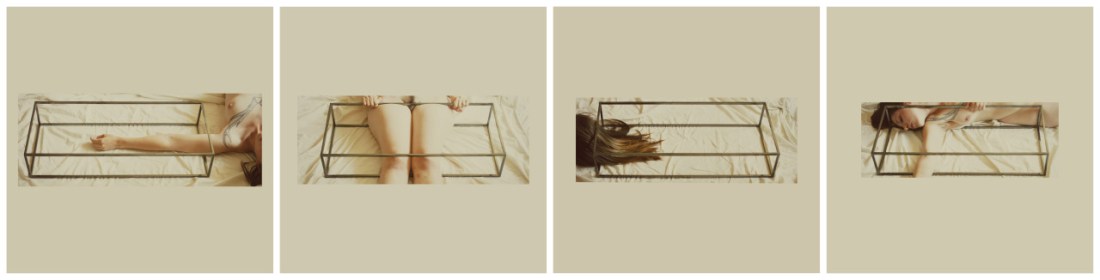
Beatrix Mira – the normativity parchment (2014)
“Never again will a single story be told as though it’s the only one.” -John Berger
n. the tendency to give up trying to talk about an experience because people are unable to relate to it—whether through envy or pity or simple foreignness—which allows it to drift away from the rest of your life story, until the memory itself feels out of place, almost mythical, wandering restlessly in the fog, no longer even looking for a place to land.
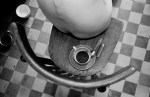
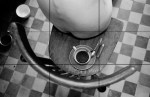
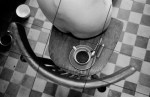
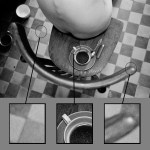
[↑] Igor Mukhin – Untitled (2010); [←] rule of thirds (overlay); [→] rule of thirds + 18° (overlay); [↓] grain density & depth of field (magnification sampling)
I talk to much and say too little. I decided to show as opposed to telling you the genius-tier visual math shit going on here.
Igor Mukhin has forgotten more about the photographic craft than most of us will ever hope to know.

Igor Chekachkov – Above (1 of 24) from Daily Lives series (2013)
There’s no sidestepping comparisons with Florian Beaudenon’s Instant Life.
Chekachov uses light in interesting ways but his composition chops lack Beaudenon’s rigor.
Yet, this image does two things Instant Life doesn’t: it demonstrates a patient reverence for the electric current of sensuality underlying bodily instantiation and an openness to being alone, together in the sometimes mundane, sometimes tempestuous sea of being.
 Acetylene Eyes