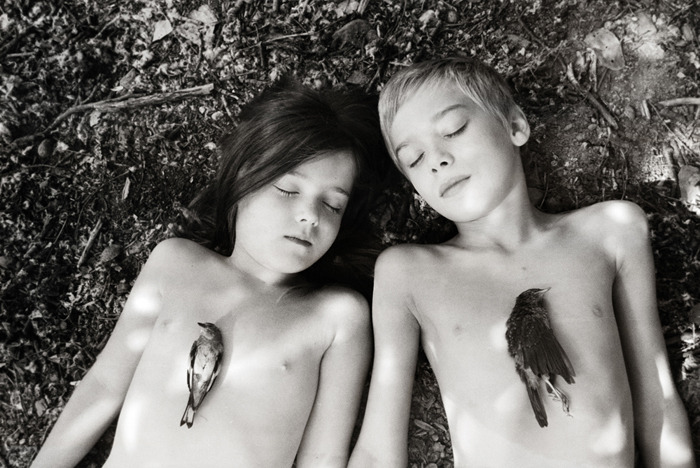
Anastasiy Mikhaylov [AKA Estergom] – *** (2013)

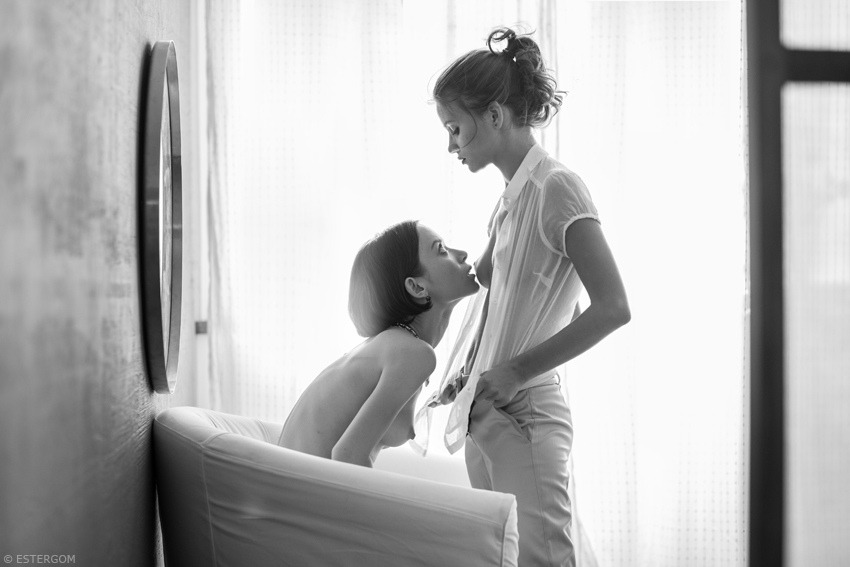
Mikhaylov’s images look as good as digital B&W can be expected to look–awful when compared with analog B&W–and are ordered according to crisp compositional logic.

I nearly had a heart attack and died from not-surprised when I learned Mikhaylov was trained as a cinematographer.

If photography is English, then cinematography would be English spoken with a nearly impenetrable Scottish inflection.

Seeing Mikhaylov’s work is like running into someone who speaks with the same accent. Someone whose words you understand in a nearly prelinguistic fashion.

In other words, the familar pretty-pretty and consistent evocation of scale attracting my eyes like ball bearings to a magnet.

Cinematographers are as a group less than astute when it comes to the nuances of conceptual art. (Two prominent exceptions that spring most readily to mind are Sven Nykvist and Harris Savides.)

Yes, echoes absolutely exist in relation to matters of visual storytelling and figuring out how to inveigle unruly images to sit politely side-by-side around the table like some many birthday party kids cracked out on sugar rushes. But I think there’s an inherent notion of what a photographer does that gets instilled in us; it transitions a bit too easily into an explanation of what photography entails.

For everything Mikhaylov does well, there’s always a corresponding deficiency. The most obvious is his inconsistency in including/eschewing eye contact. There’s no rhyme or reason to it unless you step outside any critical space and instead start from an acritical exposure to visual culture. In other words, don’t ask why does this look the way it does; begin instead by insisting this is what an image should look like.

There’s some overlap with an Matt Singer penned op-ed over at The Dissolve earlier this week in which he compares and contrasts the visual indelibility of the latest Spider-man blockbuster and Jonathan Glazer’s gorgeous and incomprehensible Under the Skin.

Referring to yet another essay by HitFix’s Drew Mcweeny, Singer notes:

McWeeny concludes his essay by imploring Hollywood to “make the stakes more personal” while “telling good stories that also happen to be amazing to look at.”

Pretty-pretty is all well and good but it is ultimately not enough. Something more is needed. In the above image, for example: it’s a matter of tone–a cishet male positing lipstick lesbian schtick as same-sex attraction.
Ultimately, despite it speaking my language convincingly, I feel like this is an image that is comparable to a seedling needing partial shade that was planted in direct sunlight. It’ll grown, but it’ll need extra attention.

Technical merit isn’t enough. And it irks me that the extra care it requires needs hinges equally on the artist’s ego and the irrigation of lusting arousal as the only viable means of fully intoxicating the viewer.

Sporadicity

Updates are going to be less frequent over the next week or so.

The Cliff’s Notes explanation runs like this:

The woeful state of my life earlier this year has stabilized somewhat. There are hints of progress in the search for gainful employment but I am rapidly running out of time/resources.

As such I’m packing a parachute; by that I mean embarking on a couch-to-couch tour of mid-size metropolises that a.) do not share the strangling cost of living New York has and b.) have enough of an art scene that I can stave off the fits of pitch dark, crippling despair.

I normally enjoy traveling but I am viscerally dreading this trip–mostly I think because my birthday is Sunday. Last year was one of the worst birthdays of my life and this year’s coincides with the two days I’ll be staying with family in one of the shit-fuckingest cities in the mid-west. In other words, it’ll be just as lonely as last year except I’ll be surrounded by people who don’t really care to know me since their misplaced illusions about me are much more palatable to them.

Sorry to be so goddamn whiny. I’ll post if and when I have a free minute or two.

Thanks for your patience and take care of yourselves,

A.

i want to apologize to all the women i have called beautiful
before i’ve called them intelligent or brave
i am sorry i made it sound as though
something as simple as what you’re born with
is all you have to be proud of
when you have broken mountains with your wit
from now on i will say things like
you are resilient, or you are extraordinary
not because i don’t think you’re beautiful
but because i need you to know
you are more than that

Yung Cheng Lin (aka 3cm) – [↑] 4.420 (2013); [←] 2401 (2013); [→] 9197 (2014); [↓] 6381 (2013).

When people distinguish between porn and not-porn, the difference is usually framed in terms of what is shown and what remains unseen.

A better question might: what does the manner of presentation tell us about how we are supposed to see what we are being shown?

There’s honestly too many things I could go on and on about with 3cm: his mindfuck mastery of color; precocious Photoshop manipulations, clever visual puns, recurrent images/themes, my guess that his process is highly improvisational and a repudiation of all the lazy ass characterizations of his work as ‘surreal’.

That’s all lagniappe.

Positioned as it is in the no man’s land between capital-A art and small-a art, I think there’s an instinct to round up. I’m not opposed to that. Not all of 3cm’s work is good, but almost none of it is crap outright.

What I think people have talked themselves out of is the implication of the sexual subtext in the work. The sexual subtext is not only the raison d’etre it’s much, much more than a subtext, it’s shockingly pornographic.

There aren’t even three nipples in roughly a thousand images. But that doesn’t matter, read the space between what you see explicitly in the images with the huggable elephant in the room of what the image is ultimately fixated upon. It’s a little like reading Shakespeare: read the first scene and then start over again and this time you’ll pretty much have it.

But here you aren’t searching for the rhythm as much as the correct tone. The space between what is explicit and what is implicit has a confessions of depravity feel to it. If you can stay in that space long enough, you’re initial response will probably be to blush. If you are like me though, you’ll be extremely turned on.

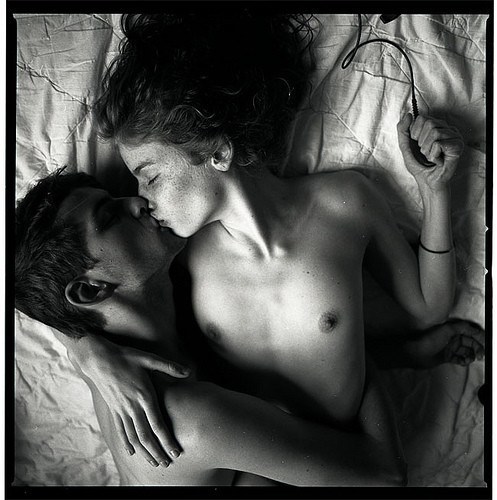
Merel WessingTitle Unknown (200X)

I’m not 100% as far as the attribution on this.

Google Image search best guesses as Belgian model Merel Wessing.

With the galaxies of freckles on her forehead and around her eyes, this is almost certainly the same young woman.

It seems she’s a photographer too. Or was, at least–there’s a Flickr account bearing her name and the The Way Back Machine shows updates between 2007 and 2011.

Unfortunately, none of those images are cached. Anywhere as far as I can tell.

Excepting the above, another photo from this same ‘shoot’ and this, her work has been scrubbed from the Internet.

Although there’s no way to qualitatively assess her abilities based on three photographs, the images–especially this one–justifying a strong curiosity with regard to the rest of her work.

I have an itching suspicion she was/is very good, if not flat out phenomenal.

I See Who You AreUntitled (2014)

Kara Neko was one of the first Tumblr models I followed.

At least initially, what drew me to her work was the deeply contemplative stillness of her self-presentation.

Like a total newbie, I fouled up the attribution on a image of hers. Almost immediately, she messaged about my error and dazzled me with her polite charm.

A bit more than a year ago, Kara began collaborating with Tetsu on I See Who You Are (ISWYA). 

What with my own pathological obsession with questions of public vs. private, representations of sexuality and the arbitrary nature of so-called social propriety, I was bound to be interested in the project.

Kara’s commentary ended up being my preliminary take away w/r/t the projects underlying conceptualization:

It’s our intention to create strong balanced and emotional portraits charged with positivity. You see photographed here, a girl looking inward, outward and for connectedness in the world around her. .

ISWYA has grown substantially. Kara’s friend, photographer Jonathan Waiter–who is battling cancer–and a handful of art models have participated.

Of late, I’ve grown ambivalent toward the project. Certain images move me but I feel it’s more luck of the draw than craft.

For example: this snatches my eye because Sylvia is the flavor of ‘beautiful’ customarily reserved solely for poetry. Then there’s how the slightly muted colors accentuating the bleaching effect of winter light and rendering impossibly perfect facial skin tone.

In turn, the dulled colors balance Sylvia’s delightfully mismatched socks against the fulcrum of the tote bag upon which she is seated.

Plus, this might as well have been shot in my actual backyard for how far it is from my apartment–a proximity which makes it even harder to believe how calm Sylvia is of her undress, openness of her pose. (Were it me, I would’ve been terrified…)

But as much as I like various facets, the work ultimately chafes me.

The reason has to do with the artists’ statement that now accompanies the work:

The images presented strive to portray a woman’s sensuality as an organic part of her environment. Rather than simply acting as nudes they create a new lexicon in the geography of the feminine form.By taking away the importance of clothing to cover ones body, the model’s emotions have become more apparent. The aspect of nudity becomes just another ingredient of the image rather than the only one. Too often in nude photography the emotional aspect is disregarded, and the viewer is left with simply a naked body. Here you are able to connect personally to a woman’s being and contemplate the elements of her life that might exist but cannot necessarily be seen.

Often in life we use our personal style as way to define who we are to the world, such as the clothes we wear or the latest technology we possess. With so many elements to explore we become detached characters, unable to connect to one another or even ourselves. When we unveil our masks and allow ourselves to be vulnerable we are confronted with what exists within: the insecurities, sadness, joy, and the instinctual desire to live and love.

As far as the tendency for the inclusion of additional context to diminish the tendency of nude imagery to simply leave the viewer with a naked body, ISWYA is v. on point.

Beyond that the conceptualization stands starkly at odds with the work.

By focusing on the body in an environment, there’s a v. fine line separating non-landscape imagery from landscape imagery. The image above with Sylvia is close enough to the subject that the inconsistent composition is masked by the exquisite balancing of colors. Whereas when the photographer is farther from the subject, the incidental nature of the handheld camera and the snap-it-quick-before-anyone-sees imperative that work close up, result in images that feel forced and feature the sort of sloppy as fuck composition you’d expect from a goat wearing a jet pack on a trampoline during an earthquake.

But that’s a lesser problem in the scheme of things. There’s the matter of eye contact, to consider.

As per Kara’s original framing where a girl is looking inward, outward and for connection with the world. Note how there is an equality between the photographing and a holistic presentation of self.

The image above suggests a total inversion of that framework. Replacing the tendency to isolate the viewer and a naked body with coy flirtation as justification for seeing and being seen–i.e. the same old straight white male gaze strum und drang–or metonymy for conveying ‘insecurities, sadness, joy and the instinctural desire to live and love’ is inexcusably unrefined and lazy in its base essentialization.

To put it another way. Recall Marcus Auerilus: of each particular thing ask: what is it in itself, what is its nature? 

Better yet, ask: why is she nude?

Note:

I am loathe to remove anything that might be even loosely deemed attributive.

Thus, in the interest of full disclosure this image was posted with a quote from Haruki Murakami’s Norwegian Wood.

I removed the quote.

I’m not anti-Murakami. In fact, I’ve read roughly half his fiction.

Norwegian Wood is the work I liked least. 

I wasn’t really able to put a finger on what exactly I so actively disliked it. But a brilliant feminist acquaintance took umbrage to my wholesale recommendation of Murakami. She suggested that he always wrote his female characters with one hand so that he could masturbate to them with the other.

It only took two me two more books to realize the astuteness of her observation. In hindsight, it’s exactly the reason Norwegian Wood left such a bad taste in my mouth.

For all I know, it was Sylvia who suggested the inclusion of the quote. In which case, apologies are in order. But the inclusion is just a little too telling given the less than subtle reality of how the work reads.

It’s fine if it’s all just masturbatory fodder. Really, I am okay with that. What I am not okay with is using the trappings of feminist discourse as a get out of jail free card.