


[↑]
Valery Todorovsky – The Thaw s1e5 feat. Anna Chipovskaya (2013); [-] Chris Heads – summer italia (2017); [↓] Zishy – On Answering Prayers feat. Basil Navas (2017)
Follow the thread.
[↑]
Valery Todorovsky – The Thaw s1e5 feat. Anna Chipovskaya (2013); [-] Chris Heads – summer italia (2017); [↓] Zishy – On Answering Prayers feat. Basil Navas (2017)
Follow the thread.
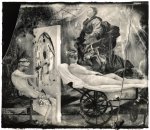


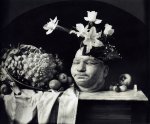

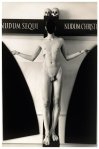

Joel-Peter Witkin – [↑] Poussin in Hell (1999); [←] Anna Akmatova (1998); [+] Nude with a Mask, LA (1988); [→] Still Life, Marseilles (1992) [↙] Glassman (1994); [↘] Naked Follow the Naked Christ, NYC (2006); [↓] Arm Fuck, NYC (1982)
I was in my final year as an undergraduate in an advanced philosophy course when I made a terrible mistake. I used the word ‘tautology’ in the context of something that was axiomatic instead of something that was redundant. Folks looked at me strangely and finally another classmate asked rhetorically whether or not I was aware that I had clearly no idea what a tautology was.
Joel-Peter Witkin is similar. For whatever reason: I’ve always associated him with Jerry Uelsmann’s seamless multiple negative fantasy landscapes.
But Witkin doesn’t really have anything in common with Uelsmann. He works with a single frame–frequently scratching the emulsion, obscuring his negatives with tissue paper when printing, defacing the film and smearing chemicals and lord knows what all else everywhere. He’s a bit like Bosch with a camera. He has a ridiculous familiarity with art history. (The proper way to introduce his work to me would’ve been to say: you know how much you love Mark Romanek’s work on // | /’s Closer video? Well, Romanek stole whole cloth, half of the visuals in that video from Witkin.)
Once I realized my mistake I dug into his work. There’s a lot of fine lines in his work–not just scratched into the negatives but conceptually. He’s a devout Catholic; also: a left-of-center Democrat. There’s a lot going on in the majority of his frames. Personally, I think that 65% of his stuff is overwrought to the point of sensory overload. When it works it’s unrivaled–a la Poussin in Hell. Mostly I prefer his less busy, more balanced compositions.
35% of his work is either too masterful or too audacious to ignore. (I’m not exactly on board with his politics and he’s not done a very good job of being sensitive to the marginalized communities he likes to depict.) And really there’s a lot of shit with his work that is not easily defensible. He’s borrowed Rhesus monkeys from animal testing labs to feature in questionable contexts within his work. (One of his most notorious photos straight up implies bestiality.)
Feeling stifled by the rules in the US against such thing, he spent time in Mexico during the early 90s photographing corpses. His exquisite Glassman was the pinnacle of that work. (I read this story before I ever say the photo, so I was never even a little put off by the work. I just think it’s brilliant.)
He’s certainly not the first artist to fixate upon cadavers. da Vinci gained a great deal of his anatomical acumen by dissecting human corpses. Then there’s Stan Brakhage’s The Act of Seeing with One’s Own Eyes–which has always struck me as antipathic through and through. As well as the work Sally Mann did on her Body Farm series.
There are oodles of problematics and objections that can be pointed at Witkin’s work. I think a lot of that has been overlooked because the work has been seen as too irrevocably unpleasant. (A lot of the criticism of his work during the late 80s and early 90s involved objections along the lines that Art is meant to instruct and edify, whereas Witkin’s work vacillates between fomenting revulsion and focusing on visions of disquiet, alienation and brutality.
Perhaps he was merely 25 years ahead of the curve because this stuff feels of a piece with a lot of edgy, emerging internet art. I’m really sort of hoping this post will take off–in spite of my heavy handed prose.
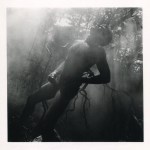

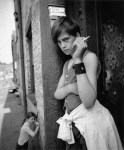
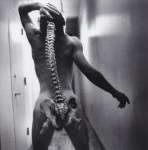
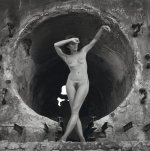

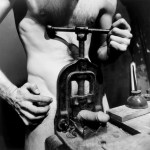


Arthur Tress – [↖] Young Man in Burning Forest (1995); [↑] Bride and Groom, New York (1971) [↗] Boy with Cigarette, Albany, NY (1970); [←] Spinal Tap, New York, NY (1996); [] Twinka At Arles, France (1985); [→] Teenager Drinking on Telephone Pole, Bronx, NY (1969); [↙] Sex with Vice (1977); [↓] Untitled (197X); [↘] Male Nude (1970)
In ritual, the world as lived and the world as imagined…
turns out to be the same world.
–C. Geertz
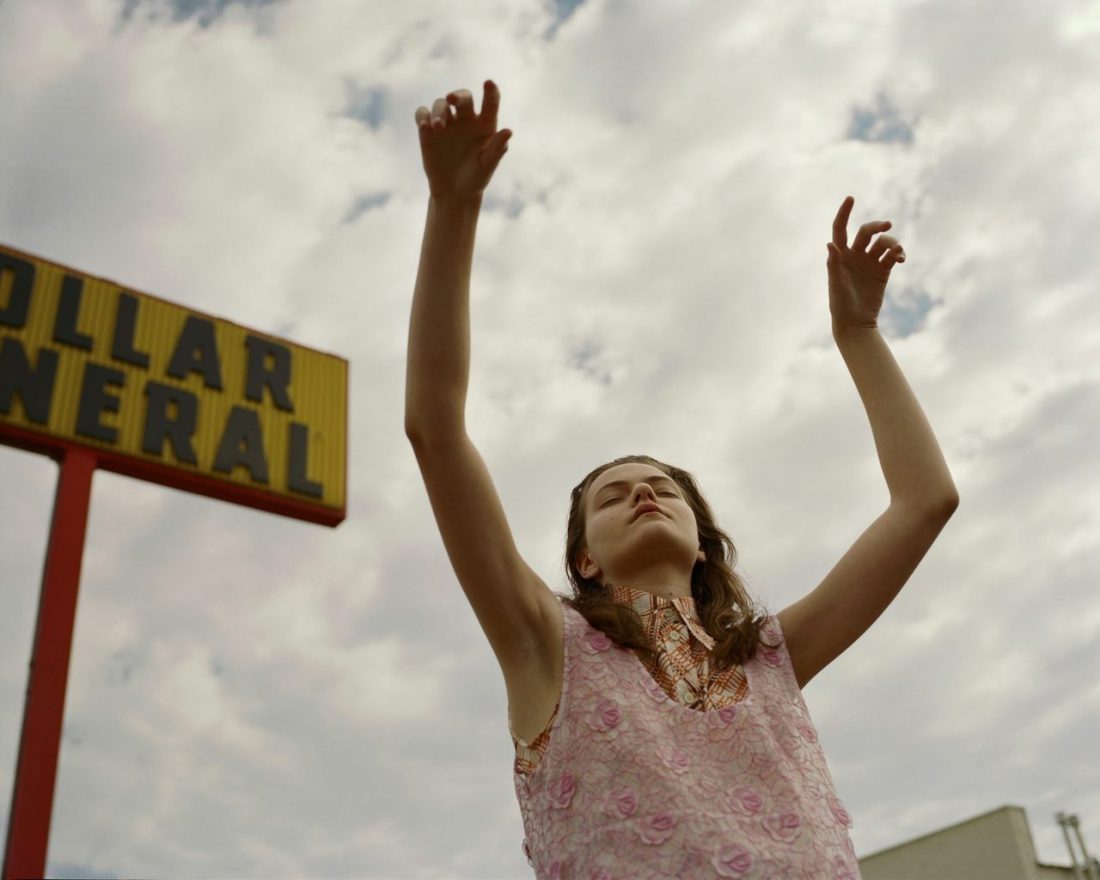
Stef Mitchell – Untitled from Them That Believe series for Revue Magazine (2018)
I am head over heals for this editorial.
I can’t find enough of a high res versionof the series to decipher the several contextual paragraphs included with the images. However, what it seems like is that this is a depiction of what it’s like to be a young woman growing up in a very conservative religious environment.
When I say very conservative religious environment, I mean a good bit more strident than the current glut of uber-political right wing evangelicals–something more along the lines of country congregations in churches that don’t have air conditioning, only fans. Where the gospel of salvation is de-emphasized to instead draw attention to sin, punishment, and eternal suffering in swamps of fire and brimstone.
Mitchell explicitly conflates the visual coding of Evangelical experience and threads it together with a more aggressive strain of Pentacostal faith–i.e. snake handling.
There are so many things this series accomplishes with near effortless aplomb. The snakes are all presented in such a fashion where it’s difficult to tell whether they are venomous or not. The expressions of the young woman are Stepford-esque–all youthful curiosity, confidence and a disturbing detachment.
The groups of young women appear to enjoy a hyper-performative group solidarity. There’s a very Virgin Suicides flavor to the proceedings.
But what I think is most effective about this is that it’s impossible to suss out whether or not Mitchell is glamorizing what she’s ostensibly depicting (a la the way Nan Goldin is so frequently castigated for glamorizing heroin addiction) or if she’s merely bestowing upon it the sheen of commercial photography as a means of bestowing upon it a since of legitimacy as far as invitation to mass consumption… or is it just an edgy editorial campaign. It’s not any one thing at once but it’s also never all three at once, either. (A more concrete way of putting it might be to point out how the image above is clearly stylized; the position of the camera is very unusual–emphasizing her hands over her head in the attitude of someone in an Evangelical service who is feeling the presence of The Holy Spirit. The camera is positioned how it is to cut out the distraction of the fact that the subject is very clearly standing in the parking lot of the sort of strip mall that are ubiquitous in the deep south of the U.S. Is this frame supposed to suggest a correlation between suburban mass consumption and extreme religious fervor, or is it about the color of the blouse, the sign and the sky taken together; or, is it a fetishization of a particular fashion aesthetic? It’s not only one and it’s not all three together.)
I keep coming back to this series. I thought it was fantastic from square one. But each time I come back to it seems to telegraph something astute about the current state of politics in my country.
It was wild to read this week about–something which is admittedly a distraction from more pressing concerns, i.e. gun violence, white supremacy, the flagrant corruption of Dump’s regime, the vicious actions of ICE and the Border Patrol as well as the breakneck dismantling of democratic convention–the hoopla over Roseanne’s inexcusably racist tweet and the predictable whataboutist response. (What about all the terrible things that the media has said about the president? What about Bill Maher? What about Keith Olbermann? What about The View?)
There’s the usual misconceptions about freedom of speech entailing equal access to public platforms. That argument runs something along the lines of Roseanne is being penalized for her speech by ABC cancelling her show. However, ABC is not bound by law to provide Roseanne a platform. The assumption is that she brings her freedom of speech to a platform that ABC provides her, she makes them something which they can in turn monetize. However, when she makes racist ass comments, they are free to decide that her freedom of speech brings consequences that are detrimental to their platform. (Freedom of speech does not and has never entailed freedom/protection from consequences.)
However, the right seems to believe that being called a racist is far more offensive than, you know: actual racism. Thus they are framing the argument as if it’s all just incivility and that the left is frequently espouses extreme bigotry towards them and is not held to account. (This plays fast and loose with the truth of the matter. For example: Maher has gotten a lot of flak–however, that overlooks the fact that there are many of us who have spoken out repeatedly against Maher’s Islamophobia and sexism.)
But in all of this–and what relates to Mitchell’s images–is that apparently Evangelicals think that calling Dump ‘a liar’ is untrue and unkind and therefore requires an apology. They don’t believe he is an actual white supremacist–you know despite his statements that their were good people on both sides in Charlottesville (FAKE NEWS!) and that he characterized Mexicans as ‘rapists’(FAKE NEWS) and referred to MS13 as animals in such a fashion that he eventually–and apparently grudgingly–admitted he had only meant gang members not all migrants/asylum seekers.
They also seem to feel that they are under attack. A particularly disturbing line of thought that I’m seeing writ large is that one of the panelists on The View referred to Mike Pence’s claim that he speaks directly with God as a sign of mental illness. Xtians see this as bigotry towards prayer.
I grew up in an Evangelical milieu that skewed decidedly Pentecostal. Things were a bit too urban to be snake handling territory but I’ve done enough research on the topic to see broad swaths of overlap between my experience and what it’s like in snake handling communities of faith.
And while we almost certainly shouldn’t refer to the claim of faith-based people’s that they talk to God personally as a form of mental illness–for no other reason than that standpoint being unfair to mentally ill folks. However, the this is already veering all to close to the sort of framework where to question whether prayer as a form of communication is legitimate also needs to tie into notions of prayer as a form of self-hypnosis. I think it’s maybe better to focus on the ways in which what Pence claims to believe are actually entirely anathema to the text he claims as the basis of his belief. (There have been an number of mainstream articles about Evangelical backlash w/r/t the broad support Dump has among white Evangelicals. One group in particular is fascinating to me–they refer to themselves as Red Letter Christians (based on the fact that frequently Bible’s include the actual words attributed to Jesus Christ in red ink).
Anyway, I’ve gone a bit off the rails but what I see in Mitchell’s work in the case of this project, is something that speaks to the increasing sense of anxiety and dread I feel as these people are entrenching themselves and strategically grasping for more and broader power.
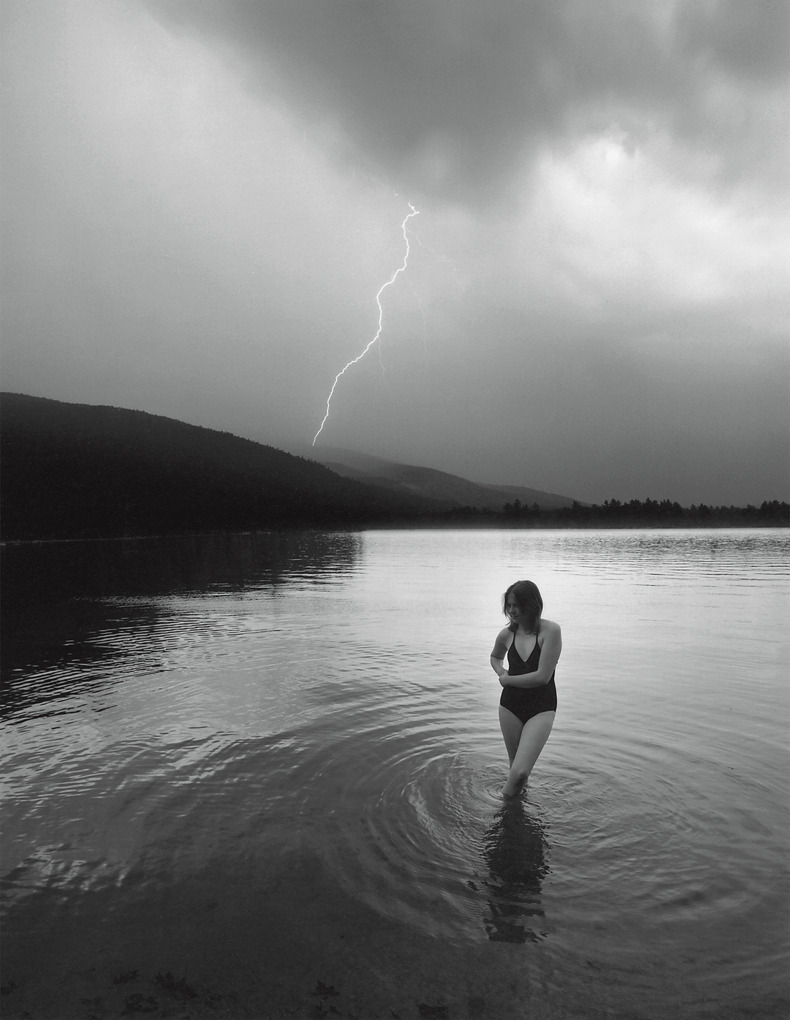
Douglas D. Prince – Adel and the Lightning from Multi-Negative Silver Prints series (1972)
I’ve featured a .gif made from Prince’s photos of Francesca Woodman in her studio on here several years ago. (At the time, I did not know that it was his work.)
The photo above is from a series produced by way of compositing multiple frames into a single, seamless print–not unlike the M.O. of Jerry Uelsmann.
However, where Uelsmann works in a vein to create an immersive sci-fi/fantasy surreal vision, Prince is much more interested in creating work that is surreal only in it’s clarity, in it’s this-could-be-something-that-happened-in-the-world-under-exactly-these-circumstances-except-those-circumstances-weren’t-ready-to-hand-so-the-liberty-was-taken-of-creating-the-envisioned-scenario-via-photomontage. (In that way, Prince is actually closer to Minkkinen than Uelsmann.)
Also, there are at least two other famous photographs that seem to refer back to Prince’s multiple negative series. The lightning in the above is more than a little reminiscent of this photo by Mark Steinmetz. Also, another of the photos in the multiple negative series seems like a harbinger for Jeff Wall‘s The Flooded Grave.

MetArt – Title unknown {remixed} (200X)
Here’s the original iteration of the above image:

The earliest search engine cached version of the image I found is from late 2007–specifically: a Flickr user named K. Pharran. (Looking through the 32 images in that account suggests the owner was posting other people’s work and presenting it as his own. The variance in style between the images is far too disparate to be from a single source.)
Several hits in the Google search came back with mentions of MetArt and the fact that there is such a hi-res version of the image still floating around out there in correlation with the earliest posting does a good bit of suggestion that they’re likely the source.
What I wanted to point out is that the fact that there is a hi res version of the image available means that there’s a lot more room available as far as color correction. (The original would’ve likely been considered artfully moody in the mid-aughts but in the late 10s, our expectations regarding what pictures made underwater look like, the remix is demonstrable clearer, more legible and captivating image.)

Ethan James Green – Connor Wall for Arena Homme+ (2016)
Green started as a fashion model but he eventually moved from in front of the camera to behind it.
I can think of several others who have followed a similar trajectory: Ellen von Unwerth and Lina Scheynius, specifically. What’s interesting about those two names is that I actually mostly dig both their stuff–because I adopt a particularly dim view when it comes to self-proclaimed fashion photographers. (Looking at trash like Helmut Newton; also, even though Annie Liebovitz calls herself a portraitist, her practice is thoroughly rooted in practicum and I have a strident dislike for both her and her work.)
But I feel like folks who start as models and then transition to roles as photographers and image makers, I feel like they are more inclined to bring clearly negotiated and carefully realized considerations about the nature and purpose of photographs and images to bear in their work. (It’s kind of analogous to a contention I’ve had for years–namely: if you put a dancer, i.e. someone who learns choreography and performs piece focused on notions of contemporary movement, into a room with a digital image maker and introduce a the topic of interrogating conceptual art; the dancer will crush the image maker at a rate which would render the occasional triumph of the image maker as statistically inconsequential.)
What former models bring is not so much a more organic sense of pose and presentation–although that is definitely the case with Green’s image of Connor Wall. Mostly there’s this emphasis on the physicality of the body. The one hand on the splurtting hose the other down his boxer briefs is a clever visual pun. But really that’s set dressing.
The hose explains the wet skin. The frame is composed in such a way that the light grey of the skin of Wall’s upper body stands out in a pronounced fashion–as does the water emanating from the hose. (A sort of emphasis speaking to the constant inconstancy of physical form.)
I don’t think this is perfect. Wall’s eyes are too deeply set and the way they just sit there like slitted event horizons and the way the top and left side of his head have no separation between the background stand at odds with everything else. Still, I am far more interested in this in 99.2% of fashion photography.

Source unknown – Title unknown (201X)
I have no ideas where this is from. But I am totally enamored with it.
There’s a nice conceptual bridge between the pulling the seat of a swimsuit from where it seems to ride up whenever you’re in and out of the water with the opening of the lily.
There is a symmetry between the gesture of spreading/stretching. An emphasis on texture–skin, lacquered nails, mesh, flower.
I am almost curious as to whether these clips are actually linked in the original source or if they were assembled from two disparate clips by someone with a really good eye for editing.
There’s an argument to be made they have to be from the same source. The nail polish and backgrounds–pink with the mesh, blue with the flower–that seem to suggest a similar approach to production design.
However, the light is different between the two–like not just a different color balance but a different approach. Also, the blue background in the scene clip with the lily, not the lines of vertical noise. You’re not getting anything like that in the pink background of the previous clip.
Alternately, whether or not they are from the same source: these work together because they embody a sort of Jimmy Marble meets Tommy Cash vibe that’s really a very NOW ™ aesthetic.

[←] Ben Rains – The Darker Parts (2014); [→] Riccardo Arriola – Title unknown (201X)
Juxtaposition as commentary


 Acetylene Eyes