10 Photographers You Should Ignore

To the extent that Bryan Formhals and Blake Andrews call bullshit on all the one-dimensional hangers-on who trot out influence as justification for shit work, I agree–vociferously, in fact.

What really grinds my gears is the unqualified ‘ignore’ in the title.

Do they mean stop ascribing undue merit to slipshod homage to great work the image maker does not understand? If so, ‘ignore’ is not even close to the appropriate word. ‘Emulate’ is closer.

Or, do they mean pay no attention whatsoever to the work of these artists? Overall, the commentary suggests–nominally–such isn’t the point.

Why use ‘ignore’ though? I understand & sympathize with–although I can’t join in–the anti-MFA fervor. But there seems a cynical underlying critique of the enduring relevance/importance of photographic masters due to a perceived diminution of the merit of the original in the face of wide spread, soulless counterfeits. I call bullshit on that notion. It’s identical to saying that because an ‘Xtian’ murders an abortion provider or a ‘Muslim’ detonates a suicide vest on a crowded bus that these religious outliers are endemic of the religion they claim.

As criticism its lazy, sloppy and condescendingly douche-baggy.

And I am reserving comment on the Stephen Shore entry; its Philistine insights act as a bellows on the embers of outsize violence smoldering within me.

10 Photographers You Should Ignore

Giangiacomo PepeUntitled (2013)

(PART I)

Back in 1999, Garrison Keillor suggested a broader conceptualization of what sex entails.

Sex is not a mechanical act that fails for lack of technique, and it is not a performance by the male for the audience of the female; it is a continuum of attraction that extends from the simplest conversation and the most innocent touching through the act of coitus.

A dear friend had posted it on her Facebook. It was literally the first thing I saw–all bleary-eyed–this morning.

It was one of those Oh shit moments where someone else somehow manages to express something you’ve been stumbling over for half a decade with a spare elegance.

For me, my experience of photography belongs to Keillor’s sexual spectrum. I mean, what but beauty causes anyone to lift a camera and sight a shot?

My reaction to beauty is unswervingly reliable: it overwhelms me, somersaults my tummy; makes me a blushing, shoe-tip-staring, dirt-kicking, boy-crazy teenage girl wanting from lips that won’t wet to shuddering knees.

***

Soon after the Keillor quote, Willow reblogged this from Sex Positive Activism

I was like what the fuck? A second Oh shit moment in the same day?

Okay, confession time: other than masturbation, I have been celibate for four-and-a-half-years. This is less a personal imperative than the fact that I am too irrevocably fucked for anyone to ever reciprocate the wanting I feel for them.

People always tell me that I need to have confidence. I think that’s bullshit. I don’t lack confidence. I lack a sense of entitlement.

When I was a film student, everyone worked with was invariably asked to do something either outrageous or obscene. No one took issue. Well, mostly. (In hindsight, I realize that I unintentionally created some very fucked up situations for people about whom I claimed to care a great deal.)

A number of things happened to shift this but one in particular stands out. For a group project, I had envisioned a scene with a bleeding, naked man smeared with mud running down a forest track. The actor who was supposed to play the part was a no-call/no-show and so I had to stand in. I was completely unnerved–I have always had a lot of body issues, they just haven’t always been the same–by the prospect of being naked in front of the small crew. I insisted on doing the scene wearing boxer shorts.

Watching the first and only (long story) screening, besides how my refusal to go nude ruined the scene, it hit me how fucked it was that I expected someone else to do the scene nude but I was unwilling to disrobe once I was in front of the camera.

***

As a result of these experiences, I abide by three etched-in-stone rules for photographing others:

  1. The photographer will under no circumstances touch the person(s) being photographed.
  2. The photographer will never ask anyone to enact anything the photographer would be unwilling to enact were the roles reversed.
  3. The photographer will never ask the person(s) being photographed to do anything the person(s) being photographed would not mutually desire the photographer to perform were the roles reversed.

***

The above image is not without flaws but between the mirror and the way she is reaching back to pull aside the crotch of her undergarment to reveal her vulva and anus, it is pornographic and capital fucking-A artful.

This is the type of work I want to make–conveying anger-verging-on-vaguely-self-destructive-arousal. I hardly expect Pepe to abide by my rules but the edge between consent and coercion is ambiguous enough on a good day that I worry about what goes on behind the scenes at his shoots.

I just don’t know how one ethically gets so many people to allow themselves to be vulnerable enough to pose in such a fashion. So many photographers seem to photograph their friends. That would be my preference. But the people in my life–who are fucking awesome and I wouldn’t trade for all the most-getting naked-est friends in the world–all have hang ups about nudity. It’s not that they aren’t sex-positive. (I just can’t do sex negativity. Not even a little.)

I worry that my own sexual frustration and realization that no one will ever ache for me the way I ache for them has tainted or will taing my work. It seems like if I could just find someone with whom I could share this sort of experimental openness in my work it would solve my problems.

The depressing truth is–there is no one who feels in kind toward me.
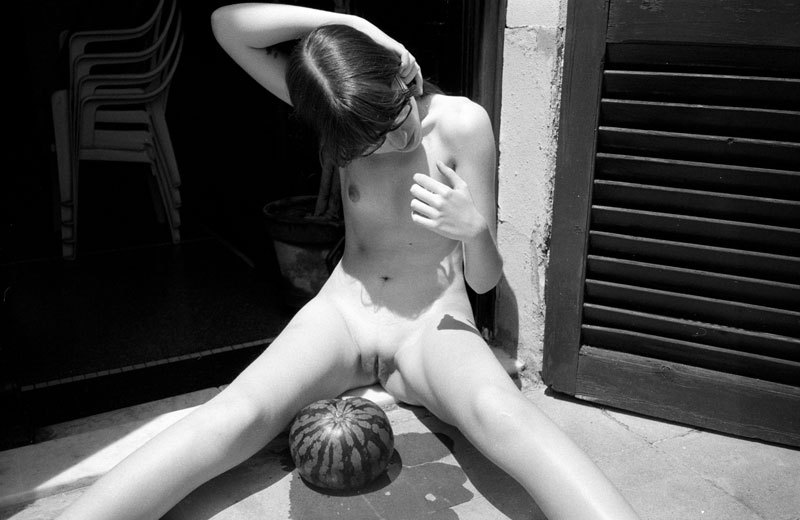
Giangiacomo PepeUntitled (2013)

PART I

Much of this rocks my socks: it’s shot on film, contains explicit nudity and the model is my ‘type’ to a T–thin with small breasts and geeky glasses; for good measure: throw in my permanent association of watermelons wjth Tsai Ming-liang’s brilliant (screw the critics) and perverse The Wayward Cloud.

There are at least two things about it that bother me, however. I don’t want to bring the body hair fetishism fire down, so let me start by saying: when it comes to body hair I believe–without equivocation– your body, your rules.

The trouble is due to the ubiquity of utterly depilated female bodies, undue cultural pressure against body hair exists and by existing it makes it more of a struggle to go your own way.

There’s the matter of her amputated legs, too. (Such is never justified–especially in the context of images featuring full-frontal nudity–but at least there is a compositional sense to it–her navel marks the center of the frame, the upper frame edge just misses her raised forearm and the concrete door jamb running along the second vertical third.)

I feel compelled to compare/contrast Pepe’s work Lina Scheynius, Igor Mukhin and Ren Hang. Yes, there’s extensive variations in styles, themes and tone: Scheynius is playful, Mukhin, insular and unflinching and Hang walks a fine line between confronting taboos and centering them on his audience.

In a similar vein, Pepe leads with his fetishizing of the female body.

The feels such fetishizing gives me are a complicated knot I’ve been wrestling to unravel for more than half a decade.

(PART II)

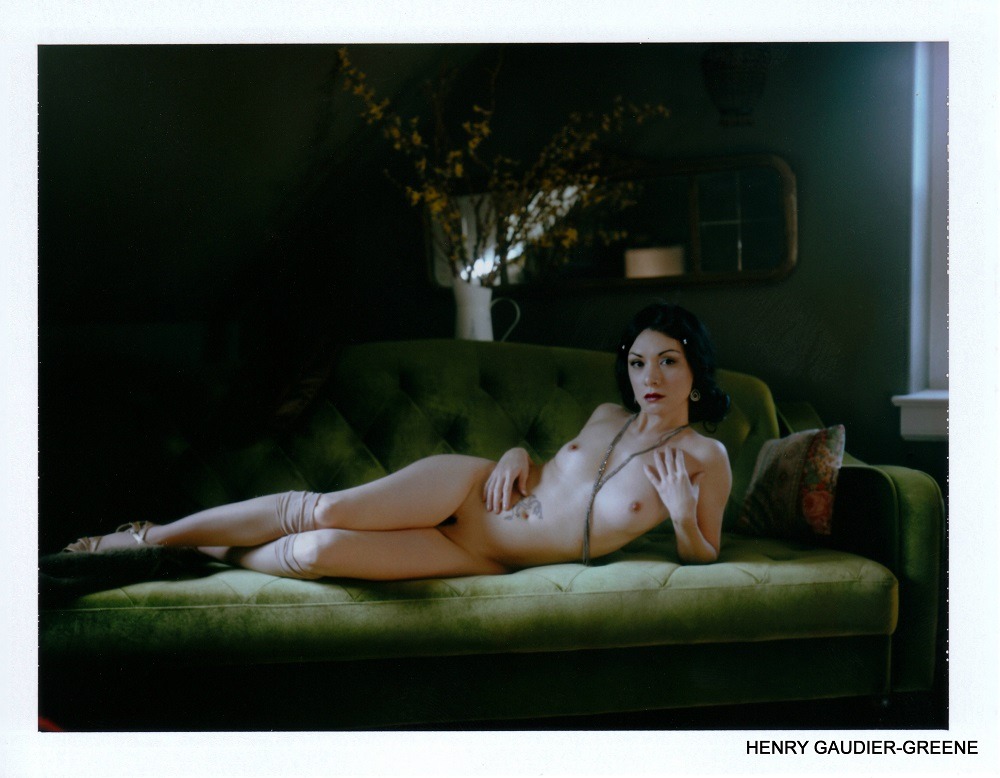
Henry Gaudier-GreeneTanya Dakin: Absinthe and Caviar for Breakfast. (2013)

One (1) of six (6) 4×5 Fujiroids created by Gaudier-Greene and Dakin appearing in Issue 7 of the always comely analogue only art-zine 62nd Floor..

Tanya Dakin is a Philadelphia based model/photographer/provacateur writing a book about her vagina; she shares explicit photos depicting her DD/lg relationship and has the most beautiful ink I’ve ever seen. 

Gaudier-Green is a photographer who shares my commitment to film and shoots with Pentax 67ii.

I dig their respective work with limited reservations–Dakin is a competent image maker but I am far more taken with her no safety net approach to life and the uncompromising openness with which she shares herself; Gaudier-Greene’s has preternatural aptitude for color work and any sort of instant film he touches becomes a medium for the transmission of god-like beauty; thus the lack of specificity in his B&W film work is never something I quite know how to reconcile.

They remind me of Luis Buñuel and Salvador Dalí: individually I respect the quality and care with which they craft their work; however, it always feels as if their personal work suffers from the echoing absence of the things that render their collaborative endeavors so effortlessly transcendent.

That’s not to say this image is free of problems and distractions–it isn’t. But between the attention to color and light, the wawker-jawed composition gets its volume turned down by the ‘realness’ of a fully-experienced unmediated moment in which two impressive talents merge into a single, uninterrupted and timeless genius.

Source Unknown

The customary context for depicting ejaculation–i.e. the pornographic money shotthoroughly pisses me off.

What upsets me is not so much behavior–any goings on between consenting parties are awesome my book–it’s the ubiquity of the presentation.

(Cindy Gallop’s TEDTak outlines the trouble with such ubiquity better than I can.)

Beyond that, the fact that the woman is expected to wait passively, looking up, making eye contact with her lover–getting semen in your eyes is worse than nosing tequila, FYI. If she really wants cum all over her face, why can’t she exercise some agency and lend a hand. 

Bringing me to the other thing–and I can only speak from my own experience here–but the best self-induced orgasm ever is only marginally better than the shabbiest orgasm contributed by a lover. Why drive cross country in a Maserati only to stop and walk the last furlong to the driveway of the destination?

Lastly, the act of ejaculation–when there’s some force behind it, is both really fucking visceral and with the projectile trajectory taking on endlessly fascinating, liquified globular forms, goddamn visually dynamic.

My own failed efforts not withstanding, I am obsessively convinced of the possibility of depicting ejaculation in ‘fine art’ context.

This .gif is equally a failure In terms of artfulness. But from the standpoint of pornography, it’s an interesting a departure.

Not to mention as far as cum shots go, the distance and arc are not only impressive but also quite lovely.

When sex becomes a production or performance that is when it loses its value. Be mutual. Be loud. Be clumsy. Make noises, be quiet, and make a mess. Bite, scratch, push, pull, hold, thrust. Remove pressure from the moment. Love the moment. Embrace it. Enjoy your body; enjoy your partners’ body. Produce sweat, be natural, entice your senses, give into pleasure. Bump heads, miss when you kiss, laugh when it happens. Speak words, speak with your body, speak to their soul. Touch their skin, kiss their goose bumps, and play with their hair. Scream, beg, whimper, sigh, let your toes curl, lose yourself. Chase your breath; keep the lights on, watch their eyes when they explode. Forget worrying about extra skin, sizes of parts and things that are meaningless. Save the expectations, take each second as it comes. Smear your make up, mess up your hair, rid your masculinity, and lose your ego. Detonate together, collapse together, and melt into each other.

(via agentlemenscoup)

My thoughts exactly.

The Frenzy of the VisibleSelf-Portrait (2013)

The first thing I notice about this is actually the last thing that registers: these are both close-ups.

I’m not averse to close-ups; they allow for focusing on details that might otherwise be missed and when thoughtfully applied can draw attention to the foreign-in-the-familiar.

However, most close-ups exemplify a knee-jerk, voyeuristic fixation: faces and erogenous zones.

It’s sensible enough tactic–glimpse up-close that which is instinctively watched; but there are at least two flaws:

  1. Contextual diminution imposes a representational metonymy wherein a part of the subject (the face) replaces the whole.
  2. Heaping familiarity on top of familiarity in tandem with physical proximity of the imaging device to the subject fosters a false sense of intimacy.

With something like say: portraiture, these are–at worst–critical peccadilloes. When it comes to imagery preoccupied with explicit content, it’s rather another.

This not only shows something beautiful, it shows its work with regard to why what is being shown is being shown in the way it is. (i.e. in close-up)

To see it: take either image independent of the other. Each is strong image in-and-of-itself; each offers an incontrovertible reading of the scene: a male-bodied individual laying on clean, white sheets, masturbating.

Taken together, the artful foreign-in-the-familiar framing in the separate panels merges to form a close-up than in an acharacteristic manner conceals more than it reveals. (Further emphasized by the matting and the orientation as a diptych.)

Truly a first-rate, fucking crackerjack image.

Sam Scott Schiavo – excerpts from La Solitudine (2013)

This post presents the images as a triptych whereas on Schiavo’s website it’s a five panel progression.

I am not sure how to process it. None of the images considered individually are especially strong.

However, re-constructed as a triptych, the separate images form a cohesive whole: water droplets and reflections in the glass separating the subject from the camera diminish as the eye moves downward; the elbow’s reiteration strangely enforces as continuity between the top and center frame, easing transition.

Whereas, the discontinuity between the absence of the hand and arm in the center frame eases what would other be an especially jarring re-framing.

I dig the the images as a triptych. The difficulty I have is the individual images aren’t strong enough to stand on their own. And to me that’s one of the prerequisites of the polyptych form. Granted I am not well-versed in the formal conventions beyond altarpieces, Van Eych and Bosch.

Familiarity with the form is certainly important but there is something disingenuous about cramming a work into a form as a remedy for one-dimensional conceptualization and lackluster execution.

And that is a shame because in the age of iPhone panoramas and automated photostitch programs there are a few image makers who are creating fascinating polyptych’s. The ones that jump immediately to mind are: David Hilliard, Accra Shepp & Tom Spianti.