Source Unknown

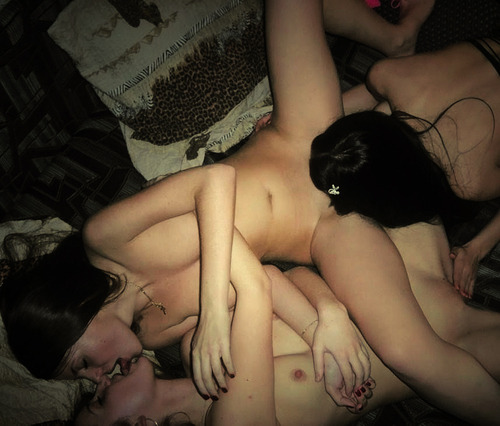
I would never claim this is a great (or even good) image: the off-kilter composition and offset flash suggest equal parts luck and artsy pretension.

And from a standpoint of image politics, it’s problematic for all the usual reasons: frame edges ‘cutting up’ and ‘immobilizing’ the three young women along with implicit kowtowing to the porn manicured male gaze that expects a smooth, depilated pubis.

I am not willing to give this a pass. However, I do appreciate the focus on a FFF threesome–something I wouldn’t mind seeing more often. Especially, if like this image, unfeigned desire (closed eyes, flushed faces and chests) and intimacy (holding hands, reaching caresses, giving and receiving of pleasure) feature in the proceedings.

It’s not without some profound reservations that I am posting this image. There are a host of things that are problematic about it: the indeterminate age of the young woman who could be older than she appears but given the doll and her bracelet probably isn’t. Add the random detritus strewn about the background along with the lurid reflected flash and there’s no denying the unsettling vibe– like some sick fuck uncle is directing his niece for a camera in Grandma Gardenia’s basement.

All that is an enormous put off for me–I know and care deeply about too many friends who have weathered such abuse. But I keep coming back to this image. Beyond everything fucked with it, something about it resonates with me.

A Google Image search returns a single hit for this: a 2009 blog post by a young Swedish woman who gravitates toward the macabre.

This does not exactly set my mind at ease regarding questions of exploitation but the text accompanying the image in the aforementioned post amplifies the resonance I feel towards this image:

Sen lekte vi med dockor.

För det var det som väntades av oss.

(Then we played with dolls.

For that was what was expected of us.)

There are two sides to expectation: what is expected of one and what one expects of oneself–I am expected to play with dolls but I don’t want to play with them or play with them in the way that is customary.

The starker the dichotomy, the greater the feeling of bodily frustration–a deep navel throbbing for physicality, no matter how self-destructive, anything to achieve even a moment’s peace.

A body with only anger to hold it– knows to trust the ruptures; wherever lies the greatest weakness, there also is the greatest need. In such moments the tang of plastic melting into the curled tip of a tongue is so empty and wrong that something has to rush in to fill the space–something no less hopeful because it is broken beyond repair.

sketchbook: 67 (no wait, 68) Tips For Art Critics

zaksmith:

1. Assume any young artist you _don’t_ write about will die of starvation tomorrow. (They won’t, but their art might.)

2. In the time it takes you to go to an art opening, you could have seen hundreds, maybe thousands of artworks online—-go to the opening, drink their beer, then go home and look for more artists.

3. Stop using events as reasons to write about artists—that just privileges the ones lucky or rich enough to be having events.

4. TUMBLR

5. DeviantArt

6. Stop asking for artist’s statements. If the statement makes you like the art more, it sucks and so do you.

7. Go to art fairs. MOVE FAST. Talk to no-one. When you find good art, demand to be alone with it for an hour.

8. Interview artists. Ask questions _about the art_ not about where they grew up or what they named their dog.

9. If Andy Warhol could have made it, do not write about it

10. Look at things that are just there for free: teatrays, pickles, pigeons. If the art is like that, don’t write about it.

11. Given a choice between “What the artist I like said is crazy” or “What the artist I like said is over my head” assume the latter & ask

12. Realize that if you can’t say a thing in clear English, you don’t understand it. Do not write in IAE.

13. Never say an artist “undermines” anything that you didn’t even believe when you walked into the show.

14. Never reward an artist for broadcasting stuff _you already knew_ to a bunch of other gallery-goers.

15. If you need context, it sucks.

16. If the artist hired someone to make their art for them, go find THAT kid and make THEM famous.

17. Interview art students & assistants to find out who is pretending to make their own art but doesn’t. Out them. Destroy them.

18. FACT CHECK FACT CHECKFACT CHECK FACT CHECKFACT CHECK FACT CHECKFACT CHECK FACT CHECKFACT CHECK FACT CHECK & then CHECK YOUR FACTS

19. Realize that the subject of a work of art is easy to write about & the style isn’t. Don’t waste time writing about the subject.

20. If reality TV, Netflix documentaries, Vice, Youtube or anybody else are already doing what the art does better, don’t write about it.

21. Never waste column inches saying something that’s obvious from the picture accompanying the column.

22. Realize the best & most honest way to talk about the art is to reproduce it. Demand your editor include lots of pictures, good ones.

23. Do not go and take a shitty snapshot. The gallery and artist have really good pictures, ask for them.

24. You see wonderful art: but, fuck, it has no story. Do NOT build a story. Close your eyes. You are Baudelaire. Rebuild the experience in words

25. If all the art does is show rich old people things in a gallery poor young people already knew outside the gallery, don’t write about it

26. Great artists can be born, ignored all their lives, and die. That can happen. Realize that does happen. Moby Dick was a failure.

27. If you’re writing about an artist, you’re doing PR for them if you want to or not. Your loyalty should be to the truth.

28. Ask installation artists where the money to put their show together came from.

29. Do not reward art just for being big. More generally: do not reward artists just for being rich or beloved by the rich.

30. Start a band or do some music journalism. It will free you of the obligation to try to meet people to sleep with at art openings.

31. Sometimes students make the best art. Sometimes 17 year olds who can’t afford art school make the best art. Galleries won’t tell you this

32. Realize all group shows are bullshit. Use them for what they are: mercenary opportunities to get the folks you like in front of people

33. Don’t pretend your opinion is fact. Instead: if you want authority, state your prejudices upfront. Like so. 

34. Read: David Thomson’s Biographical Dictionary of Film (that’s how you describe people)

35. Read Borges “Collected Nonfictions” & David Foster Wallace’s “Tense Present” & Orwell’s “Politics & the English Language”

36. Read Lolita. This is the best & most extended work of art criticism in the world. Humbert is the critic, Lolita is the art. Be careful.

37. When in the presence of beauty or talent, be humbled by the realization that it is unknowable & bigger than you OR the artist.

38. If all the kids like it and all the grown-ups don’t, the kids are right.

39. You can chip away, but you can’t know it all. Mathematicians admit there might always be another solution

40. Don’t look for messages or meaning. Everything has tremendous meaning. Look at art like food: it’s tasty—find out how it got that way.

41. Read Susan Sontag “Against Interpretation” & at least one essay by Sarah Horrocks on some comic book you never heard of

42. Read David Sedaris’ 12 Moments In the Life Of The Artist. Use it as a gut check: am I one of these assholes? Why not?

43. The artist’s goals and intentions don’t matter in evaluating the art any more than the baker’s in evaluating a cake

44. The wall text is there for people who hate art but feel class anxiety telling them they shouldn’t. Ignore it.

45. If it tastes good, it IS good as far as you will ever know. If it tastes bad, it IS bad as far as you will ever know.

46. Once you read 12 Moments in the life… read Thorsten Veblen’s Theory of the Leisure Class. You write about Veblen goods. Don’t forget.

47. If you are interested in the artist: go be interested, write a book. But it won’t tell you if the art’s good or bad. 

48. Abstract art had a very short heyday because critics had a hard time writing about it: no subjects to grab on to. Be better than them.

49. Go to the little church in Rome where they keep The Ecstasy of St Teresa. If it isn’t at least that good, don’t write about it.

50. If you don’t know, don’t _guess_. Ask. You are, after all, a journalist.

51. “Important” just means “influential” which just means “easy to copy”. None of those words mean “good”.

52. Never ascribe to simultaneous spontaneous mystical agreement what can be explained by capitalism.

53. Vasari started a tradition of art criticism where the Renaissance was a sort of TSA gate you had to go through to get to “real” art for 100 years, hard-working art historians have been tryna correct that mistake. Listen to them. If you don’t know who Bihzad is, learn.

54. Once a year read a major article in that month’s Artforum. Then ask everyone you meet in the art world if they read it. (they didn’t read it, but it’ll give you a sense of proportion to realize they didn’t)

55. Remember the art isn’t just competing with other art, it’s competing with everything else you could do that day. It must win anyway.

56. Remember the current critical consensus was formed by people who are so high they still like jazz. Drugs make boring things interesting.

57. Never trust an artist, critic, or curator who says they are “interested in problems…” that they aren’t actually trying to solve.

58. The gallery business survives by claiming they found a genius once a month. The excuse is “Well they might be..blah blah….test of time…blah blah….” (There is no test of time)

59. ..and even if there was: a world where it’s in nobody powerful’s interest for art to ever depreciate short circuits any test of time

60. When there is corruption or injustice artists & dealers cannot afford to name names. Not even Banksy names names. You can. Do it.

61. Right now some would-be great artist is exhausted from just spending 12 hours making an elf ear for some tv show. Realize that happens.

62. Arthur Danto said The Polish Rider was deeper and more searching than a random agglomeration of paint that happened to look exactly like The Polish Rider. And he _still had a job_ afterwards. So: the bar’s pretty low.

63. Don’t say “we” unless you’ve read a lot of neuroscience.

64. If it looks like a prop or film still from a movie the artist wishes they’d made but didn’t, don’t write about it.

65. This is Roy Lichtenstein.

This is Jack Kirby:

This is what class warfare looks like.

66. It’s 2013 so everyone gets to be told what artists have been told since the ’60s: your ability to get noticed is not just more important than your job, it IS your job. You enjoying that? Is it making your work better?

67. Anything can ignite debate with a high enough ratio of how loud you are to how boring it is.

…thank you. Now if you’ll excuse us, we’re going to get some noodles

image

See you next time.

p.s. should add one more:

68. If you disagree with any of this—or anything an artist or critic says—and don’t talk to them about it: you’re part of the problem.
sketchbook: 67 (no wait, 68) Tips For Art Critics

By Way of Explanation

My sincerest apologies for the drought from which this blog has suffered for the last month.

I have been here, there and everywhere in Europe; I brought my laptop along with the intention of getting in a few topical posts but:

  1. Between my paranoid insistence on security and a less than appropriate current converter, my computer proved less than cooperative whenever I tried to access it;
  2. The occasional downtime I had anticipated did not pan out;
  3. Hostels hardly afford the privacy necessary for composing contemplative sex blog posts.
  4. I have been feeling somewhat ambivalent about this project, lately. (It’s not you, it’s me.)

However, I am back and re-acclimating to my own time zone. I am a little swamped with day-to-day exigencies but it feels as if the notions floating around in my head are preparing to coalesce and spread out like a gathering storm on the horizon.

Ana MendietaBlood Sign #2 1974

Mendieta genius is indisputable but I have no goddamn clue what-so-fucking-ever of how to approach it.

A lot of ink has been spilled about her performance of gender, her concern with identity politics. Yeah. Check. Got it. I see that too. But what about the questions of medium in her work: photographs of sculptures, performance as sculpture, photography of performance as sculpture, the inherently ephemeral nature of performance rendered repeatable via video.

It’s all a complete mindfuck to me–but not alienating more a fascinating puzzle I can’t tear myself away from no matter how little progress I make.

Mendieta only cracked for me in the last week as a result of ‘discovering’ her ‘Untitled (Rape Scene).

***Trigger Warning***

I recommend read the Tate’s comments on the work first as they describe the images and you can decide from there whether or not you actually want to view them.

I am not ready to talk about the images. That will take months, if not years. But something clicked for me about Mendieta’s work: the zen-like focus of her execution counter-balanced by randomization– the way the paint on her hands smears unevenly, the muddy lighting at the scene of the crime–utilizes her own body as a fulcrum to not only balance multifarious and otherwise dichotomous elements but to enact great violence upon innocence that offers the required blood sacrifice without perpetuating any further harm.

The Misnomer/Fallacy of Artist Intentionality in Criticism

1.     If a friend says oh, look at how green the grass is today, I have no doubt what she meant—I look about and see its punchy emerald hue. (If she were to say the grass was red, it would be quite another matter.)

I am often misunderstood. Despite this I rarely catch myself wondering mid-conversation how it is my words have meaning.

It is in quiet moments when I question how words mean.

At first I want to say: a word has meaning because it names something. This works for tables and chairs and the names of colors but not so well for shapes and numbers.

What if the meaning of a word functions not unlike pointing to indicate that instead of this?  Okay, but point to an object’s shape as opposed to its color or number. How did you manage it?

Pointing seems to be a solid addition to this model. Let’s say that I was just wrong about pointing to something in the external world. Instead, words refer to some inner mental sense of meaning.

If I accept this then it would be as if my friend who wants me to notice the color of the grass has some big book in her head. Inside are lines and lines filled with every word she knows, beside each word is a mental sample or picture of the words meaning. Thus the words look, green, grass and the rest are essentially placeholders pointing back to the meaning housed in this index in her mind.

Ah, but then how do I know that her sample of green is the same as mine since I can’t very well lay my book alongside hers to check?

If this is true—and of all the models this seems the most functional—I can only know with certainty what green means in my own case.

2.     It doesn’t matter if I can compare my friend’s sample of green to mine. It could be fire engine red for all it matters as long as we both identify grass as being green in color.

Words have meaning because they refer to what is in the world around us, by how they are used and the context in which they are used.

3.     That is but process, one side of the coin. The obverse is occupied by the question: how are words understood?

I want to explain understanding in terms of a mental process. I hear a word and then a picture of it flashes before my mind’s eye. Is the flash or the picture the understanding?

Right off, I want to make understanding a mental process. I hear a word and it triggers some internal experience: whether it is a picture flashing before my mind’s eye, a feeling of a light bulb going off over my head or some effortless associative connection.

Are these experiences what understanding entails?

Well, if I see the quadratic equation all written out on a sheet of college-ruled notebook paper every time I solve a formula requiring the quadratic equation, the picture is not the understanding. Only, solving the problem is indicative that I understand. What every inner process can happen or not happen without consequence. For as long as I can comprehend the given information at the same time as knowing what to do what that information, I can be said to understand.

4.     Although these are processes are a function of the other; it is a colossal mistake to conflate them..

5.     All this has a bearing on a matter that aggravates the piss out of me: critics who go on and on about the intentions of the artist.

First off, there is the very practical consideration of what the fuck does ‘artistic intention’ even fucking mean. There are at least six different schools of thought—the majority deems matters of authorial intention to be irrelevant or unknowable.  

What I understand ‘artistic intent’ to indicate is what an artist intended their work to mean. And this framing comes perilously close to the demonstrably erroneous view that a word has meaning by pointing to some mental conceptual index.

Like a word, a work of art means and is understood because it is tied not to anything inner but to a common place use in the world through which we move.

6.     As best as I can tell the term ‘artistic intention’ indicate something closer to what might be termed ‘artistic pretense’. The artist has an idea or no idea whatsoever. They weigh medium, experiment with form and take into account any number of conceptual considerations.

The work comes out fully formed in one go; or, it takes them three thousand attempts. The artist edits, obsesses or doesn’t. Yet at a certain point the work reaches a point where it is ready to stand on its own two feet, to return to the wild.

In my own work, I find that if the work is especially well-executed, it eclipses my original vision for it. To speak of ‘artistic intention’ here is baffling to me.

(This reminds me of a scene in Anna Karenina where Anna and Vronsky visit a famous Russian painter-in-exile during the travels in Italy. It is my favorite scene in one of my two all-time favorite novels. Anna comments at length on a painting. The artist doesn’t completely agree with her but on one point, he is absolutely blown away by how much better her notion is than anything he had ever considered. After the couple departs, he makes several minor changes to the painting to more clearly suggest Anna’s interpretation.)

7.     At the point when work enters the world with whatever facts are known, additional multi-valences and contexts, the audience is left to interpret it. Interpreting is not unlike understanding a word; it is no one thing. It can spark a memory, suggest some technical insight, and engender a purely aesthetic reaction.

Such responses do not necessarily get at the meaning of the work as much as revel the psyche of the audience.  (Remember your AP English: never assume the narrator is interchangeable with the author.)

8.     What if my friend does comment on the redness of the grass?

My first instinct is not to question whether she intended to say green. No, it is to question whether I understood her correctly. In other words, I am operating on the side of the meaning understanding coin that is appropriate considering who uttered the word and who heard the word uttered. For example, I might ask: did you really just say the grass was red?

If she maintains the grass is, in fact, red, I might wonder if she were color blind? Perhaps, she is pulling some elaborate prank reminiscent of Margritte. Or, suspect her of having taken some hallucinogen without offering any to me.

At this point, I am rather quite a ways into the scenario and I am still working at understanding what she meant, not questioning her intentions—and what would the point of that be as she has made it clear that she does emphatically intend red.

I might ask her to identify the color of a fire alarm box. Her answer her would implicate whatever was at issue as well as suggesting the subsequent actions to be taken.

9.     ‘Artistic intention’ is a misnomer at best and at worst a fallacy. In effect, and inference with regard to intention arises from interpretation of/response to the work and not the work itself.

Similar to the way I can only know what my friend means by her words, I can only know what the artist means through their work. Trying to access the intention of the work is not an available option given that as a member of the audience my role is to understand.

Garry WinograndNew York 1969

I would never dispute Al Pacino’s skill as an actor; I just don’t really ever respond to his performances– perhaps that’s the virtue. (Bear with me; I promise this comes back around to the image.)

Pacino is one of those actor’s actors–a notion I find intolerably snobbish, as if someone were saying you need to know something about what it takes to be an actor in order to understand.

Something not unlike being a photographer’s photographer–minus the snobbery–is true of Winogrand.

Saying I was initially nonplussed by his work would be putting it nicely. It seemed too random, chaotic and unpolished. I remember thinking anyone could have shot these.

For nothing else than my perpetual tossing around of that famous Picasso quote in defense of the modernists, this sentiment should have set off alarms.

Alas, I remained off put by Winogrand until a dear friend showed me this image recently.

I’d never delved deeply enough to have encountered it. The precise composition– the couple kissing, the smoldering cigarette pinched between fingers, the Tortilla Factory sign, the what-are-you-looking-at-motherfucker glare and the go-ahead-and-watch-you-motherfucker glance–made my head explode a little. The image appears almost accidental, unmediated.

You know that moment when you glance at something and look away without really seeing it? And suddenly, the scene registers and you have to do a double take to make sure you saw what you thought you did. This photo is a photographic approximation of that first seeing but unseeing glance. It inspires an instinct to look back at the image again to see if what you think you saw is what you really saw. 

That is really what makes this image so extraordinary. The skill of the photographer is on display only to the extent that the camera is no longer an extension of the eye but the eye itself. It’s all so vital, so gleefully transgressive.

Clearly, my initial estimation of Winogrand was wrong. I don’t necessarily like all his work. But I can appreciate it and I do get what all the fuss is about now.

I don’t like being wrong. But the wonderful thing about admitting your mistakes is that little else motivates learning and growth quite as effectively.

Pulling Back The Porn Blanket

krissyeliot:

Why society should learn what porn is not.

I agree that it is fucking tiresome when cocksocks add weight to their lazy assumptions by deploying loaded terms in knee-jerk fashion.

Insofar as those idiots have made ‘porn’ a ubiquitous designation for what ought to be termed ‘explicit’ or ‘adult’, I am on board with Eliot’s critique.

However, piling the erotica vs porn dichotomy on top of the porn/not-porn question adds complexity when less was sought. (Not to mention bestowing an enormously fucking problematic privilege on authorial intent in relationship to post non-authorial interpretations–i.e. I, the author, intended it as erotica not porn and therefore it is erotica. Larry Flynt would have been happier than a pig in shit with such a distinction to claim.)

Eliot wishes to distinguish between pornography and erotica. Where pornography is defined by obscene content and little, if any, artistic merit and “erotica is art or literature that focuses on the emotional connection as well as the sexual experience.”

And just so you know: porn and erotica are never-the-twain-shall-meet, 120% incompatible.

I am going to try hard but fail miserably at overlooking the fact that Eliot uses E. L. James 50 Shades of Gray as an example of the focus on emotional connection in erotica. By dint, she is suggesting 50 Shades of Gray is ‘art or literature’; a suggestion to which anyone who gives a single good goddamn about literature will take umbrage– James is a qualitatively fucking atrocious ‘writer’. (EDIT: Ms. Eliot. She never labels 50 Shades of Gray is erotica, merely points out that it “focuses on complex emotions.” My post hoc fallacy bad and apologies all around.)

I realize this suggested framework is very loosely inspired by Audre Lorde. And I must confess an inexcusable lack of familiarity with her writing considering what I know of her life deeply impresses me. Still, I think there’s a point that someone along the line missed.

For good, bad or ill, attributing the designation of porn to content for nothing more than sexually explicit content is one way the word is used in ordinary language.

Labeling something with the term ‘porn’ doesn’t happen in a vacuum, however. There is context to consider. The three examples Eliot mentions in the first paragraph all share a similar feature: the Puritanical conceit wherein graphic depictions of sex are fundamentally obscene.

Yes, it’s facile sanctimony and moral outrage as an avoidance strategy for avoiding the ’rough ground’ of grappling with what obscenity entails.Yes, things shouldn’t be done that way. Words have meaning and should be used correctly. But to suggest different categories for various depictions of sex based upon criteria misses what original made new categories fucking necessary.

This whole porn vs. erotica dichotomy is a straw man.

Now, if you really want to make porn mean something more instead of less specific–as the blanket metaphor suggests–let’s have a conversation about obscenity not governed by reactionary responses. While we’re at it, let’s discuss if and to what extent producing work for profit can ever be creatively meritorious.

Pulling Back The Porn Blanket