

[←] Ben Rains – The Darker Parts (2014); [→] Riccardo Arriola – Title unknown (201X)
Juxtaposition as commentary
[←] Ben Rains – The Darker Parts (2014); [→] Riccardo Arriola – Title unknown (201X)
Juxtaposition as commentary

wonderlust photoworks in collaboration with @kyotocat – Analog Bath (2018)
Bathrooms are not a great setting for photographs. First, they tend to be small/cramped. Second, they generally have crummy lighting.
This was a lesson I learned the hard way back when I was a film student. Every single project I attempted involved a scene in a bathroom. Without a bathroom with a window–which for those who don’t live in Brooklyn is a truly mythical creature.
But–for once–I have a bathroom with a window. It’s small but it’s south facing and my tub is actually photogenic.
During my last session with Kyotocat, I wanted to try to do something with it, esp. given that I only have this apartment for three more months.
By the time we got to it, the light was all but gone. My instinct was to just ditch the idea and cut things short. I figured that since I had no idea when I’d have someone else to work with, I might as well try.
I metered things and it was super sketchy. The rule of thumb is you can operate an SLR handheld down to roughly 1/30s shutter speed. Anything lower and you’re going to have camera shake. Interestingly, this has to do less with drinking too much caffeine and being jittery. An SLR has a mirror which flips up and out of the way before the shutter opens. The up and down motion of the shutter actually causes more of the shake than your movements.
I’ve all but sworn off SLRs–excepting the Pentax 67ii, I have trouble with fine focusing. By contrast, although rangefingers can be more challenging to find gross focus, fine focusing with them is a breeze for me. But I digress….
With a 35mm range finder I can get down to 1/8 of a second before I start seeing noticeable camera shake. When I first measured the light it was 1/4s (100 ASA, aperture wide open–f4).
It was 1/2s by the time I was ready to expose the first frame. In other words, there’s no way doing this handheld is going to work out.
Again, I thought about scrapping it. Instead I locked my xpan down to my tripod, put the camera strap around my neck, straddled the tub, braced two of the legs against the wall behind me and then treated the camera as if it was my tango partner.
To give you even more context: I’m wearing a long dress and Kyotocat is scootched with her legs halfway up the wall behind me. (She probably looked not unlike the model in this magnificent image by Joanna Szproch.)
I tried to line everything up symmetrically–which sounds much easier than it actually is when you find yourself in such a position.
When I got the slides back I was thrilled with the color. However, the slight angle of the composition bothered me. It wasn’t what I had envisioned compositionally–so I didn’t want to accept it.
I kept circling back to it for some reason. I still can’t decide whether the tilt harms or contributes; I have decided that the symmetrical intention is clear enough as it is and that the angle perhaps doesn’t harm or contribute and instead complicates.
Stepping back from questions of composition: the mood I was chasing is absolutely conveyed in spades. So I’m sending this photo out into the wild as a reminder to others just as much as myself that that adage about crisis being another word for opportunity is correct. This isn’t what I had in mind but I’m pretty sure it’s better than what I originally intended. I’m just not sure how to articulately defend that thesis because it’s more a nascent feeling than any sort of intellectual certainty.
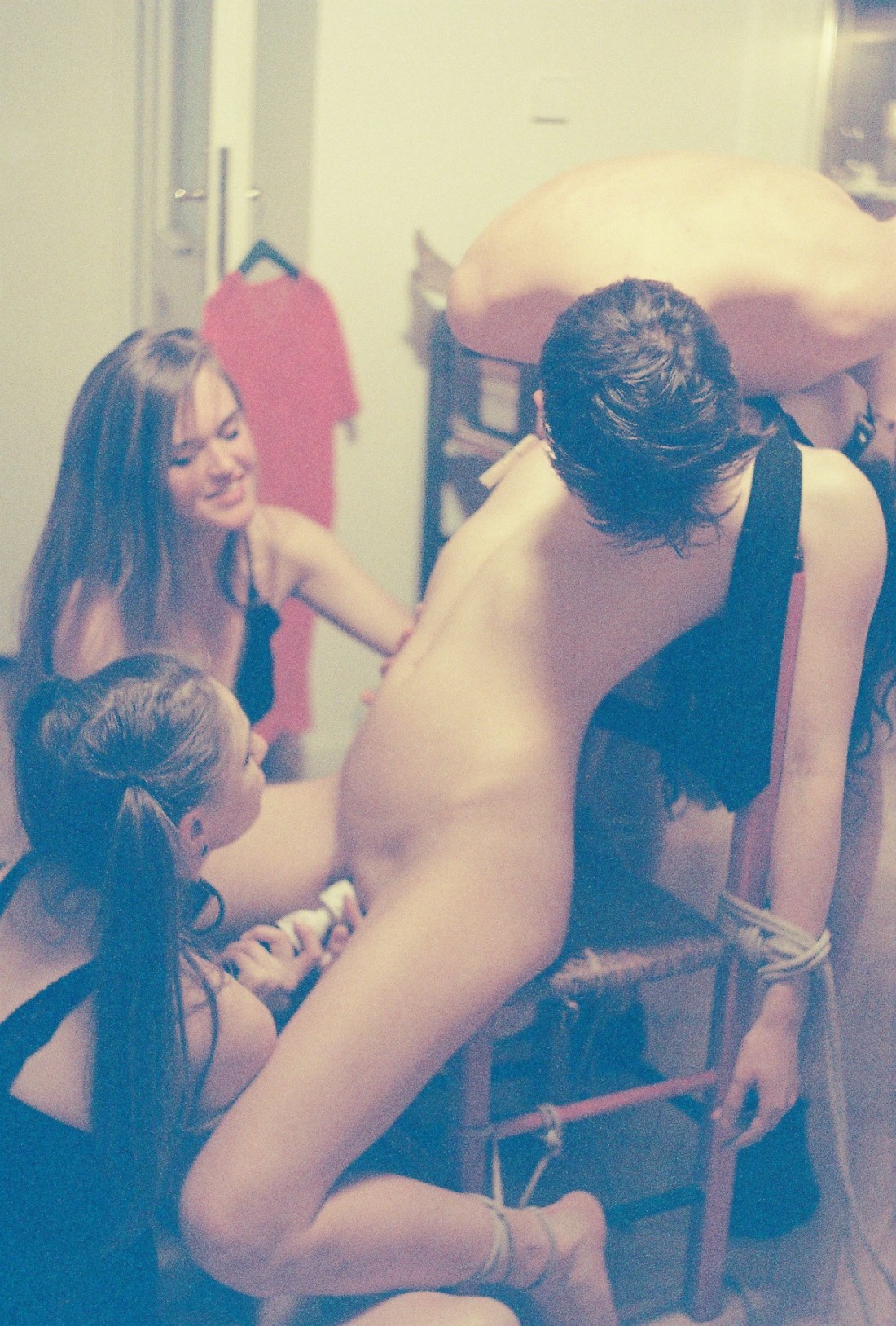
The Tiger and the Pilgrim – Friends. (2016)
This photo was made using Kodak’s 800 ISO Portra emulsion.
The higher the speed of a film, the better it is at producing photographs in low-light settings; however, the higher the speed the more visible the grain.
It’s also a film that is optimized for tungsten light sources, i.e. the color temperature of light emitted by most incandescent light bulbs.
It’s also low contrast—as a result of which this image suffers. It also doesn’t help that it was made using at the minimum a ceiling mounted overhead lighting fixture. (In other words: some of the most aesthetically unappealing light imaginable.)
But I’m here for what this depicts more than how it’s depicted.
…
I’ve been aware of the Folsom Street Fair since well before I started this blog. However, my conception of it has been off.
Basically, I had understood it as Pride only for leather and BDSM folks. It seems it’s quite a bit more than a celebratory parade. I’m not entirely clear on the rules governing it but it does seem to be closer to an open air sex party.
…
A while back adult content creator and performer Chelsea Poe (of whom and of whose work I am a tremendous fan) posted several images of her being dominated by Eden Alexander publicly at the Folsom Street Fair.
As kids these days are fond of saying: #AllTheFeels
…
The images of Ms. Poe tied to a tree reminded me of the above photo. In both cases a woman is physically restrained in a public space and she has consented to having her boundaries tested.
I’ll admit that it’s a tenuous connection. But it’s something I keep coming back to and I think I’ve finally figured out how to articulate something about it but it’s going to involve rather a good bit of TMI.
…
Give or take: I began masturbating when I was eight.
It wasn’t like I was horny. In fact—it was only vaguely tied up with anything sexual. It was more curiosity.
With hindsight, I realize that this curiosity was informed as a result of being molested when I was six. I didn’t understand the contradiction of the extreme interest on the part of my abuser with the parts of my body that I was otherwise told over and over and again and again were sinfully unclean.
Quite by accident, I discovered that by touching myself in very particular ways (read: humping my pillow), I could trigger this warm and fuzzy tingling sensation. I’d hump, feel myself start to climax, pause, ride the wave of the sensation and as it ebbed I’d go right back to humping my pillow, chasing the next endorphin rush. Sessions usual involved 4 to 7 orgasms.
I knew instinctively that because what I was doing involved the parts between my thighs, that it was something about which I shouldn’t ever tell anyone.
I think I figured out what I was doing was termed masturbation when I was eleven. My instinct not to tell anyone about it made a lot more sense…
…
Two things happened more or less simultaneously. Puberty struck and the way I masturbated shifted. Whereas previously, I would have spent an hour or so more or less continually stimulating myself with intermittent pauses; I started to experience more forceful orgasms. Like before I would feel the sense of release building, I would feel myself pass the rubicon and then my body would lock up. I would orgasm and then my intimate parts would be painfully sensitive.
I still needed the same endorphin rush but it took me sometimes as long as a half an hour before I could begin again.
The second thing that happened was that my peers and I were informed that masturbation was a mortal sin. It was presented in the following fashion. Girls were generally not interested in it and those who were didn’t because they weren’t gross floozies. Boys who were good Xtians didn’t and boys who weren’t strong Xtians might but they should repent and sin no more.
We were told that if we were freaks who experienced urges that we should pray that God removes the impure thoughts and desires from our hearts.
For the better part of a year, every time I felt the need to get myself off. I would pray. But unlike masturbation—which always felt like a prayer and an answer to that prayer; my actual prayers to God, never went any higher than the ceiling.
…
I feel it’s also important to note that although I conceptualized masturbation as sexual behavior, it was all but devoid of causal connection. It was something I did for the dopamine hit to my system.
It didn’t shift to being sexual until I was in my late teens.
…
There was this episode the reboot of The Outer Limits in the mid-90s staring Alyssa Milano. I remember being so aroused that it physically hurt.
The next day while I was in the shower—the only place I had any privacy—I masturbated but as I passed the point of no return, I kept seeing flashbacks to the show from the previous night and instead of stopping I climaxed once and without any pause came again after roughly three minutes.
It was a game changer.
…
I have no idea what prerequisites have to be satisfied for me to have multiple orgasms while masturbating. I’ve managed it roughly a dozen times—each time seemingly isolated from the rest.
I have substantially better luck with partners.
I think part of it is comparable to solving a chess problem vs figuring out how to get out of check without fucking yourself when you are playing against an actual opponent. In the first case, you control both the moves and countermoves in advance; in the second, you only have a vantage to the moves you make. Someone can make a move that surprises or confounds you.
A better analogy may be found contained within the observation that it is impossible to tickle yourself.
…
What I’ve discovered with a partner is that my experience of sexual pleasure is analogous to a river—the water level rises and falls depending upon other factors.
If the water overflows, there’s a levee to safely channel the excess. However, any overflow into the levee gets processed by my body as a pain sensation.
Even when it’s happening to me, I wouldn’t label it pain. It’s merely an amplification of sensitivity to a point that although I crave the sensation, my body actively revolts and recoils from continued stimulation.
…
The act of refusing to cater to this instinctive recoil from continued stimulation in the face of heightened sensitivity is called post-orgasm torture.
There are an increasing number of videos out there for it. As a lesbian, I’m very put off by anything I’ve ever seen involving femme folk subjected to post-orgasm torture. (Another reason I am into the above photo—it seems post-orgasm torture-y but in a way that is an intense as it is consensual.)
I end up watching a fair amount of content featuring post-orgasm torture involving masc. folks. (For example: this one—although vertically oriented video is never acceptable—is pretty run of the mill; this one is over-long, poorly edited and the technique is a little galling in it’s heteronormativity—also, I think the boy, contrary to the on-screen count, only orgasms twice, I think the rest are just leaks despite his concerted efforts at avoiding ejaculation. His response when he does actually finish and the way he responds to continued stimulation is one of the best documents of a body’s response to post-orgasm torture that I have ever seen.)
…
What does all this have to do with the initial photo? Well, given the way her back is arched and the way the vibrator is pressed vacuum seal tight against her genitalia—it’s probably understandable how I’d make the leap to this as a depiction of post orgasm torture.
The fact that she also appears to be the singular focus of a group of people is also appealing. (As someone who is over-stimulated any time there are more than four people in a room at a time, the social over-stimulation combined with physical over-stimulation is also something I would like to explore.)
The Chelsea Poe images make me curious as to whether a scenario like the image above might be possible at the Folsom Street Fair. The thought of being publicly subjected to post-orgasm torture while very publicly restrained is a prospect that I’m into. As long as I was blindfolded and trusted my dom to not let obviously creepy people touch me, I would be into a modicum of crowd participation.
And I think that’s the ultimately realization that engaging with this photo over the span of several years has made me realize that it’s not that I’m not into BDSM/kink, it’s that my relationship with it is very specific. I don’t want to be humiliated. Being humiliated is a massive turn off for me. I also don’t get the pain as pleasure exchange; mine has more to do with pushing the limits of pleasure so they pass through pain and back into pleasure again.

wonderlust photoworks – γνῶθι σεαυτόν in collaboration with @kyotocat (2018)
With the exception of a few days scatter here and there through the worst wilds of winter, it’s been viciously cold here in NYC. Today was a bit better–even if there is still a lingering chill in the air that is not at all normal for here.
In an effort to sum up the state of things one of the high end liquor stores on my walk home had a sign out front reading: this weather is more confusing than my teenage daughter.
It’s not that it’s a bad joke (it’s awful); it’s not that cliché (the union of forty-something straight white cis dads from the 1970s called and wants their joke back) and it’s not that it punches down instead of up–it’s victim blaming.
If young women are ‘confusing’ maybe it’s less due to the fact that they’re hormonal while trying to negotiate cryptic boundaries/navigate societal expectations with regard to gendered embodiment and perhaps due in large part to the complete contradictions our society imposes on them with regard to their appearance, behaivor and even physical being.
The expectation to be attractive without being so attractive that you invite unwanted attention. Because no matter what you do–there’ll be someone who isn’t happy about it.
I’ve talked with too many femme friends who all offer variations on the theme of men started looking at me different, treating me differently and behaving differently toward me long before I ever even started puberty. Everything from then on was less about me and my own autonomy and instead was about making a space to exist and feel if not safe then at least not always threatened.
Anyway, I’ve been thinking a lot about bodies–positivity towards them and acceptance of them. The idea started out as a result of something I read years ago about a young woman who curious about why she was dirty or disgusting because of her genitals decided to get a good look at them in a hand mirror. Instead of finding something unappealing, she was fascinated by the lips, ridges and folds. She realized through nothing more than the act of looking closely that everything she had been told was wrong and that her body was beautiful, miraculous even.
This is just as much for young women–who through the glut of false expectations foisted by porn–think their own labia aren’t normal/attractive. It’s also for those who experience dysphoria related to their genitalia–because it’s not always about learning to love/accept what you’ve got.
The title is in ancient Greek–which is insufferably pretentious–but it’s known widely enough that it doesn’t strike me as hermetic. It means know thyself and was allegedly the inscription over the enterance to the oracle at Delphi. (A place well known for giving cryptic but astonishingly prescient advice–the disconnect between the wisdom/efficacy of the advice and the resulting actions endeavored based upon the advice given frequently catastrophically hinging on folks really not having a clue about their essential nature.)
And huge thanks to Kyotocat for working with me through a bazillion different variations on this concept before nudging me in the direction of something that didn’t immediately come crashing down under it’s own weight of self-serious import.
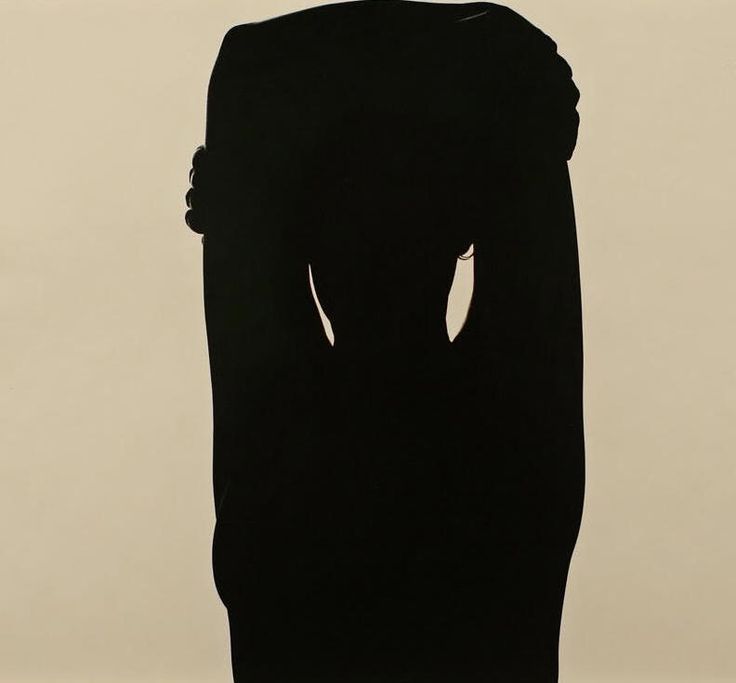
Harry Callahan – Eleanor (1948)
There are only a handful of photographers in the history of the medium with as roundly as exquisite a body of work over their lifetime. Callahan is absolutely one such photographer.
(In fact: if I was asked to name one photographer who one might through an especially thorough study of their work, glean the most extensive picture of photography as an art form, I’d probably insist that Callahan was the only consideration.)
My favorites are the photos he made with Eleanor and subsequently Eleanor and his daughter. But even with his minimalist landscapes and plants in the landscape–he is always magnificently attuned to nuance of light, tone and dimensionality.
I love everything about this photo. (I’ve somehow never seen it before encountering it here.) But what’s particularly revelatory about it is that silhouettes usual appear completely flat–as if someone cut out a shape in heavy cardboard and placed them between the camera and the light. (If you’re thinking of the scene in Home Alone with the cardboard Micheal Jordan cut-out… good call.)
The reason for that you’re dealing with something that is brightly backlit–thus, the object is blocking the light. The point at which the object blocking the light is the widest only has one dimension and there’s light that is blocked and light that is not blocked on either side of that object.
When I teach three point lighting to undergrads, we talk about the key light, the fill light and the back (or rim) light. The reason it has become customary to use this setup is because it a standardized approach to the stylized representation of natural lighting.
If you’re standing in the middle of a field on a sunny day–unless you’re facing into the sun (which doesn’t make for the most aesthetically appealing imagery–the sun is going to be bright on one side of you than the other. This is because the sun hits one side of you and by hitting that one side of you, it’s blocked from hitting the other side of you. (Unless you’re a ghost and then my apologies.)
The ground around you actually reflects light to a certain degree. So while one side of your face is brighter than the other, the ground helps fill it in so it’s still slightly darker but naturally and flatteringly so. (The key light is usually to left and the fill light to the right of the scene–you can do it however but as the convention is borrowed from Dutch Baroque painting, where the light almost categorically falls left to right.)
It’s the light behind you that actually gives you dimensionality. (A key light and a fill light will make the objects illuminated appear flat in exactly the same way a silhouette makes the subject presented in silhouette appear two dimensional.)
Notice how just the faintest of fills on the fingers of Eleanor’s right hand on her left arm–I’m reasonably certain that she’s is standing with her back to the camera–have dimensionality; and therefore create this strange since that she is and is not actually flat.
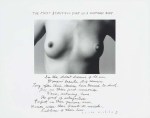
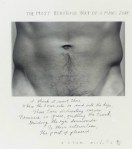
Duane Michals – [↑] The Most Beautiful Part of a Woman’s Body (1986); [↓] The Most Beautiful Part of a Man’s Body (1986)
[↑] In the oldest dreams of old men / Womens’ breasts still remain. / Long
after their desires have turned to dust. / They are their first
memories. / Warm, nurturing, home. / The point of satisfaction. /
Perfect in their gracious arcs. / Women wear their breasts as medals, /
Emblems of their love.
[↓] I think it must there / Where the torso sits on and into the hips /
Those twin delineating curves / Feminine in grace, girdling the trunk /
Guiding the eye downwards / To their intersection, / the point of
pleasure.
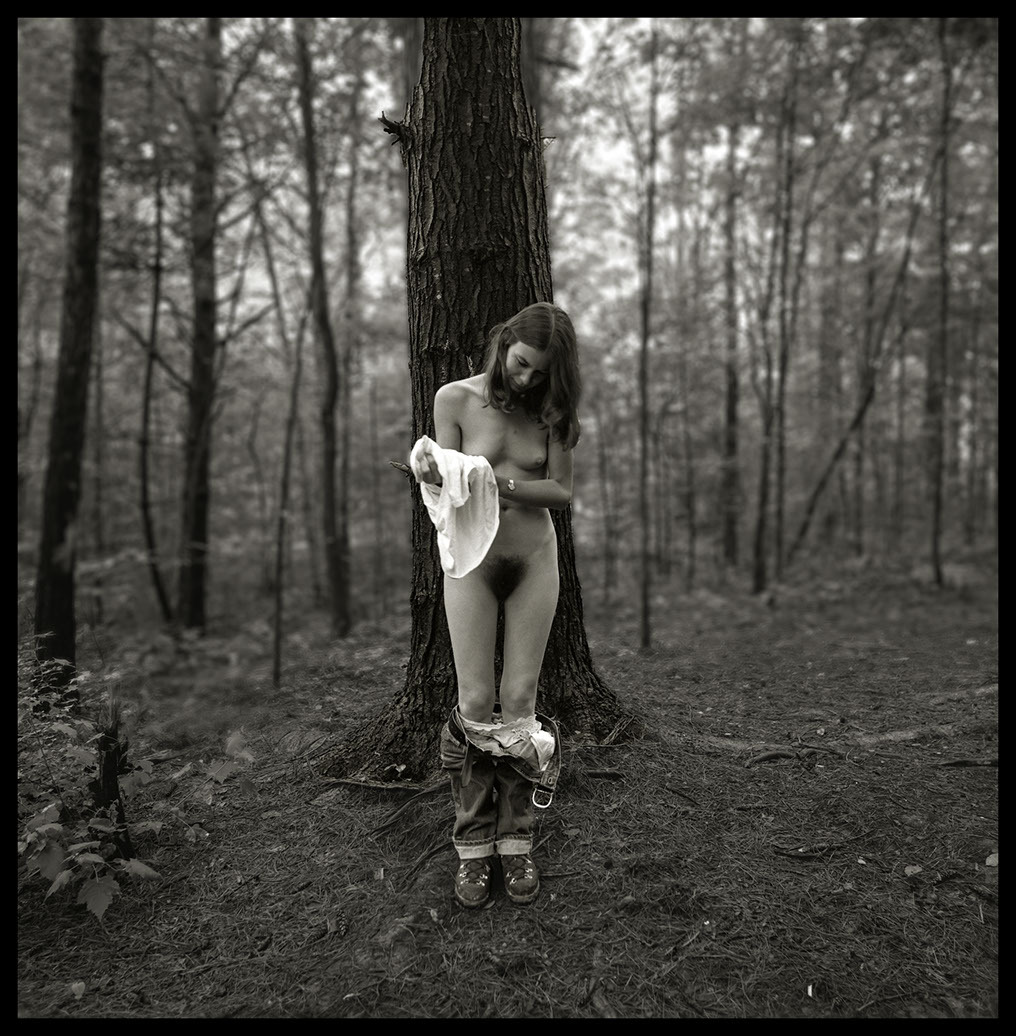
R. Michael Walker – Melissa Undressing, Red River Gorge, KY (1979)
Malcolm Gladwell’s assertion that it takes 10,000 hours of deliberate practice to become world class in any discipline has–by now–been thoroughly debunked. Simply from that standpoint of stifling elitism, I consider the kibosh that’s been put on this a tender mercy. Except…
I don’t think the notion that it takes time to hone your craft is actually–in any way–bad advice. If a young photographer/image maker came to me and asked what advice I have for them as far as achieving their dream, my response would probably be inline with what I was told when I first started making photos: lock yourself in your room and read until your eyes burn and don’t touch a camera for five years.
Or, that’s how I would’ve put it until recently. I think there’s a balance between doing and fueling the doing. And the 10,000 hours probably have less to do with conditioning and more to do with forcing you into a give and take relationship with your craft where you realize that sometimes you do it when you don’t feel like it and sometimes doing it when you don’t feel like it is detrimental to the doing. It’s only through trial and error that you figure it out.
Also, fueling your doing is less fulfilling but it’s easier to learn things that may take you much longer to address in your own work.
For example: the above image has crystallized for me a number of things I’ve been grappling with in my own work.
Long story, Cliff’s Notes ™ version–it’s only in the last 18 months that I’ve begun to see photos as dimensional. And by that I mean more than just the separation between foreground, mid-ground and background. It’s more than a little like Lotte Reinger’s multiplane camera–except expanding so the entire space in the frame is represented by distinct planes.
The experience of seeing space as constructed of layers has actually slowly shifted the way I think about composition. It’s still at a point where I’m not so great at articulate it but there’s a very clear feeling of it.
My notion of seeing space as layers of planes relates to depth of field. And generally depth of field has very proscribed uses. The majority of photographers/images makers think of bokeh as a means of emphasizing the subject while still conveying a sense of the subject in space without all the decontextualization that comes from staging things in a studio space. (In fact, it’s arguable that the quality of bokeh is usual measured across cameras and lenses by giving consideration to the bokeh offered by the fastest lenses available in an 85mm–or equivalent–focal length.)
(As a brief digression: if you’ve read anything written by folks who have worked as cinematographers for several decades, you’ll hear them talk about how different lenses are best suited for shots of a particular scale. I’m increasingly realizing that there is actually a good bit of truth to those claims.)
But the point is there’s a tendency to either go for the shallowest depth of field possible–the reason why fast 85mm lenses are considered the bokeh gold standard because they tend to support the shallowest DoF; or, for deep focus a la Group F/64 or Gregg Toland’s work on Citizen Kane.
In my own work, I favor a shallower depth of field but as I’m frequently working in medium or specialty formats, I’m limited by lenses that by and large are only considered fast in large format.
Really, your DoF should be used as a tool to help the viewer know how to read the frame you’re presenting them. The photo above for example: was most likely faster film shot in low-ish light with a mid-range aperture. Note how all the foreground is in focus and the focus starts to go soft at the rear of the tree directly behind Melissa. Note how this forms a compositional wedge from the lower corners through Melissa to the tree. The subject is pulled forward whereas the forest is pushed backwards. (Yes, digital devotees, you can capture your images in raw with everything in focus and then selectively unsharpen in post but it’s never going to look as organic as the above.)
Point is: I don’t think I’ve ever seen DoF used to quite this effect and I like it rather a lot.

Janice Guy – Untitled (1979)
Murray Guy is one of the most preeminent galleries for photography, film and video.
Janice Guy is the co-founder and co-owner through March 2017.
She founded the gallery in the 1990s after moving to NYC from Düsseldorf, Germany.
In Düsseldorf, she studied photography at Kunstakademie Düsseldorf, working closely with Bernd and Hilla Becher.
Being a woman and a photographer preoccupied with self-portraiture, she’s frequently lumped together with folks like Ana Mendieta, Cindy Sherman and Francesca Woodman–the operative framing being fixated on artists as both simultaneously author and subject.
To think of it that way strikes me as a bit lazy. It fits–with certain limits–for Sherman and Woodman–less so for Mendieta; however, most of Guy’s photos feel less like self-portraiture and more like proto-selfies.
If one were to describe Guy’s work she documents herself as a photographer considering herself in a mirror–i.e. she’s not setting up the camera like Sherman or Woodman and then positioning herself in front of it; she’s interested in including considerations of process in her product (if you subtract capitalist connotations and instead consider the term in a more mathematical sense).
She’s nude in most of her work–except for a utilitarian wristwatch.
Her work wasn’t really exhibited until the late aughts–but there continues to be interest in it to this day and I suspect that interest may even grow down the line.
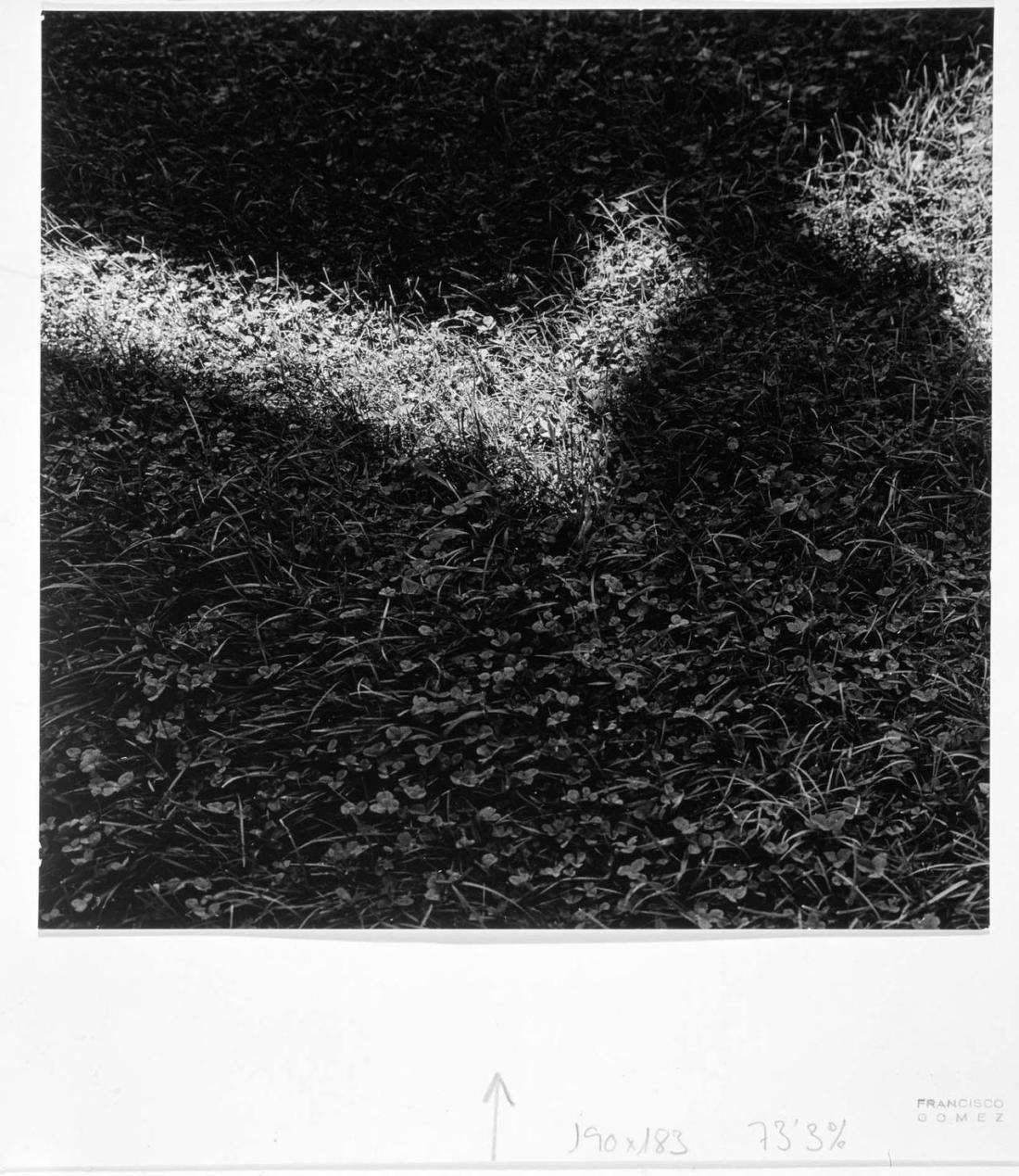
Francisco Gomez Martinez – Sombra y Luz (1956)
Fragment 83
Sappho (translated by Anne Carson)
love, lay me down under grass &
sunlight, and touch me [right here]
and here and here, where the ache
& hurt have gone to nest.
[(now again)] my fingers will find
yours, tangle & sweeten the air,
and the birds will cry [for]
us alone.

 Acetylene Eyes