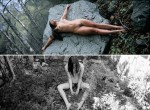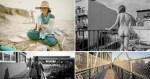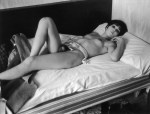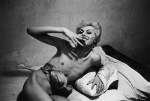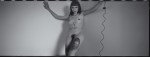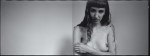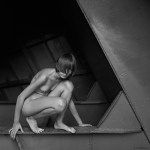
Brandy Eve Allen – [←] 1331-036 (2016); [→] 1151-11 (2013)

Initially, the plan was to use this post to heap praise upon Allen’s thoroughly distinct and downright exceptional analog photography.

Then I read her artist statement/bio… new plan: let’s talk about how artists speak about their work.

There’s this notion–as far as I know originating with Renoir–that art ceases to be art as soon as it begins to require explanation.

Practically speaking Balthus’ 1968 retrospective at the Tate was probably the last time anyone has gotten away with the let the work speak for itself tact. Curators, gallerists and the gatekeepers of high culture all demand artist statement tributes and offerings of a modicum of veiled explanation. (I am not suggesting that instinct is entirely pointless… just that it almost always undercuts the mystery and nobility of the work. (Not to mention situates the audience in a position not only of passive acceptance but inferior receptivity where one must be educated regarding the merit of what one is has or is about to experience.)

It is very rare that an artist’s statement not only clarifies but also illuminates. Allen’s is an example.

…Sometimes
I just want to photograph things, see the pictures and burn the
negatives.  It’s overwhelming at times, all these memories trapped in
36x24mm acetate frames.

..I’m
not doing this for myself, I don’t have much say in what’s going on.  
When I look back at what’s come through and what’s been made, I don’t
know how I did most of it.  It was another person than I am now.  And
now I’m making things that one day I’ll look back on and say, I’m
another person now, once again.

…Everyone’s
a photographer.  It’s not so precious anymore.  The “print” is lost… on
a search to find it.  Old cardboard with moisture stains and a
distressed image with a small frame around it, nothing fancy, something
cherished.  I’ve got ideas, about to act on them.

…Fever.  Avoiding suicide.

…There’s
actually a group of aliens making my work, I have no idea how it’s
done, they just give it to me and I present it, that’s what you see
here.

…I’m
waking up with the sun everyday, I can feel it peering over the horizon
like a cat meowing to be fed.  Laying in bed, thinking about who is the
real Banksy, some article online got my brain spinning too early,
again.  I have a ton of friends who are all half my age, I know there’s
something to analyze there.  Watching people my age turn into their
parents, they said that would happen.  I feel no sense of beginning,
middle and end, I’m living in a timeless existence where one day I will
cease to exist, taking that last breath and never saying anything more
into this world.  I’m lost there, in that last breath, extending it for
as long as I can.

…Someone asked me this week what are my photos about?  Okay, no one asked me, I was asking myself.  And I stood there, silent.

….These
last couple series I’ve been working on, Gestures, Sunken Dream and
Earth Water are shot with 35mm film using multiple exposure techniques.
I shot fireworks, underwater sea life at the aquarium, plants and the
sea and then reshot the same rolls with a figure posing in my studio.
There’s never any digital modification on my photos.  I could probably
create something similar with less orchestration involved but It’s just
too easy to use photoshop, I need to be challenged.  I don’t like taking
the easy way out, I’ll get burned if necessary.  I like process.  I
like figuring it out.  I like going to the museum and looking up real
close to the canvas and figuring out how the artist made something, and
then I want to know if they were feeling what this piece makes me feel.
I start to wonder about strangers…

… The three stages of Emotional Exile: Shock, Surrender, Catharsis.

… I’m not a fan, I’m an admirer.

… 4:20

….I used to hate photographs where the feet or hands were cut off, but now it doesn’t bother me.

…I
trust myself more than anyone else, especially when it comes to
developing my own film.  My kitchen and dining area are my lab.  I
photograph my friends, or will pose myself.  Some of my friends are
people I’m really close to, some are people I’m not as close to but I
feel a strong connection with.  All these people who are at different
places in their lives, figuring it all out.

…There’s a sense of surrender, but not in a losing sense, one who surrenders to themselves and gives up on apologies.

….When
nothing seems like everything and everything seems like nothing.
no-mans-land feels like an invisible trap door.  No one, not a one.  In
the ear of the great sea, I call it closer.  Hear the blahs slipping
into aahs. Timing is a mother fucker.

….I’m
just really into passion fruit.  I love the contradicting taste, the
sweet and the sour, the fact that it’s not easy to eat, that I have to
shove my face inside it to lick out all the seeds.

….That
moment when I go out on the road with just me, my cameras and a bag of
various clothing pieces.  Into the wild, following the weather until it
brings me somewhere and then I set up the tripod, figure out what to
wear, if anything, and prepare the camera for a shot.  Meter the light,
focus, filter.  I have 10 seconds to run into place and then place
myself there as if I belonged.  On to the next.  I promise myself that
every moment I even think about photographing, I have to stop and
capture it.  I’m not taking anything for granted.  

….There
are a million ways I could describe myself and today I’m going to put
it like this… I’m a contradiction but I mean everything I say.  The
noise of the city gets to me and I’m counting the days until I get to
where sweaters.  I’m dreaming of traveling to far off places with just
me, my camera and a sense of adventure, meeting random amazing souls
along the way.

I won’t be able to enumerate all the ways this statement compliments her work. However, there is a central theme: fragmentation.

She speaks of her work as if aliens possessed her and while in control her body made the work. She also uses multiple exposures. There’s mention of how the past is discontinuous with the present, etc.

The form of the statement replicates this approach–the disjointed thought fragments in the writing mirror the visual form of her work.

David Bowie famously practiced decoupage–he’d tear up his lyrics and then re-order them looking for new patterns to emerge. Allen is doing something very similar with both her photography and her statement. In effect: making sense of her statement doesn’t so much explain the work as it offers a map of how to approach the work–that is: getting a sense of the words on the page is a process that is more or less interchangeable when applied to the work.

It all reminds me of a conversation I had while back with a friend who was telling me about a course she took where a writing professor taught a course on literary form but in a way which reduced form to graphical representation.

It strikes me that Allen’s work is very much about illustrating how to use photography to read between the lines. (And with the notion of reading between the lines there’s traces of Renoir’s notion of art being opposed to explanation–i.e. telling someone to read between the lines means that you either won’t do it for them or that you can’t because it’s so obvious that if they can’t see it, then the explanation won’t help them.)

Between the lines is actually an idea which can be graphically illustrated, actually:

image

Yet, it is possible to deploy the same elements of the above graphical representation in a host of manner which preserve the conceptual integrity of the original while providing more open ended interpretations:

image

Or:

image

The ratio of shadow to highlight are the same in all three examples, yet they each have a different psycho-aesthetic effect.

It’s a huge leap to realize that photography is hard wired with the ability to illustrate what is between the lines. But that fact that Allen not only realizes it but is exploring the possibilities so assiduously is goddamn breathtaking.
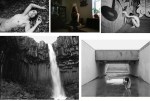
wonderlust photoworks – [top to bottom; left to right] Mx Incohate (2014); Homesick for the Distances (2015); 29:18 collaboration with Anonymous (2010); Map in the Maze collaboration with @camdamage (2015); A Dark Chant collaboration with @marissalynnla (2016); Baba Yaga collaboration with @suspendedinlight (2017); Hasp collaboration with @kyotocat (2016); Svartifoss (2015); Echo (2019); Woodland Cathedral collaboration with @marissalynnla (2016); Wombs + Tombs collaboration with @kyotocat (2016); Hold Me Now or Hold Me Never (2017); A Piece of the Sky collaboration with @suspendedinlight (2016); Coney Island, October (2016); Two Red Plastic Bags (2015); Samson’s Riddle collaboration with Kelsey Dylan (2016); Moxie (2016); Hold Me Like the Landscape Holds the Light (2017); Heart-Shaped Sunglasses + Helianthuses collaboration with Jacs Fishburne (2016); Emma collaboration with @kyotocat (2016)

Since I’ve been yammering on about it, it seemed only fair to share with the rest of the class. Above is the work I am submitting to MFA programs. (Apologies for some of the early formatting awkwardness…I had to trick Tumblr into letting me upload everything to a single post.)

The accompanying statement reads as follows:

I grew up in a Christian doomsday cult—an experience which forged a lifelong
preoccupation with the conceptual interpenetration of sin/transgression + salvation/
transcendence.

Storytelling figured prominently in this milieu—scads of Trojan horse fables secreting ideological payloads—but, also: beautiful, expansive conversations which were
less dialogue + more interactive sharing of stories not unlike a carefully curated anthology places various parts in implicit dialogue across the whole.

This effusive sharing sparked a strong sensitivity for wonderment which drew me
to music (something that saved me, continues to save me) + lead in turn to Johannes
Vermeer
’s paintings, Andrei Tarkovsky’s oneiric long takes, William Eggleston’s impeccable dye transfers + Francesca Woodman gothic self-portraiture.

(Other artists to whose work I perennially return? Chris Burden, Duane Michals,
Rackstraw Downes, Ana Medieta, Peter Hujar, Kelli Connell, Aino Kannisto + Allison
Barnes
.)

The enormity of experiencing beauty has always seemed a profound responsibility—as if in seeing there is a duty to labor in whatever way one is able to give something
back for what one have so undeservingly received.

My own art making process begins with the identification of a “visual problem” +
fits the form of a question*—e.g. How might a single, static frame imply a narrative
arc?
(This question maneuvered me from cinematography to fine art photography.)


Any rendering of a person in an environment suggests narrative potential insofar
as the viewer asks who the figure is (characterization) + how she came to be in this particular scene (causation) + what she is doing there (context).

This introduces a second, more complicated conceptual problem. Given that photographing people is a minefield of political + ethical quandaries, how does one depict
identity, gender + sexuality while actively thwarting the art historical, dominant (hetero-partiarchal) gaze?

The only means I have found to ameliorate this is to conceptualize my photography as collaborative . I seek out + work with artists—sharing my questions with
them, asking each to bring their ideas + personal sensibilities to the proceedings.

When I am behind the camera, I refuse to allow myself to fixate on conceptual
considerations. Instead, I trust the preparation + planning that has led to the point of
making something. I proceed instinctively, acting less as author + more as a steward/midwife; the camera serves as a means of extending my capacity to feel outward—both
from the standpoint of sensory stimulus but also with regard to emotional resonance.
When what I see through the viewfinder feels like a response to the visual problem(s), I
snap the shutter.

My strategy for editing retraces the above steps from conceptualization to execution except in reverse order + with one notable exception: my collaborators receive “first
edit”, i.e. if they are uncomfortable with any aspect of their depiction they can opt to exclude any image(s) from further consideration—allowing for the exercise of personal
agency in expressing identity within the context of visual representation. 


From what remains, I review the work with special attention to frames which
exhibit ‘good’ composition in tandem with unity between form + visual grammar. Work
which surprises me hints at subsequent avenues of exploration (whether by expanding
my understanding of one or more problems or suggesting more effective ways of addressing those problem). Time has taught me the photos which evoke a feeling similar to
what I felt when the shutter clicked are the ones that matter.

I am at a point in my life where it feels as if I am on the cusp of making a leap
forward in my work—the work is asking me to commit to it. The [REDACTED] program would allow me to dedicate myself to my work for two years—allowing me to take risks + experiment, e.g. I am fascinated by the ways my process
overlaps with conceptual + performance based modalities of art making; also: how might it possible to convey visually something of the feeling of gender dysphoria?

The [REDACTED] MFA would not only foster a richer understanding of art history,
it would also provide a in-depth interdisciplinary insight into the working practice of
cohorts + faculty in an edgy, forward thinking creative community

*Trial + error have shown me that a good question anticipates less an answer and instead suggests a better/more focused question.

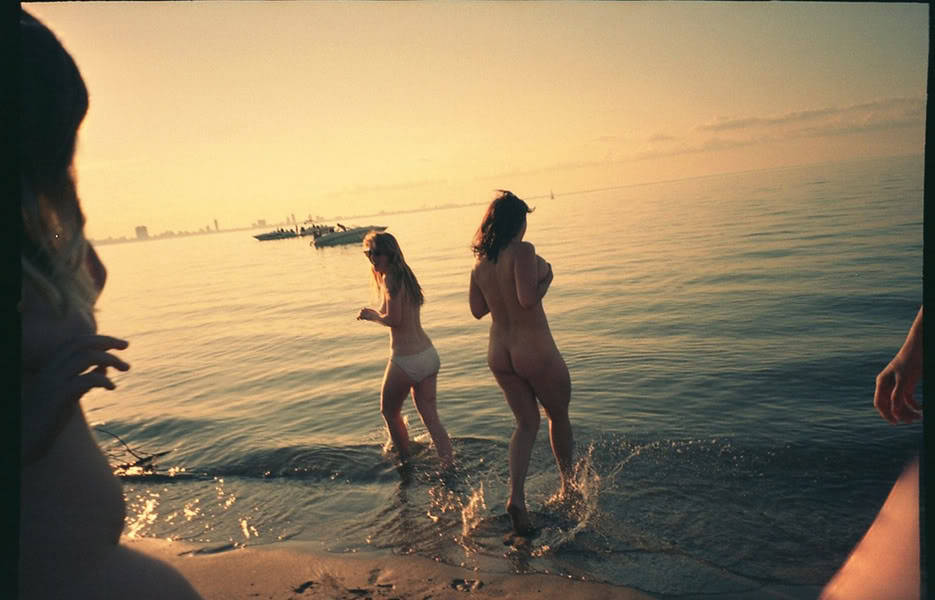
Dimitri KarakostasUntitled (2011)

The has a great sense of motion in space and time.

For example: the woman at the left edge seems to be running parallel to the tide line, blocking the sun just enough to get that lens flare effect at the lower right corner; in turn, the flare draws attention to the hand that’s so wonderfully enters from frame right.

The running woman and the hand create a parenthesis containing the two women running into the surf–the left most who is peeling off while glancing back at the running woman at frame left while the right most woman in the white bikini bottom runs straight into the water.

I find most of Karakostas’ work underwhelming–despite his impressive sense of immediacy. Still, there’s something about his work that strikes a cord and it occurs to me that it has to do with his investiture with skate culture.

That knowledge triggers a number of ancillary realizations for me. First, it places his work within a lineage tracing its way from Ryan McGinley and Spike Jonze back through Larry Clark to Diane Arbus; second, there is the prevailing notion that there are (at least broadly) two flavors of photography: photojournalism and fine art; the former is ‘objective’, the second–‘subjective’.

I’m not sure I agree with this bifurcation. Photojournalism is only more objective in aim–but the artifice of the frame is already to have introduced notions of inclusion and exclusion; also, work that is disseminated has be prejudiced over other work for what are closer to subjective criteria. (Also, McGinley, Jonze, Clark and Arbus are–to the best of my knowledge–outsiders who are recognized and trusted in the community they prefer to document. I’m not entirely sure why there seems to be so much more trust in the art world for outside observers telling stories that aren’t their own. Karakostas is–in some ways–more in line with Nan Goldin.)

However, the main thing an awareness of the photographer as a part of skate culture is a result of spending the last six weeks interrogating my own personal approach to art making: I’ve realized what an indispensable facet of my process failure is.

It’s not a popular thing. We all want to make it seem like it’s effortless and second nature and the ideas just emerge from us like Athena springing fully formed from the head of Zeus. In reality, there’s a lot of shit that just doesn’t work–but you have to put a lot of work into that failure before you realize it doesn’t work.

(I was once told that Aimee Mann claims that for every song she releases she writes 99 songs that are awful and don’t work.)

And I think about these kids I see skateboarding from time to time in SoHo. They’ll spend hours, days and weeks repeating the same stunt–falling, picking themselves up, trying it again; you don’t learn to do a trick without at least getting a handle on all the things you can do to fuck it up and then training your body to be mindful w/r/t avoiding those mistakes. But all the failures make the minor successes all that more motivating–the eventual mastery all the more appreciated for how challenging it was to accomplish.

Show me a skater who is also an image maker and I’ll show you someone who has a ridiculously refined notion of the dynamics of motion with regard to the spatial relationships between bodies and environments. (Yes, most likely they’ll burn through an exponential amount of film–but they also will have a ridiculously good idea of what works and what doesn’t work)

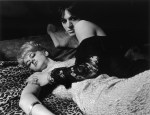
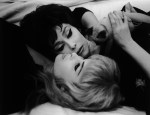
Christer Strömholm – [from first to last] Suzanne and Mimosa (196X); Suzanne and Mimosa (196X); Cobra and Caprice (1961); Narcisse (1968); Soraya and Sonia (1962); Cynthia (196X); Gerdy (196X)

Apparently Strömholm moved from Sweden to Paris towards the end of the 1950s. He took up residence in Place Blanche, at the heart of the red light district.

During his time in this locale, he befriended a number of the trans women sex workers in the neighborhood. (Many of who were working to save up money for gender confirmation surgeries.)

In 1983, he published this photos in a book entitled Les Amies de Place Blanche–of the work, he wrote: It was then— and still is— about obtaining the freedom to choose one’s own life and identity.

Thy Tran – [↖] Untitled from Cacher series (2016); [↗] Untitled from Cacher series (2016) ; [↙] Untitled from Cacher series (2016); [↘] Untitled from Cacher series (2016)

When I saw Tran’s work, my first thought was: wow, there’s A LOT of overlap with Kim-Ngân Ao (aka yatender). Both filter elements from Lina Scheynius and Ren Hang through a stubbornly lo-fi analog aesthetic.

However, after sitting here suffering from that oft reported feeling in police procedurals where the unorthodox detective feels like she’s missing a piece of the puzzle that’s right there staring her in the face, I figured it out: Tran and Ao almost certainly know each other.

Consider: this self-portrait from Tran’s Flickr account and this photo made by yatender–the tattoos are the same.

Initially, my thought was that I favored yatender’s work but I’m not so sure that’s the case any longer. Yes, both are working in very similar veins but I think yatender is more audacious in the risks she takes as well as being decidedly on the take photos vs make photos end of the spectrum; Tran is more reserved and contemplative as well as being decidedly on the making end of the aforementioned spectrum.

Also, being that Tran’s Cacher series is focused on interrogating her identity as a lesbian and the visibility vs invisibility that comes part and parcel with that–her work resonates more with me as a fellow queer person.

wonderlust photoworks in collaboration with @suspendedinlightAssisted Self-Portraits (2017)

Over the last three years or so, I’ve dabbled a bit with street photography. Alas, the only camera I have that I’m fast enough with is a panoramic camera–which is not exactly well-suited to that task.

Really, though–what’s stopped me is that there are just issues of consent with street photography that I find increasingly disturbing.

The idea for these emerged partly from an urge for the challenge of street photography style work–quick thinking on your feet, rapid response, etc; the other part was I’m always looking for ways to reduce the amount of time I allow myself to over-thinking things; and, from the vantage of procedure, I’m interested in minimizing my imposition on the work.

The notion here was that I hand a cable release to the subject–in this case Lyndsie–and she chooses the moment the photo is taken. I merely have to keep her in frame and in focus.

It was such a revelation to work this way that I’ve actually instituted it as a sort of icebreaker every time I collaborate with someone.

AdeYdependency (2015)

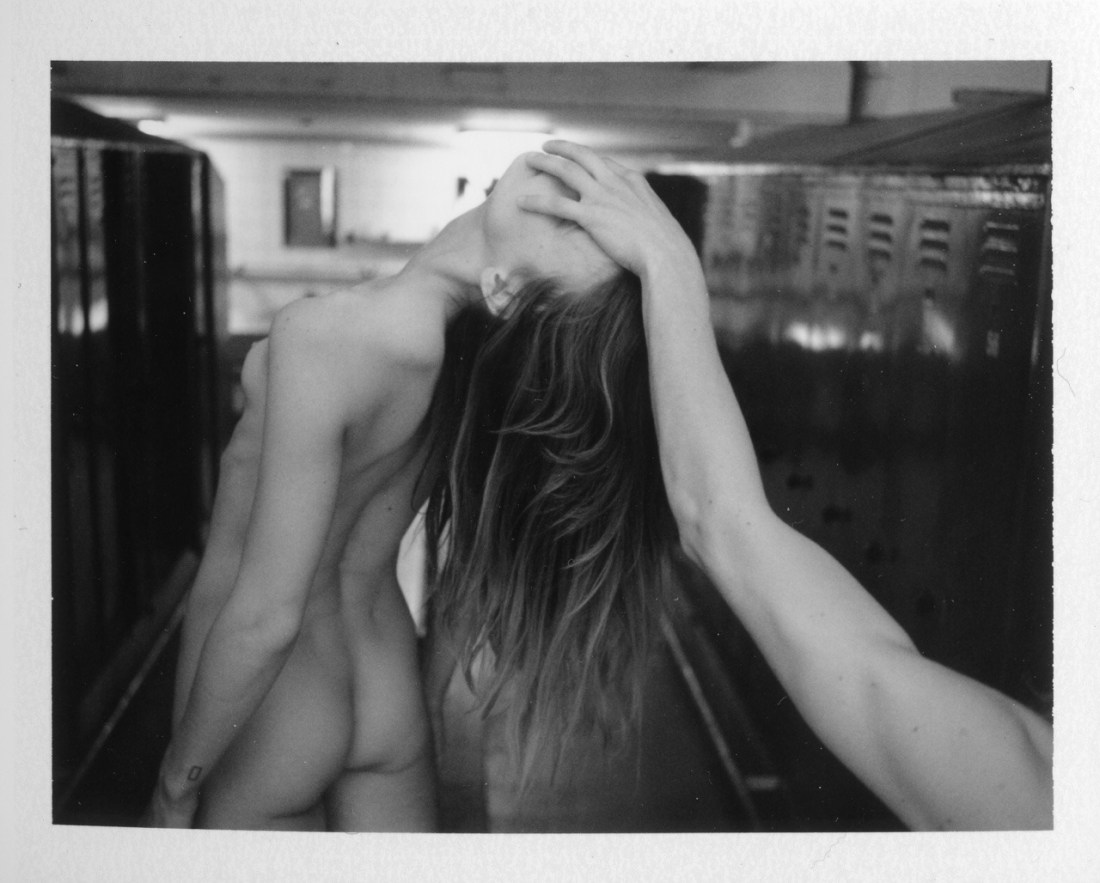
I think it was in third grade where we learned about the five questions a good reporter always answers when relaying a story: Who? What? Where? When? And How?

This isn’t exactly a shabby mode of approaching art, come to think of it. Except, there’s perhaps a proscribed order (at least as far as visual art goes).

I suggest you start by asking: what is this, what am I looking at?

In this case, it’s a stereotypical locker room–rows of lockers on either side of a central bench running along an aisle. A woman (nude) is standing on top of the bench leaning backwards in a manner that has to be both uncomfortable and precarious as far as balance goes. A male arm extends into the frame from the lower right corner; its hand holding her face not unlike a basketball superstar slam dunking.

The lighting in the locker room indicates that it is currently unoccupied and the lighting on the interaction in the foreground has a sort of cinematic flare that is suggestive of a nightmare tableau or horror film. (I can’t look at this and not think of the penultimate scene in It Follows–where they fight the monster at an indoor pool.)

What is seen speaks to viscerality/physicality but in a fashion that is unsettling/menacing/sinister.

Now–if this we’re in hanging in a gallery–there would be some placard someone explaining that the artist’s name, the title of the piece (if there is one) when it was made, where the nationality of the artist, perhaps (I’m pretty sure he hails from Sweden). Astute galleries will address the how with notes on media (in this case medium format Polaroid), the size of the work, provenance and ownership/bibliographical information).

And here’s what I think people who think art is dumb mean when they criticize it. If you’re going to understand what you’re looking at, you often have to conduct the same operation multiple times. In this case, when you get to the title, i.e. ‘dependency’, you are forced to ask yourself what that means in the context of what you’ve already figured you’d gotten super clear about.

The first thing I think of is that dependency can indicate something suspended–like a pendulum or the Sword of Damocles hanging by a single hair from a horses tail. (The position of her head to his hand is in keeping with this reading and it further strengthens my original notion that there’s something malevolent happening here.)

The second thing that pops into my head is this woman I walked by two mornings ago. She was speaking loudly on her phone to someone and I heard her say: I’m not going to waste my time on you, ‘cause I can’t depend on your ass for nuthin’.

I think there’s a tendency to view dependence as a bad thing. But I’m a dependent upon food, water, shelter and clothing (alas, we have not yet returned to the naked idyll of Eden). I depend on my job to pay me for the work that I do so that I can trade the money I earn in order to survive and exist in the world. I–personally–am also dependent upon a steady stream of illicit substances to counter the stress of functioning somewhat normally in this completely fucked world.
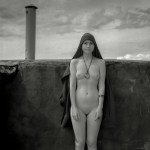
In other words, there are degrees of dependency and degrees of acceptability of various forms of dependency which general relate to whether they serve society or the individual.

Yet, my gut is that the sinister tone is a projection I’m placing onto the image–and it’s a strange feeling. I’m not used to it. And when I poke at it a bit more things shift for me.
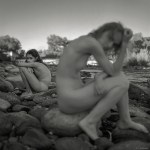
My BFF and I have been talking recently about how depression–despite being awful and numbing–is actually sometimes beneficial.  When you’re numb the generally awful stuff has a muted effect and things need to be really horrendous to register. That’s a defense mechanism, of sorts. I think this photo functions similarly.

For me it’s about the fact that her face isn’t so much held as covered–the proceedings the viewer witnesses here are reasonably anonymous. And anonymity is a concept without a point unless the one who wishes to be anonymous is likely to be seen.

It feels to me like this is–in a fumbling way–trying to get at the dichotomy wherein the voyeur watches in order to see/understand and the subject wishes to both be seen and unseen at once.

And if this is more than just pedestrian hearsay, which equivocation muddles meaning more–that of the voyeur or that of the subject?

Evgeny Mokhorev – [↖] Marina near the forest bath, Lagoda (2013); [↑] Anna (2016); [↗] ***, Baltic Sea (2017); [←] Anna and Yuri, Tichino, Italy (2015); [+] Katya, Kronstadt (2016); [→] Yuri and Anna, Tichino, Italy (2015); [↙] Alexandra (2010); [↓] Anna, Crimea (2015); [↘] Anastasia from The 26th Element series (2001)

I’ve featured Mokhorev’s work at least once before. (I’m almost positive it’s twice but since Tumblr now hides NSFW content blogs, I have to rely on my own tags to find anything. Alas, I haven’t always been vigilant with regards to tagging, so…)

In the 1990s, Mokhorev was focused on youth culture in St. Petersburg. It was a rather different species than the bohemian, hipster rock n roll rebellion of his compatriot Igor Mukhin; There’s none of the trappings of counter culture and things seem to prosaically orbit the fact that it’s one of the most heavily populated cities nearing the Arctic Circle. Winters are bitterly cold and summer is a time people revel in. As I understand it, getting blitzed on vodka, stripping down and swimming in the Neva is a fairly commonplace occurrence.

There’s a sort of feeling of everlasting summer, of primordial pagan sunworship to his work. It also frequently features folks unabashedly cavorting around in the buff.

Some of his earlier work was a bit disconcerting–frequently featuring nude pre-teens and teens. I’ve spent the morning revisiting his work and what impresses me is that although it is ostensibly interested in nudism, it avoids the trappings of the other two prominent artists interested in nudism, Mona Kuhn and Jock Sturges (in the case of the former, the works remain antisepctic and are less concerned with the conveyance of an sort of concept beyond a sort of idyllic reverie and instead pivot upon questions of form, representation of space and color; whereas Sturges is a perverted hack who dresses up his pedaphiliac ideation in the trappings of fine art legitimacy–I was at one time a fan of his work but increasingly it creeps me out and the work itself relies more on the perception of technical mastery, while demonstrating no such acumen in point of practice.)

I’ve been wary of his work before. Unlike Sturges, however, I have always been fond of it–and suspicious of that fondness. These images make me feel more justified in my admiration.

Here’s some things I noticed about his more recent work. [↑] bears more than a passing resemblance to Mark Steinmetz’s Jessica, Athens (1997); Steinmetz is objectively the better photo, but it feels as if Mokhorev only fell short because he was more ambitious in attempting to convey a similar feeling but also opening up the frame more. (I’d bet $20 that he’s very familiar with Steinmetz.) [↗] I like this because it’s a fundamentally intriguing image but also I’m curious what it is he’s holding and he looks a bit like a hedgehog; [+] between the watch on the necklace and the smoke stack behind her (which reminds me of the scene in Mark Romanek’s music video for // | /’s The Perfect Drug, where there’s a funerary urn that has crushed someone leaving only a pair of legs in riding breaches reminiscent of the Wizard of Oz; [↘] this might as well be channeling Rodchenko from beyond the beyond.

The last thing is a technical note. I am certain Mokhorev favors Ilford film stocks. And I am reasonably convinced he uses HP5 pretty much exclusively. While it is absolutely better than the comparable Delta 400 Pro–which is garbage, fwiw–it’s a finicky stock. It’s impressive that he’s getting these kind of results from it. Damn impressive actually. I’d have said that it wasn’t possible prior to seeing these. Also, another little known analog tidbit, there are subtle differences in the emulsion between different formats. The grain is usually more or less the same but there are differences in contrast, dynamic range and tonality. But the backing is always different–especially with Ilford. All the above are medium format except [↓], which is 4×5 sheet film–it’s possible this is not HP5 but in my experience 4×5 has a completely different feel to it than the 35 and 120 formulations of the same stock.

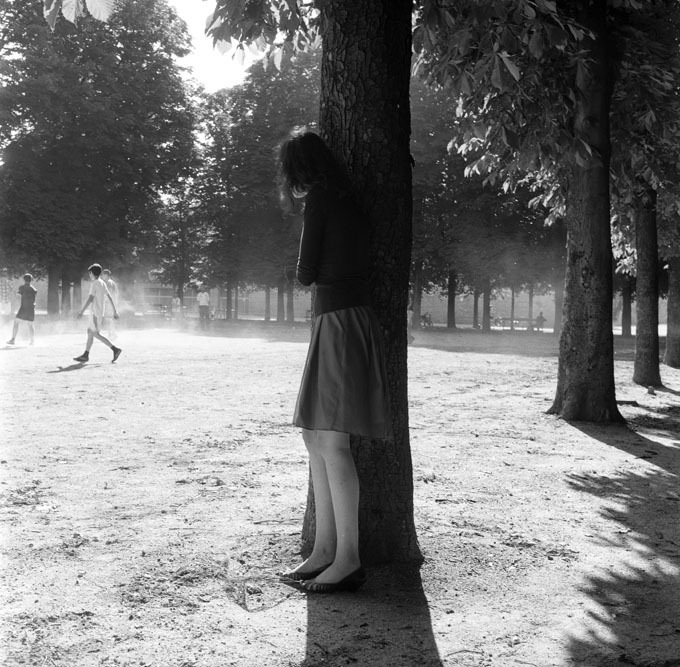
Olivier KervernParis (2010)

I know the saying: those who can’t do, teach; those who can’t teach, teach Phys. Ed. But I’ve always loved teaching–that moment where the light bulb suddenly illuminates. I don’t know…it always feels like you’re doing something that actually makes a difference in some small, concrete way.

I daydream a lot and a frequently recurring motif is being a photography teacher. I coach imaginary students and construct pithy activities.

One such activity would be for each student to bring two contact prints of one roll of 35mm film to class. (Of course contact sheets, it’s foolish to attempt to teach students photography by allowing them to substitute a completely different standard–i.e. digital imaging.) On the first sheet, the student will have indicated their choice for the best 3 frames on the roll in white grease pencil; the second sheet will remain pristine.

The pristine copies will be reviewed by their classmates. Everyone–except the photographer–will vote to choose the top three images. Subsequently the student will reveal their picks and share why the picked them. The class would have a chance to respond and then I would inquire if the student agreed or disagreed–and to provide an accounting of their considerations in making their final decision.

In my head, there’s usually some overlap between what the photographer selects initially and what the class chooses. It’s all intended to be a valuable lesson in considering the reaction of your audience and standards and expectaitons with regard to interpreting visual grammar.

But as a teacher, as a photographer and as an individual, I’m always going to be interested in the discrepancies.

If you placed Olivier Kervern in this scenario, I’m pretty sure there would be zero overlap between his selections and the class’.

Given Kervern’s body of work I’d be inclined to not let him join the class. It’s really not very good. Except… this is extraordinary. And it’s never something I’d pick off of the contact sheet assignment.

Look at the photo. Seems pretty balanced between light and dark, doesn’t it. It’s not. Highlight tones make up roughly 2/3 of the frame, but the shadows seem to dominate–mostly because they control the foreground.

Then there’s the young woman–who appears to be simultaneously a part of the tree and a figure hiding behind it watching the boys playing on the field–a feeling of quite literally being rooted in the shadows, while also stepping out into the light. (This is part of why I’d never pick this based off a contact print, the fusing of the woman and the tree is almost certainly something done via post-exposure means.)

I also freaking adore the way that her voyeurism is not open to any sort of interpretation. There’s not enough context but even if you assume–which I don’t think is incorrect–that she fancies a boy on the field (who likely doesn’t even know she exists), the focus is too sharply directed towards the implication of the viewer’s voyeurism. In the watching her watching, we have more access to our own motivations than we do to hers.

Finally, there’s my empathic response. It’s very rare that I see a work of art and am willing to assert that the author understands what it is to be as lonely as I am. Pretty sure Kervern is an exception that proves the rule.