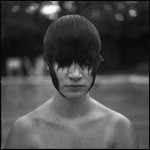
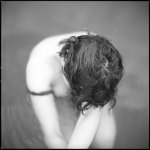
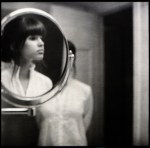
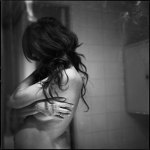
Jordi Gual – Untitled (200X)

I have posted one of Gual’s photos before. I’d link to it except after Tumblr’s NSFW schism, Google searches are no help in tracking down previous comment anymore. (And they were never exactly steller, if we’re honest.)

It doesn’t much matter. The post–as I recall–was not able to provide attribution for this photo. At the time, I posted it because I admired the subject’s fashion sense (being similar to my own with an emphasis on comfort and sumptuously soft textures).

I still love the photo. In fact, it’s grown on me since I last saw it.

Now, as I’m re-encountering it in the context of proper attribution I’m a little unnerved at how prescient my reaction was to the work.

See: Jordi Gual is an analog photographer born, raised and residing in Spain. His work focuses on his family–his wife and his two daughters, predominantly.

His oldest daughter, Natalia, was born blind. She is the subject of the photo I posted previously and it appears to be she who is the focus of the upper five photos here.

Beyond traces of his work work that are still floating around the digital aether, he doesn’t seem to have an online presence. That’s unfortunate. He’s not as technically accomplished as someone like say Patricio Suraez; and he’s no more effective at creating moody portraits than some pretentious jack ass hipster shooting in B&W because it’s ‘artsier’; however, what he does have in goddamn spades is a preternatural knack for facilitating unsettled tension.

What little is left of his work on-line sports all sorts of folks imposing their reactions to the work as it’s impetus–oh, it’s ‘sinister’, ‘disturbing’ or ‘sad’. I–for one–reject such facile efforts to pin the work under the viewers finger.

Even I referred to the work as ‘unsettled’ but that was an effort not to project my own view onto the work merely point to the thing about it which I think is crucial and absolutely vital in a way that few things being made these days have even the vaguest ability to imagine in their wildest dreamings: Gual feels like a madman architect who builds ornate structures on shifting sands. He’s studied the sands enough to know that what he builds will stand the test of time but acknowledges that the shape can be–ultimately–maleable beyond his control. In effect, he is walling off an sort of dialogue the viewer can have with any sort of notion of the image being a decisive moment; instead, the viewer is given a moment that is unknowable with regards to any definitive resolution.

I don’t know really know how to say it any better than that but if you understand what I’m pointing toward and squint a bit, you’ll likely start to discern the outline. Even if you don’t, this is some extremely next level shit right here. I hope this guy is still shooting because the B&W stuff of his that you can still find is exquisite and his color work (1 & 2) is also fucking stunning.

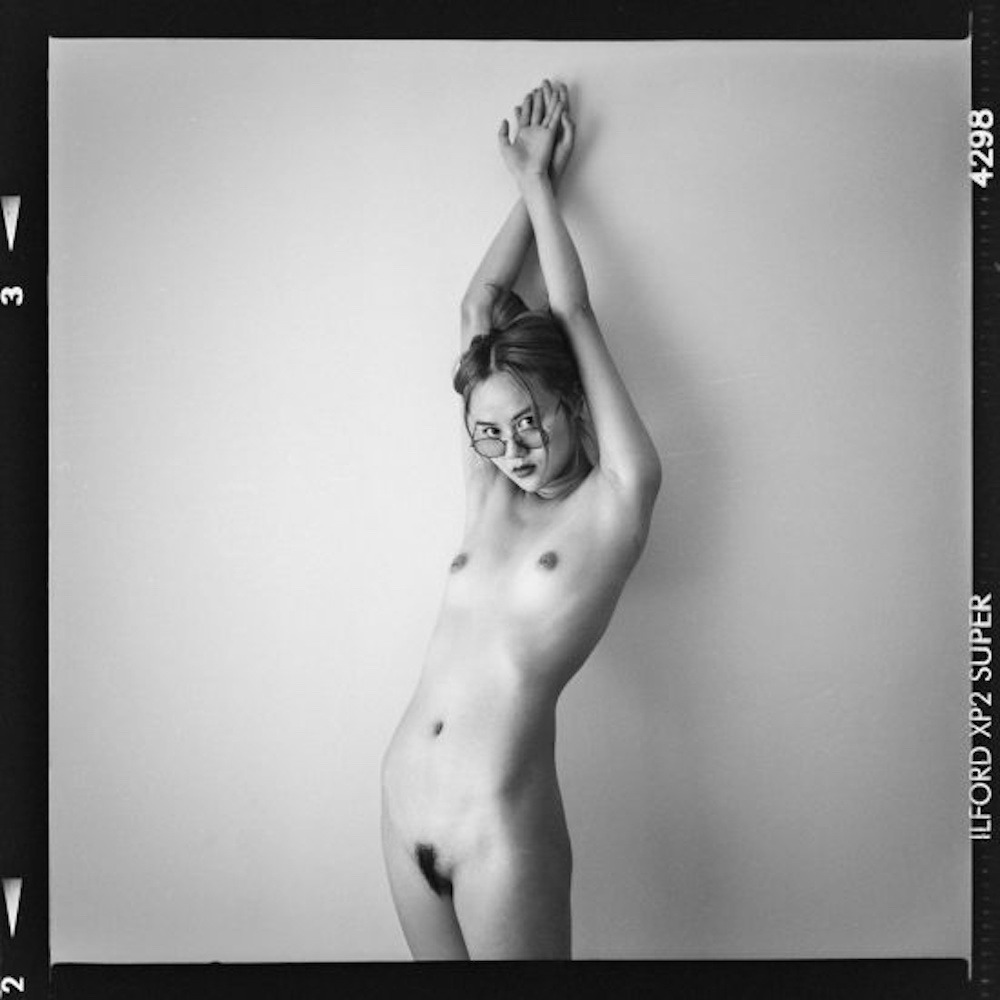
Danny LaneJohn Yuyi for Purple Magazine  (2017)

Perhaps the primary reason I’m less than fond of studio/studio adjacent work is that the point is–to greater or lesser extent–emphasizing decontextualization.

It’s sexy knickers on a model in a catalog vs you finally trying them on in front of a full length mirror.

If you’re going to make studio work, it’s a good idea to embrace the decontextualization and to show the viewer something about why the absence of more context was a necessary precondition of the work.

The above photograph succeeds marvelously at this task. It’s simple. A beautiful model, in front of a plain white wall. Light left to right, after the Baroque fashion. The pose is unusual, dynamic–fashionable in its artifice, but open, confident.

It’s an astute use of space–the balance between the positive space of the Yuyi’s body/posture vs the wall and shadows cast on the wall.

Taylor RadeliaUntitled (2010)

This crossed my dash attributed to William Eggleston.

On the one hand I can understand why someone would think that. It’s an image of a piece with Eggleston’s oeuvre–fixated upon seeing the beauty of colors despite the often numbing interference of the mundane.

It’s almost like this photo by Radelia is–from the standpoint of photography math: this + this.

There are still notable differences anyone who has spent any sort of time with Eggleston’s work really ought to have caught: namely, Eggleston doesn’t really use a strobe all that often and although virtually all of his work trades in sublimated sexuality, the above is a little too direct in it’s perverse punning to be a lost Eggleston.

Radelia’s image is fascinating though because it’s a rare work that both stands on its own to feet but also holds up well when compared with the work from which it clearly draws inspiration. That’s not a small thing at all.

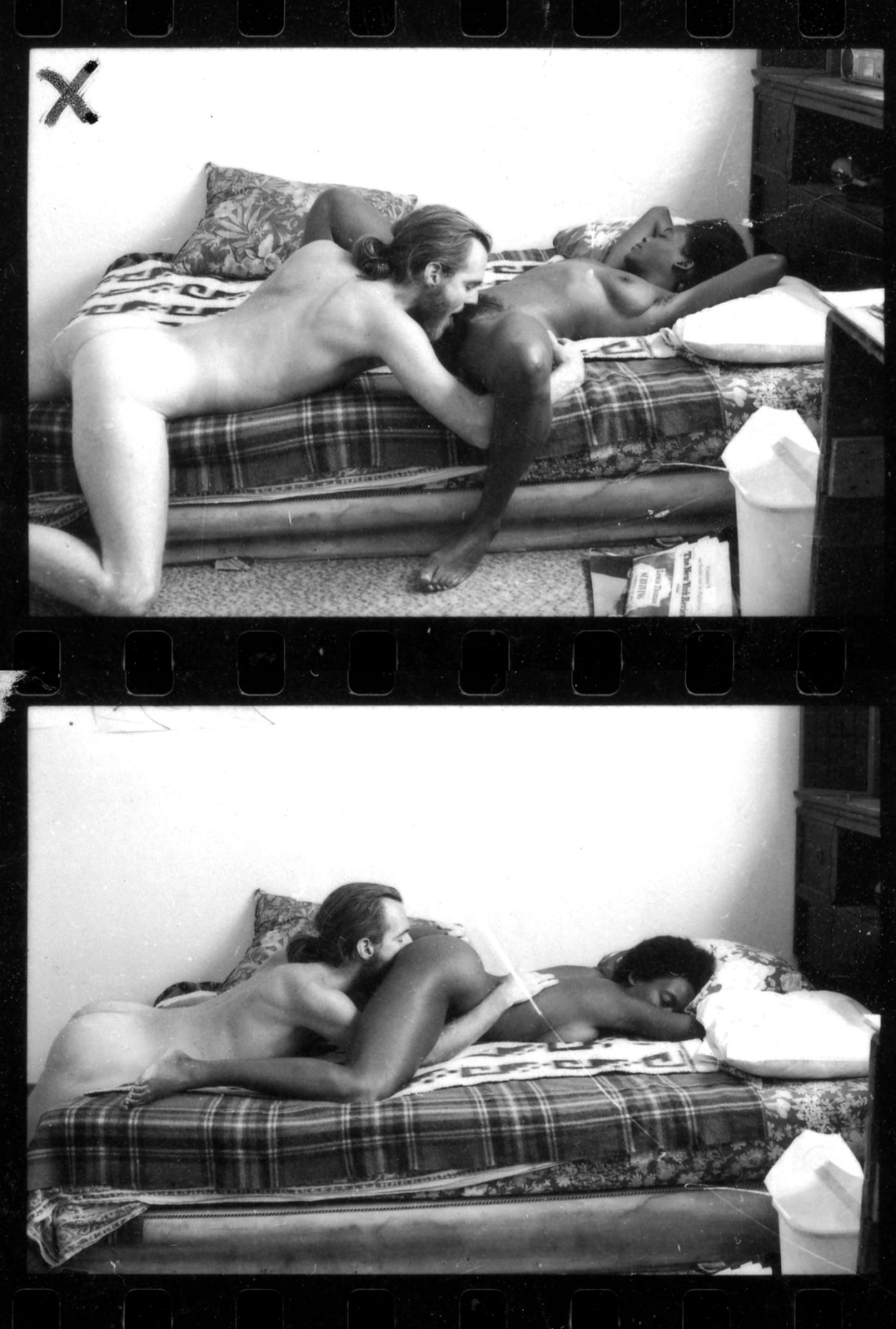
Source unknown – Colorado cunnilingus (1980)

There is a language
older by far and deeper than words. It is the language of bodies, of
body on body, wind on snow, rain on trees, wave on stone. It is the
language of dream, gesture, symbol, memory. We have forgotten this
language. We do not even remember that it exists.
                   —

Derrick Jensen, A Language Older Than Words

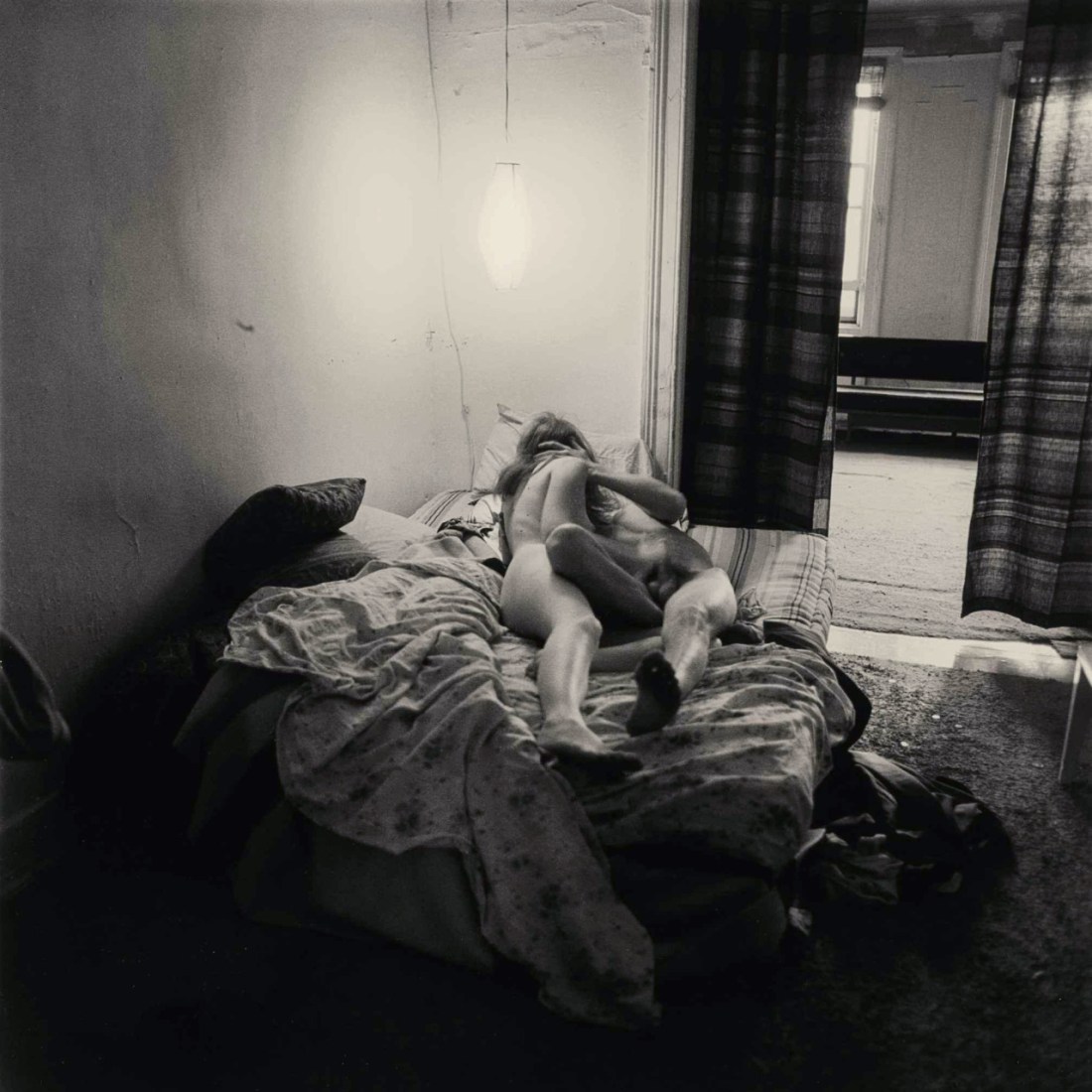
Diane ArbusCouple in Bed Under a Paper Lantern, NYC (1966)

I’ve maintained for years that reading something on a screen vs on a page effects how you process the information. (My recall for printed materials is generally better-than-average; via digital interface noticeably less astute.)

As far as Arbus goes, I’m not a fan. Yes: Child with Toy Hand Grenade in Central Park is one of the all-time best street photography portraits. (And one of the reasons it’s so brilliant is because it was made as things started to escalate in Vietnam–intuitively connecting wars overseas with their psychic impact closer to home.)

I never knew what I didn’t like about her work–and here it’ll become clear why I started with memories formed reading something off a page vs on a screen–I remember reading something on the Internet, a criticism of Arbus that associated her well-known quote: I really believe there are things nobody would see if I didn’t photograph them.” with her interest in social outliers and the stigmatized.

I look at so many of her pictures and there is this circus side show feeling to them–an I’m going to show you what you don’t want to see. That’s maybe okay: spectacle sells, after all. (But also: maybe don’t rely on solely that?)

Her images always leave me with this feeling that she was far more interested in what made someone a freak than how such social castigation impacted a person’s humanity.

So while I’ve seen this image a dozen or so times before it wasn’t until I saw it in the context of Tumblr porn reblogs that I realized what it depicts–a couple making out while a vigorous handjob is administered.

There’s something more disarmingly honest about it for it’s focus on the familiar–Arbus being ostensibly white (Jewish), cisgendered and heterosexual.

Further–and again, now that I need it I can’t find it–there is a similar post-coital image of Sally Mann with her husband Larry that actually is almost certainly influenced by this Arbus’ image.

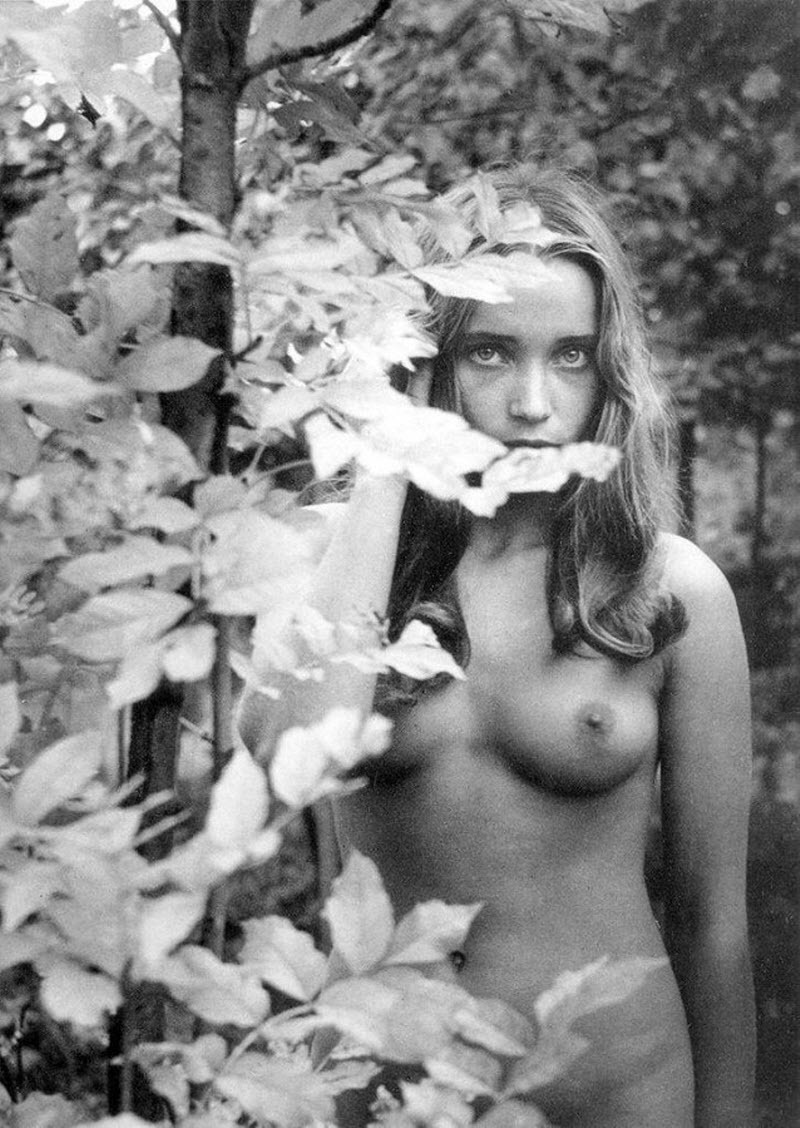
Rimantas DichavičiusUntitled from Žiedai tarp žiedų (1965-1989)

All of Dichavičius‘ work that I’ve encountered feature female nudes in nature (in fields of tall grass, walking along the shore of some eastern European lack or amidst sandy shoals and dunes).

The subjects of his images seem more like mythical nymphs than women–he likes wildly, disarrayed settings where grass, leaves and even cascading hair serves to both veil the subject and make them recede slightly, as if each belongs to the landscape more than the viewer.

Additionally, he preferences extremes of contrast–prejudicing tones at the edge of over-exposure and at the point where details in the shadows begin to flag to more measured/even tonality.

Along with his frequently surreal flattening of space and his efforts to skew perspective through composition tricks contribute an extra layer of surreal feeling to his scenes.

The work I’ve seen is all a bit too one note for me. But I’ve admittedly not seen more than the scant offerings available online. And really, the above image is thoroughly exceptional–not in that it’s far more concrete than a lot of his work.

(Further, I can’t help but feeling that this photo is likely an effort to imagine what the photo Imogen Cunningham might have taken of Twinka in Judy Dater’s reknowned photo if the photo had been an actual random encounter instead of a staged happening.)

Richard AvedonAndy Warhol and Members of The Factory, New York (October 30, 1969)

If I were more ambitious/less of a lazy layabout, this is the sort of work that I would summon David Foster Wallace-esque footnoted footnote levels of ‘scholarly’ exegesis. However, I’m in a an unusually clearheaded place today–I’ve absconded to a more temperate clime where spring is very much in the air + it’s having a restorative effect.

Thus the only things I want to address related specifically and concretely to a direct interpretation of this large format triptych are as follows:

I tend to be resistant to spending time with the work of iconclastic. This is actually the height of irony–given my own iron clad anti-authoritarian bent. But I do possess strong enough of post-left anarchist pretenses that I rankle in the presents of efforts to make outsiderness a sort of new status quo.

As such I’ve been a late subscribe to folks like Robert Frank–if you want to be a photographer of any consequential merit you absolutely need to know The Americans like the back of your hand. (Yes, it is actually that crucial a work.)

I’ve only recently began flirting with Avedon’s oeurve–largely due to how smitten I am with his portrait of Sandra Bennett from In the American West.

I’m still on the fence when it comes to Warhol–although I am intrigued by The Factory (more on that in a bit).

I think of how the first panel is obviously riffing on art historical depictions of Adam and Eve–except with the implication of queerness in the pair of two men with a trans woman. The way the center panel captures a sort of sex, drugs and rock and roll vibe that subsequently transitions into a sort of art star as cultural gatekeeper/philosopher king trope. (And conceptually, everything that is read before you reach Warhol, essentially emerged from his efforts.)

I also think about how this is one of the earliest examples I can call to mind of fostering the illusion of a panorama across multiple frames. (And  here I would be remiss if I didn’t take the chance to point you in the direction of folks who’ve continued in that tradition, a la:  David Hilliard, Accra Shepp and Tom Spianti.)

Yet, just as how the progenitor of all that precedes is the last thing you encounter, these observations are really the last things that come to mind for me when I look at this triptych. What I’m really thinking about is a sort of melange of thoughts and impressions.

I guess first off I think about a chat I had with a close friend where she mentioned that although she is not queer, her understanding of queer experience is that you feel a profound sense of not belonging from a young age. And as someone who identifies as queer, my own experience is not so clear cut. I did feel I was different but growing up in an Evangelical milieu, I viewed that as an advantage for many years. I had no desire to be like those who surrounded me/to fit in. In my late teens this bearing became and increasingly dissonant point. I craved love and acceptance from someone/anyone and I was surrounded by people who insisted that I accept their general framework to receive love and affection. So what I wanted/need stood at cross purposes with what I knew to be my own personal truth; I learned to a large extent you have to play a part and/or lie to get what you want. I’ve never been able to manage that feat. (For someone who can at times be a pathological liar, I am honest to a fault.)

Honestly, art is the only thing in my life that has ever even tried to meet me halfway. (Actually, that’s not entirely true. My 30s have been a super mixed bag but increasingly there have been folks with whom I’ve shared + continue to share a mutually cultivated middle ground.)

However, in that there is a danger of building a monument to outsider-ness, an echo chamber. I’m reminded of one of the best things Brain Pickings has ever posted: The Paradox of Active Surrender: Jeanette Winterson on How Learning to Understand Art Transforms Us.

One passage in particular resonates with me:

There are no Commandments in art and no easy axioms for
art appreciation. “Do I like this?” is the question anyone should ask
themselves at the moment of confrontation with the picture. But if
“yes,” why “yes”? and if “no,” why “no”? The obvious direct emotional
response is never simple, and ninety-nine times out of a hundred, the
“yes” or “no” has nothing at all to do with the picture in its own
right.

“I don’t understand this poem”
“I never listen to classical music”
“I don’t like this picture”
are common enough statements but not ones that tell us anything about
books, painting, or music. They are statements that tell us something
about the speaker. That should be obvious, but in fact, such statements
are offered as criticisms of art, as evidence against, not least because
the ignorant, the lazy, or the plain confused are not likely to want to
admit themselves as such. We hear a lot about the arrogance of the
artist but nothing about the arrogance of the audience. The audience,
who have not done the work, who have not taken any risks, whose life and
livelihood are not bound up at every moment with what they are making,
who have given no thought to the medium or the method, will glance up,
flick through, chatter over the opening chords, then snap their fingers
and walk away like some monstrous Roman tyrant.

As much as I’m intellectually against dismissing something without thought, I’m not super good at practicing what I preach. I tend to develop intractable opinions on the merit of certain work vs. other work I deem to be less meritorious. It’s not that I don’t think about these decisions, it’s that I maybe don’t think enough about them before dismissing them.

That’s one thing I adore about Tumblr–and too all the folks claiming this forum is dying, I see you and feel you, it’s not what it was (that’s for sure). But I keep being confronted with things independent of any prejudice to whether I’ve made up my mind about them yet. It’s why my opinion on Avedon has changed from I don’t care for his work to an awareness that I haven’t really explored it in enough depth to have an informed opinion on it. Also, I’m excited by the prospect of engaging with his work. This wouldn’t have happened if I were part of an ostensible community that insists upon work I would otherwise ignore.

And that’s the other side of things, the community that Tumblr provides not only causes me to reconsider my own assumptions on established artists and canonical art, it also introduces me to stuff I wouldn’t otherwise have encountered.

I’m thinking here of one of my favorite posts of all time on this blog: a documentary still from FeminismoPornoPunk’s staging of a porn variation of the experimental theater piece Public Domain.

And I feel like that’s something Warhol got right with The Factory. It wasn’t sex, drugs and rock ‘n roll for the sake of excess–although that was almost certainly a byproduct. Instead, it was about the potential in that milieu to construct a sort of interpersonal space/a ad hoc community of lived experience as informative and educational and evolutionary. A catalyst for exploration whether that exploration was transgressing boundaries or creating art. (I don’t think it’s an accident that so many art world luminaries emerged from this scene, actually.)

And I guess that’s what I am grappling with how to achieve: making this blog a sort of space not unlike The Factory. Except I don’t want to be the Warhol figure. I’d rather be just another faceless participant.