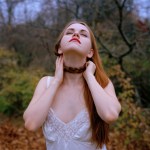
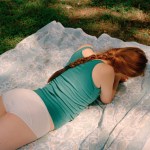
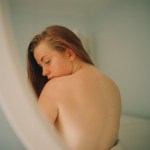
wonderlust photoworks in collaboration with Lyndsie Alguire – [↑] The Right Light; [^] A Piece of the Sky; [+] Fever Dream; [v] Invisible Syllable; [↓] Annunciation (2016)

Nothing short of pure joy to work with @suspendedinlight and I could’ve easily included double the images here. (About half turned out really damn well.)

These were the most intriguing and distinctive to my tired eyes, though.

I am already very eagerly anticipating the opportunity of work with Lyndsie again in the future.

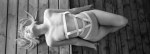
Sebastián GherrëBenja (2016)

I feel about Gherrë the way I’ve come to feel about Araki–namely: I don’t always get it but the work is consistently of high quality and in spite of the tendency for both artists to cover the same ground over-and-over-and-again, there remains surprising freshness and variation.

Also, I love that there’s someone out there who is still making traditional dark room prints. They just look so much better, damn it.

Andrew KaiserTitle Unknown (201X)

I dig Kaiser’s work. His B&W stuff is frequently good, sometimes great. (This image of Gwendolyn Jane from last year will hold its own against just about any other image made that year.)

He seems to prefer film and although I’m probably reading into it too much he seems to possess a better grounding than 95% of the quote-unquote fine art nude photographers out there–in that he appears to own that something isn’t just art because some schlep asked a a naked woman to stand on a bounder in a picturesque landscape.

I love this image, for example because there’s a stillness, a calming quiet around it. It feels uncontrived–the viewer is allowed to glimpse something that they probably wouldn’t otherwise be able to see. But the emphasis isn’t on the transgressiveness of the seeing but on documenting the immediacy of the experience. The current rippling around her fingers, the watery undulations of her reflection.

But the thing I like best about it is that her anonymity is preserved. No, it doesn’t look entirely natural–it’s clearly been burned in quite a bit. But the point is it is unequivocally bad craft/technique/etiquette to use the frame edges to decapitate a subject. It’s inherently objectifying, first off. Second off, it’s lazy and inexcusably sloppy. Yes, including the entirety of the body presents a litany of additional challenges that aren’t always easy to negotiate; but the result will always be superior to the alternative.

wonderlust photoworks in collaboration with Kathleen Truffaut – [↑] Atelier (2016); [+] Redolent (2016); [↓] Cauterwaul (2016)

My last trip out to L.A. was pretty much a cluster fuck of truly epic proportions. The highlight of the trip though was meeting and making photos with the angelic and thoroughly intriguing Kathleen Truffaut.

(An extra special shout out to @jacsfishburne–without whom the above would not have happened.)

Rosie Brock – [↖] Untitled from Lily series (2015); [↗] Untitled from Bone, Flesh, Memory series (2015); [↙] Untitled from Lily series (2015); [↘] Untitled from Lily series (2015)

Two days ago, Canon released the results of a survey where 1004 people were asked about their image making. A preposterous 80% graded their skills as excellent.

There are a veritable litany of problems with the methodology of this survey. The most pertinent is asking people whose only training to be an image maker is likely owning a camera to self-critique is a little like administering a multiple choice test and instead of checking it against an answer key, instead grading the test take on how they feel they did.

Really, it’s great that we can talk about the democratization of image making. I mean these days virtually any cell phone comes with a built-in camera that is superior to any standalone device under $1000.

Further, anyone coming of age from the 70s onward, grew up immersed in a culture steeped in a preternatural awareness of the impact of lens based visual media.

If anything, one would expect given the wide availability of quality equipment and an awareness of form and function that might as well be ingrained at a cellular level, you’d expect more and better work.

The truth of the matter is: you’ve got more people with better equipment making far less inspired, interesting and urgent work now than at any time in the history of the medium.

What does this have to do with Brock? Well, their are scads of young women making work with similar, perhaps over-earnest examinations of what it is to be young, female and visible in a culture dominated by notions of male entitlement and rote sexualization of women and women’s bodies.

Some of it is very good but by and large the majority of it is poorly conceptualized, executed and presented.

Not so with Brock. Part of it, I suspect, is that she’s shooting on film–specifically with a Hasselblad 500CM. It’s not just that with the ubiquity of digital, she’s willing to blaze a more solitary trail, it’s also that there seems to be an awareness that the square format is particularly well suited to portraiture.

And that’s the other fascinating thing about the work–it borrows tropes and traditions from portraiture–but it’s as if her images manages this delicate mobile-esque structure where each part exists able to be examined both as a part and as a part of the whole; everything is in balance and the balance is what activates the photograph.

For example, Brock has a patience with light that I haven’t seen many photographers bother with. She favors illumination just slightly beyond the confines of golden hour. At 19 she possesses an impressive familiarity with both form and composition, shaming the majority of folks who’ve been doing this half their lifetimes.

She’s presenting singular, indelible images with a seeming effortlessness that I know from experience takes endless work and fearless dedication. If she continues on her current trajectory, she will almost certain be a force of goddamn nature within the next decade. Thoroughly excellent and exceptionally noteworthy.

Adrian Sztruksportra 400 (2014)

Kodak Portra is NOT my cup of tea. It tends toward muted pastels with compression in the highlights that I find unappealing.

Plus: if you’re working analog and making portraits or so-called fine art nudes, you likely use Portra. And call me an iconoclast but: girlfriend, ubiquity is an enormous turn off.

That being said, three things about this scan interest me:

  1. It’s medium format with a shallow depth of field, check the way that the bokeh seethes against the grain structure–a nice, thoroughly cinematic effect that highlights the young woman while also clearly grounding her in her environment.
  2. Because it’s medium format, there’s a good chance the camera doesn’t have built-in metering. As a result, this is slightly underexposed. (Little known oddity about cameras, unless you’re actually measuring the amount of light in exact relationship through the lens onto the focal plane, then you get hit up by the discrepancy between F* and T* stops.
  3. The highlights aren’t compressed, you’re retaining a full range of detail in the sheets but further more note how the tonal range of the wall–ostensibly yellow–is not replicated within the woman’s skin tone. The result is an appealing warm tone–which is 120% in keeping with the image. However, from the standpoint of color correction, such separation offers a ridiculous range as far as color balancing. (For example: I’d apply basic color correction, monkey around until I got Prue Stent-esque skin tone and lastly add a little bit of the amber glow back.)

Emmet GowinEdith, Danville, Virginia (1973)

In speaking of his work, Issac Newton famously asserted if I have seen further it is by standing on the shoulders of Giants.

It’s one of those famous quotes that much like the ubiquitous inclusion of Robert Frost’s The Road Not Taken in graduation speeches doesn’t quite mean what most people think it does. For example: people cite Frost because the feel the poem celebrates the worth of the difficulty and hardship of taking the less traveled path, when in fact, the narrator is expressing regret over his choice.

Similarly with Newton, the quote is less the by product of reverent humility and more history’s most notable humblebrag. (Newton plagiarized at least half of the revolutionary ideas history now attributes to him.)

That’s a super pretentious way of introducing the idea of influence on creative endeavors.

I find Gowin absolutely fascinating. His early figurative work is among my favorite photographic work. Conversely, there’s little canonical fine art photography that I detest more than his late-career aerial landscapes.

I can’t look at Sally Mann’s work without seeing the debt she owes Gowin. (It’s no accident that her son is named Emmet.)

And I can’t look at Gowin’s work without thinking of Harry Callahan. (No accident either given that Gowin studied under Callahan.)

All three–Callahan, Gowin and Mann–work competently by envisioning a hybrid of genres; they all focus on family, lovers as well as work that symbolically alludes to existential concerns.

Yet, the small variations in approach and execution speak volumes to the ways in which personal perception affects creative output.

It’s dangerous to deal in generalizations but although Callahan clearly loved Eleanor, there’s something cold and clinical to his images of her. It’s an issue I feel Gowin addressed fabulously–so well, in fact, that it makes me hate his later work even more; he’d figured out how to present something between portraiture and erotica, full of pathos and vitality, yet simultaneously devoid of an sentimentality. Whereas Mann is always working expertly to upend the notion that sentimentality–in and of itself–is anathema to art.

Also, I really love how this is almost certainly a reverse angle featuring the same shed in this stunning photo of Edith pissing–my second favorite Gowin photograph ever.