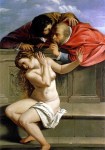


[←] Artemisia Gentileschi – Susanna and the Elders (1610); [+] Kathleen Gilje – Susanna and the Elders {Restored) (1998); [→] Kathleen Gilje – Susanna and the Elders {X-Ray of Restoration} (1998)
There’s another post featuring the restoration and the subsequent x-ray–specifically additions regarding the biographical details surrounding Gentileschi that are making the rounds on art history nerd tumblr. However, the original post is not as clear as it could be so I’ve tried to clarify that here.
Alright, just so we’re all on the same page: the left-most painting above is Gentileschi’s original (circa 1610–bear in mind she produced multiple iterations of this same story throughout her life). The middle painting is Gilje’s painstaking copy of Gentileschi’s painting. The right most image is an x-ray of Gilje’s restoration; wherein Gilje originally painted Susanna caught in a scream of rage holding a knife which was subsequently corrected. Painting something and then painting over it would’ve been a contemporaneous exercise during Gentileschi’s career and x-rays are frequently employed on such work to see what the artist was originally thinking. This restoration and x-ray are an attempt to connect the narrative of the story of Susanna and the Elders to Gentileschi’s lived experience.
Now some context provided eloquently by @rgfellows:
Oooh my gosh this is rad. This is so rad.
For those who don’t know about this painting, the artist was the Baroque artist Artemisia Gentileschi.
Gentileschi
was a female painter in a time when it was very largely unheard of for a
woman to be an artist. She managed to get the opportunity for training
and eventual employment because her father, Orazio, was already a well
established master painter who was very adamant that she get artistic
training. He apparently saw a high degree of skill in some artwork she
did as a hobby in childhood. He was very supportive of her and
encouraged her to resist the “traditional attitude and psychological
submission to brainwashing and the jealousy of her obvious talents.”Gentileschi
became extremely well known in her time for painting female figures
from the Bible and their suffering. For example, the one seen above
depicts the story from the Book of Daniel. Susanna is bathing in her
garden when two elders began to spy on her in the nude. As she finishes
they stop her and tell her that they will tell everyone that they saw
her have an affair with a young man (she’s married so this is an offense
punishable by death) unless she has sex with them. She refuses, they
tell their tale, and she is going to be put to death when the
protagonist of the book (Daniel) stops them.So that painting
above? That was her first major painting. She was SEVENTEEN-YEARS-OLD.
For context, here is a painting of the same story by Alessandro Allori
made just four years earlier in 1606:

Wowwwww.
That does not look like a woman being threatened with a choice between
death or rape. So imagine 17 year old Artemisia trying to approach
painting the scene of a woman being assaulted. And she paints what is
seen in the x-ray above. A woman in horrifying, grotesque anguish with
what appears to be a knife poised in her clenched hand. Damn that shit
is real. Who wants to guess that she was advised by, perhaps her father
or others, to tone it down. Women can’t look that grotesque. Sexual
assault can’t be depicted as that horrifying. And women definitely can’t
be seen as having the potential to fight back. Certainly not in
artwork. Women need to be soft. They need to wilt from their captors but
still look pretty and be a damsel in distress. So she changed it.What’s
interesting to note is that she eventually painted and stuck with some
of her own, less traditional depictions of women. However, that is more
interesting with some context.(Warning for reference to rape, torture, and images of paintings which show violence and blood.)
So,
Gentileschi’s story continues in the very next year, 1611, when her
father hires Agostino Tassi, an artist, to privately tutor her. It was
in this time when Tassi raped her. He then proceeded to promise that he
would marry her. He pointed out that if it got out that she had lost her
virginity to a man she wasn’t going to marry then it would ruin her.
Using this, he emotionally manipulated her into continuing a sexual
relationship with him. However, he then proceeded to marry someone else.
Horrified at this turn of events she went to her father. Orazio was
having none of this shit and took Tassi to court. At that time, rape
wasn’t technically an offense to warrant a trial, but the fact that he
had taken her virginity (and therefore technically “damaged Orazio’s
property”. ugh.) meant that the trial went along. It lasted for 7
months. During this time, to prove the truth of her words, Artemisia was
given invasive gynecological examinations and was even questioned while
being subjected to torture via thumb screws. It was also discovered
during the trial that Tassi was planning to kill his current wife, have
an affair with her sister, and steal a number of Orazio’s paintings.
Tassi was found guilty and was given a prison sentence of…. ONE. YEAR…….
Which he never even served because the verdict was annulled.During
this time and a bit after (1611-1612), Artemisia painted her most
famous work of Judith Slaying Holofernes. This bible story involved
Holofernes, an Assyrian general, leading troops to invade and destroy
Bethulia, the home of Judith. Judith decides to deal with this issue by
coming to him, flirting with him to get his guard down, and then plying
him with food and lots of wine. When he passed out, Judith and her
handmaiden took his sword and cut his head off. Issue averted. The
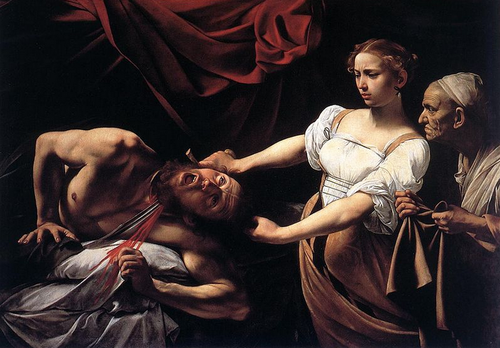
subject was a very popular one for art at the time. Here is a version of
the scene painted in 1598-99 by Carivaggio, whom was a great stylistic
influence on Artemisia:
This
depiction is a pretty good example of how this scene was typically
depicted. Artists usually went out of their way to show Judith
committing the act (or having committed it) while trying to detach her
from the actual violence of it. In this way, they could avoid her losing
the morality of her character and also avoid showing a woman committing
such aggression. So here we see a young, rather delicate looking Judith
in a pure white dress. She is daintily holding down this massive man
and looks rather disgusted and upset at having to do this. Now, here is
Artemisia’s:

Damn.
Thats a whole different scene. Here Holofernes looks less like he’s
simply surprised by the goings ons and more like a man choking on his
own blood and struggling fruitlessly against his captors. The blood here
is less of a bright red than in Carrivaggio’s but is somehow more
sickening. It feels more real, and gushes in a much less stylized way
than Carrivaggio’s. Not to mention, Judith here is far from removed from
the violence. She is putting her physical weight into this act. Her
hands (much stronger looking than most depictions of women’s hands in
early artwork) are working hard. Her face, as well, is completely
different. She doesn’t look upset, necessarily, but more determined.It’s
also worth note that the handmaiden is now involved in the action. It’s
worth note because, during her rape trial, Artemisia stated that she
had cried for help during the initial rape. Specifically she had called
for Tassi’s female tenant in the building, Tuzia. Tuzia not only ignored
her cries for help, but she also denied the whole happening. Tuzia had
been a friend of Artemisia’s and in fact was one of her only female
friends. Artemisia felt extremely betrayed, but rather than turning her
against her own gender, this event instilled in her the deep importance
of female relationships and solidarity among women. This can be seen in
some of her artwork, and I believe in the one above, as well, with the
inclusion of the handmaiden in the act.So, I just added a million
words worth of information dump on a post when no one asked me, but
there we go. I could talk for ages about Artemisia as a person and her
depictions of women (even beyond what I wrote above. Don’t get me
started on her depictions of female nudes in comparison to how male
artists painted nude women at the time.)To sum up: Artemisia Gentileschi is rad as hell. This x-ray is also rad as hell and makes her even radder.
I love art history.


 Acetylene Eyes