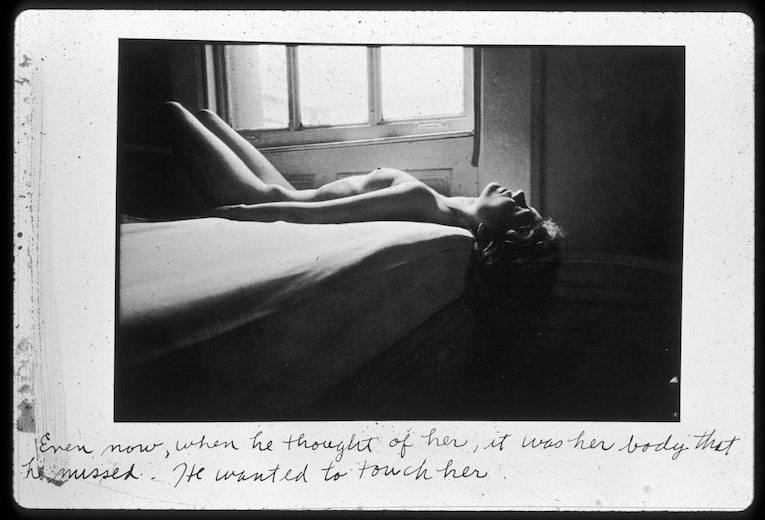
Duane MichalsEven now, when he thought of her, it was her body that he missed. He wanted to touch her. from Person to Person
 (1974)

Quite frankly, Michals’ frustrates the piss out of me. His work is always so goddamn in-fucking-scrutable.

Take this. As with many of his prints, it’s unrefined, sloppy. But it works. And the reason it works had to do with the presentation.

Michals’ tends to present his photographs as a series. He also frequently imposes inscriptions on the image which tend to hijack mere archetypal readings. The inscriptions read like crib notes to the artists more than the audience. Their hurried, seemingly off-the-cuff character enact a strange sort of alchemy wherein the weary, ailing aspects of the image become assets instead of liabilities. 

For example:

This photograph is one of 15 photographs in a series entitled Person to Person which invokes Lynchian account of a relationship’s dissolution. (It’s a little Lost Highway (in structure), a little Mulholland Dr. (in content).

The image I’ve featured is beautiful–in spite of not being on speaking terms with mid-tones. Yet, what’ s interesting is the way the text colors the image with a wistful resignation.

Without seeing another image: the words re-contectualize the photo so that the audience understands that they are envisioning the lover for which the ‘he’ pines. He misses her and wants to touch his lover’s body but cannot. Something happened and they are no longer together.

As you browse through the series, the basic narrative is clearly presented in each frame. And with each additional frame, the story is implicitly re-stated and more details are sussed out.

In the end, although I really don’t want to, I can’t help but like Michals. He’s the type that prefers the prospect of two marshmallows later to one now. But unlike the rest of us, he somehow always manages to have one now and two later.

[

Normal
0

false
false
false

EN-US
X-NONE
X-NONE

/* Style Definitions */
table.MsoNormalTable
{mso-style-name:”Table Normal”;
mso-tstyle-rowband-size:0;
mso-tstyle-colband-size:0;
mso-style-noshow:yes;
mso-style-priority:99;
mso-style-parent:””;
mso-padding-alt:0in 5.4pt 0in 5.4pt;
mso-para-margin-top:0in;
mso-para-margin-right:0in;
mso-para-margin-bottom:10.0pt;
mso-para-margin-left:0in;
line-height:115%;
mso-pagination:widow-orphan;
font-size:12.0pt;
mso-bidi-font-size:11.0pt;
font-family:”Garamond”,”serif”;}

↑] Les KrimsFall, Fargo Avenue, Facing the West Side Armory, Buffalo, New York (1969)

[

Normal
0

false
false
false

EN-US
X-NONE
X-NONE

/* Style Definitions */
table.MsoNormalTable
{mso-style-name:”Table Normal”;
mso-tstyle-rowband-size:0;
mso-tstyle-colband-size:0;
mso-style-noshow:yes;
mso-style-priority:99;
mso-style-parent:””;
mso-padding-alt:0in 5.4pt 0in 5.4pt;
mso-para-margin-top:0in;
mso-para-margin-right:0in;
mso-para-margin-bottom:10.0pt;
mso-para-margin-left:0in;
line-height:115%;
mso-pagination:widow-orphan;
font-size:12.0pt;
mso-bidi-font-size:11.0pt;
font-family:”Garamond”,”serif”;}

↓] Masha Sardari – The Ashen Heart (2013)

Juxtaposition as commentary.

Google Image Search suggests the earliest instance of this image being post to a site on Blogspot called Tacobill in June 2010 even though all the links on the page are broken. Beginning in August 2010 a broad swath of entries are attributed to So Many Boys. (EDIT: Wyohhandplay was kind enough to inform me that the source for this is bitemarks.)

It’s really a shame. For what it is– a staged photo of a boy with his fist circling his cock– I think this is classy.

The composition is nice. He’s presented entirely within the frame, not making eye contact with they camera. His body’s mid-line angles to his right, counter-balancing the framing which clips the vertical of the lamp base against the middle vertical of the metal bed frame/headboard.

With the lamp turned toward the wall, the light blows out into a white-hot super overexposed orb. In turn this allows the reflected light to illuminate the rest of the frame with appealing, dusky tones.

It’s an artful take on what could have easily been another uninteresting, disposable iteration of the same old thing.

Normal
0

false
false
false

EN-US
X-NONE
X-NONE

/* Style Definitions */
table.MsoNormalTable
{mso-style-name:”Table Normal”;
mso-tstyle-rowband-size:0;
mso-tstyle-colband-size:0;
mso-style-noshow:yes;
mso-style-priority:99;
mso-style-parent:””;
mso-padding-alt:0in 5.4pt 0in 5.4pt;
mso-para-margin-top:0in;
mso-para-margin-right:0in;
mso-para-margin-bottom:10.0pt;
mso-para-margin-left:0in;
line-height:115%;
mso-pagination:widow-orphan;
font-size:12.0pt;
mso-bidi-font-size:11.0pt;
font-family:”Garamond”,”serif”;}

There’s a cropped, desaturated version of this with nearly 5K notes.

I’m not knocking it altogether—whoever shopped it had to have some fierce chops to dodge the area around the right eye while keeping the skin tone throughout consistent.

The edit emphasizes the young woman as a signifier of conventional beauty norms. It’s a flat casual shot.

It’s not how it reads in color, with the original framing.

This way the image is not flat. The single source of illumination is a skylight visible in the top-right corner of the frame. There is a dynamic contrast range—dark underexposed shadow areas to bright overexposed light pooling on the young woman’s skin.

And this way the awkward framing the removes the top of the young woman’s head and deletes her feet is logically explained by additional context—namely, the room is very small and the image maker is likely backed against a wall.

The original resonates with a warmth and intimacy—the antithesis of casuality.

kalkibodhi:

The reach through

KalkiBodhi Archives

Even though it’s oriented without any goddamn regard for compositional logic and lacks the technical rigor and sophistication of say a comparable work by Robert Mapplethorpe, this image is noteworthy for avoiding the visual impoverishment which seems to follow as an almost natural consequence of focusing on the extremity of the act– an experience contrary to the experience of fisting and being fisted.

Not that extremity should be excluded. It is more that any roughness or violence in the exchange is– at least in my own experience– is beside the point. It’s about intimacy/connection; or, more specifically it strips the pretense and affectation of intimacy/connections, laying bare the vital underlying vulnerability. 

That’s my two cents, anyway. And since our experiences ends up projected outward on the world around us, this is what I see here.

Plus, I think it’s hell of sexy that you can see her piercing.

creativerehab:

Valeriya on the bed.

Normal
0

false
false
false

EN-US
X-NONE
X-NONE

/* Style Definitions */
table.MsoNormalTable
{mso-style-name:”Table Normal”;
mso-tstyle-rowband-size:0;
mso-tstyle-colband-size:0;
mso-style-noshow:yes;
mso-style-priority:99;
mso-style-parent:””;
mso-padding-alt:0in 5.4pt 0in 5.4pt;
mso-para-margin-top:0in;
mso-para-margin-right:0in;
mso-para-margin-bottom:10.0pt;
mso-para-margin-left:0in;
line-height:115%;
mso-pagination:widow-orphan;
font-size:12.0pt;
mso-bidi-font-size:11.0pt;
font-family:”Garamond”,”serif”;}

A film school cohort of mine (and long-time shameless Tumblr lurker) begged me to re-blog this photo of Valeryia.

Normal
0

false
false
false

EN-US
X-NONE
X-NONE

/* Style Definitions */
table.MsoNormalTable
{mso-style-name:”Table Normal”;
mso-tstyle-rowband-size:0;
mso-tstyle-colband-size:0;
mso-style-noshow:yes;
mso-style-priority:99;
mso-style-parent:””;
mso-padding-alt:0in 5.4pt 0in 5.4pt;
mso-para-margin-top:0in;
mso-para-margin-right:0in;
mso-para-margin-bottom:10.0pt;
mso-para-margin-left:0in;
line-height:115%;
mso-pagination:widow-orphan;
font-size:12.0pt;
mso-bidi-font-size:11.0pt;
font-family:”Garamond”,”serif”;}

He’s interested in booking her for a photo shoot but claims the Google has exactly zilch on her.

If you know her or have decent info to pass along, maybe throw him a line: minuslinear at yahoo dot com.

The first thing I notice—okay, truthfully the second: the first thing I notice is the muddled lighting design—has something to do with the difference between ‘work’ and ‘labor’.

I am not especially fond of work and I tend toward laziness.

Work is not a thing from which I derive pleasure. I do it because I prefer a certain degree of misery to living on the street at the mercy of my growling empty stomach.

Labor, on the other hand, while not necessarily intrinsically pleasurable does possess the capacity to induce joy.

Even that is perhaps too abstract. A better way to put it would be saying: work is unloading the truck; labor is not unlike making a game of unloading the truck.

On the surface, that sounds stupid. But everyone has experienced this transformation of dull, repetitive tasks into games: Joe stacks boxes on the loading dock as quickly as he can with Margie hefting them onto a conveyor belt even faster in an effort to allow her to stand around—if only for a second—and gets to friendly needle Joe about how slow he’s moving.

Sex is a form of labor; or, it should be—with give and take, friendly but unrelenting pushing of boundaries.

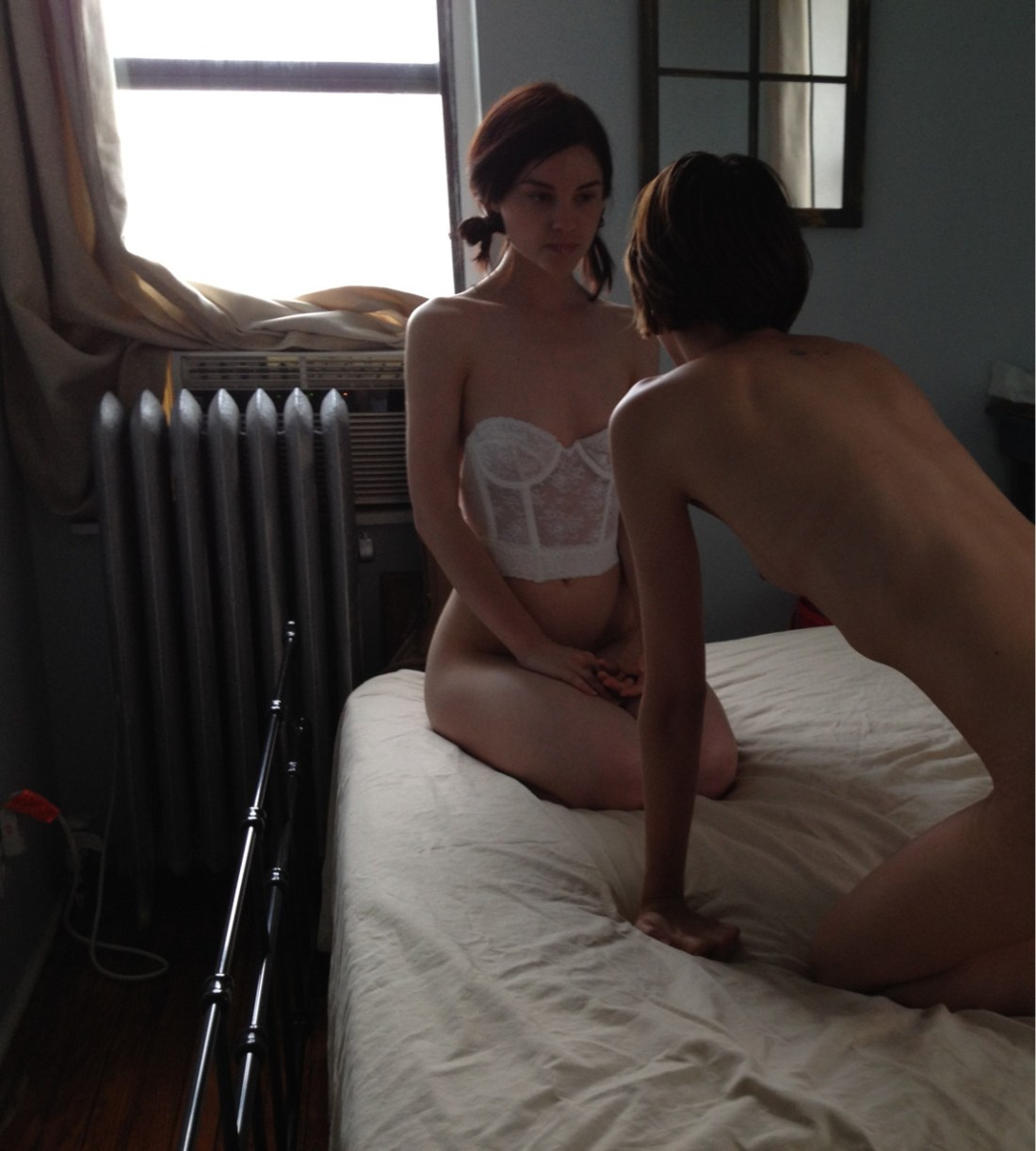
One gets the feeling that these two young women are working. This is a job for them. But their eye contact, the intense focus of the woman on the left and the pink flush to the girl on the right suggest that both are holding back, racing to make the other first in succumbing to a shuddering ecstasy.

But unlike most races, there are no losers—only winners.

Kara Neko and Brittany

Ibn Arabi, a venerable Sufi mystic, understood reality as the breath of Allah—praise upon him.

All was tohu va bohu until Allah—praise upon him—breathed out, creating the world. But, upon breathing in again this newly world vanished, returning to Him to be annihilated. Until he breathes out again, calling another completely formed reality into existence.

This notion is called continuous creation.

In case that is not entirely clear there is one of those rare perfectly serving metaphors: cinema. A reel of film consists of thousands of individual frames. Each frame only a little different than the one before and after it. As the strip runs through the projector at a continuous rate, a shutter that blocks each frame as it appears and before it disappears; thus the stream of discontinuous images appear to be continuous, fluid.

Over the last four years, I have spent a lot of time thinking about stories: making some up, listening to others them their own, stripping them down like that crazy uncle who thinks he can not only fix the toaster but make it work better if he can only get it put back together again.

And I am realizing that well-told stories are almost always acts of continuous creation.

Take these two exquisite young women in the above photograph image. (’Photograph’ as it’s likely this is a 6×7 image scanned from 120 color negative film. EDIT: Kara contacted me to correct this was taken with an iPhone by her boyfriend.) Despite the awkwardness of the framing—seriously we all see you are observing the rule of thirds but nothing was gained by this not being framed horizontally!)—this is a seed which contains an entire narrative within it.

Look at just what is within the frame: an uninspired bedroom in a small apartment, daylight streams through the windows (yes, plural—check the mirror over the bed).

Invariably, despite even Hollywood’s best efforts one lover always ends up undressed before the other. And here the naked one leans towards the other eyeing her bust line—her pose is assertive, communicating a physical desire but her distance is close enough to make her desire clear but still respectful of possible reservations. She of the bustier appears uncertain, her hands a mix of openness and hesitation.

The story is here. There are different ways it can go, yes. But one person is more in love than the other. Both see the edge of the cliff approaching but what you survive is always preferable to what might have been. The tension holds even though we already know how it all ends already.

I love their closed eyes, the bright flush to their faces, the bodies tense with forestalled impatience— I want you to enjoy it, enjoy me enjoying you enjoying it—a full-blown sensory flashback: I remember my knees shaking and teeth transformed to mercury quivering in my gums and the weight of knowing— God himself did make us into corresponding shapes like puzzle pieces from the clay; knowing is not enough against wanting, wanting to see this through tired-tired eyes spread holy-holy awed and wide as the wet of lips meeting and our fumbling lead boned find those secret fleshy spaces with their tiny, tiny alters to bear and burn lonely so many offerings.

The pale one, her fingers slid up almost to the wrist into the others blue-grey briefs, deeper; while she is herself caressed through white knickers— I remember the slick groove of a dew pussy leeching through cotton and then glistening silken on gliding fingertips.