Jacque JordãoUntitled (2016)

As best as I can tell, Jordão is a Brazilian model with a killer fashion sense with an impressively varied range of projects in her portfolio.

Her Tumblr usually credits other photographers–there this is likely a self-portrait.

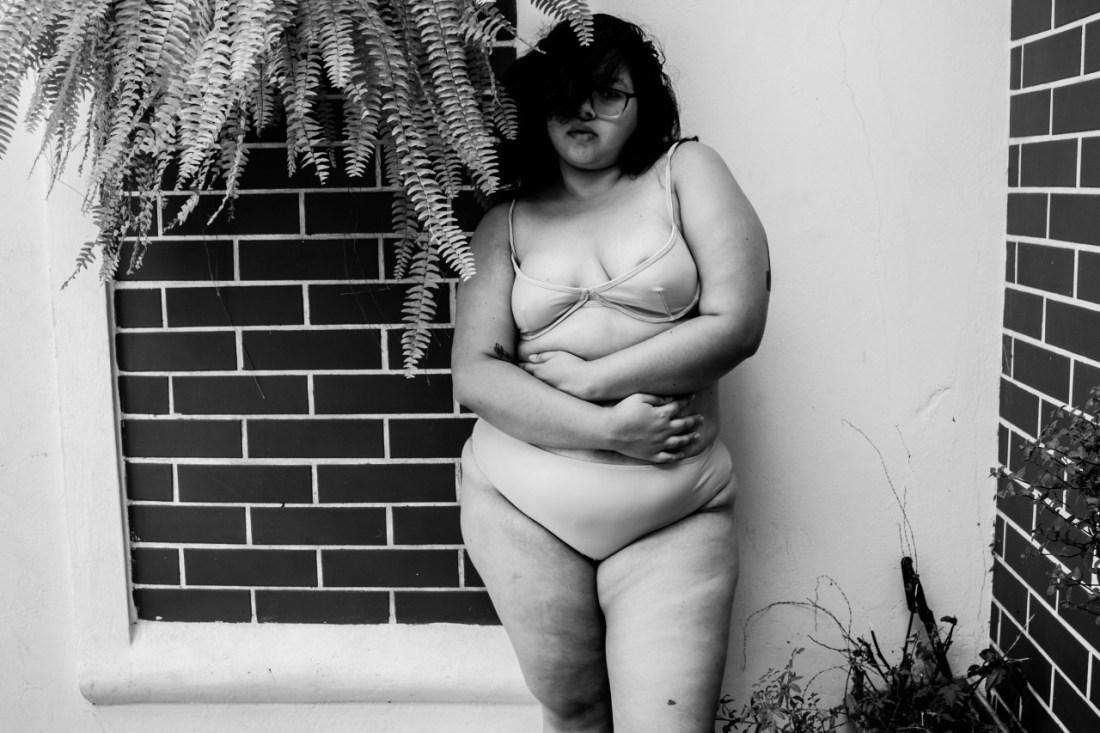
Technically, this makes a number of ‘mistakes’. For example: the reason that so many photographers and image makers prefer to work with seamless backdrops is so that the location becomes less of a consideration that the subject. (Also, you can light the subject in any fashion you choose with much less effort than working in an actual real-life environment with light shifting over time, physical obstacles getting in the way, etc.)

This notes he contrast of the bright white wall and the less brilliant white mortar and dark bricks as an astute backdrop for a monochrome image.

This is actually underexposed–likely a feature of this almost certainly being taken with a kit zoom lens, wherein the fixed aperture limits exposure adjustments to ISO and shutter speed. (This is almost certainly a lower ISO–as there really is very little noise.)

I haven’t actually opened this in Photoshop to check the histogram, but my gut says there’s probably 2/3 of a stop before the highlights well and truly blow–and you can usually pull them back just enough in post so they aren’t pure white.

Objectively, it likely would’ve been preferable to figure out what you’d need to set the shutter speed at to show detail in her hair, then split the difference between that and the settings which produced this image.

Yet… I can’t really fault things too much–because although the choices that went into producing this are arguably less than pristine, they do actually work. For example, I’d usually complain about the failure to align verticals with the left and right frame edges. Here, I can’t.

The downward tilt of the camera suggests that the viewer is roughly the same height as the model but is looking down in a submissive fashion. There is–fundamentally within the image at the level of visual grammar: a sense that the subject is intimidating.

In tandem with the way Jacque is standing in the shadow of the potted fern, with her hair swooping low over her right eye–there’s an added layer of enigma in the way her expression and even whether or not she’s looking at the camera remain inscrutable.

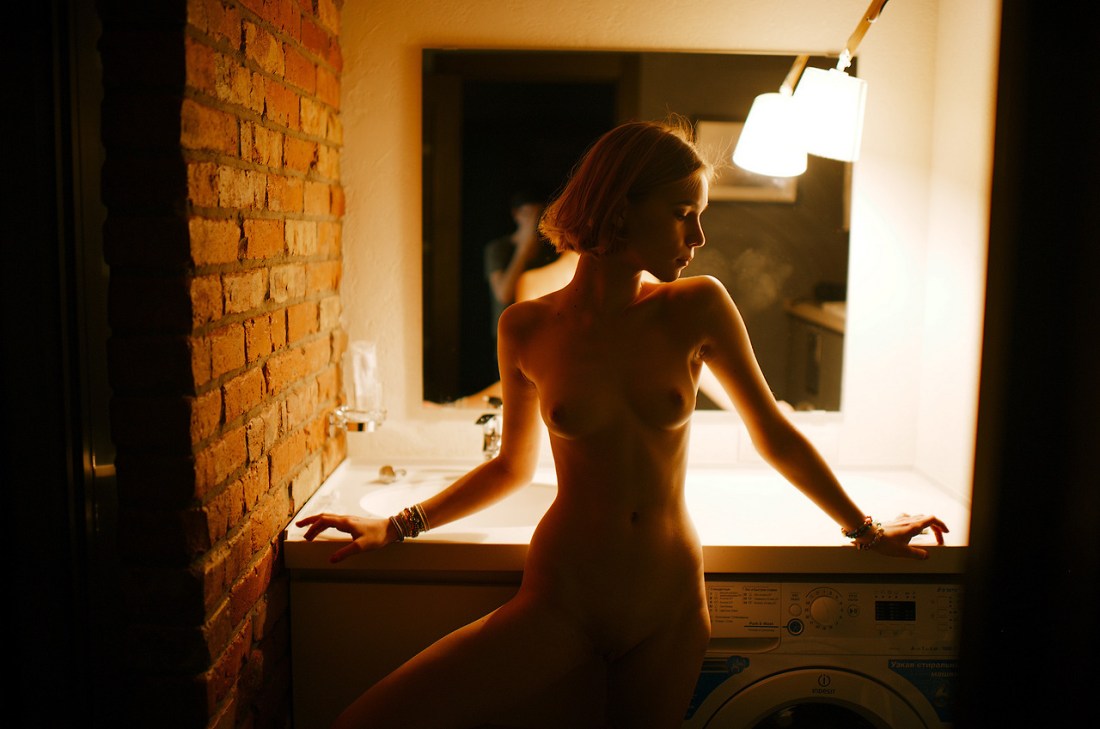
Marat SafinCamapa (2017)

This image has been shuffled around in queue for more than a month.

Initially, I wanted to focus on Safin’s knack for consistently presenting the women with whom he works–regardless of whether or not they acknowledge the camera/viewer–as reveling (for lack of a better word) in their own femininity; since, you know: that is the one consistent piece in his work.

This rapidly degenerated into a morass of attempting to balance an unbalance-able equation of problematics to virtue, however.

Next, I figured it was damn time I called out Brooke Shaden again–seriously her work is fucking inexcusably god awful. (The connective tissue being how both use over-the-top post-process intervention to justify their images’ existence. On the one hand, Shaden guilelessly embraces the Lynchian conflation of the grammar of surreality with the grammar of the oneiric–not that Lynch is inherently bad, it would just be better if more folks considered his work as a cautionary tale warning against any sort of casual and/or unconsidered aping of his style. Safin’s manipulation are similarly egregious but they integrate holistically with the images and never insist on themselves.)

For a while, I had it following this image in an effort to point out backlighting and then present something backlit and subsequently drawing attention to an aspect other than the backlighting. (A good teacher–and what else is a curator?–makes efforts to build occasions into the lessons where the student gets to feel smart but by paying attention/staying engaged.)

Yet… all the time the only thing I want to talk about is the fundamental Russian-ness of his work.

I mention this all the time but I’ve yet to define it in any sort of non-abstracted fashion. I think I may have found a way to do it–not now, but maybe at some point down the road.

See: looking at this image, I’m reminded of Igor Mukhin’s color work with the Leica AG M9 (an absolutely fabulous camera if you can stomach the astonishing cost)–specifically the vivid blacks it renders.

Safin is using a Nikon d700 with a 35mm f1.4g lens–as far as I can tell it’s the lens he’s used for most of the stuff he’s posted in the last year or so.

A good 35mm lens is an interesting beast. It’s wide angle without adding too much unattractive distortion–the wider the lens for example the more unflattering it is to say the dimensionality of the human face, for example.

Yes: Safin is not using it on anywhere near the level of precision and care as Mukhin; but credit is due for managing what he does with a camera that’s a fraction of the cost as Mukhin’s top of the top of the line kit.

An idea occurred to me in the process of unpacking all the above: I began to wonder about respective influences of these two artists.

All I’ve managed to find regarding Mukhin is that he studied with Alexander Lapin and that he cites Alexander Rodchenko and Lou Reed as influences.

Rodchenko is actually super useful in getting at what I mean when I point to essential Russian-ness of a photo or image. (It occurs to me that it might be interesting to create an infographic wherein the historical influence of Rodchenko is mapped.)

Lou Reed is more interesting. I dig The Velvet Underground just as much as the next arty fucker. And I’ve heard literally all the correctives about what a heinous human being he was. (Anyone who worked at Film Forum in the mid-to-late aughts can tell you stories that will strip paint off walls.)

But, as far as I know, Reed believed rock and roll could save the mortal soul. (I think this is one reason his work appeals to me so very much; I would not be here now if it weren’t for music, in general–but specifical Rock and Roll.)

I found the mention of the influence of Rodchenko and Reed in a blurb about Mukhin penned by A. D. Coleman. I don’t agree with all the author’s conclusions; namely: I’d bet a tidy sum on the fact that Mukhin was intimately familiar with Robert Frank before he began documenting youth culture in the Soviet Union in the 1980s, the notion that Mukhin is somehow inherently more conservative for not being familiar with/embracing the work of someone like William Klein is disingenuous, a bad faith engagement with Mukhin’s work and prejudices America’s role in the advancement of the photographic medium in a fashion that’s a little too imperialistic to be allowed to stand.

Interestingly–and I promise I’m working my way back ‘round to Safin, Coleman does at least imply the dual role of culture and individual taste in the creation of work. To the extent that Mukhin has lived in Russia all his life, his life has been impacted by state censorship then and now. I’m not entirely sure that his gravitation towards youth culture and it’s stock and trade in activities, practices and documents banned by the state was entirely innocent. (We move towards what moves us–so my thought is that Mukhin either already had access to western work most others wouldn’t have seen or he gained access to them through this path.)

But the question of how freely information flows and how it impacts questions of artistic influence is something to consider–all the more in the light of Mukhin vs. Safin; or: pre-Peristroka state censorship vs post-Soviet surgical censorship.

There’s a very fine line between doing the work and feeding the work. A better way to say it is that Andrei Tarkovsky always claimed that he was a better artist for having to navigate around concerns of state censorship–in other words: being able to convey his premise in both the shape, form and manner he intended while not running afoul of anyone.

I feel like as long as you are doing your own work and feeding the doing by critically, appreciatively and contemplatively looking at other people’s work–that’s a good place to be. The problem is that with so much information out there, part of the work becomes feeding the work and it’s dangerous to fall into that trap because that’s where it’s very easy to began aping the work of others.

And at the bottom of it I think that’s what I mean by essential Russian-ness the attempt to balance scarcity with abundance. Because speaking of mapping influence–an interesting project (and if anyone does this and does a good job I will actually post your work here): would be to map Marat Safin’s influences because I can’t think of another image maker whose work is such a who’s who of paen to virtually all the top notch internet famous photographers and image makers active today.
alveoliphotography:

August, 2015.

Tiffany Helms x Alveoli Photography

This post is guest curated by @suspendedinlight.

As someone usually preoccupied with stillness, my favourite thing about
Alveoli Photography’s work is actually how it always feels on the verge
of coming to life. I can look at his images and feel that they are
moving and breathing. Also I genuinely think
Tiffany Helms is one of the most talented faces out there right now.
Her expressions are so genuine, she can tell an entire story, sell an
entire image with her eyes. I can’t decide with this one whether she
might be inviting the viewer in or walking them
out.

Jacs FishburneAnd the stars falling cold in the river vales where we found ourselves again (2015)

We need to talk about how absolutely in-fucking-credible the work Jacs has been doing lately is.

‘Breathtaking’, ‘spectacular’, ‘the level beyond the next level’: pick a top shelf superlative and fill in the blank. I promise no matter the word, it won’t be overstating the matter.

Lula HyersUntitled (2014)

Were you to take the current bumper crop of twenty-something lifestyle/fashion image makers, write their names on slips of paper, fold up those slips and place them into a hat, shake the hat about and pull out a name at random, any name would share some obvious parallel with Hyers’ work.

I am certain that Hyers would be at least passingly familiar with the large majority of names in that hat. She probably even considers many of them influences. The thing is: her work is also frequently better than the work of at least ¾ of those names that might emerge from the hat.

A bold statement: yes; but if you stop and look at her work–I mean engage with it–you can’t dispute the assertion. Add to that, Hyer’s still being a teenager and Jesus Harold and Maude Fucking Christ on Christmas her aptitude is freaking unbelievable.

And while I am of a mind that she’s better than the majority of her peers/influences, what she does better than just about anyone is the way she presents bodies and the sometimes related sometimes unrelated sexual expression of bodies as almost an afterthought–allowing her broad latitude in presented the truth of those in her life without misrepresenting the complexity of the moments she captures or relying on knee jerk shock value.

It’s surprisingly mature work for someone so young. And although comparisons to those aforementioned twenty-something lifestyle photographers are astute (along with correlations to Goldin and McGinley), I feel there’s a closer relationship with the frenzied urge to document life exemplified by one of my favorite photographers Igor Mukhin.

What I see matters little next to  than simple truth that this work is breathtaking; I cannot wait to see where it goes from here.

Kim Eliot FungPhenomenon of Being 2006

Normal
0

false
false
false

EN-US
X-NONE
X-NONE

/* Style Definitions */
table.MsoNormalTable
{mso-style-name:”Table Normal”;
mso-tstyle-rowband-size:0;
mso-tstyle-colband-size:0;
mso-style-noshow:yes;
mso-style-priority:99;
mso-style-parent:””;
mso-padding-alt:0in 5.4pt 0in 5.4pt;
mso-para-margin-top:0in;
mso-para-margin-right:0in;
mso-para-margin-bottom:10.0pt;
mso-para-margin-left:0in;
line-height:115%;
mso-pagination:widow-orphan;
font-size:12.0pt;
mso-bidi-font-size:11.0pt;
font-family:”Garamond”,”serif”;}

It’s like returning to a location that filled the child-mind with its enormity only to find it suddenly shrunk, like music that once moved you, moving on now without you.

A rule to which there are precious few exceptions.

The disparity between perception and reality has to burn away over time, like morning fog. Perhaps this is what Baudelaire was about when he advised poets to burn anything written before the age of twenty-five if they wanted to be taken seriously.

If you take the idea of poetry literally: what of Rimbaud—who wrote everything he would ever write prior to turning twenty?

What if you define poetry as did Emily Dickinson—and I do—what does this mean for the photo poetry of Francesca Woodman?

What about Kim Eliot Fung who was a teenager when she made this photograph?

I mean there are certainly criticisms that can be made here—adolescent angst, sentimentality. I might even add question with regard to why the model’s head is cut off—though I think the effort of the image has something to do with the spectators gaze and how an awareness of that implication inverts and skews notions of anonymity, gender perception/performance and the politics of visual representation of identity.

Criticisms that the work lacks refinement or is unaccomplished are completely off base. In other words, it suggests a precocious understanding of what maturity entails even if it has not yet fully reached maturation.

This is one of my favorite photographs. Unlike so many things that I return to in time, this does not seem smaller than my memory of it. If anything, the opposite is true: the image itself seems larger, richer and fuller when measured against my memory of it.

It’s my hope that Ms. Fung will return to photography at some point. Until then she makes aprons and curates the always impressive Editor’s Index.