Normal
0

false
false
false

EN-US
X-NONE
X-NONE

/* Style Definitions */
table.MsoNormalTable
{mso-style-name:”Table Normal”;
mso-tstyle-rowband-size:0;
mso-tstyle-colband-size:0;
mso-style-noshow:yes;
mso-style-priority:99;
mso-style-parent:””;
mso-padding-alt:0in 5.4pt 0in 5.4pt;
mso-para-margin-top:0in;
mso-para-margin-right:0in;
mso-para-margin-bottom:10.0pt;
mso-para-margin-left:0in;
line-height:115%;
mso-pagination:widow-orphan;
font-size:12.0pt;
mso-bidi-font-size:11.0pt;
font-family:”Garamond”,”serif”;}

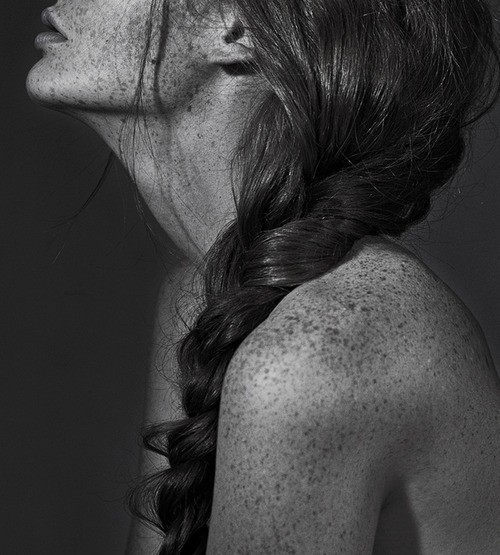
Great googly moogly aren’t freckles goddamned sexy as fuck?

And their effusion on this young woman’s shoulders and face is truly resplendent.

Now I could follow my usual knee-jerk rabbit trail with regard to composition—a horizontal frame would have almost certainly improved this photograph—but the freckles seem more the point.

Photography and digital imaging distill the space and time of a select visible area down to a two-dimensional representation. In the process, a great deal is changed and/or lost completely.

To a degree, image makers exercise control over what remains in the picture. For that reason, I am constantly unnerved that given a field of so many options the results of what stays and what goes tend to be so starkly homogenous.

Most images provide a record of an objects position in a particular spatial field at a given moment in time. How often though is the object treated as more than an insinuation representation of itself? Or, to say it in a less abstract way: when was the last time you say an image wherein skin was presented as more than the container for representation identity or a symbolic placeholder?

It’s not just pictures of people, it’s fabric, wood, everything. Photography fails more often than it succeeds to give solidity to its representations. A means of accomplishing that is beginning to think less strictly visually. There is this amazing sensory overlap between sight and sound—a sort of synesthesia that everyone shares: the sight of different textures affects our eyes differently, in a way that is—in fact—somewhere between seeing and feeling.

For example, consider this image of coffee beans ground to varying coarseness. By looking at them you see the different visual texture but that impression is processed in some fashion as an awareness that each feels different.

That’s ultimately what I adore about this image: her freckles add texture to her skin and thus weight and solidity to her body. She is not a representation; she’s a living, breathing, dreaming being with fears, hopes and ideas who also happens to be breathtakingly beautiful.

youarecordiallyinvitedtopissoff:

Reto Caduff 

It is unnecessary to state this comes from a series called Road Trip; the feeling of driving through some summer night with the windows half-down into dawn is embedded:

The thick-limbed weight of waiting as humidity films the skin.

The lulling half-time found in shared space, motion and momentum.

Eyelids heavy with loneliness, with wind-whipped hair, with the world of trains and lightpoles smeared against the windows.

William Eggleston – Two Girls on Couch 1976

When photographers gather and conversation turns as it will to Eggleston, you hear a lot of talk about color. After all, the man all but made color photography a meritorious visual art medium single-handedly.

What everyone misses in the justified fuss and bustle over grand spectacle of color is just how deliciously subversive the work is—rich with subtly deviant, transgressive flourishes.

Take the Red Ceiling: check out the poster edge stretching into the lower left corner of the frame; and how damn fucking creepy is this one yet you don’t stop to think about that because the print is so warm, mellow and aesthetically pleasing.

Eggleston is unrivaled in inciting within the spectator an understanding of why—visually speaking—the photo was taken without being aware that such understand implicates the spectator in the artist’s gleeful disdain for anything conventional.

Yes, Two Girls on Couch is not overtly sexual. At the same time, it is not asexual. It focuses on a slippery intimacy, how crossing that perilous bridge over the chasm of puberty changes our instincts with regard to bodily relationship to others.

The fluidity of girl-childhood and femininity in a shimmering ghostly game of leap frog. Customary lines of communication shorting, reconnecting, fading. Being your self to another no longer fits as well, pinches at the seams, effort a new ingredient to produce the same old recipe.

If this possessed the sumptuous colors of Eggleston’s dye transfer prints, the voyeurism of these girls intimacy would read as a leering older man fetishizing a moment he is outside.

Make no mistake such undertone belongs here even though it has been carefully diminished with harsh lighting (a single overhead bulb?)—atypical in Eggleston’s oeuvre. By checking the customarily sumptuous color, the focus shifts away from the artist’s craft and more toward the immediacy of the moment. 

This is not porn. It isn’t exactly transgressive either. But to not recognize the way it edgily toes the line is to miss at least half of what is at work here.

I dig the shit out of edgy. All the better when the craft is fucking impeccable.

Why is there so often an direct relationship between sleek, high-production value and imagistic vapidity?

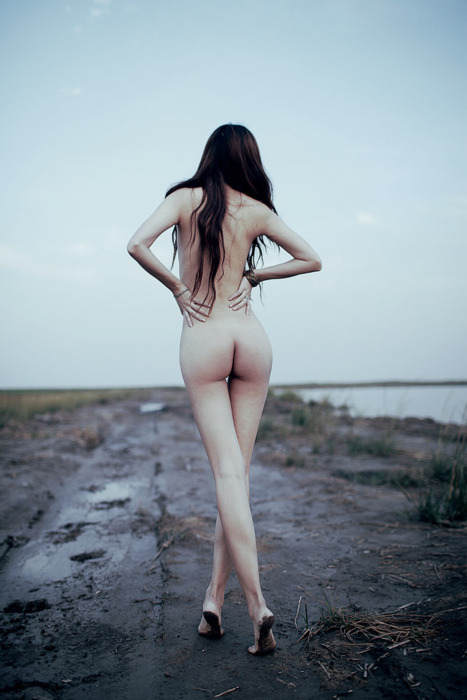
I mean, this image looks stunning. The color is controlled, Albers-esque. The light is just so—morning golden hour most likely, with just enough a kiss from the flash to provide a slightly unearthly skin tone.

But what is this photo trying to convey? All there is to go on is a naked woman with her back facing the camera, her legs crossed in a very contrived pose and the washed out and muddy track on which she stands has stained the bottom of her feet—somehow impossibly also visible.

As with 90% of all instances of vertical framing, nothing is added by this decision—except to make the woman appear taller.

This does succeed but recasts the image as a fashion image that is not selling fashion; sells an aesthetic instead. I suppose that’s fine but without something behind that aesthetic, it is all rather empty.

A better way to criticize this image is to imagine it framed horizontally. (Go ahead and keep the contrived posture.) How does her position in the environment change the questions you ask of the image?

For me, with a horizontal frame the questions I ask generally becomes less about what I think of her and her situation and more wondering what she thinks about herself and her situation.

chichispalabanda:

Artfully depicting masturbation is not an easy feat.

The act is private, sequestered. Thus, the question of how one came to be able to witness such goings on becomes a central—is it voyeurism, exhibitionism or a bit of both?

The more voyeuristic the image, the less intentional it appears and the more it relies upon the reputation of the image maker to supplement its ‘artistic’ merit.

The more exhibitionist the image, the less artful it appears. Exhibitionism being rooted in self-consciousness; the efficacy of the work of art being so frequently measured on its ability to dissolve notions of self and other.

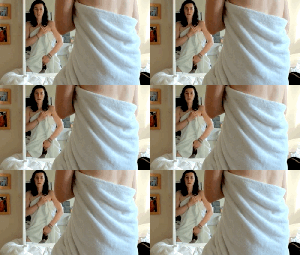
These clips of a larger piece suggest an altogether ingenuous way of subverting this dichotomy: fuck with the distinction between subject and object. What’s the easiest way to do that? Point the camera at a mirror. (And I do not mean any of this teen-girl-shooting-her-reflection-in-the-bathroom-mirror Tumblr noise. I fucking HATE that shit!)

Now, I will not for a second argue that she is unaware of the camera—I am almost certain she is. But is she looking at it or looking at herself in the mirror? This becomes about the spectator watching her watch herself cause and experience her own pleasure.

For me it also has the effect of focusing me on her growing arousal—which while certainly mirroring my own is continually refocused on hers.

Take these photographs—similar in form and content, starkly different in execution.

Top: a stunningly young woman stands on a lanai, skin suffused by white hot tropical light. A medallion—perhaps an inch and a half in diameter—dangles just below her supersternal notch from a thin black cord encircling her neck; a visual trick that succeeds in making her tiny breasts appear flat. Her carefully manicured hands hook a thumb each in the elastic waist of her bikini, offering a glimpse of her depilated pubic area and labia majora. With her head tilted forward and right slightly—she appears as if interrupted in looking down at her body, judging how much of herself to reveal—eyeing finding the aperture and the spectator lurking behind it.

Bottom: Alba, (photographed by the devastatingly talented Lina Scheynius), a stunning young woman stands naked before an amaranth backdrop. Warm amber light—presumably from a window beyond the left frame edge—angles across her chest mirroring the line of her collar bone. Another illumination echoes the angle of the window—correcting it downward slightly— casting white across her right elbow, stomach, hips, unshaven pubis, finally finding her left forearm/hand as a result of the vague contrapposto bearing of her pose. Shadowed, her head gaze downward; focused on something only she can see. A single stray strand of hair escapes the bun atop her head, dangles by her cheek.

I know I am always going on about the politics of frame lines. To what extent I mean that as pertaining to graphically sexual images or all images, I am not sure I can articulate yet.

There is a general “rule” on this matter when it comes to image making: if you have to amputate a limb with the frame edge cut midway between joints instead of closer to the joints; this creating a more life-like rendering. (Don’t ever decapitate! Seriously if you are concerned for your anonymity just take a normal picture and black out your face in Photoshop, already!)

Which of the above follows this rule? What is the effect?

Also, note how the vertical frame edges in the top image do not line up with the fence or the edge of the patio.

The young woman in the top photo is sexually appealing in the extreme. After first blush, she is perfect. At the same time, she is not someone I am convinced could ever be known in any sense. Her eye contact purports a false intimacy, implies that if our paths ever crossed I would be best served to view her as nothing more than her exquisite body instead of seeing her as someone with a life that goes well sometimes, others not so much; who has needs both met and unmet. I am not saying she is objectified so much as reduced to an archetypal idea.

On the other hand: with every shred of context removed except her body, I find myself wondering who this Alba is, what her inner life is like at the same time I am aware that she wouldn’t owe me an answer if I ever met but that if I were lucky she might not mind being asked.

In the end, the last image is for me sexier; like most of Scheynius’ photos its restraint, patience and passion sears itself like a brand onto your visual memory.

The above frame would benefit from a slight shift down and right. Setting that aside—as well as my ambivalence at best toward the Instagram trend—this image is well crafted.

Come on, you may say, explicit images of beautiful young people fucking are not the sort of thing anyone appreciates because of technical merit.

I mean, yeah, this easily succeeds at level of beautiful young people fucking. But, where it blows—pun gleefully intended—the competition away is it’s carefully considered composition.

A lot of people like to drone on and on about composition this and rule of thirds that when all you really need is to realize that composing a visual image is—whether you realize it or not—almost identical to telling a story.

Just as image makers can only represent a limited sliver of the world within a given frame, the storyteller must determine what details serve the story and therefore bear inclusion; as well as those which are superfluous and therefore best excluded.

The skilled storyteller conveys not only the sense of a story but also something of what was excluded. William Carlos Williams’ poem so much depends is the perfect example. It describes two objects; but in describing only the two most necessary objects in the scene our imagination thrills at building a seamless world around them.

The fundamental difference between images and words is that the former allows for the whole and various parts to be taken in simultaneously; whereas even describe something simultaneous by saying: at the same time this and that happened, the linearity of the sentence privileges ‘this’ over ‘that’ by an ‘and’ length measure of time.

The composition of this image guides your eye over the various parts of the image while always reinforcing its place within the whole. For example: before I even take in the extent of his nakedness—fuck, his skin is like milk cooling in the shade—I see the muted variegation of the sedge on which he is splayed.

At the same time it all shifts into sudden focus and I see everything: his outstretched arms terminating in fingers—fierce with whiteness— tangled in the brown of her hair; his hands and her head meeting to form vertex of an inverted V which tenderly frames her right hand taking his erection and guiding into her mouth to a depth only a hair’s breadth above its edged tip.

And the wide gape of his knees, a second non-inverted V, re-frames her body between his legs where she is crouched as naked as he.

I love their closed eyes, the bright flush to their faces, the bodies tense with forestalled impatience— I want you to enjoy it, enjoy me enjoying you enjoying it—a full-blown sensory flashback: I remember my knees shaking and teeth transformed to mercury quivering in my gums and the weight of knowing— God himself did make us into corresponding shapes like puzzle pieces from the clay; knowing is not enough against wanting, wanting to see this through tired-tired eyes spread holy-holy awed and wide as the wet of lips meeting and our fumbling lead boned find those secret fleshy spaces with their tiny, tiny alters to bear and burn lonely so many offerings.

The pale one, her fingers slid up almost to the wrist into the others blue-grey briefs, deeper; while she is herself caressed through white knickers— I remember the slick groove of a dew pussy leeching through cotton and then glistening silken on gliding fingertips.

In his The Birth of Tragedy, Nietzsche—bear with me—suggests Athenian drama as the highest form of human art due to its seamless fusion of the two most basic human tendencies; he termed these: the Apollonian (critical) and the Dionysian (libidinal).

Perhaps, this is not a bad way of beginning to analyze whether and to what extent a work of intended as pornography can transcend the intention of its creation and be seen as art.

This image suggests an approach to me because I have two very equal and opposite responses to it that can more-or-less be mapped along axes of critical and sensual responses.

Looking at this image with a critical eye I appreciate that, excepting for her knees and feet extending beyond the edge of the frame, this young woman is presented intact within the frame. If she were to feel so inclined she could get up and walk away.

She is aware of herself being seen at the same time she refuses to engage the spectator by closing her eyes and positioning her feet in a way which ensures the focal point remains her body as a whole not just her vulva.

On the other hand, the kitchen backdrop is hell of problematic. Whether intended or not, it portends an unchallenged allegiance to prevalent patriarchal attitudes.

Technically, the image is over-exposed and would have benefited immeasurably from the photographer taking a half step back before clicking the shutter. Also, the bright light falling on both the subject and the wall behind her flattens the image.

My libidinal response to this image is less conflicted. This woman is my decidedly my type: petite brunette with Eastern European features and barely-there breasts; and wonder of wonders, she has pubic hair—a hairless pubis can be breath-taking when it is the exception not the rule but I prefer hair down there.

But I cannot read this either as an Apollonian or Dionysian. My gaze drifts until it locks in on the slight glimpse of the hollow held by her labial folds. Then her set against the (cold?) wood floor reintroduce the angle at which her porcelain legs. My eyes scan upward and I find myself faced again and again with another human who desires (and is desired), dreams(is dreamed of) and needs (and is needed).