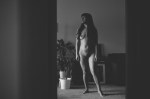
Claire LaudeUntitled from Upward on the Streaming It Mooned (2016)

I’m super into Laude’s work.

My immediate reaction to encountering this was: It reminds me of Stanley Donwood and Thom Yorke’s work on the album art for Radiohead’s OK Computer.

Actually, it took me a bit to figure out why in the hell I jumped to that conclusion. See I read the line work to the right of the figure as De Stijl-esque.

As–I’m sure–most of you know, De Stilj was essentially a form of abstract art based in Amsterdam, interested in reducing representation basic forms and colors. One of the key practitioners being Piet Mondrian. (It’s interesting to note that Mondrian fled mainland Europe for London to avoid the advancing tide of fascism that served as a prelude for the Second World War.)

The lines run off the wall onto the body and in so doing becomes less abstract.

There’s also the way in which the square and above the figure and the crude right arm, suggest a sort of robot personae. It’s as if an automation and abstraction flow together into a body rendered penitent through connection.

And if there was ever an album that dealt whole cloth with the topic of alienation in a historical context, it’s OK Computer. (Of which–confession: I appreciate only reluctantly. Radiohead has never and from all appearances will never be my bag.)

But I do think it’s interesting that OK Computer was released right around the same point into Clinton’s second term as we are into the current ‘president’s’ first… Although there isn’t much separating Clinton’s neo-liberal globalization vs 45′s nativism, there is a means in which abstraction as a trend has been co-opted and employed as a means of perpetuating these varied flavors of fascism.

It feels to me as if Laude is trying to harness the lightning of understated menance for the purpose of questioning the invisible effect rules and codifications of form have on shaping not only the relationship with the viewer but history itself.

Rimel NeffatiTitle unknown (201X)

Death, The Last Visit
Marie Howe

Hearing a low growl in your throat, you’ll know that it’s started.
It has nothing to ask you. It has only something to say, and
it will speak in your own tongue.

Locking its arms around you, it will hold you as long
as you ever wanted.
Only this time it will be long enough. It will not let go.
Burying your face in its dark shoulder, you’ll smell mud and hair
and water.

You’ll taste your mother’s sour nipple, your favorite salty cock
and swallow a word you thought you’d spit out once and be done with.
Through half-closed eyes you’ll see that its shadow looks like yours,

a perfect fit. You could weep with gratefulness. It will take you
as you like it best, hard and fast as a slap across your face,
or so sweet and slow you’ll scream give it to me give it to me
until it does.

Nothing will ever reach this deep. Nothing will ever clench this hard.
At last (the little girls are clapping, shouting) someone has pulled
the drawstring of your gym bag closed enough and tight. At last

someone has knotted the lace of your shoe so it won’t ever
come undone.
Even as you turn into it, even as you begin to feel yourself stop,
you’ll whistle with amazement between your residual teeth oh jesus

oh sweetheart, oh holy mother, nothing nothing nothing ever felt
this good.

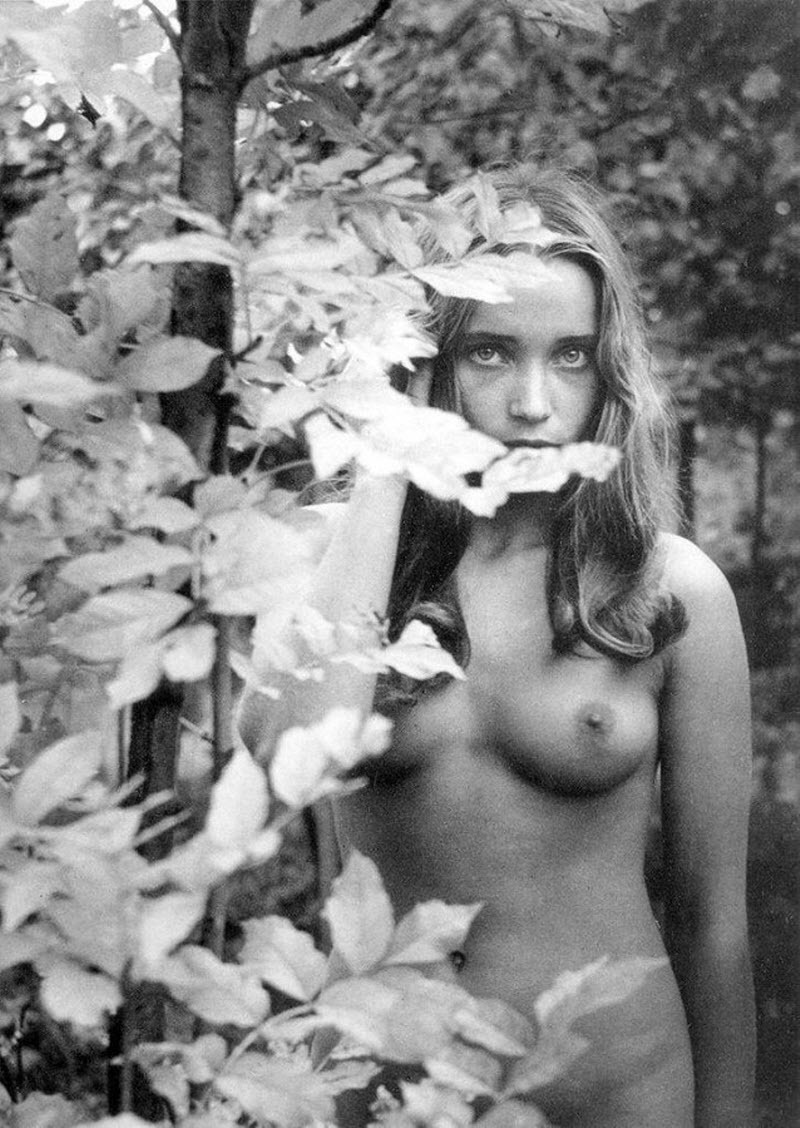
Rimantas DichavičiusUntitled from Žiedai tarp žiedų (1965-1989)

All of Dichavičius‘ work that I’ve encountered feature female nudes in nature (in fields of tall grass, walking along the shore of some eastern European lack or amidst sandy shoals and dunes).

The subjects of his images seem more like mythical nymphs than women–he likes wildly, disarrayed settings where grass, leaves and even cascading hair serves to both veil the subject and make them recede slightly, as if each belongs to the landscape more than the viewer.

Additionally, he preferences extremes of contrast–prejudicing tones at the edge of over-exposure and at the point where details in the shadows begin to flag to more measured/even tonality.

Along with his frequently surreal flattening of space and his efforts to skew perspective through composition tricks contribute an extra layer of surreal feeling to his scenes.

The work I’ve seen is all a bit too one note for me. But I’ve admittedly not seen more than the scant offerings available online. And really, the above image is thoroughly exceptional–not in that it’s far more concrete than a lot of his work.

(Further, I can’t help but feeling that this photo is likely an effort to imagine what the photo Imogen Cunningham might have taken of Twinka in Judy Dater’s reknowned photo if the photo had been an actual random encounter instead of a staged happening.)

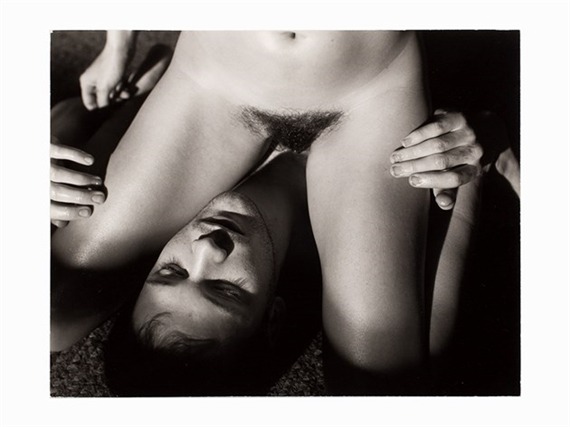
Malerie MarderUntitled from Carnal Knowledge series (1998)

I’ve wanted to post this for at least a year–but have not be able to track down anything larger than a teeny-tiny thumbnail. (I have complicated feelings about Marder’s work; over all I lean toward the fan person end of the spectrum.

Now that I can post it… I just don’t have any thoughts on it. I mean I love the direct sunlight, the way it makes the skin shine. I love the way you could likely distinguish shadow detail to a degree that would allow you to distinguish individual strands of pubic hair around the edges of the bush–but things go dark and become solid away from the edges (almost like a vague nod to something not unlike modesty, in spite of the explicit nature of the image).

I love how the low angled light stains the boys cheeks with the shadow of his lashes. The way he’s meeting his partners eyes even if the viewer can’t see them. The gentleness with the way he’s touching her things with his fingertips.

Still: looking at this I have trouble feeling the usual resonate rush of vicarious anticipation that I usually do when I spend time with it. I know why I feel this way: my fortunes have shifted rather drastically over the last year. I’m definitely in a better place than I have been but I’m a long way from OK.

And honestly, as much as the feeling of this image has always been something that motivates hope for future physical intimacy with folks I care about–that is something that it’s becoming increasingly clear is not in the cards for me. So while I love this and want to share it with you and hope you can feel something towards it that I don’t seem to be able to muster any more.

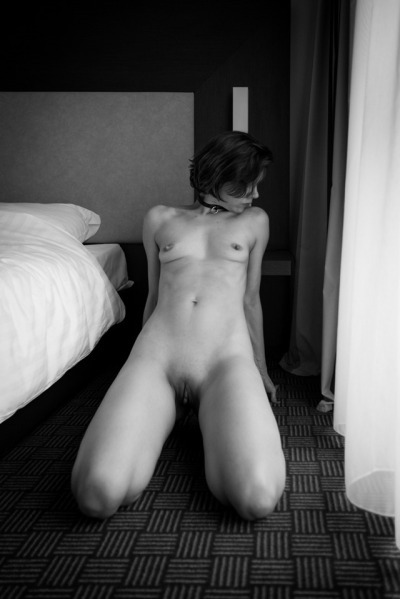
PeterVRSoleilaberlin, Bonn (2017)

I’m not at all fond of vertical orientation in photography/image making–I refer to it with the pejorative #skinnyframebullshit.

This isn’t #skinnyframebullshit. Why not?

My frustration with portrait orientation in photography/image making was born of the same thing that makes me distrust zoom lenses–i.e. the place an emphasis on results over process.

Instead of standing in one place and adjusting the focal length of the lens to provide an angle of view that allows you to convey the information you select to the viewer. It fosters a first idea, best idea approach that I think when deeply ingrained too early on becomes a huge stumbling block further down the road.

But my bias is definitely in favor or work that is more studied and/or contemplative.

Of course, at the end of the day the only question that matters is did you or didn’t you get the shot? A vital shot that is legible–will depending upon the urgency of the moment–work despite failings in visual grammar.

After a decade of looking at student work and working with novice photographers and image makers, I can say that in my experience–unless the photographer/image maker is working within the confines of the architectural genre, a vertical oriented frame is almost always self-conscious, affected and logically incongruous when considered within the context the scenes it depicts. (I’ve actually had a half dozen people tell me that the reason the chose the vertical composition was because they felt more like a photographer when they took it–which is one of the most idiotic things I’ve ever heard.)

The saying goes: you have to know the rules before you break them. Yet, by the same token: there are exceptions which prove the rule.

Intermediate practitioners love to take me to task about my strenuous objections to #skinnyframebullshit. (There are at least two internet famous photographers who disagree with me vociferously–in one case the photographer seems to have specifically built a body of work in an effort to flout my assertion. I find it ironic that this insistence is actually very much to the detriment of what would otherwise be better than average photos.)

In my own work–there have been instances where I have employed a vertical frame. I only use it as an absolutely last resort. And frequently I find a way to do it wherein the resulting image will be presented as if it were original conceived and executed as a horizontal frame.

This is partly because I am interested in more narrative or cinematic photos/images. And if you are intended to make a narrative photo/image and you frame it vertically, you’ve already missed the bus.

Another excuse I hear a lot is that the framing echoes the relationship of the subject to the space the subject occupies. This is actually dumber than the but I feel like a photographer/image maker because I tilted my camera on its side while taking a picture. Almost categorically, people who use this reasoning do so because they like the age old trick of making already skinny women look thinner through the imposition of a vertical frame. Or, they do it because they are shooting in an unphotogenic space and want to through shallow depth of field and careful staging draw attention to the subject while merely implying things about the physical space (i.e. it’s an interior with a brightly lit window.) :::masturbatory gesture:::

Most folks don’t stick around long enough to advance beyond the intermediate level. Also the gap separating a novice from an intermediate is much less than that which separates the intermediate practitioner from the advanced.

At a certain point you have to realize that the rules only apply to the well-traveled paths. They are there to keep you safe. But when you find your passion and chase it off the well-beaten path, the same rules deteriorate, clutch up and cease to offer their assistance. You begin to make your own. (And the way you’ll know whether or not someone is at that level, the ones who deny they’ve reached there are always more trust worthy than those who insist they know better.)

So why does this image work? I mean am I not contradicting myself because the framing so clearly echoes the position of the subject in space that is depicted. Well, yes. But also, not how the frame functions as an ellipses. The grading toward black at the top and bottom of the frame presents an impermeable boundary. Whereas the white on either side (bed and curtains, respectively) speak to space beyond the left and right edge that has been purposes excluded due to repetition. In other words, by seeing what we do of the bed and the curtain, we are able to extend the frame out in either side in our mind’s eye.

Anything that manages to include and engage you in the process of perceiving is a victory. But that fact is while being invited to participate is invigorating, a horizontal frame here would actually be boring. Too much white and not enough black would give it a oneirically suffused look; whereas because of our participation this seems edgy, voyeuristic and even lonely.

I’m not super familiar with all of PeterVR’s work but looking back over some of his recent stuff, he actually does a really good job of knowing when to use vertical frames. So if you’re interested, you should definitely spend some time with his work.

wonderlust photoworks in collaboration with @marissalynnla – [↑] Tenebristic Curatrix; [↖]  _.._; [↗] Against a Tide of Tyrants; [↙] Liminal Interval; [↘] Tightened with a Pin; [↓] Eigenstate (2017)

Back when I was first dipping my toes into the shadowy fjords of photography, I was a ridiculously squeeing fangirl when it came to work produced by Houston neighbors Traci Matlock and Ashley MacLean.

I utterly adored the ambiguity their work faciliated–mid-way between out-and-out eroticism and unblinking, it-is-what-it-is matter-of-factness.

I’d been following their work for the better part of a year before I learned how they worked; namely, when Traci made a photo of Ashley, Ashley was given the first editing pass. Allowing the subject of the photo a thumbs up/thumbs down first look–a means of allowing the person in the photo a very real degree of agency in how their visual identity was presented.

This process has become integral to my own work. With whomever I collaborate, I always offer them first look rights.

One of the interesting things about these images was that–without prompting–Marissa zeroed in on the all the same photos by which I was already captivated. (I’m telling y’all she’s not just a first rate model, she’s also a damn fine artist.)

The other interesting thing was that between shooting more frequently and being able to work in B&W in my preferred manner, it feels like my work is actually gathering something not unlike forward momentum.

Now if I can just find more folks who want to collaborate…

Edgar DegasTwo Women (1876-1877)

Most of the canonical oil painters from the mid-19th century onward can hardly be said to have produced entirely chaste work.

But what I find interesting is the extent to which sexuality is implicit in the quote-unquote masterpieces and explicit in their sketches, BTS experiments.

Seeing this sketch absolutely gives me a better grip on Degas’ work. (The feeling that I’ve always had that his bathers are prostitutes, washing up between clients–now seems far less preposterous and the so evocative rendering of his dancers suggests a fixation on sexuality associated with bodies and/or nudity.)

Gustav Klmit, Egon Schiele and Picasso all made v. similar sketches, actually. And the thought that suggests to me is that Schiele was probably the most honest about what he was up to–since there’s less discrepancy between what he exhibited publicly and what he mediated upon privately. Klimt and Degas were more interested in attempt to present sexuality organically within a proscribed context–one facet in a many faceted presentation. (And the Picasso drawing in the ambiguity of the depiction of the person performing oral sex on the woman preserves an undifferentiated, ambiguously gendered person that can serve as both signifier of a woman or a place holder for a man–which seems to be entirely in keeping with Picasso’s legendary misogyny.)

Source unknown – Title unknown (19XX)

I’m not 100% sure the framing works here–both his legs and here right shin are amputated in awkward places. While there is very much a sense of context–i.e. a boudoir, there’s a flatness to the print that does no one any favors.

On the plus side: I’ve never seen the above position enacted in porn prior to viewing this–it’s rather charming; emphasizing giving over receiving and I simply adore they way their lazily holding hands and caressing each other.

Also, that Cheshire smile she’s wearing would’ve been enough on its own to convince me to post this.

Richard AvedonAndy Warhol and Members of The Factory, New York (October 30, 1969)

If I were more ambitious/less of a lazy layabout, this is the sort of work that I would summon David Foster Wallace-esque footnoted footnote levels of ‘scholarly’ exegesis. However, I’m in a an unusually clearheaded place today–I’ve absconded to a more temperate clime where spring is very much in the air + it’s having a restorative effect.

Thus the only things I want to address related specifically and concretely to a direct interpretation of this large format triptych are as follows:

I tend to be resistant to spending time with the work of iconclastic. This is actually the height of irony–given my own iron clad anti-authoritarian bent. But I do possess strong enough of post-left anarchist pretenses that I rankle in the presents of efforts to make outsiderness a sort of new status quo.

As such I’ve been a late subscribe to folks like Robert Frank–if you want to be a photographer of any consequential merit you absolutely need to know The Americans like the back of your hand. (Yes, it is actually that crucial a work.)

I’ve only recently began flirting with Avedon’s oeurve–largely due to how smitten I am with his portrait of Sandra Bennett from In the American West.

I’m still on the fence when it comes to Warhol–although I am intrigued by The Factory (more on that in a bit).

I think of how the first panel is obviously riffing on art historical depictions of Adam and Eve–except with the implication of queerness in the pair of two men with a trans woman. The way the center panel captures a sort of sex, drugs and rock and roll vibe that subsequently transitions into a sort of art star as cultural gatekeeper/philosopher king trope. (And conceptually, everything that is read before you reach Warhol, essentially emerged from his efforts.)

I also think about how this is one of the earliest examples I can call to mind of fostering the illusion of a panorama across multiple frames. (And  here I would be remiss if I didn’t take the chance to point you in the direction of folks who’ve continued in that tradition, a la:  David Hilliard, Accra Shepp and Tom Spianti.)

Yet, just as how the progenitor of all that precedes is the last thing you encounter, these observations are really the last things that come to mind for me when I look at this triptych. What I’m really thinking about is a sort of melange of thoughts and impressions.

I guess first off I think about a chat I had with a close friend where she mentioned that although she is not queer, her understanding of queer experience is that you feel a profound sense of not belonging from a young age. And as someone who identifies as queer, my own experience is not so clear cut. I did feel I was different but growing up in an Evangelical milieu, I viewed that as an advantage for many years. I had no desire to be like those who surrounded me/to fit in. In my late teens this bearing became and increasingly dissonant point. I craved love and acceptance from someone/anyone and I was surrounded by people who insisted that I accept their general framework to receive love and affection. So what I wanted/need stood at cross purposes with what I knew to be my own personal truth; I learned to a large extent you have to play a part and/or lie to get what you want. I’ve never been able to manage that feat. (For someone who can at times be a pathological liar, I am honest to a fault.)

Honestly, art is the only thing in my life that has ever even tried to meet me halfway. (Actually, that’s not entirely true. My 30s have been a super mixed bag but increasingly there have been folks with whom I’ve shared + continue to share a mutually cultivated middle ground.)

However, in that there is a danger of building a monument to outsider-ness, an echo chamber. I’m reminded of one of the best things Brain Pickings has ever posted: The Paradox of Active Surrender: Jeanette Winterson on How Learning to Understand Art Transforms Us.

One passage in particular resonates with me:

There are no Commandments in art and no easy axioms for
art appreciation. “Do I like this?” is the question anyone should ask
themselves at the moment of confrontation with the picture. But if
“yes,” why “yes”? and if “no,” why “no”? The obvious direct emotional
response is never simple, and ninety-nine times out of a hundred, the
“yes” or “no” has nothing at all to do with the picture in its own
right.

“I don’t understand this poem”
“I never listen to classical music”
“I don’t like this picture”
are common enough statements but not ones that tell us anything about
books, painting, or music. They are statements that tell us something
about the speaker. That should be obvious, but in fact, such statements
are offered as criticisms of art, as evidence against, not least because
the ignorant, the lazy, or the plain confused are not likely to want to
admit themselves as such. We hear a lot about the arrogance of the
artist but nothing about the arrogance of the audience. The audience,
who have not done the work, who have not taken any risks, whose life and
livelihood are not bound up at every moment with what they are making,
who have given no thought to the medium or the method, will glance up,
flick through, chatter over the opening chords, then snap their fingers
and walk away like some monstrous Roman tyrant.

As much as I’m intellectually against dismissing something without thought, I’m not super good at practicing what I preach. I tend to develop intractable opinions on the merit of certain work vs. other work I deem to be less meritorious. It’s not that I don’t think about these decisions, it’s that I maybe don’t think enough about them before dismissing them.

That’s one thing I adore about Tumblr–and too all the folks claiming this forum is dying, I see you and feel you, it’s not what it was (that’s for sure). But I keep being confronted with things independent of any prejudice to whether I’ve made up my mind about them yet. It’s why my opinion on Avedon has changed from I don’t care for his work to an awareness that I haven’t really explored it in enough depth to have an informed opinion on it. Also, I’m excited by the prospect of engaging with his work. This wouldn’t have happened if I were part of an ostensible community that insists upon work I would otherwise ignore.

And that’s the other side of things, the community that Tumblr provides not only causes me to reconsider my own assumptions on established artists and canonical art, it also introduces me to stuff I wouldn’t otherwise have encountered.

I’m thinking here of one of my favorite posts of all time on this blog: a documentary still from FeminismoPornoPunk’s staging of a porn variation of the experimental theater piece Public Domain.

And I feel like that’s something Warhol got right with The Factory. It wasn’t sex, drugs and rock ‘n roll for the sake of excess–although that was almost certainly a byproduct. Instead, it was about the potential in that milieu to construct a sort of interpersonal space/a ad hoc community of lived experience as informative and educational and evolutionary. A catalyst for exploration whether that exploration was transgressing boundaries or creating art. (I don’t think it’s an accident that so many art world luminaries emerged from this scene, actually.)

And I guess that’s what I am grappling with how to achieve: making this blog a sort of space not unlike The Factory. Except I don’t want to be the Warhol figure. I’d rather be just another faceless participant.