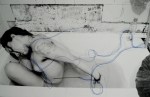
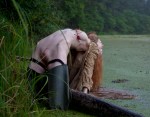
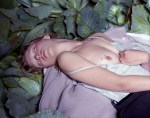
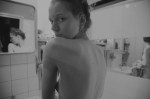
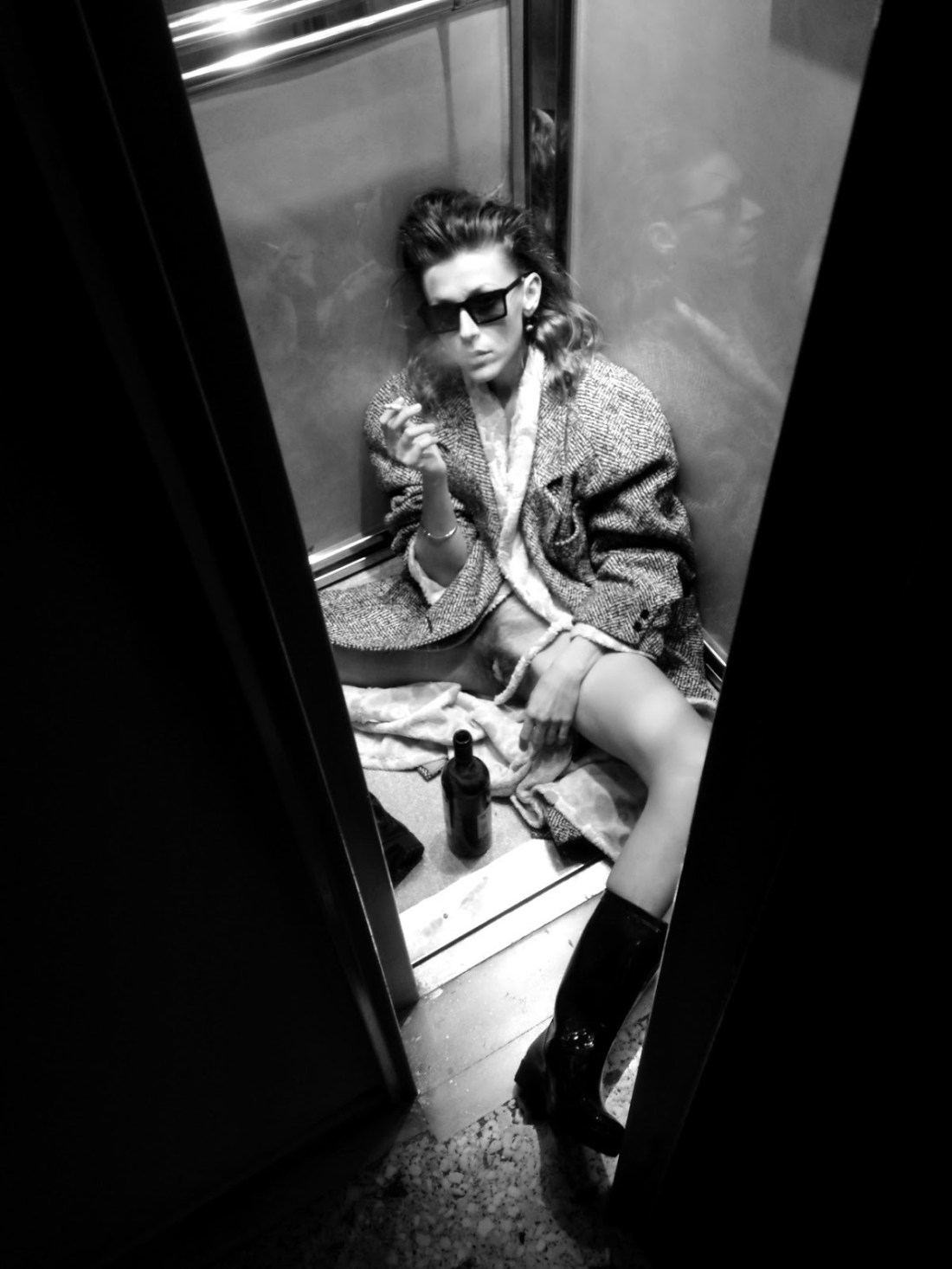
Jack Welpott – [←] 65 Ave Paris (197X); [→] Elle se lave (1973)

For all I know about photography, I have some enormous lapses. (One of the only lasting + pervasive drawbacks of being an autodidact.)

I had never heard of Welpott until I encountered Elle se lave this morning.

The first thing I noticed was the two mirrors like eyeglass lenses. (It reminded me of one of many breathtaking shots in Raw–specifically the bifurcated bathroom mirror after Justine vomits, where another girl overhears her and assumes she’s purging instead of legitimately ill.)

I popped over to Welpott’s website and immediately took note of the first photo above. It’s interesting because in both images the camera has a noticeable down tilt. I’m normally not fond of this. I prefer interior scenes like my web design: clean and minimal.

As such, I’m inclined to read the camera here as self-conscious. (To my mind, the downward angle eventually draws attention to the camera. Also, angling down when the photographer is made by a cishet male and the subject is a woman are über problematic given you know centuries of entitled patriarchal hegemony and the dependence of such modes of command and control on the subservience of women..)

Yet, the ambiguity between authority and self-doubt actually comes across in these. So there’s that. (Also, I was able to go for a walk this morning and I walked eastward with the sun in my eyes the entire way. I noticed the way I looked at the ground in front of my feet–there are sometimes snakes chilling out on this trail, so you have to watch out; and it feels to me like these images have a similar privileging near as opposed to far–which adds a-whole-nother level of ambiguity to the proceedings.)

But then I read in his bio that Welpott played jazz piano and said of his photography:

When I’m working behind a camera, I feel like I’m trying to achieve something like a jazz musician does.

(This resonates with me because one of the reasons I’m a photographer is because I lack any sort of innate sense of rhythm and that ruins my chances of being a musician. I love music. In fact, I’ve gotten higher off of experiences of sonic immersion than I ever have on drugs. Also, I’ve been actively listening to more music than I have in years–it’s a really great time to be a metal lover, tbh.)

And that makes me wonder if I find these mirrored resonances in other peoples’ work because I’m attempting to feel less alone or if assiduous efforts to understand one’s self actually causes you to see yourself in the other?

Also, I’ve been doing a shit ton of drugs… so it could just all be in my head. (Yep, it’s probably that. But–in the same breath: I do think it’s interesting that the downward angle is paired with landscape oriented frames. I think if I was a little bit more together, I’d actually be able to sharpen this into another reason why there really isn’t a justification for #skinnyframebullshit more often than I am inclined to call #skinnyframebullshit.

Joanna Szproch – [↖] Title unknown from Sulejow series (201X); [+] Untitled from Personal I series (2013); [↗] Patricia with mosquito, Warsaw, Poland from Sulejow series (2011); [↓] Untitled for Tissue Magazine (2012)

This is the second time Szproch has been featured here.

I’m still head over heels for that photograph. And it’s exciting to see the plethora of new work she’s posted to her portfolio.

Not all of it is too my taste. In fact I’m honestly a bit underwhelmed by the extent to which her commercial work seems to uniformly adapt a Lukasz Wierzbowski affect.

I mean there’s no disputing the quality she delivers–it’s just according to Szproch, her approach is motivated by:

a mixture of vulgarity and innocence, saturated color and dowdiness, high technology and analogue, [the photos &] images are a celebration of contrasts.

That’s an actually an astute observation. However, it raises the issue of whether or not she is perhaps losing some of the force of the work by incorporating such shouted visual trends.

I’ve culled the above images from her more personal projects. And I want to point out how when she cultivates a quieter tone, how it sharpens the ambiguity and constrasts within the work.

Let’s start with top-right image. The light is most likely from some sort of canned lighting to the right of the camera–some of the color is getting bleached out in order to provide a nice right-to-left light-to-dark grade is preserved. It doesn’t pop like the still life to the left or the luminous and surreal image on the top left.

Now consider the dates the pictures were made: Patricia with mosquito dates from 2011, Untitled from the Personal I series is more recent by 2 years and I’d wager that Title unknown from the Sulejow series is likely the most recently created of the work posted here.

It’s too easy to overlook the way that form and content interpenetrate in the quieter work. Patricia with mosquito is painterly and connected to the tradition of oil painting until you realized that all the elements are rigorously ordered around the mosquito’s presence–and the implications of that a suggestion of fecundity as an invitation to parasitism.

With the still life the compression of both highlight and shadows both makes the color seem aqueous, as if it is both radiating off the fruits and vegetables–the lushness against the blacks and greys possesses an extravagant superfluity that I can only think to describe as erotic.

In the top-rightmost picture the shape of the woman’s body, her pre-orgasmic expression and the way her dress spreads out behind her but her head hangs, while the strain of her posture–there’s no way that position doesn’t hurt to hold; all point to a dichotomy between the beauty of nature and the way that such beauty is never that far removed from something that will soil the skin if it’s touched.

But I really love the sensitivity of the B&W image the most. The way she’s choosing to ignore how she sees herself and focus her attention on the camera and the way the downy hair on her arm is all standing on end along the left edge of her arm and the way you can see the reflection of her clothes which she holds balled up protectively against her stomach–it’s a devastating indictment of the art historical male gaze that instead of supposing an equal and alternative female gaze, demonstrates how given any degree of agency the subject can by merely reacting instinctively to a scenario can upend that entire paradigm.

Source unknown – Title unknown (201X)

I have so many complicated and conflicting feelings about posting shit like this. Or honestly even looking at them–it feels a bit like being stranded in the middle of a desert desperate with hunger and thirst and having an airplane fly overhead and drop menus from a fancy restaurant. I’m looking at something that will never be a part of my life.

I don’t know maybe that’s what gives this project a vitality that some of you seem to respond to: the wanting makes it seem more relevant.

In the end I’m posting this gif loop not because of what it depicts but because of the notion that maybe someday someone will see me as containing multitudes and within those multitudes are contained all three of these lovers.

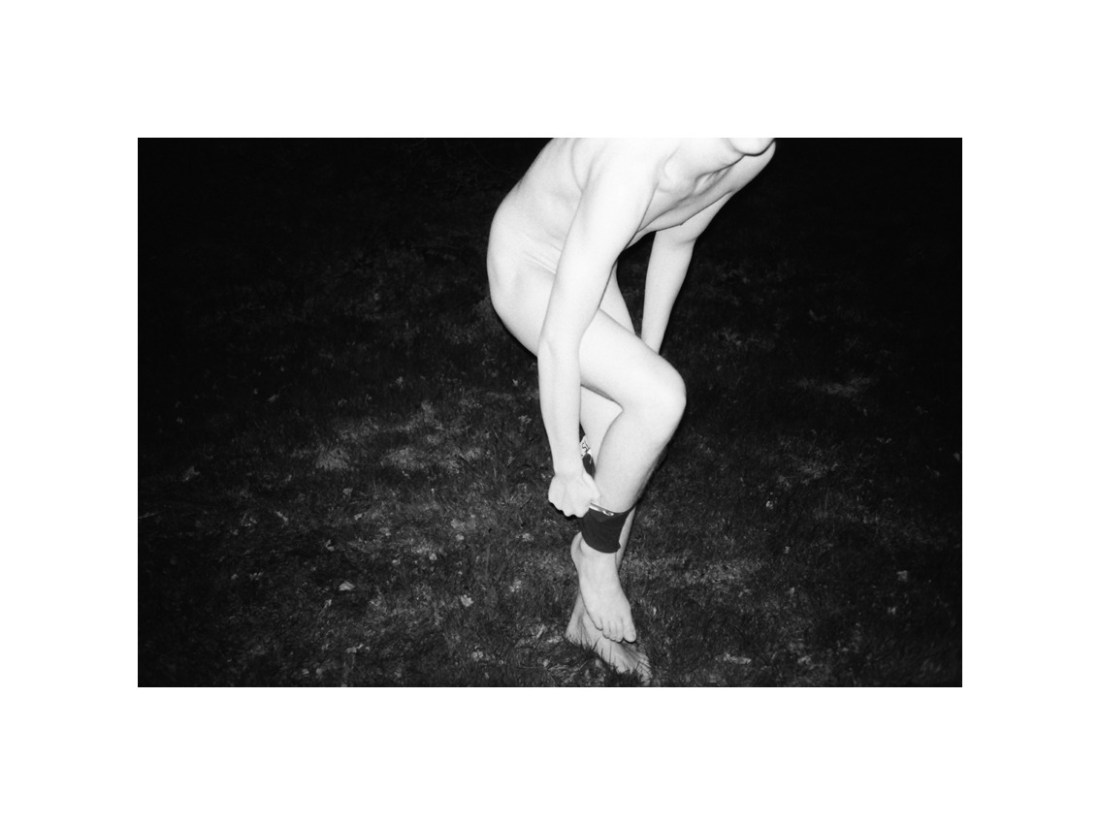
Julie van der VaartUntitled (2015)

A good percentage of folks reading this likelyknow that almost a month ago (at this writing) Ren Hang–one of the most ‘internet famous’ photographers–took his own life.

Now, I’m not now nor have I ever been a Ren Hang apologist. However, as–ostensibly a fellow photographer–who also suffers from fairly debilitating depression, the knowing in this case has not been exactly easy to process.

What I know of the man behind the work suggests he would vigorously disagree with my characterization of his work as ‘audacious’ and ‘brash’. It seemed very much like he was struggling to feel some sort of connection, any sort of connection (however ephemeral) to the world around him.

And on those grounds, he certainly succeeded–insofar as his photos presented a seamless stylistic imperative of casual confrontation and conceptual extremity.

My gut feeling is that history will likely not be especially kind to his work. And I would be fine with that were it not for a handful of things I think he did that were of crucial importance.

I can’t look at his work and not think of Terry Richardson’s bright strobe with the subject frozen against a milk white background. Hang unquestionably ‘wore’ it better and to more stunning/less predatory effect–harnessing the immediacy of a snapshot and anchoring it to a fine art formalism.

It’s unlikely that he intended to comment on questions of pornography vs art but there’s a way in which his work bucks the trend to which Rebecca Solnit points about how the balance between highlight and shadow is–in pornography–skewed away from the more typical human experience of sexual intimacy.

I have no way of knowing definitively but there are a handful of up-and-coming image makers that seem to have internalized the fetishized conceptualization of technique in Hang’s work and applied it exquisitely to their own work.

I’m thinking here primarily of Ao Kim Ngân [aka yatender], who for my money is one of the best upstarts actively making new work. But also van der Vaart. The hyper-bright, edging on over-exposure vibe is reminiscent of Hang–especially given his exterior, night work. However, the technique folds together seamlessly with the concept. The pose is at once confrontational and demurely modest–hiding as a sort of revelation.

Although I have objections to cutting off body parts with the frame edges and think there are far better ways to preserve anonymity without decapitation–this actually is an exception to that rule. There’s a logical consistency to the presentation here.

The point is I think Hang’s work is a long way from done with the world of fine art photography and the milieu of internet famous image making.

[↖] Sally Mann – The Last Time Emmett Modeled Nude (1987); [↑] Mary Ellen MarkAmanda and her cousin Amy, Valdese, North Carolina (1990); [↗] Sally MannCandy Cigarette from Immediate Family series (1989); [↓] Jen ErvinUntitled (2015)

Follow* the thread.

* There’s a photo that featured on a poster in my undergrad dark room–by an American woman circa the mid-to-late 1990s; it’s a B&W photo (a platinum print?) of a girl–perhaps 9 or 10–standing in dripping wet one-piece swimsuit next to a split rail fence (I think?). Maybe one of her siblings is climbing on the fence, I think there are two other people in the photo. The girl is making eye contact with the camera and is mugging a bit. The surroundings scream American suburbs. Also, I think the title of the image possibly has something to do with summer in Connecticut and it was on a poster from either a gallery or advertising a book (I can’t remember which). I am more than a little irritated with myself for being unable to remember it. (I swear it was Corinne Day but I’ve been unable to find the same photo in anything of hers online.) If anyone has a clue what I’m referring to–please for the love of all that is holy, drop me a line. The point of this post was supposed to be how young photographers don’t even necessarily have to be familiar with the full history of fine art photography because frequently the work that influences them draws influences from folks that are even more prototypically working within the same conceptual realm/with a startling overlap in their creative concerns.

Virginie KhateebUntitled from the series A crowd of people turned away (2016)

The two words I’d use to describe the emotional state that precedes composing posts like this are: uncertainty and dread.

I’ve said it before but the not dead yet horse can use a few more lashes–writing is an intensely painful undertaking for me. (All my writer friends would be quick to console me that such a feeling means I’m ‘doing it right’.)

But I never feel like I’m doing it well, let alone ‘right’–whatever the hell that might entail.

I just know that this belongs here. It’s a less preternatural awareness and more obsession–I just read this as being staggeringly perverse. And I can say that and merely by asserting the point, disengage and leave you, dear reader, to unknot my meaning through your own meditative contemplation.

But to do so would indicate an intellectual disingenuity that I can’t really abide.

I guess the first thing I notice about this image is that the staging of it seems intended to convey more than anything the relationship between these two women. In other words: maternal (mother or grandmother) figure and progeny (daughter or grand-daughter).

And the thought reminds me of a conversation I had recently with an acquaintance about how all relationships are–by their very nature–a sprawling mess but that mother-daughter relationships are far and away the most fraught and messy.

Add to that the way that just barely visible in the background is ruined building in front of which these two women are standing. It’s almost as if the world behind them is collapsing as they look towards the future.

The younger woman is slightly closer to the camera. Her body is angled so that she is both perhaps about to walk forward and positioned in such a way to minimize the parts of her body that can be touched by the older woman. In other words, her body language speaks of trying to make herself a smaller target while still behaving as is expected of her.

I am inclined to suggest the older woman is supposed to be her mother and not her grandmother. (I’d expect a grand mother to either stand at slightly more of a remove; or, to be less demanding in the way she’s forcing physical contact.)

The older woman is positioned in relationship to her daughter and the ruins behind them. There is a very profound sense that this scene will not last long and that if the older woman moves, she will retreat not follow the younger woman as she moves closer to the camera.

I adore the texture of the sweaters and how with selective contrast control, the boundaries between their body are clearly delimited but there’s still a connection between them.

I look at this and I almost hear my own mother ordering me to not slouch and to do people the courtesy of looking them in the eye. (Eye contact is unbelievably difficult for me and I think there are maybe four people I know whose eye color I can tell you when asked.)

But none of that is really perverse. It’s loaded with pathos and highly relateable, yes. So what makes it perverse?

It’s partly the way she’s forcing her head into this haughty, regal posture. It’s also the way the sweater has fallen around her right shoulder revealing her camisole. And I can’t help but see the sort of dichotomy mothers must face with their daughters where they want them to be self-possessed, independent and strong–while also not cold and unappealing.

Also, the way the older woman is more concerned about the way her daughter has positioned her head as opposed to the unsightly fallen sweater, suggests a bit of the adage where women are socialized to leave something to the imagination.

All that makes me uneasy. But then there’s a fact that this photograph is part of a series borrowing it’s title from lyrics to The BeatlesA Day in the Life.

As I’m sure you know that song includes the infamous line “I’d love to turn you on.” Which is supposed to be a reference to the famous line from Timothy Leary advising folks to turn on, tune in and drop out. (But you can’t overlook the more obvious meaning, especially in light of this image.)

So I really think this image is about how parents dedicate their existence to providing a better life than they had for themselves. It’s well intentioned enough but it contributes a lot of baggage when kids don’t necessarily want a life similar to their parents.

It’s like at what point does the task of raising a child end as does a certain level of at least indoctrination, if not straight up brainwashing occur?

There’s a feeling–to me, at least–that things don’t necessarily end well for either of these women. The younger one maybe still has a chance. But what I think makes it interesting is that although there’s a sense of foreboding, there’s a humanity to the older woman that saves her from being read as a unyielding crone.