Source unknown – Title unknown (200X)

This appears to be an earlier image from the same sequence as something I posted way back when Acetylene Eyes was just a baby blog. (The similarities run beyond both being taken in a truck cab: that’s the same boy and the pattern stitched into the upholstery is an exact match.)

But there’s other similarities, stylistic overlap. I noted in the early post before #skinnyframebullshit was a fully qualified thing, that the vertical orientation was counter-intuitive given the tableau.

The astute reader will pause here to inquire but aren’t you being disingenuous? You’ve said on a number of occasions that whether the eye scans left to right over the image or top to bottom can be a part of the logic governing the decision between landscape vs portrait orientations?

I have two responses.

  1. You have to distinguish between actual 3D space and how three dimensions are rendered in 2D representation.
  2. I noted that about the previous posted image as well: the top 20% of the above frame and the bottom 10% contributes nothing to the compositional logic. (It’s negative space that doubles down on information that would otherwise be conveyed to the viewer even if it was cropped out.)

Let me expand that first point a bit further: from the standpoint of visual grammar, the image is telling the viewer that it has something to say about elevation. But that isn’t supported by the image. One only sees, what a meter of elevation from the low point of the stitched seam in the lower right almost corner to the halfway up the open passenger side door? (Depth of field, i.e. front to back representation of 3D space in 2D vs top to bottom orientation for the purpose of emphasizing a sense of concern with the relationship of various elevations are not interchangeable.)

Also, whereas I commented that the previous image would benefit from slight shifts in the poses, I think that a horizontal oriented frame would add a narrative denotation to the reading of the image. (Something which is conceptually appropriate given that the question what constitutes narrative is so similar that it runs virtually parallel to questions of the mechanics of eroticism.)

If her right leg were braced against the door frame instead of bent as such, it would open the frame up more. From which point it would be logical to cheat her a little bit further towards the edge of the passenger side bench, reposition the camera with a bit more of a down-tilt so that you can see a bit of the grassy shoulder outside the car door and perhaps something of what he’s doing with his hands–his current position above is hell of awkward.

My point is it’s a reasonably good notion for a image that unfortunately muddies matters when it comes to thoughtful execution.

There are some technical considerations to belabor, too. Gun to my head, I’d say this was shot digitally and desaturated in post. Shutter speed is below 1/30 of a second. My gut says its 1/8th of second given the slight motion blur of her left leg.

I can’t really quibble with the overall exposure across the image. Yet if this is, in fact, digital, then you’d want that highlight contained just inside the upper limits of the histogram.

Then you’d have room to selectively dial things some detail back into the some of the heavily shadowed areas in the frame.

Jorge Golgo QuinteroNuda 1605A (2016)

It’s the height of irony to me that so-called ‘internet famous’ image makers are so at odds with so-called fine art photography aspirants.

The former tend to have models pose in such a way that they are standing either right next to a window or a window is implied just beyond the frame edge; the latter tending to favor a more studio-tinged set up, i.e. the subject standing in front of a seamless backdrop.

Although the resulting work might as well be as different as day from night, both are–in point of fact–motivated by a similar conceptual tact: de-emphasizing the relationship between the body and the space the body inhabits.

Now, I can’t really say I’m especially fond of studio work. (Truthfully, it’s all a bit ubiquitous and cloying to my eye.) And I can’t say that I’m over the moon about this image–I mean there are some pretty serious problems with it.

I do want to acknowledge that there is something unusually vital about this image. It’s playful in a way that most of this type of work just straight up isn’t. Yet, that playfulness that contributes a vibrant vitality, also points a little too handily towards what makes the image so fundamentally problematic.

The image is very male gaze-y. The coy pose bestows a dynamism to the work by contextualizing nudity in a fashion whereby being nude is rendered transgressive by the implied relationship between the model and the audience. (I’m naked and want you to see me, but shhh don’t tell anyone, it’s just for you–in other words, she’s enacting the same misogynist charade that makes gross ass cishet men harass women on the street.)

(There’s maybe an outside chance that Quintero might be familiar with Robert Mapplethorpe’s famous bullwhip self-portrait, but that’s likely giving more credit than is due given the totality of his work.)

The difficulty is that conceptually the image undercuts itself. Yes, the pose is dynamic. But it’s overt stylization actually works against it due to the fact that the artifice of the pose is brought into sharper focus due to the fact that the model is so close to the background and that the strobes are set up in such a fashion where the flash fill is so bright it’s casting it’s own shadow in addition to the shadow cast by the key illumination.

Such artifice only draws further attention to the hyper-stylization of the image, which in turn casts a pall on the dynamism of the pose when it’s considered in the broader swatch of art historical sexism.

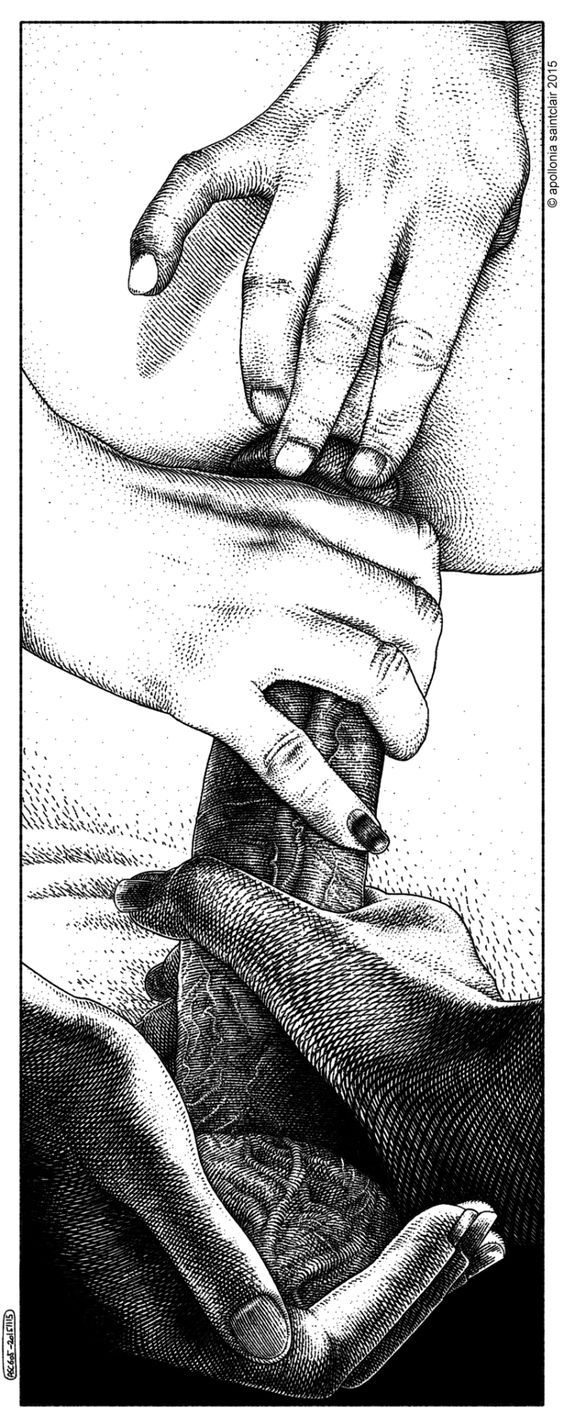
Apollonia Saintclair605 – Les béquilles [The Third Auxiliary] (2015)

Each time I re-encounter Saintclair’s work, my appreciation of her talent expands.

Like Mœbius–who’s syncretism of sacred (attuned to the rigorously established precepts of classical drafting and design in high art) and profane (explicitly graphic depictions of sexual activity) is almost certainly a major influence–Saintclair almost always releases work that is both salacious and eminently refined.

I adore the image above. I appreciate the fact that I actually sat here for ten minutes decoding the fact that the hands depicted here belong to four different people.

Further, I love the way her treatment of cross hatching and shading render appear to be almost art nouveau-esque when you are examining the piece close at hand, and then when you zoom out and see it at a distance, the stylization diminishes to affect a sort of photo-realistic look.

Compositionally, I can’t see how anyone could look at this and not appreciate the careful balance between highlight and shadow–I mean this illustration is, after all, a gradient from top to bottom (light to shadow). But like the yin-yang symbol, the shadows in the light area balance against light in the shadow areas. It’s masterful, really. (She’s probably also riffing on Escher here.)

Lastly: for three years–give or take and excluding guest curatorial stints–I’ve insisted on alternative between B&W and color images every other post on this blog. (I know, I know–your mind is blown.)

It’s not especially easy to pull of. There is a dearth of B&W stuff, a surfeit of color. So it’s refreshing to have an artist whose work successfully scratches a particular itch in such a virtuoso fashion.

(Disclaimer: this Tumblr was high af off Cali’s finest medical edibles while writing this post.)

Agnieszka SosnowskaLansendi, Iceland (2012)

I first encountered Sosnowska’s work through Lensculture’s underwhelming showcase of her work.

Several months later, I caught a broader cross section of her work as part of the Traces of Life exhibition at the Reykjavik Museum of Photography.

What struck me immediately was how good her printmaking chops were and how her digital presence seemed almost completely devoid of life by comparison.

Yet what strikes me looking at this photo which–excepting the stunningly luminous range in skin-tone and subtle gradations in the sky, which my guess would be were burnt in–limits everything in the frame to three zones: the textured black sand (Zone II), the dark grey rocks (Zone IV) and the sky (Zone IX).

It’s also interesting to note how Sosnowska has been working with variations on the idea of the image for more than a decade. For homework: compare and contrast the above with this photo from 2007.

Alek LindusUntitled (2010)

I was in time, in flight, in finiteness. The present had
disappeared, there was nothing left for me but a past and a tomorrow, a
tomorrow which I was already conscious of as past.
Since then I have
tried, every day, to cling on to something stable, I have tried
desperately to recover a present, to establish it, to widen it.
Eugene Ionesco, Fragments of a Journal

@house-of-fortitudeUntitled (2014)

This blog gets it’s fair share of garden variety Internet trollery. After that, the most common query I receive is people making reasonably cogent arguments that I present myself as an infallible authority.

Uh… no. I’m wrong. Frequently. However, the frequency is less a function of idiocy and more a matter of the fact that I really do put my ideas out there a lot–which presents more opportunities to be wrong.

(For the record: I encourage everyone to take what I say with a Gibraltar sized grain of salt. Always think for yourself. If you think I get something profoundly wrong, drop me a line. I have zero qualms with substantive disagreement–the point of this project is actually to facilitate dialogue that I find to be currently lacking and which I feel is both vital and important to have within the medium and those who appreciate the medium.)

Case in point: very early on, El Desouky submitted a photo for publication. I don’t really accept submissions–although I have something in the works that won’t necessarily change that but will shift it slightly. (Hoping to make that announcement during the back half of the month. Stay tuned.)

I turned up my nose at it.

Now? Well, now I feel like an arse about it.

I mean I’m super hard pressed to name another photographer with as singular a visual voice, who works in both B&W and color in ways that underscore the necessity of that particular image preferencing one medium over the other and who can be bothered with the notions of melancholy as neither inherently positive or detrimental so much as necessary or perhaps even suggestive of a form of radical self-exploration.

I freaking L<3VE the above photo. It’s partly the simplicity of it. A cluttered kitchen and a woman. Nothing about this is in any way so complicated as to be prohibitive to arrange. Yet, there’s something magical about it. It really does look as if she’s drifted off into quiet reverie as a result of looking at snapshot. The snapshots–splayed as they are on the table, clearly legible as photos but not clear enough to distinctly discern what the portray–suggest a glimpse into the woman’s thoughts in a way that let’s the mystery be.

Then there’s the light–which as far as I can tell comes from two sources. An ugly, bare overhead bulp as well as a single very direct light source just beyond the left edge of the frame angling down on the table, her face, neck, shoulders, back of the chair and the little leak filtering through the shadowed triangle formed between her neck, shoulder, bicep and forearm, drawing attention to her left breast, accentuating the nipple.

The magic of it is that anyone with a camera could have made this image but only El Dosouky could make it in a way that is both insinuating of a narrative and resistant to such interpretation, that feels so vibrantly alive and authentic. It’s a scene that is so mundane, we might overlook it we happened upon it unaware. But now we get to revel in it’s glorious wonderment.

Karen KuehnUntitled from MetropoLOVE (2010)

Confession: I find this ineffably effing sexy.

It’s really all the little things in concert that get me worked up into a lather. The texture–his pants (the bunching of the rolled down waist band against the velveteen texture of the rest of the garment), the thickness of the cotton of the waistband and leg holes of her panties (and the visible stitching!!!) vs. the busy pattern on the thinner, inner cotton. His skin against her skin (the sheen and grain of it so tactile.

I love that the picture in and of itself communicates–without a single word–some of the truth underlying the image. The illumination as well as the background (what you can see of it) is very clearly arid and dry. And it turns out that Kuehn is a burner and travels to Burning Man every year with her camera gear.

But it’s really the intimacy of it. His thumb is clearly inside her underwear but the position makes it clear that it’s in the crack of her ass. Further, his index and ring finger are positioned in such a way that he’s almost certainly touching her anus through the material.

Given a wider frame, you would’ve lost the emphasis on the graphicness of the touch while–presuming nothing in the background–contributing a sense of two lovers alone in an empty world.

But the close up here in combination with the gesture, brings in questions of public vs private. With this frame there’s no way to know if anyone else can see this but given that the photographer can, we presume others can but since we don’t see others in the frame, they are both engaging in amorous foreplay with a potential for the behavior to be occurring simultaneously private and in public. (It’s a clever way of invoking the thrill seeking mind set that drives most people to attempt to have sex in public in the first place: the balancing of the risk of being caught with not actually being caught.

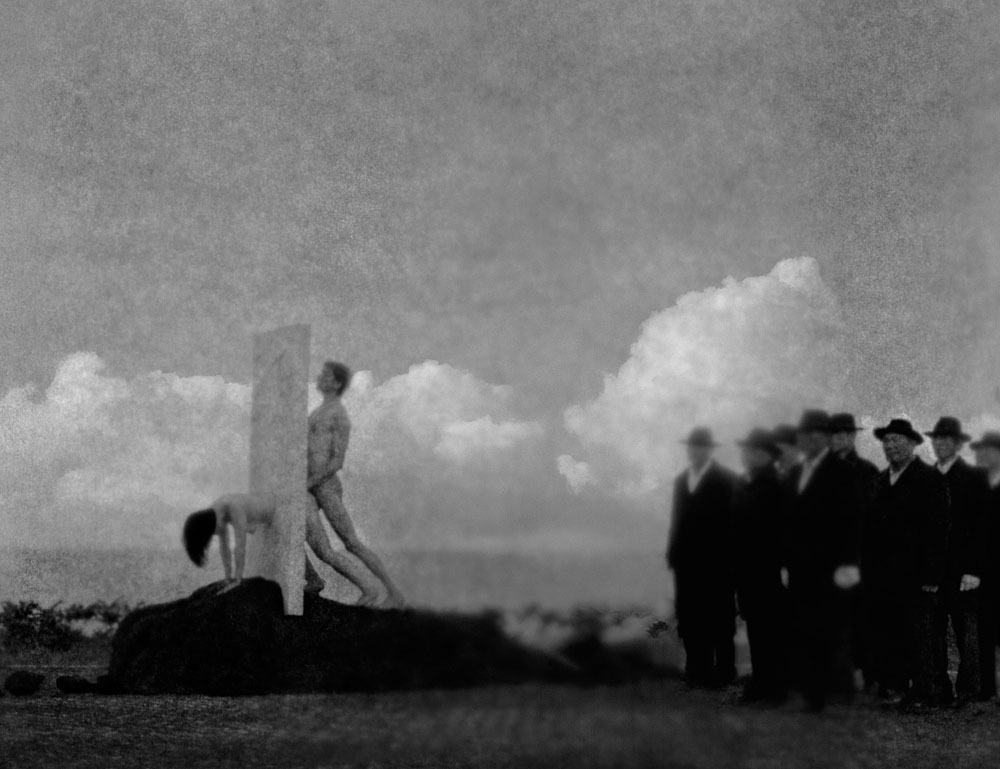
Hsieh Chun-Te – The Romance on the Stele from Raw series (1987-2011)

The images in the Raw series are intended to be narrative–yet what the narrative entails remains muddled due to how little is available on the artist in English.

For example: an image titled Bitches was, according to Chun-Te inspired as a result of: “overhear[ing] a journalist
friend of mine who got beaten up during an investigation of human
trafficking of a prostitution ring. Girls were captured then sold, some
of them tried to escape.”

I was not able to find the creative impetus underlying the above image. In fact, I discovered very little of merit beyond this blurb from the 2011 Venice Biennale.  I agree that themes of desire, eroticism and death permeate his work. But, he’s clearly working within the Surrealist tradition. (I feel as if this is so apparent as to not need comment but to put to fine a point on it, he makes a point of telegraphing this affectation via his inclusion of bowler hats–a reference to Margritte’s seminal painting The Son of Man.

I’m inclined to disagree with the aforementioned blurb w/r/t what the above image depicts. It takes the easy route of correlating death and eroticism and suggests the image depicts a scene of capital punishment by means of being fucked to death. (The pose of the woman in the image suggests she’s still very much alive.)

And that is definitely an interpretation in keeping with the tone. Except, I read this as a far more nuanced examination of punishment in society. The relationship between the person receiving punishment and the remove at which the person who inflicts the punishment must be placed in to avoid sullying polite society by association.

I look at this and see it point to an irony. We’re not okay with this because of the context–restraint as a means to facilitating punishment and punishment as a means of retaining social control.

But this can also be read as an allegory of the relationship between pornographic performance and consumption within a capitalist, hetero-patriarchal system.

And really one of the reasons this works so well is that the author is clearly far more interested in pointing to a slippery corollary than passing any sort of judgment on it.

Hans BellmerStudies for Georges Bataille’s L’histoire de l’oeil (1946)

Beyond a generalized outline and the Freudian psychoanalytic babble about the more unsettling aspects of his work–erotomania, pedophilia, etc.–my gut feeling is that the majority of art historians really get Bellmer all wrong.

It’s a bit too facile to call him a perverted pedophile–I won’t argue that his work doesn’t support these claim but only pursuing it to the point of dismissing him for his proclivities is perhaps cutting of one’s nose to spite one’s face. (Especially when you realize that almost all of his work that incites cries of pedophilia was a response to the cult of the perfect body in Germany circa the 1930s.)

The thing I think it’s important to keep in mind is how Bellmer repeatedly situated his work to stand firmly in a position counter to authoritarianism.

I find the Freudian analyses of him and his work even more frustrating–with their insistence on interpreting surrealist images as coded subconscious projections, i.e. Bellmer was a repressed homosexual (at that I have to question whether the person making that claim has ever even really looked at his work in more than a cursory fashion, he’s very much obsessed with female sexuality in a way that no gay man I know is…)

There’s talk of oedipal anxieties and fear of castration–and while both fit into the anti-authoritarian locus of his work, I read things differently. I feel a sort of shared experience with Bellmer–an overarching sadness at AMAB status and a sort of erotomania as the only perceived means of recovering some of the experience of what it might be to experience sexual awakening in a manner suiting your actual gender identity.

I feel like so much of Bellmer’s work is actually more literally anti-authoritarian than most people realize–because it channels a frustration with authoritarianism where your experience is limited by being born into the wrong body.

Further, non-consensual interactions are the bread and butter of both authoritarianism and pedophilia. I don’t know for sure that Bellmer had his head entirely screwed on straight in this regard–but I can’t see that he wouldn’t have been unaware of it. And while the stories of him hiring young girls to pose provocatively for him are unsettling, I’m reasonably sure that the resulting images would most likely be to unsettling to serve as pornographic material and I think that fact is crucial in understanding Bellmer and his work.

On a slightly different note, given the ascendancy of Drumpf in my own country, I think Bellmer is an artist not only due an in depth re-evaluation but who also has a great deal to offer on the subject of how art should strive to fight fascism. (If there are an gallerists reading this: Ana Mendieta is another artist who needs a major retrospective stat.) 

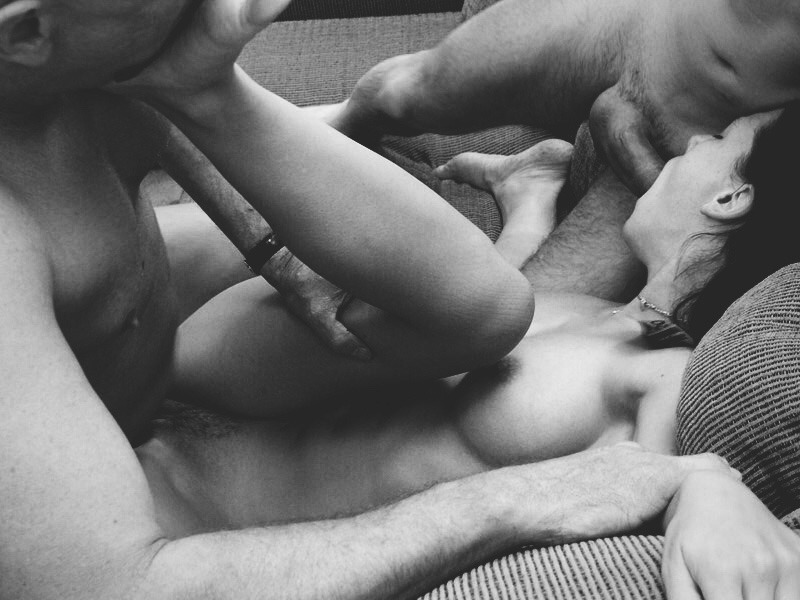
Source unknown – Title unknown (20XX)

I have so many complicated feels about this…

On the one hand the way she’s curled in the frame with the dude pressing into her from the left while pinning her wrist against the couch as the other guy leans in so that she take his cock in her mouth is super problematic–tied up in patriarchal notions of female receptivity and convenience with regard to male sexual gratification.

And yet, that’s countered–to a small degree–by the way that she is stretching to meet the dick she’s sucking and the way her foot is pressed into the other guys face is probably some foot fetishist shit but it does suggest a degree of control and willful participation.

(I also completely fail to understand non-queer instantiations of group sex–but then I tend not to really understand normal human boundaries beyond the most basic notion that your right to swing your fists ends where my face begins. Also, I find it hilarious that with that heteronormative wisdom that a woman is supposed to save herself for a man while men can fuck whomever, whenever–that strictly hetero threesomes increase the woman’s number by two and the male participants by only one. Lastly, if you’re in a threesome, why not maximize your pleasure. I mean I’ve never been in a full blown threesome but the times I have that have gotten close, I’ve instinctive engaged physically with both participants. I just don’t understand how it’s any fun any other way. And if you’re a dude who likes gay-for-pay lesbian action and still fully believe that the actresses are straight but you’re not okay sucking a little bit of dick to liven things up then you are super gross.)

Really, what appeals to me is the sort of twisted empathy I feel towards her. I’ve mentioned before how we speak of desire most often in terms of hunger. I don’t experience it that way. My experience of desire is closer to thirst.

I don’t think you can read this in a way that illuminates anything about thirst but as far as hunger, I feel like these dudes are hungry for her body and their very real and physically demonstrable hunger functions simultaneously as a sort of you are hungry and I care about you so I want to feed you, I am not hungry but I am thirsty and the way you need me takes a bit of the edge of the thirst I feel.

I have to have that feeling of being needed and if I were ever in a situation to have people need me in a fashion of a kind with the above image, I would not squander it.