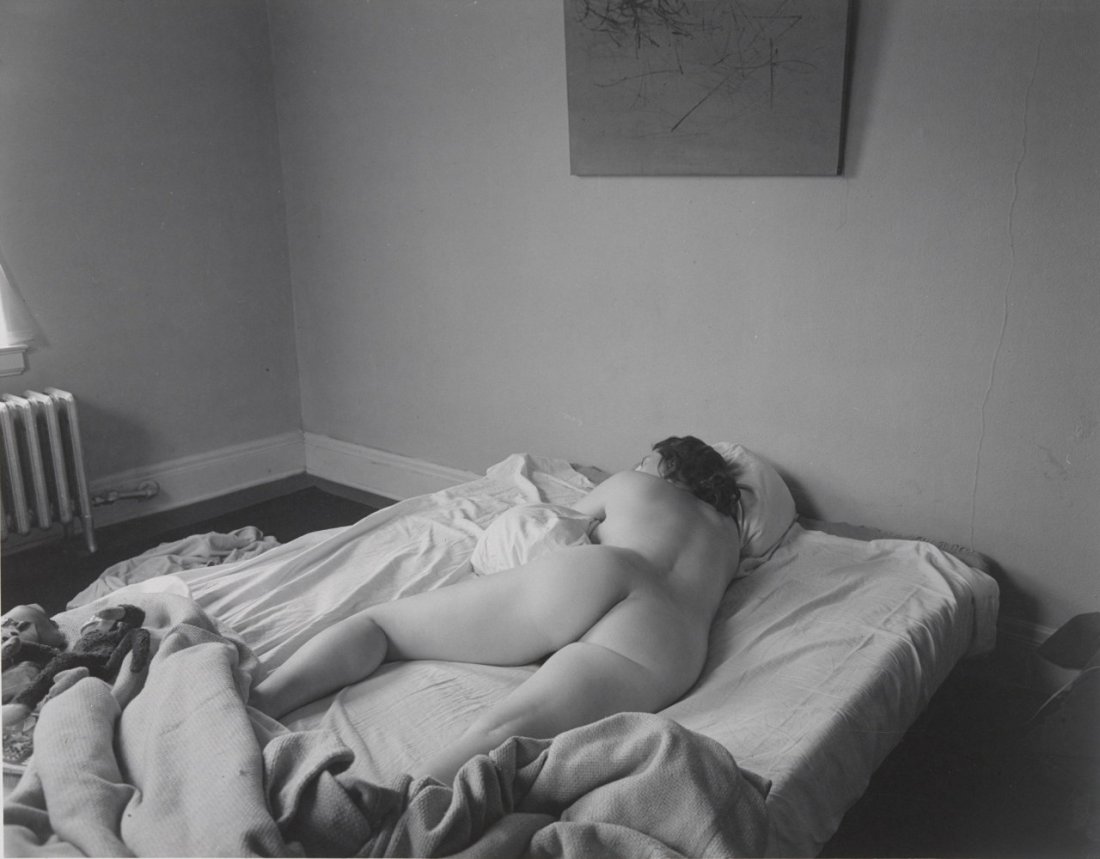
Harry Callahan – Eleanor (1953)
If I could have one wish for all my followers it would be this: find someone who looks at you the way Callahan photographed Eleanor.
Harry Callahan – Eleanor (1953)
If I could have one wish for all my followers it would be this: find someone who looks at you the way Callahan photographed Eleanor.
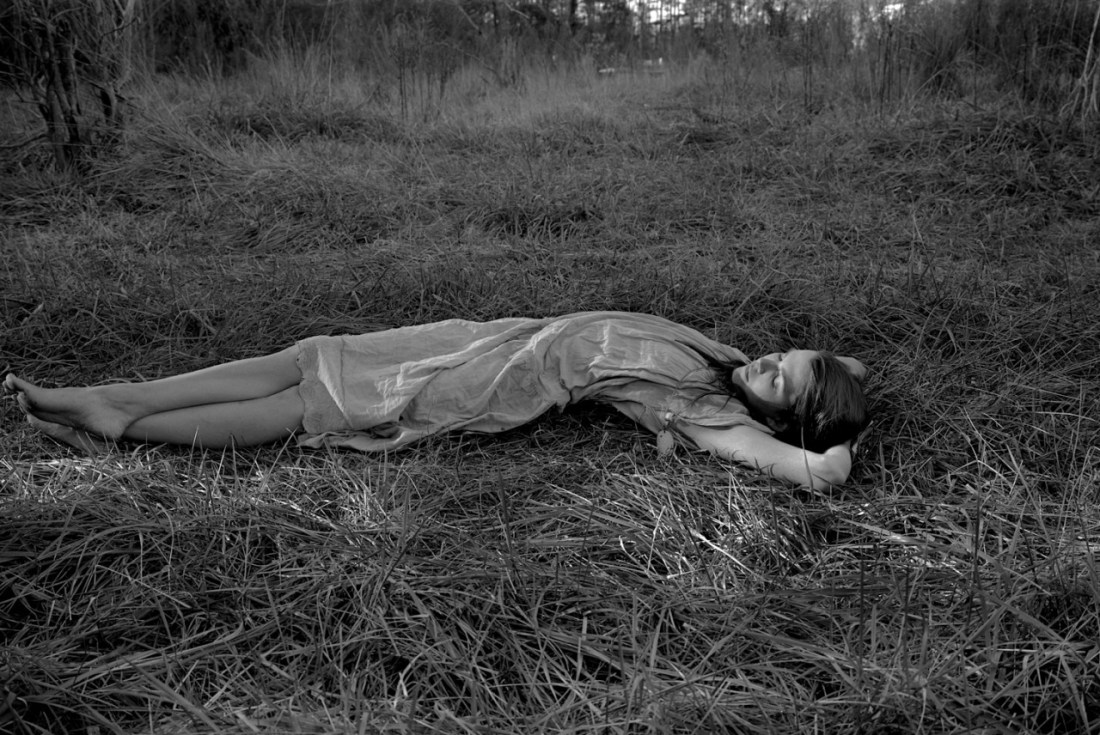
Mark Steinmetz – Athens, GA [Carey] (1996)
I’ve seen this photograph a dozen times but haven’t fully engaged with it. At first glance, it’s lovely enough.
The forested dappled light falling on the grass is reminisicent of Kurosawa’s magnificent Rashomon.
The camera is low to the ground–giving it an almost Russian feel–except for the fact that near the top of the frame you can see just the hint of the top of some sort of structure. (I first thought it was the upper rear door of a van parked at the curb on a suburban street but on closer view, I’m pretty sure it’s the top of a house you’d expect to see a conversion van parked at the curb in front of in the Suburban south of the United States.)
It all feels a bit slapdash for Steinmetz. But then Carey’s position is so purposefully arranged–and given the way he necklace has slipped against her armpit, it’s not unreasonable to assume that at one point she was laying on her side before rolling onto her back.
This sort pose recurs at intervals in Steinmetz work. Consider: this from Summertime, Athens, GA [Jessica] (1997) & Athens, GA 1996. The pose–which you might term recumbent–is usually reserved for kids and young adults.
(E.D. Note: Here the author thought of the word ‘supine’ as a result of listening to Swans pretty much constantly for the last three weeks but had to use google to verify it meant laying face up as opposed to face down.)
I remember in a presentation Steinmetz referred to why he is interested in photographing teens that are no longer children but not yet adults is a result of what he terms a “ramshackle elegance”. (I know, it’s a dreamy turn of phrase; heart eyes emoji.) For illustration he showed pretty much my favorite photo he’s ever made.
There’s another thing he does assiduously in his work–subvert anything that might push things towards any sort of objectification. Take the previous photo of the young woman standing at the screen door. She’s clearly post-pubescent, but the aluminum cross section on the door is framed to block her chest. The viewer is left with both a profound sense of the subjects physical presence but the only means of connecting with that in any sort of way is through a confrontation where she’s ‘safe’ behind the door looking out; in other words, the visual grammar indicates a confrontation as opposed to any sort of clandestine, subtle or even outright voyeurism.
It’s always as if Steinmetz is diverting any sort of sexual objectification but leaving room for sexual potentiality. (I may be projecting a bit here and if so I apologize both to Mr. Steinmetz and you, dear reader.)
I think the best way to put it is to compare two other artists I find very similar: Ren Hang and Yung Cheng Lin. Hang is raw, gritty and in your face. His perversity is loud and clear, front and center.
Alternately, Lin inverts Hang’s lo-fi aesthetic and shoots the obverse of what Hang shoots. As I’ve noted previously, if you want to really grasp the degree to which Lin is the equal to Hang in terms of pervsity just consider everything the camera strategically doesn’t reveal in his frames and then you’ll start to understand how truly audacious his work is.
I wouldn’t necessarily say Steinmetz conceptualizes his work in a fashion where he distinguishes between sexual objectification and sexual potentiality. I think it’s just that his interest is ostensibly people and their stories in relationship to the stories that construe reality in the world around them.
But, to come back full circle, I don’t think my initial notion of comparing this to Rashomon is off-base. I mean Steinmetz, although an expert on the history of photography, like myself, is almost more likely to reference filmmakers than photographers.
I think it’s interesting that the story in Rashomon centers on four incompatible/irreconcilable testimonies detailing the events of an encounter in the woods. In turn that reminds me of the best advice I’ve ever received on writing: do not write about anything for at least three years because what seems important to remember in the immediate aftermath and what you remember down the road are two completely different things. The latter will have the most universal resonance to those who read what you write.


[←] Sally Mann – At Warm Springs (1991); [→] Lisandra Gusmerini – A Cold Autumn feat. Zara Gusmerini (2016)
Juxtaposition as commentary

Jo Schwab – Untitled (2015)
Studio work de-emphasize setting and by extension temporality. The notion–or at least the notion as I understand it–is that this contributes to an isolation of the subject and through that isolation any adornments or distractions are removed and the viewer is confronted by the visual embodiment of an individual identity.
I think what bothers me about studio work is that I’ve always felt it jumps up and down and screams: look, I’m telling you the truth! Unfortunately, I feel that other factors shift and upend the implicit truth value.
Arguably, good studio work requires image makers to remove their own intentions from the picture so that the image will function as a sort of confrontation of the viewer; the camera and the image maker disappear, in a fashion, and the audience is placed in direct correspondence, vis-a-vis another person.
But the relationship between the image maker and the subject isn’t some sort of catalyst that foments the reaction and completely burns away in the process. It fundamentally shapes the resulting image. In other words, the pose and composition are only half the equation. Invisible things–like the mood of the image maker, the mood of the subject, how warm or cold the studio is, the shape and form of the relationship between the subject and the image maker. (Does the image maker want me to like the subject? Be wary of them?)
There’s at least half a dozen reasons why I dig Schwab’s portraits. Partly, I feel like he gets out of the way more the most folks who embrace studio portraiture. There’s a simple, effortlessness–which I know enough to realize is anything but–to his images. You get the feeling that you aren’t face to face with someone who is trying to be liked or disliked. His work feels very much like that moment when the facade cracks and the real person shows through–like that de Botton line about hav[ing] to be quite heavily invested in someone to do them the honour of telling them you’re annoyed with them.
Not that Schwab’s subjects are annoyed with the viewer… it’s more that their expressions belie emotions outside the norm of decorous interpersonal interaction. The model in the above image seems that she could’ve been given the same instructions–give me a look of “world weary ennui” that Sally Mann gave her daughter in this image.
I especially like the lighting in the image above. It’s simple and imperfect. I’d guess a key light with a softbox on the left, overhead and angled down, with some sort of bounce board or reflector on the floor–giving that background just a little kiss of light to separate the subject from the background.
But note also how background behind her hair remains completely dark, pushing her hair forward in the composition, emphasizing the texture. In fact, I think that’s one thing that holds true of the work beyond the amazing expressions–there’s a ridiculous capacity to use extensive technical acumen to parse the frame in such a way that the subjects take on something more akin to a sculptural dimensionality.
It’s really quite impressive.

Alfred Stieglitz – Georgia O’Keefe (1919)
I don’t especially care for Stieglitz.
I mean I recognize his contribution to the advancement of photography as an art form both within the US as well as around the world; yet his work–although frequently very beautiful–feels not flat, but affectless in a way that comes across as contrived. (It’s like he spent way too long reading Thoreau in his teens and latched on to the pretentious naturalism more than the admonishment to ‘live purposefully’.
His work with O’Keefe is a little different. Or, the better way to say it might be: what I don’t like about his work actually serves the work instead of undercutting it.
Take the image above: there are similarities in her pose to depictions of Eve in oil paintings throughout the western canon; a ruse meant to preemptively short circuit Puritanical objections to the more sensual facets of the composition. (Eve for example is unlikely to be depicted hold her breast in such an ambiguous fashion, but even that can be traced back to something in-line with the asp biting Cleopatra’s breast.)
I don’t think there’s any way you can wrap your head fully around the Steiglitz and O’Keefe collaborations without acknowledging that they were ravenous with carnal desire for one another.
I know the prevailing wisdom is that an artist should remain aloof and not become entangled with their subjects. But I don’t think you can deny that when a photographer is consensually involved with their subject, it absolutely complicates the work–usually in interesting and unpredictable ways. (Thinking here of Corwin Prescott and Nicole Vaunt as another sterling example.)

Andrew Kaiser – Title Unknown (201X)
I dig Kaiser’s work. His B&W stuff is frequently good, sometimes great. (This image of Gwendolyn Jane from last year will hold its own against just about any other image made that year.)
He seems to prefer film and although I’m probably reading into it too much he seems to possess a better grounding than 95% of the quote-unquote fine art nude photographers out there–in that he appears to own that something isn’t just art because some schlep asked a a naked woman to stand on a bounder in a picturesque landscape.
I love this image, for example because there’s a stillness, a calming quiet around it. It feels uncontrived–the viewer is allowed to glimpse something that they probably wouldn’t otherwise be able to see. But the emphasis isn’t on the transgressiveness of the seeing but on documenting the immediacy of the experience. The current rippling around her fingers, the watery undulations of her reflection.
But the thing I like best about it is that her anonymity is preserved. No, it doesn’t look entirely natural–it’s clearly been burned in quite a bit. But the point is it is unequivocally bad craft/technique/etiquette to use the frame edges to decapitate a subject. It’s inherently objectifying, first off. Second off, it’s lazy and inexcusably sloppy. Yes, including the entirety of the body presents a litany of additional challenges that aren’t always easy to negotiate; but the result will always be superior to the alternative.



Vojtěch V. Sláma – [↖] Catherine in the Pond, Slatina, Czech Republic from Wolf’s Honey series (1998) [↗] Lucy, Jevišovice, Czech Republic from Wolf’s Honey series (2003); [↙] Ka. Te. Mi., Slatina, Czech Republic From Wolf’s Diary series (2006); [↘] On a Schooltrip, Stříbský mlýn, Czech Republic from Wolf’s Honey series (1999)
Is not the most erotic portion of a body where the garment gapes? In
perversion […] there are no
“erogenous zones” (a foolish expression, besides); it is intermittence,
as psychoanalysis has so rightly stated, which is erotic: the
intermittence of skin flashing between two articles of clothing
(trousers and sweater), between two edges (the open-necked shirt, the
glove and the sleeve); it is this flash itself which seduces, or rather:
the staging of an appearance-as-disappearance.
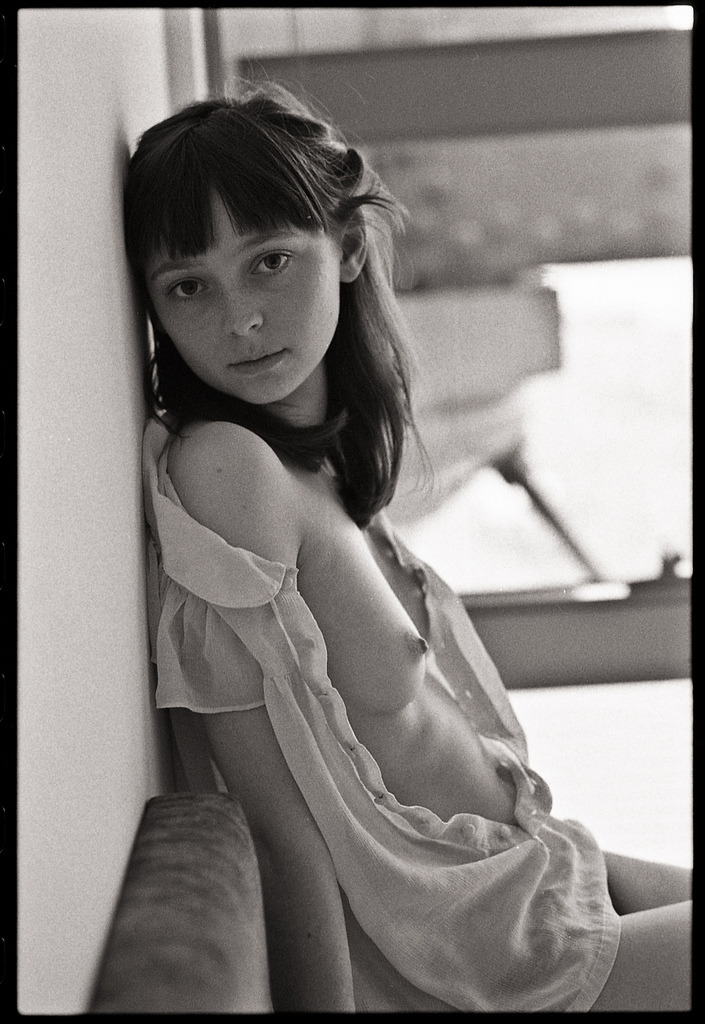
Ronan Carrein – Emma (2010)
One of the best songs–and I reference song instead of band because I’m not super into anything else they’ve made–I’ve stumbled upon in the last five years is the tune Nine by La Dispute.
It’s an amazing song that I relate to so hard I can’t even begin to articulate it. But, one line–in particular–resonates with this image:
I should’ve stopped to paint our picture
Captured honest pure affection
Just to document the difference between attraction and connection
I think that’s a distinction that the vast majority of Internet famous and wannabe Internet famous image makers fail to grasp. (It’s all about the former and rarely the latter.)
The above is an exception that proves the rule.
It’s imperfect–there’s the illusion of level in the foreground but not even close in the background. It works from the standpoint of the way the eye scans the image but it would’ve been formally superior had the level been maintained across the entire frame as that would’ve provided a sense of something halfway between a Mondrian-esque of backdrop and a frame that while not conforming to the Golden Mean actually parses information in a similar fashion.
Also, the way Emma’s forearm is cut off by the bottom of the frame is awkward at best and more likely appears unseemly. (And: the cinematographer in me desperately wants some sort of eye light.)
Yet when you manage to capture an image that exemplifies some sort of strong connection between image maker and subject that translates in an unmediated fashion to the audiences experience of the subject then there’s reason to perhaps prejudice that display over technical or formal considerations.
In other words: an image does not have to be perfect to be meritorious, it merely has to convey some sort of truth about the world and the ways in which that world may be perceived.

Has anyone else noticed how Kyotocat is absolutely slaying it on the modeling front lately? (The image above, this one, god, like everything she’s doing is effing fabulous.)
Evocative expressions, visceral poses–an ethereal presence in space and time (not like a fairy, more like the presence of the mystic).
Her tumblr is kind of incredible because it not only showcases her latest work–but it also gives you a kind of angle on the mechanics motivating it (passion for art, music and activism).
I think that’s many things that folks forget. Have a vision is one thing. But your vision is not unlike a second body that very much needs to be fed, watered and tended to much like your actual physical body. You have to read, you have to look at the world around you and continually explore what art teaches you about the infinite complexity of how the world is seen and how in being truly seen the world shifts under the gazes, expands, grows and changes.

 Acetylene Eyes