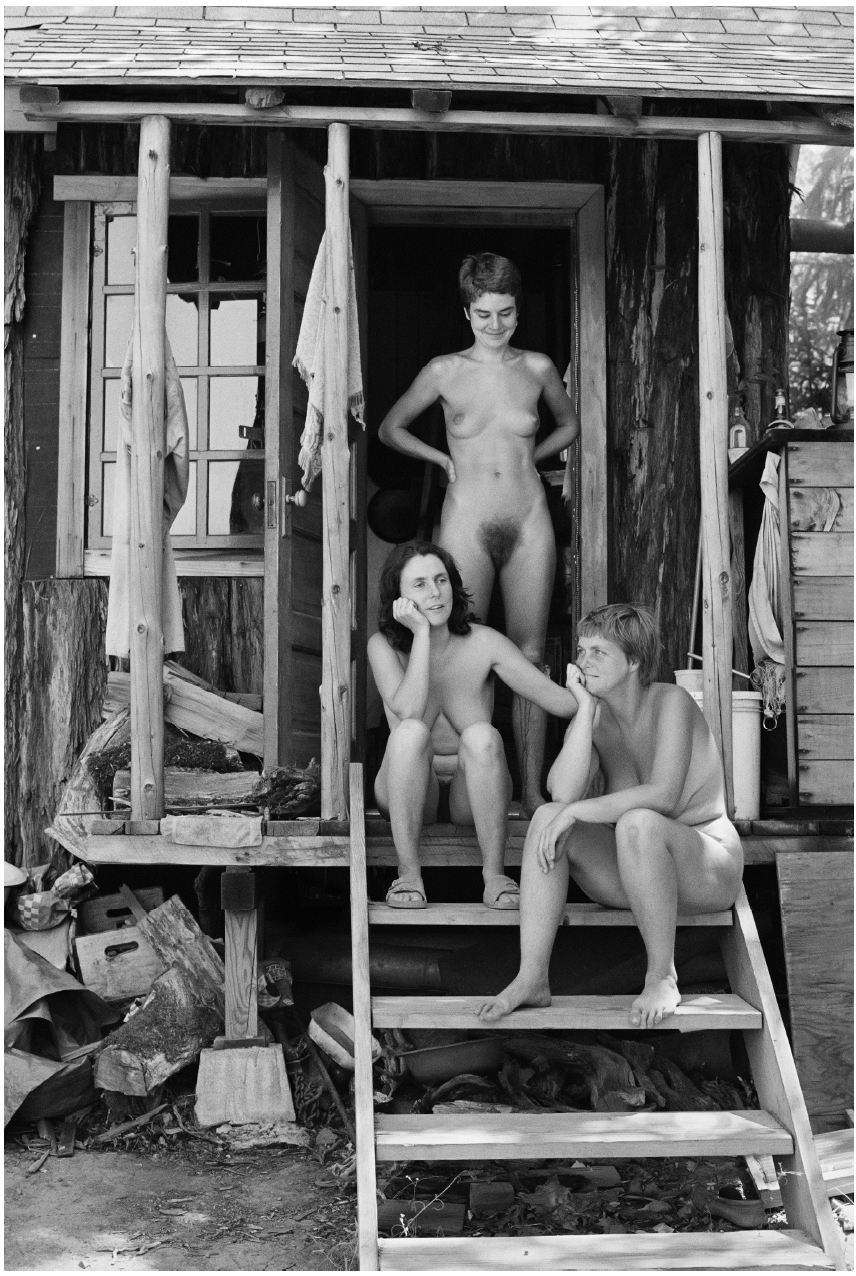
Joan E. Biren aka JEB – Summmer, Morning, Meadow, Willits CA (1977)

Without a visual identity, we have no
community, no support network, no movement. Making ourselves visible is a
political act. Making ourselves visible is a continual process.

— Joan E. Biren (JEB), “Lesbian Photography – Seeing Through Our Own Eyes,” Studies in Visual Communication 9, no. 2 (Spring 1983): 81. 
(via @lesbianartandartists )

Mysterious CC – Misungui (2016)

@misungui‘s alias apparently means “spirit of the wild cat” and was prompted by a genie appearing to her under the influence of ibogaine.

I’ve followed her with something not unlike reverence ever since I first encountered her after stumbling onto the photographs Plume Heters Tannenbaum–whom I consider to be one of the most jaw-droppingly talented, visionary and thoroughly fucking brilliant people making pornographic Art right now.

She identifies as a performer, model, queer feminist and pro-sex, anarcho-communist activist. I frequently gush about her work and the work of artists in her orbit as this performance art writ large as a medium for educating w/r/t kink, genderfuckery, public vs private and just general debauchery.

A video from her birthday party showed up over on Vimeo and reminding me more than a little of the spirit of Maria Llopis’ Public domain porn versionwhich may be my single favorite thing I’ve ever learned about running this blog–except where for Llopis’ the politics of the performance seems to be the point, Misungui seems to sublimate politics in favor of the transgressive glee of pure, unmediated experience. (Also, the birthday video is the first time I’ve actually understood the draw to shibari.)

But the other thing that I want to draw attention to besides offering an introduction, is to point out a leitmotif in Misungui’s work that I appreciate immensely.

Although it’s not as true as it was a decade ago, it used to be that one of the main things separating mainstream cinema from the art house was–for lack of a better term: poetry.

Let me try to illustrate what I’m thinking. Consider the following scene as it might be written in a script.

EXT. Train Station – DAY

A uniformed soldier embraces his lover. She is tearful. He his strong and stoic. The train whistle sounds, people push towards the train climbing aboard. The soldier picks up his suitcase and moves to the train.

INT. Train – DAY

The soldier boards the train, finds his seat and turns to look at the window as the train starts to move. He waves at his love as she walks and then runs along the platform as the train picks up speed.

Forgive the fact that this portrays the woman as nothing more than her relationship to the male character. I hate that shit more than most people but I did it to illustrate a scenario we’ve all witnessed in one film/TV show/Etc. before.

Now in a mainstream movie, this scene will be broken down into a number of setups. An establishing shot. The couple on the platform together. Close-ups of their faces. Perhaps an insert of him picking up his suitcase. A reverse shot of him moving towards the train with her unsure of whether she should follow him or stay where she is so he’ll know where to find her once he boards the train and finds his seat. Not to mention various close-ups of their faces to convey their emotional state.

You can show him boarding the train–the question of whether you show him boarding from outside or move the camera inside has profound implications with regard to how the director and editor envision cutting the scene.

Inside the train though it’s the same thing. Establishing shot to provide a sense of the place. Him finding his seat. Perhaps checking his ticket to be sure of the seat number. Sitting and looking out the window while the train begins to pull away from the station.

In other words, the mainstream way involves all the information being conveyed in a cleanly parsed, easy to digest fashion. There’s nothing to linger upon. Nothing left for the audience to imagine. You don’t sense the impending separation because you’re too busy readjusting to knew sensory stimulation.

The arthouse way of shooting this scene would be something closer to a one shot. The camera framing an empty seat inside the train, the camera focused through the wind as the couple embraces on the platform. We see him pick up his suitcase, he moves towards the camera passes and we are left watching the woman not sure what to do, her face a mess of conflicting emotions. Rack focus as he sits, turns to look out the window, rack focus again to see her follow the train as it begins moving. Droplets of rain fall on the window, thicken, the train picks up speed. The woman falls out of focus, her blurry form stops running. Focus racks back to show the main staring out the window as more and more rain falls.

In this second version you’ve conveyed the emotional resonance of the scene in a fashion that is conceptually resonant with the information you are trying to convey. It’s not parsed, it’s not clean but it is clear in the same way a good poem evokes far more than what the words describe/explain.

All this is really by way of saying that Misungui’s work always strives for a more poetic approach. How cliche is the pornographic trope of a woman masturbating and licking her fingers when she’s done. This conveys the same sense but in a much more kinky and visually legible way.

I’ve never seen anything like it and it’s extremely impressive and hot.
Jessica YatrofskyTitle unknown (2010)

If you’ve ever thought to yourself: Self, you know what? I really, really wish Ryan McGinley had a female twin who was a photographer, too; only I wish she limited her output to stuff in keeping with McGinley’s Yearbook project then Yatrofsky is exactly the image maker you’ve been waiting for. 

It sounds like I’m throwing shade–and, in fairness, I probably am a bit (really, I can’t think of an image maker who embraces such a limited scope of exploration)–but occasionally it pays off for her. The above for example is derivative as fuck but it also captures an open, honest, in-the-moment immediacy that so much made-for-Internet-aggrandizement sorely lacks. And, although her seeming lack of any familiarity with cinematic form is appalling, she is actually putting together interesting, boundary questioning video work. (Please, please for the love of all that is good, pure and holy–if you are shooting video and not celluloid, the resulting work is not ‘film’, it’s ‘video’ or ‘digital cinematography’.)

Elaine BezoldWrap (2014)

I’m not entirely sure what to make of Bezold–her work is all over the place.

When the work lands, there’s a sort of an Allison Barnes and Mark Steinmetz arguing over coffee about the merits/detriments of Emmet Gowin vs. Garry Winogrand to it.

I don’t think the above necessarily lands but it exemplifies something about Bezold’s work that doesn’t fit with any of her potential influences–there’s a nearly pathological preoccupation with texture.

This image is a relatively flat matte with the subject is standing pretty much right up against the wall but the texture of the wet, coiled hair is still clearly represented.

In other images (for example: this, this, or this), there’s a better use of space and depth (also: strobe–in the last two) to present a perfectly exposed image in a way that is interesting and compelling.

Anastasia TikhonovaUntitled (2014)

I’m intrigued by Tikhonova, or as she calls herself: Antipictures.

‘Anti’ meaning to stand against and also a clever contraction based upon the first two letters of her given name and patronymic.

It’s the exactly the same sort of multivalent turn upon which most of her work hinges.

She introduces her self in her anti-artist statement, as follows:

Photography is
a survival mechanism for me. My generation was the first to come of age
following the collapse of communism – my youth coincided with an
esthetic and existential wasteland experienced on the national scale. We
were caught between the institutional aesthetic of the Soviets and the
gaudy taste of the nouveau riche, and there was no established cultural
norm, no expectations to rebel against. That lack of expectations was
disorienting, but also liberating
– and I focused on drawing out the
sublime from the surroundings both vulgar and mundane. Photography is a
way to carve beautiful moments out of the habitual, and I live for that.

Projects followed, with magazine deals and exhibits. I moved to London
and sought to give a conceptual focus to the most basic of my drives –
to reveal the beauty and to show it to those who share a similar sense
of life… Yet the yearning for prestige and recognition gave me nothing
but panic attacks. I am back now – we haven’t met yet but take your
chances.

The added emphasis is mine because it hits upon something I’ve been trying to pin down for years; namely: the sort of It-factor that allows you to spot a mid-career Eastern European or Russian image maker from thirty paces is exactly that space between ruins and crass, resplendent decadence.

It’s a prescient observation. Unfortunately, it’s much more in keeping with say Igor Mukhin than Tikhonova.

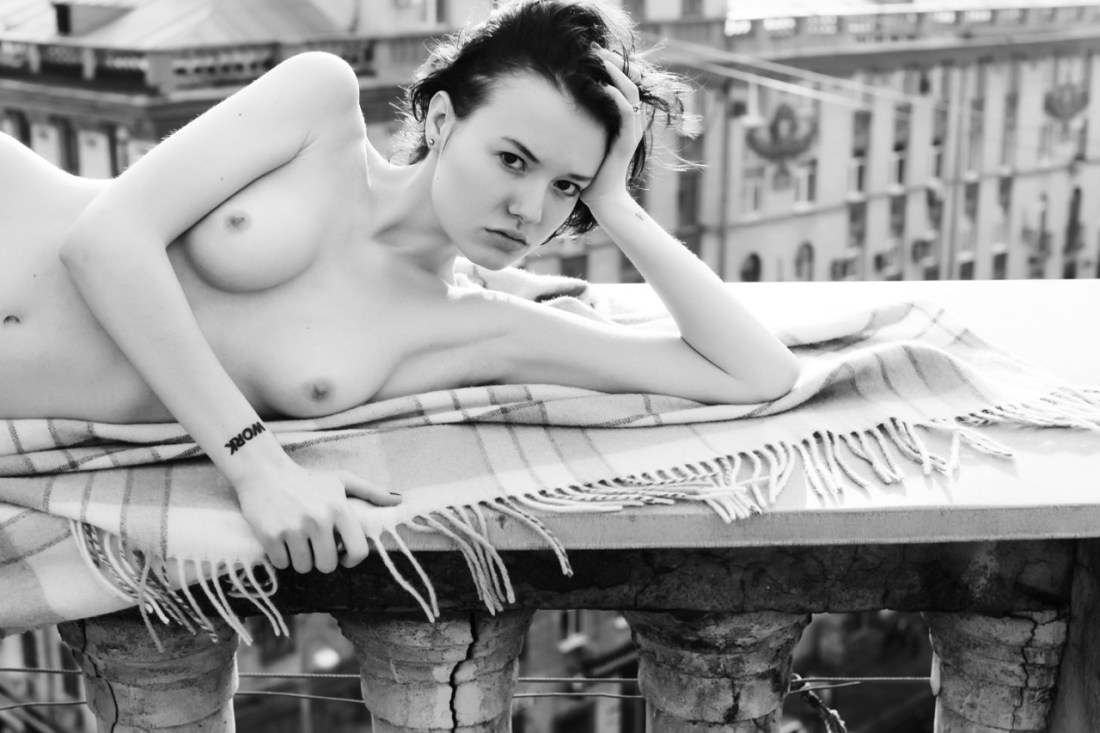
I’m only halfway intending to knock her though. For example: the image above is–without question–pretty. Beyond that I’m not sure what it’s purpose is. There’s not enough context to determine what’s being said about notions of public vs private. And the ‘work’ tattoo on the subject’s right wrist suggests there might be something to do with notions of images as means of person expression vs agency-less objectification. But it’s all too muddle to decrypt.

Still, even though I don’t necessarily like all of her work it still resonates with me. I think she has excellent instincts. For example: I appreciate her artist statement for the fact that it functions in a way that mirrors the majority of artist statements splayed on gallery walls–except it replaces superficial pretension with something real. (Every statement I’ve ever written has made a similar gambit.)

And although it’s unspeakable poor form from the standpoint of webdev standards and practices (animated splash pages are just the worst, y’all), I do appreciate the way Tikhonova overlays her images with quasi-religious/meditative aphorisms. It underscores the degree to which her work is preoccupied with searching.

Ultimately, I think that’s what appeals to me about her work. I think, I’ve mentioned before that my training is as a film maker. Essentially, I stepped away from that world because I had developed extensive, existential doubts about narrative structure and the authentic telling of a story. A decade later, I’m still wrestling with messy questions but the crux of the debate boils down to two questions:

  • How do you known where to begin?
  • What details are inescapably relevant/what details are extraneous?

Looking at Tikhonova’s work I can’t help but think that she’s still trying to resolve for herself:

  • How do I know when a picture is worth taking?
  • Is the point to remember the moment or to render the moment intelligible to those who will only ever witness it second hand and in a heavily cloistered form?

These may not be the questions she’s asking herself exactly but despite some of her works failings, with regard to the process with which she’s addressing these considerations, her work is shockingly forthcoming if you’re willing to put in the time with it.

I can’t think of another contemporary image maker who show there work more faithfully and completely. So even if her work isn’t quite there, her process is very much on point.

Madeleine FromentUntitled from Accord/#1 DM series (201X)

I make a pretty solid effort when it comes to familiarizing myself with the work of the artists I post here.

Frequently, I find that while a particular image resonates it seemingly telegraphs to my eye that the I will end up considering the rest of the work an–at best–mixed bag.

It’s frustratingly rare to find work which truly fans the flames of my curiosity.

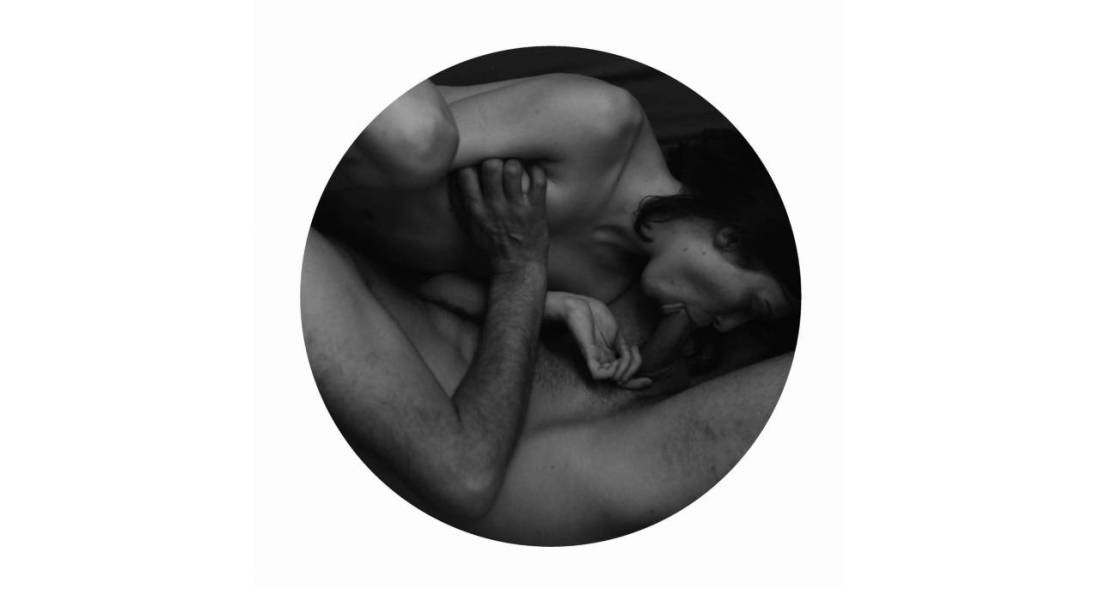
But when @reverdormir2 posted this drawing by Froment, I was immediately taken by it; I don’t know, I think it’s the obsessive and perhaps even a little awkward details of the hair–the way her hair obscures her face, the careful rendering of the hair on his back, arms and legs, the texture of his beard contrasting against her tightly cropped pubic hair.

I clicked over to her web site and promptly dropped into a sensual erotic K-hole for the better part of an hour.

For the record, not all of her stuff works. But unlike the majority of intellectually dishonest wannabe creatives out there, she doesn’t foist the work on her audience despite its flaws. Instead, she presents the work in a fashion that patiently bridges the gap for the audience between the impetus for the work, the details that drive and enliven it–all subsequently recontextualized in the final work.

It’s really goddamn ingenious. However, what makes it even more exceptional is the degree to which Froment understands her own aesthetic peculiarities and formulates her installations in such a way as to further compliment it, but to also enrich the complex relationship between the work and the world it inhabits.

If you think I’m being a pretentious blowhard and talking out of my ass, just browse through her website and notice how the work flows from documentary like snapshots, to more refined images which in turn provide prima materia for her spare, meticulous drawings. Note: also the holistic way each project is presented to emphasize how the work is supposed to be viewed–ethereal (representative) vs actual (representational).

This is extremely high end work. And it’s thrilling to see an artist this young and this preoccupied with the sort of topics that I think are all too often excluded from artistic discourse–much to the detriment of Capital A Art, unfortunately.

@sugarmagnohlia – mood indigo (2016)

For those of you who don’t know, Sugar (Magnohlia) is one-half of @slide-2-unlock–the best couples sex blog on Tumblr. (King is the other half; both are breathtakingly beautiful humans. Full disclosure: the linked image of King always makes me drool. ALWAYS.)

Following their story over the last year and a half or so has been a constant source of fascination.  Unlike most couples blogs, they relay the good, the bad and the ugly with the same careful, honest attention. It’s in this way that you’re truly able to see the breadth and depth of their commitment and passion for each other.

A while back King reported that Sugar was struggling with mental health issues and needed to step back from slide-2-unlock. It’s been inspiring and humble to watch her fight off her demons and slowly but surely emerge from the ashes of the way life can try to burn you to the ground.

I’m not 100% sure of this but it seems that Sugar has started to use her interest in image making as a tool to help beat back some of the darkness. Her work has evolved and improved at an unprecedentedly pace. (Really, her recent work with the incredible Kyotocat is among the best work from either.)

I love the way this image appears to be riffing on Duane Michals.

Also: I’ve featured one of slide-2-unlock’s photosets before. It resonated with me strongly because Sugar bears more than a passing resemblance to an erstwhile partner that I’ve never managed to completely get over. Given the intensely personal nature of that resonance, I was worried about appropriating the image. I reached out to Sugar and she gracefully allowed me to reblog the photoset with my personal commentary appended.

Anyway, by way of update, there’s still a lot to work through and figure out but my former partner and I are tentatively working on reconciling in order to get back together. I feel like I may be jinxing something but admitting it but it’s all so unexpected and disarming that I can’t help but shouting it from the rooftops–or in the case posting about it on Tumblr.

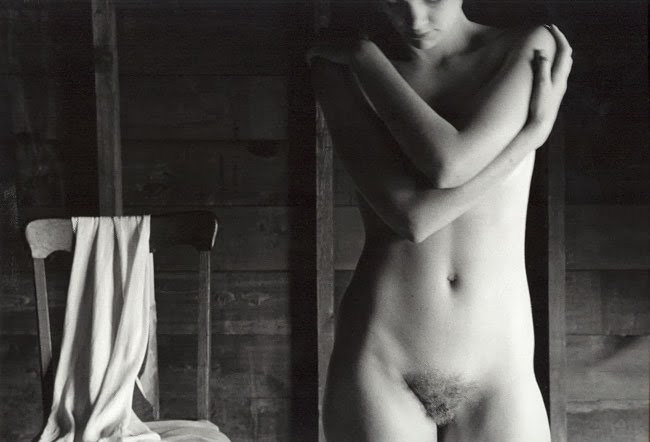
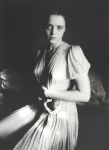
Eva RubinsteinJane Standing, Minneapolis, USA (1977)

This does several things very well.

First, it’s simple. Distinct foreground (Jane), mid-ground (the chair with a dress draped over it) and background (unfinished walls). The light travels from right to left–countering the art historical precedent established by the Dutch Baroque.

Second, while Jane’s position in the frame is governed by the rule of thirds, nothing else in the frame fits that mode.

Third, the lenses hyperfocal distance is set in such a fashion so that focus fully sharpens at the outer edges of her body. This accentuates the bright light and also manages to make her both disappear into the heavy shadows behind her while standing out from them–the placement of the chair keeps this optical illusion from becoming distracting.

Fourth, it’s not easy to see right away but the camera is angled downward ever so slightly–as if the photographer is adopting a posture similar to the model. It’s a small thing but it’s really what makes the image work so stunningly.

I was completely unfamiliar with Rubinstein before seeing this and I have to say her work is extraordinary–minimal without ever crossing over into minimalism as justification for vacuity.

10/10. Recommend.

Taras KuščynskyjUntitled selections (196X)

Viewing Kuščynskyj‘s work it’s easy to get caught up in interrogating the anxiety of influence.

For example, you can’t see an image like this and not think of Arno Rafael Minkkinen; or, consider the way he frames subjects against backgrounds as a sort of revisionism of Koudelka where fixation on the relationship between perspective, space and people positioned in it it becomes less concrete, more oneiric fleeting/unstable.

Really though what ought to be celebrated about Kuščynskyj are his poses. And I think his work is only as good as the singularity of the poses he presents. The above all work because the way the subjects inhabit the frame is an organic outcropping of the environment. There’s a meditative lack of self-consciousness, an unnerving unity of form and function.

It’s probably not entirely inaccurate to draw comparisons with the Czech New Wave–since Kuščynskyj was making most of his work concurrently. However, I think arguable a bigger influence would’ve likely been André Kertész–who was also unparalleled at presenting people in moments of uncontrived immediacy.

(Another interesting exercise: there’s almost no way Emmet Gowin wasn’t familiar with Kuščynskyj. It’s fascinating to see the way Gowin uses the same sort of end–documenting unselfconsciousness–by adopting a wider palate of from non-contrivance to stylistically over contrived than Kuščynskyj. Yet, Gowin never managed to make an image that provided such a singular and perfectly realized pose as the middle image in the right column above.)

I find it galling Kuščynskyj‘s work isn’t more widely available. There’s some clips of his work laying around if you care to search for them and they suggest that what’s available of his work online is of shabby quality compared to the original prints.