AJ MokshaRainy days featuring Kyotocat (2015)

The shadow-light interplay in this is masterful. Mid-tones appear compressed (the hallway wall in the left foreground is separated from the mid-ground wall behind it more by softening of focus than tonal variation) allowing for a great range of detail in the highlight areas. Alternatively, there’s little variation in shadow tones–used to staggering effect to separate Kyotocat’s silhouette from the mid-ground wall.

Unfortunately, the air return vent is an eyesore and detracts measurably from the image.

The dangling bulbs are a strange addition. Are they ornaments or are they those new fangled things with succulents growing in them. (Given the dim illumination, I can’t tell.)

I am torn between thinking their inclusion adds an unpleasant touch of kitchy contrivance–I mean they wouldn’t be hanging at that level in a hallway or whomever passed them would knock their head against them; thus they appear to be dangled like a puppet into the frame for the sake of the picture.

It reminds me of Jeff Wall’s After “Invisible Man” by Ralph Ellison, the Prologue–which was quoted nearly verbatim by the production designers for HBO’s terribly uneven but dumbfoundingly ambitious series The Leftovers.

Or–since these bulbs are not illuminated–it could be a reference to Amir Naderi’s Davandeh (one of my top five all-time favorite films). In it, the young protagonist lives on an abandoned ship, the roof of which is covered with hanging bulbs.

There’s also the matter of the image being some pretty flagrant #skinnyframebullshit. The vertical frame renders the proportions of the wall in the left foreground, the wall in the mid-ground and the pitch dark hallway at the right of frame. A horizontal frame would have required a definitive decision on how to use the size or each plan relative to the others as a means of unifying the composition. With the vertical orientation, the obviousness of the arbitrary way in which they are used is diminished–the to detriment of the work, sadly.

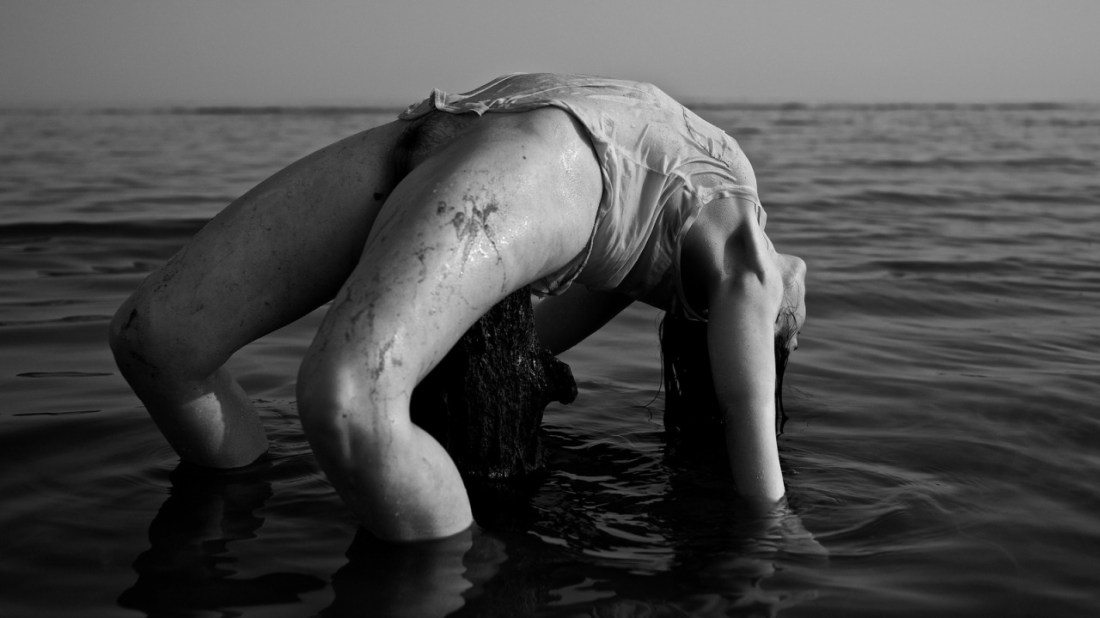
Scott MorganIMG_0283 [1] (2012)

On dry land, even in a studio under canned lighting, this would be a dynamic as fuck pose but orchastrating it so that the pose occurs in approximately a foot of water is inspired.

The problem is that you can’t really appreciate how completely mesmerizing the surface of water can appear when rendered in B&W given this angle.

The better angle would’ve been at roughly the same height as this image, only with the camera angled to see the woman’s face.

Unfortunately that wouldn’t work–since part of what makes this composition work is that the figure is presented off-center and the slanting light capturing glistening skin and taut musculature serves to balance it. Shifting into the better position would black light and in so doing interrupt the carefully positioned horizon (which contributes an oneiric tone) by necessarily including the intersection of water and shoreline from the alternate angle.

Instead, the best course of action would probably have been for the woman to shift 90 degrees clockwise and then to have the camera line up with her face. This would further emphasize the surface of the water and diminish the degree to which the shadows consume her hair, arms and legs.

Although, props to the image maker for having the sense not to make this a full on crotch shot. I know about two hundred lesser image makers who would’ve done exactly that given this pose.

Garry WinograndPhoto night at the Ivar Theater (1982)

Call me an iconoclast if you must but I really detest fucking Monet.

I won’t argue his technical accomplishment as far as applying paint to canvas–at that he was an indisputable master. And Woman with a Parasol is exquisite.

However–by and large–I find his paintings intolerably cloying and consider the impetuses for his stylistic affectation specious at best, at worst: entirely contrived.

At the same time, I would never challenge his art historical import.

I feel similarly about Winogrand–except there maybe merit in the conversation about whether or not he deserves to be as lauded as he has been and in some circles continues to be.

He made some great photos. I adore New York, 1969. And Mark Steinmetz has repeatedly referenced Utah (Wyoming), 1964 as one of the first photographs that truly captivated him completely.

In a painfully overlong, overwrought, overwritten and sparsely edited essay entitled Standing on the Corner – Reflections Upon Garry Winogrand’s Photographic Gaze – Mirror of Self or World?, Carl Chiarenza manages (despite these significant faults) to provide valuable observations and insights; namely: Winogrand produced far more shit than shine and he was godawful when it came to sexualizing/objectifying women.

Yet, with an image such as the one above, anyone with any sort of partially developed critical facilities should take issue here. There is nothing particularly studied about the frame. In fact, it appears like a crap snapshot any idiot with a basic understanding of how their camera works could have produced.

That we look at it today independent of the context of vintage pornography is solely due to the name of the reputation of the person who made it.

But that shouldn’t be where an analysis stops. Frankly, I find this image disturbing. Chiarenze addresses this better than I will but was entirely preoccupied with photographing the world around him in such a way that it allowed others to see the world the way Winogrand himself assumed it ‘really’ was.

The above image is unequivocally about photography. At least three men are taking pictures–the two we see and the third who created the record that allows the viewer to witness the other two.

I get messages all the time from people who think I’m a raging dickhole when it comes to critiquing framing. But take this as an example of two things I’m always going on about–whether or not the image space given suggests a continuity or discontinuity with the space/reality surrounding it and the issue of decapitations/amputations w/r/t frame edges to preserve anonymity or for any other reason.

The frame here is analogous to a peephole where the aim is not the setting but the occasion–a naked women. Thus, there is no suggestion of space beyond the frame edge.

As such, the decapitation is a calculated act of violence. And I can’t help but see a similar act of violence in the patrons–who are equally absent feet and legs which would allow them to get up and leave. The implication of this image is because those who are sexually desired cannot think since they are presented sans heads (minds, facial identities) are essentially interchangeable.

The sex object merely is a sex object, in other words; there is no recursive abilities. But the men–who are presented with head’s–are rendered impotent by their sexual attraction. They couldn’t leave where they are to walk away because they are presented without feet and legs to do so.

Whether Winogrand meant to or not, this image clearly blames the stripper for the existence of this purgatorial tableau–an implication I find fucking repugnant.

Unfortunately, once you begin to see this less-than-subtle misogyny in Winogrand’s work, you can’t help but to begin to see it in everything he ever did.

While in Berlin several months ago, I got up early one morning. Unlike in Brooklyn, where one can get a decent cup of coffee at any hour. Coffee places generally do not open until 9am. I decided that since the sun was coming up and the light was golden and lovely, that I would walk around with my camera for an hour or so.

In truth, although I started out walking around looking for interesting things to make pictures of, increasingly–despite the fact that I am technically a landscape photographer (for better or worse)–I don’t know what to do without people in the frame. I tried a POV shot of myself throwing away a beer bottle in one of those strange brown glass recycling mounds. I tried to treat an abandoned lot as if it were a landscape.

I tried several angles but was increasingly aware that a rough looking forty-something was making a B-line for me. I mean, it had to be me, since there was no one else around.

He queried me in German. Then Dutch before I got out that I only spoke English. He demanded to know what I was taking pictures of. I tried to explain the light was nice and I was looking for shots but he wasn’t interested. He said that I had better not be taking pictures of people; that to do so was illegal and I should know better and if he caught me pointing my camera at him or anyone else he was beat the piss out of me.

I was quite taken aback but he’d already continued on past me, looking occasionally over his shoulder as he moved away.

It turns out that he wasn’t entirely wrong. The legality of street photography in Germany is very much in question at present.

Of course, my initial response was that’s absurd. Street photography is a respected fine art tradition. Making that illegal is detrimental to capital-A Art.

I’ve subsequently come to question that response, however.

These days we are quick to decry invasions of privacy. We rally around Edward Snowden for allowing the world a peak behind the curtain. Yes, that was mostly regarding data accessed from within the privacy of our homes. But in the same breath we fault Apple for tracking our every move and lament the growing security (theater) state, we still defend the virtue of street photography–the whole point of which is to surreptitiously invade personal privacy.

It occurs to me that maybe this isn’t okay. That perhaps my defense of street photography is–ultimately–a defense of the patriarchal straight, cisgendered heterosexual status quo. Since so much of street photography has traditionally hinged on an absence of consent.

Which is not to say all of it. Helen Levitt, doesn’t make me feel creepy. Alternately, some of Vivian Maier work is ethically super suspect from a standpoint of consent.

I don’t know the answer but I know that a great deal of what is considered technical mastery in photography and image making emerges from photojournalism and subsequently street photography. Given the inherent potential for the transformation of photographic documentation into voyeuristic experience and considering the predominance of patriarchy and institutionalized sexism (misogyny, rape culture, et al.), I’m pretty sure street photography doesn’t deserve a pass. In fact, I think it should be aggressively interrogated with regards to this considerations going forward.

Mihail Nekrasov Title Unknown (201X)

The strong right to left key light illumination and the desaturation gives this image an arty pretense.

The composition, however, does not hold up under scrutiny. There appears to be no regard for form or logical arrangement of positive/negative space–it’s a left hand, a right hand and a phallus disembodied and floating in a void.

In other words, the impetus for this image is the gesture. Yet, since gesture consists at least partly of considerations with regard to observation of form, the image ends up establishing a criteria for conceptual success it subsequently ignores in execution.

Ultimately, it’s sloppy image making.

However, I am grudgingly willing to acknowledge that it does at the least nudge my thinking in an unexpected direction; namely, the fact that in utero all fetuses are gender neutral for the first two or so months. It’s the presence/absence/mitigating levels of dihydrotestosterone which determines whether the fetus’ genitals develop into a penis, vulva or remain indeterminate.

Society makes a really fucking big deal about gender distinctions along anatomical lines. And while, yes, the anatomy looks different. The underlying structures and functionality are not actually that different.

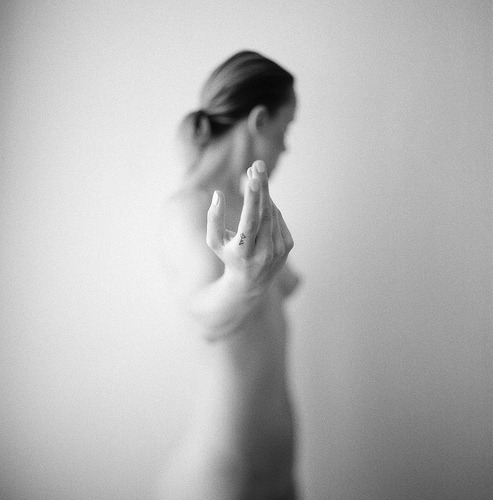
Christoph Boecken – Claudia (2015)

Maybe I look at too much porn but initially I thought this gesture was something more along the lines of this than hey, show me your tattoo.

Either way, it’s nice to see bokeh used as something more than just a means of highlighting a subject in a frame.

Also, check out that creamy medium format film super fine grain tonality–always shiver inducing.

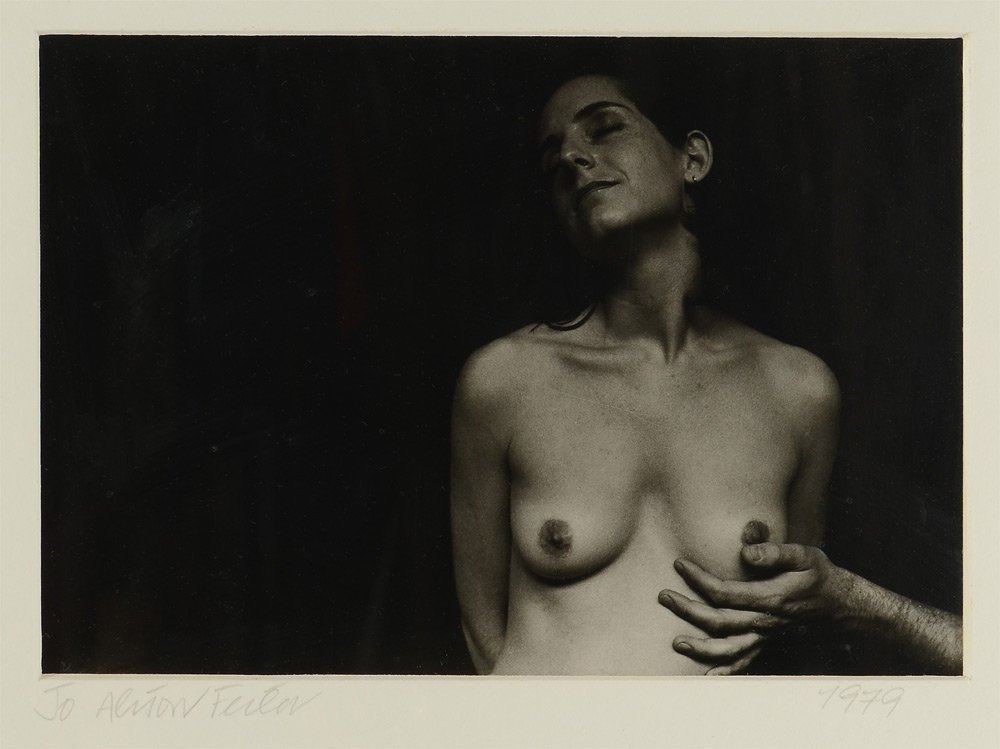
Sally MannGoosebumps (1990)

I’ve introduced roughly a half-dozen folks to Mann. And I’ve had the pleasure to sit with at least three of them while they perused Immediate Family for the first time.

This image almost always solicits some sort of visceral response. Whether it’s a gasp or an unsettled comment about how the photograph maybe takes things a little farther than they should have been taken.

I’ll defend Mann to the ends of the earth and back. Her work–all of it, no matter how sentimental, overwrought or printed inexplicably pitch dark–will always render me impossibly spellbound.

And I know she’d respond to the people I’ve watched shifted uncomfortably looking this image. She’d likely offer the following anecdote:

Once,
Jessie, who was 9 or 10 at the time, was trying on dresses to wear to a
gallery opening of the family pictures in New York. It was spring, and
one dress was sleeveless. When Jessie raised her arms, she realized that
her chest was visible through the oversize armholes. She tossed that
dress aside, and a friend remarked with some perplexity: “Jessie, I
don’t get it. Why on earth would you care if someone can see your chest
through the armholes when you are going to be in a room with a bunch of
pictures that show that same bare chest?”

Jessie was equally perplexed at the friend’s reaction: “Yes, but that is not my chest. Those are photographs.”

I don’t think she’s being disingenuous–I’d go so far as to say knowing what I do about her: she’s incapable of that.

But I do think part of what she’s skillfully avoided addressing in all the controversy surrounding her work is her own voyeurism. Her images–to a one–show us things that implicate the viewer by pulling aside the curtain to reveal things we would–if we were polite–avert our gaze. We don’t though.

And what I think is so vital about her work is what shines through in this work so clearly–everything about this image feels like a private moment (and if I recall correctly, it was until Mann caught a glimpse of it and asked I think it’s Jessie here to hold still while she got her camera).

I feel what upsets people is that we judge Mann as a woman and a mother on top of being a photographer. The photographers duty is to be unflinching–but many people suggest Mann was a bad mother.

But frankly, I don’t really understand the controversy surrounding her work. Although, looking at this photograph, I do find myself wondering how much richer her work would’ve been had she not had to navigate such a puritanical society which associates so automatically nudity as categorically interchangeable with sexuality.

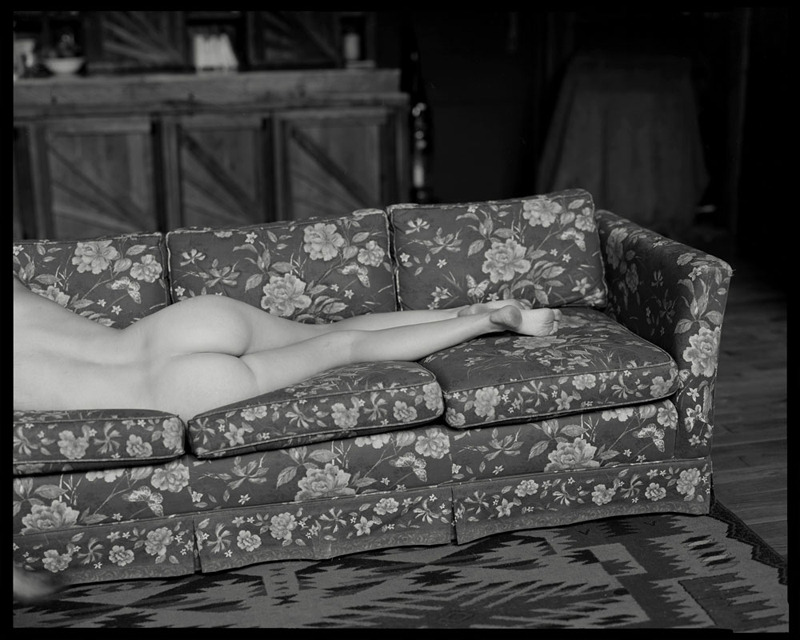
Allison BarnesBlooming Sofa from Neither For Me Honey Nor The Honey Bee (2014)

While I was traveling in Europe several months back, a gallerist inquired as to who I held to be the single contemporary American photographer making the most important work.

Without so much as a pause, I suggested Allison Barnes.

That probably surprises a few of you with how much I am perpetually singing @ericashires praises…

But while Shires’ polyglotism w/r/t various, disparate image making processes along with the way the tone of her work seems to invoke a similar force as when a dream unexpected develops a malevolent undertone and you wonder if you should pinch yourself, appeal to me on an almost preternatural level, there’s a still small voice that questions whether an image maker can be a viable consideration for the gate keepers of culture without at least some degree of academnification.

With the possible exception of digital collage and the definite exception of cinema, photography is an adolescent art–what with Joseph Nicéphore Niépce’s first image being 1826ish, photography hasn’t even reached it’s bicentennial.

Further there’s a lag between the introduction of the work and it’s adoption by the academie. How long had color photography been around before it was considered a viable fine art medium? How long after Robert Frank’s release of The Americans, the subsequent backlash and the eventual promotion of it to the yard stick by which the art-worthiness of American photography is measured? Who’s the most recent photographer to achieve fine art canonization–Alec Soth?

During the two years I studied photography in an academic setting, I ran into–again and again–this antipathy to work not accepted as ensuing from the framework of fine art photography.

As someone who does a lot of work with nudes in ruins and landscapes, I was concerned about potential overlap with someone like Miru Kim (whom I fucking detest). However, she wasn’t considered to be making work under the fine art umbrella.

I object to this rigid demarcation for at least a hundred different reasons but mostly I hold that without an aggressive cross-pollination of practices, perspectives and methodologies, that which is good becomes less good. In other words, shit stagnates.

No, you shouldn’t include Miru Kim just because she gave an awkward TED talk. But if you step back and look at things with a wider lens, you can see how Miru Kim’s relationship to fine art photography vs. pop photography is the exact inverse of what Noah Kalina’s relationship to those respective categories.

So why Allison Barnes?

Well, to grossly over generalize, it has to do with that adage about a picture being worth 1,000 words. And they question–whether conscious or not–is what do we do with those words? We can explore, document, tell a story, seek out the foreign in the familiar, etc.

I don’t believe it’s an accident that the series from which the above image emerges is taken from one of Sappho’s most famous poem fragments.

There’s that great line by one of the greatest poets–whom I consider an honorary photographer–William Carlos Williams:

It is difficult

to get the news from poems

yet men die miserably every day


for lack

of what is found there.

By using her 1,000 words toward the end of poetry, Barnes does more to unify the rigid parameters of fine art photography with the impetus driving the creation of so much self-confessional pop photography than anyone else with whom I am familiar.

Source unknown – Title Unknown (201X)

One of the things I appreciate about Tumblr is that in the process of seeking out things I like I encounter a lot of stuff I would otherwise never in a million years seek out.

For example, I have less than zero interest in anime/hentai. Yet, I saw this while scrolling down my dash and I like it quite a bit.

I think what draws me to this is the way that it’s explicit but not especially graphic. In the context of the sort of anything goes excess for the sake of excess world of hentai, restraining the typical insanely graphic depictions of sexual behavior somehow–for me at least–conveys a stronger sense of intimacy.

Verbose – Upskirt on Road (2013)

Upskirt as a motif in porn makes me wary. There are so many scumbags with zero concern for basic consent who surreptitiously film women: submariners, Bostonian and this guy in Kobe, Japan.

At the same time, the women I’ve dated have although categorically being only loosely pro-porn, they have all been super into material featuring upskirt shots as a ‘plot’ point. (I’ll never forget the day my ex I and I watched a video with a women hiding under an open stairway in a shitty desert motel to try to peek up women’s skirts while she masturbated. (Of course, this led to another woman catching her.

I won’t argue that it wasn’t a hot clip. I was very into it–if only the actresses seemed really into each other.

Yet, I do think that ETHICAL upskirt is probably a sorely under explored vein of erotic photography.

For example this picture isn’t bad–it’s not compositionally excellent but it’s roughly balanced. Her not looking at the camera and instead futzing about with her shoe–distract from the contrivance of the framing. She isn’t positioned so the view up her skirt is dead center in the frame, either. There’s some subtlety operating. (Although given the composition, a wider frame would’ve be preferable to this narrow frame. I’m only not calling it #skinnyframebullshit because I have a strong sense that it was shot horizontally and subsequently cropped.)